Guest post by Dakota Gale. The latest article in Dakota’s series Notes from the Keyboard, aimed at adult pianists


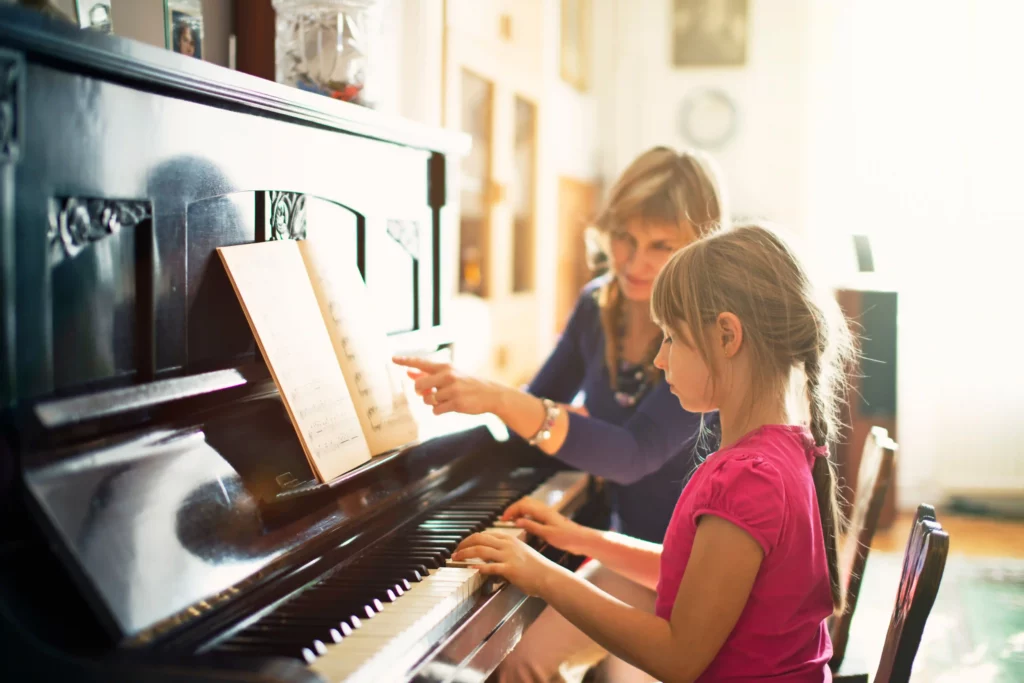
I recently attended a piano performance, during which I spoke with a 92 year old woman sitting next to me. She’d played and taught piano for decades. When I mentioned that I take lessons online, her eyes widened. “ONLINE lessons? But…that is the most amazing thing!”

She’s not the only one surprised. “Wow, you take lessons online?” is a common response from most people, even after the nuclear proliferation of pandemic Zoom meetings.

Yep, ever since I began taking lessons in spring of 2021, I’ve done them online. My teacher, Antonio, is located in southern Brazil; I’m in the Pacific NW in the U.S, thousands of miles away. And it’s not just me; plenty of people do it, including:

  • Those looking for specific expertise (e.g. Chopin etudes from a professional)
  • Those being careful while going through chemo or with a disease affecting their immune system.
  • Those who travel a lot (tougher if you’re flying, obviously)
  • If you have a favoured, dear teacher, but one of you moves, going online allow you to continue lessons.

Me and Online Lessons

For me, initially I took online lessons because of two things: to save money and to avoid COVID.

Since then, I’ve seen additional benefits. For one, they’re much more time efficient. No travel across town! For parents, I imagine this would be a huge benefit since you’d avoid shuttling kids around. (Actually, one of my friend’s kids is taking lessons with Antonio.)

I travel fairly often and like to keep lessons going. In fact, I’m currently rolling around the Pacific NW with my wife for three months in a Airstream travel trailer. Between mountain bike rides, hikes, and hanging with friends, I’m both continuing to play consistently and still taking my weekly lesson. Courtesy of Starlink satellite internet and a digital Kawaii piano, I’m not skipping a beat.

When my teacher is on vacation, I’ve also taken lessons with professionals such as Grzegorz (Greg) Niemczuk, who I found on YouTube. You might be surprised how many YouTubers offer lessons (a friend takes lessons with the popular Heart of the Keys YouTuber.)

You know what makes piano better? Playing outside!

Beyond all those boring logistical things, Antonio being Brazilian brings a fun perspective to my experience. (I’ve learned a few choice phrases in Portuguese, for one!) I’ve also learned about (and love!) Brazilian music that I would otherwise not know, including tangos, the music of Tom Jobim and Ernesto Nazareth, and folk songs arranged for piano.

It inspired me to start a listening quest of different genres and international composers that has deepened my relationship to piano. Perhaps a local teacher would have provided that, but certainly it would have been different.

The nuts and bolts of online lessons

For those wondering how this is possible, allow me to describe the situation:

  • Antonio uses a Yamaha grand piano to teach. On it, he has four cameras for his face, top down on his hands, sideways on his hands, and another on his pedal. He even uses software that allows the camera to track his hands (AI magic!).
  • The sound quality is quite good–the nuances he can hear and comment on astonish me.
  • For my setup, I use a different system depending where I am. At home, it’s my computer with a webcam plus my phone on a stand looking straight down at my hands. While traveling, I just go with my phone on a small tripod set up to the side and occasionally my laptop in front of me. It works great.

The benefit of all this: the only time I’ve missed a piano lesson is when I’ve taken bikepacking trips. I challenge you to carry a full-size digital piano through the mountains…no thanks. A pianist needs to take a break from the keyboard SOMEtimes!

Resources:

To find an instructor, just type “piano lessons online” into any search engine. A few popular services: Superprof or Wyzant; a fellow traveler I met on this trip used Preply to find her ukelele instructor. (If you want to work with Antonio, just ping him on Whatsapp at +55 48 9181-9164.)

Cheers to piano on the road!


This site takes many hours each month to maintian and update. If you find value and pleasure in what I do, why not

Guest post by TC

The score is the backbone of a film’s emotional landscape, serving as an integral element that enhances storytelling, deepens characters, and elevates or emphasises cinematic moments. Composed to underscore the narrative and visuals, a good score can transform the viewing experience from ordinary to extraordinary, subtly guiding audience reactions and infusing scenes with mood and meaning.

Good music can really make a film (and bad music can really harm a film), and is a very powerful tool. Music can be used to set the mood and move on, or delay, and inform the action. Some film scores enjoy iconic status: Brief Encounter uses Rachmaninov’s Second Piano Concerto, and the rich romanticism and pathos of this music truly enhances the narrative.

It’s no accident that some of the best modern and contemporary classical music (using the term loosely here) comes in the form of film scores (think composers like Erich Korngold, William Walton, Bernard Herrmann, Howard Shore, Maurice Jarre, John Williams, Ennio Morricone, Hans Zimmer, Yann Tiersen….) and is performed outside of the cinema by leading international orchestras. These programmes are enormously popular with audiences, not only because the scores are familiar from the films, but also because the music itself is so good that it can stand alone from the visuals.

The popularity of film music is regularly reiterated by radio stations such as ClassicFM, which regularly broadcast excerpts from the soundtracks of, for example, Lord of the Rings (Howard Shore), The Mission (Ennio Morricone), The Hours (Philip Glass) and more, and certain composers of film scores enjoy near-legendary status in the world of film and music

I’ve been to several film screenings with live score, an experience which can enhance one’s experience of both the film and the music, together and separately (and such performances do, I think, really highlight a good score).

The film Blade Runner (released in 1982) has an arresting score by Vangelis – considered by some to represent the very essence of Vangelis’ sound, with its shimmering synthesisers, sweeping orchestral passages, and haunting melodies. It has expansive majesty but also moments of tenderness, intimacy and poignancy. It is possibly one of the best film soundtracks ever.

Image credit: Paul Sanders

We went to a screening of Blade Runner: The Director’s Cut (2007) at the Bournemouth International Centre (BIC), a building of unrelieved dreariness, more used to hosting political party conferences than cult films with orchestra. Previously, we’ve seen films with live score at the Royal Festival Hall, which boasts comfy seats and pleasant social areas. The screen was perhaps too small, the film itself interrupted by subtitles (which as the action progressed fortunately became easier to ignore).

If you are familiar with Blade Runner, you will know that it is, on the surface at least, a science-fiction film, set in a dystopian future Los Angeles in which synthetic humans called Replicants are bio-engineered by the Tyrell Corporation. Renegade replicants are hunted down by ‘blade runners’. Harrison Ford plays Deckard, a disllusioned, world-weary policeman/blade runner. It’s based on a book by Philip K Dick, Do Androids Dream of Electric Sheep?, and it poses philosophical questions on the meaning and power of memories, lived experience, and, above all, what it means to be alive. This is most powerfully portrayed by the character Roy Batty (leader of the renegade Replicants, played by Rutger Hauer), who knows his time on earth is finite and his life is precious. He provides an important foil to the weary Deckard. In the closing scenes of the film, Roy’s touching death monologue reinforces the message of the entire film and expresses the fundamental experience of everyone who has ever lived. And it was here that the live score really highlighted the power and the poignancy of this message.

From the outset, despite the rather grim venue, performed live by the Avex Ensemble, the unsettling low-register rumbling, shimmering harp-like synthesiser lines and eerily descending scales set up what is to come. As the sound blooms and swells, it draws you in, placing you right in the heart of the film’s atmosphere, and you focus not just on the film itself, but also the shifting soundscapes of that transcendent, memorable and melancholic soundtrack. At times I found myself listening more intently than actually watching. The live score offered new nuances on the film, at times heightening and magnifying the action, intensifying emotion and intimacy, while also conjuring up the broad vista of a future world and worlds beyond our world.

Other notable highlights were the haunting solo saxophone in the love scene and live vocals in ‘Rachel’s Song’ from a female singer with a voice reminiscent of Beth Gibbons of Portishead.

Rutger Hauer as Roy Batty

If you haven’t yet discovered the delightful gem that is the 1901 Arts Club, now is the time to do so….

7 Star Arts present a trio of concerts at the 1901 Arts Club this autumn featuring leading musicians, including pianist Viv McLean and up-and-coming soprano Sofia Kirwan-Baez, in a range of imaginative programmes of music from Nadia Boulanger to George Gershwin and Benjamin Britten – and much more besides. These concerts are in support of English National Opera’s Benevolent Fund

Housed in a converted schoolmaster’s house a stone’s throw from Waterloo Station, the 1901 Arts Club is an intimate, convivial chamber music venue whose ethos, ambiance and decor is inspired by Europe’s ninteenth-century Salon culture. It’s the perfect place to enjoy music with friends, and it boasts an elegant upstairs bar for pre- and post-concert socialising. And at these concerts with 7 Star Arts, you’ll have the chance to meet the artists as well.

Tuesday 24 September HIDDEN GEMS OF FRENCH SONG with Sofia Kirwan-Baez

Hotfoot from her recent appearance at Longborough Festival Opera, soprano, pianist and songwriter Sofia Kirwan-Baez takes you on a journey through French song, from Nadia and Lilli Boulanger to Edith Piaf and Barbara. Plus a few surprises along the way…


Wednesday 30 October ALICE NEARY cello and VIV McLEAN piano

Two of our finest musicians perform much-loved sonatas for cello and piano by Debussy, Britten & Franck.

The pianist Viv McLean seemed exceptional….he astonished us with his musical maturity and extraordinary sonority

Le Monde, Paris


Wednesday 4 December CLASSIC GERSHWIN with VIV McLEAN piano & SUSAN PORRETT narrator

7 Star Arts most popular words and music production makes its 1901 Arts Club debut. This “glorious celebration of Gershwin’s life and music” weaves the vibrant music of the ever-popular composer with his fascinating life story from birth in the colourful, teeming New York of 1898 to his tragically early death in 1937. Programme includes Gershwin favourites The Man I love and Rhapsody in Blue as well as lesser-known works.

I haven’t touched the piano for months. I have a beautiful early 20th-century Bechstein model A grand piano which has been sitting, untouched, in my piano room/office. There is music open on the stand – Schubert’s Piano Sonata in A, D664 – suggesting intent, but I have not played it seriously in over six months.

Why? Lack of motivation, lack of time, yes. But also something which I think is particular to the amateur musician – the knowledge that, unlike the professional musician who must practice regularly to maintain their skill and artistry, one can come back to the instrument at any time and pick up where one left off.

But it can be hard and the first line of that wise saying of violinist Jascha Heifertz – “If I don’t practice one day, I know it…” holds true as much for the amateur as for the  professional musician. The more time passes, the harder it becomes to start over again.

But it’s not impossible.

Rekindling the habit of practicing and playing the piano after a pause, however long, can be both challenging and rewarding. The key to a successful return lies in setting realistic goals, cultivating patience, and reviving your passion for music. Here’s a guide to help you navigate this journey back to the piano:

Set Realistic Goals

One of the first steps in returning to piano practice is setting achievable goals. Begin by assessing your current skill level and recognising that you may not be able to play at the same proficiency as before. Setting short-term goals that focus on gradual improvement, such as playing music that is already well-learnt or attempting a short piece or study, help you reacquaint yourself with the instrument, build confidence and provide a clear sense of progress.

Establish a Routine

Consistency is crucial in developing any skill, and piano playing is no exception. Create a practice schedule that fits comfortably into your daily routine. Practice “little and often”: even 15 to 30 minutes a day can make a significant difference over time. Ensure your practice sessions are regular, but also be flexible and kind to yourself if the demands of daily life/work interrupt your schedule.

Revisit Familiar Pieces

Playing pieces you were once comfortable with can be immensely satisfying and a great confidence booster. It allows you to gauge how much you remember and where you need to focus your practice. These familiar pieces can act as a bridge, easing you back into more challenging repertoire while providing a sense of accomplishment.

Explore New Repertoire

While revisiting old favourites is comforting, exploring new music can really reignite your interest. Choose pieces that inspire you and reflect your musical tastes. Don’t feel you have to learn certain pieces because they are good for you; play the music that interests you. Learning new repertoire not only keeps practice sessions interesting but also broadens your musical horizons and challenges your skills in different ways.

Seek Guidance and Support

If you have taken a long break from the instrument, consider taking lessons, even if only temporarily. A teacher can provide personalised guidance, help you set realistic goals, and correct any bad habits that may have formed during your hiatus. Additionally, joining a music meetup group can offer support, motivation, and opportunities to share your progress with others.

Be Patient and Positive

Returning to your instrument after a break requires patience and a positive mindset. Progress may be slow at first, and you might feel frustrated by the gap between your past abilities and your current performance. Set realistic goals and celebrate small victories – and, above all, remind yourself of the joy that playing the piano brings. With time and persistence, your skills will improve, and the music will flow more naturally.

Enjoy the Process

Ultimately, the journey back to the piano should be enjoyable. Embrace the process of relearning and rediscovering your love for the instrument. Allow yourself to experiment, make mistakes, and have fun. Remember, the ultimate goal is the joy and fulfilment that comes from making music.

Happy practicing!


This site takes many hours each month to maintian and update. If you find value and pleasure in what I do, why not