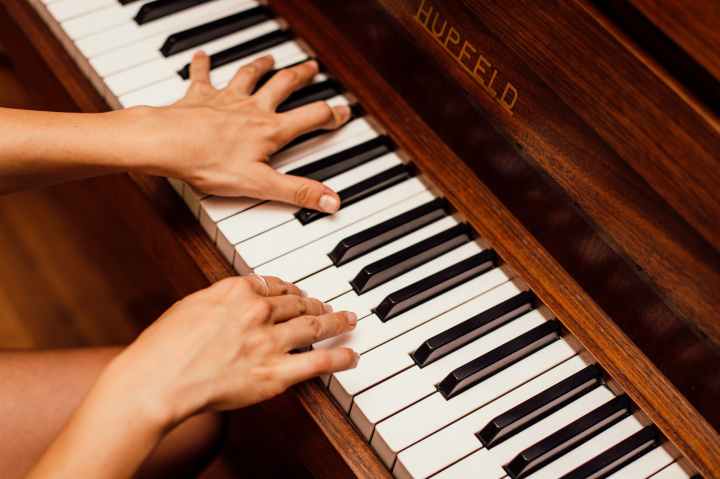
Guest post by Orlando Murrin

Have you ever wondered why we ‘play’ musical instruments? If you’re like me, it doesn’t feel at all like playing; ‘practising’, ‘learning’ or ‘studying’ are the usual descriptions.

This got me thinking – are we missing out? What if – at least some of the time – we approached the piano in a more playful spirit? Instead of self-improvement, we sat down at the keyboard and had fun for its own sake. Experimented… Fooled about… Played, in the true sense.

I’m in the lucky position of being an amateur, with occasional, optional opportunities to perform. For a short while as a teenager I considered pursuing a career in music but my then teacher, the Czech pianist Liza Fuchova, advised strongly against it. ‘You’ll get far more pleasure from it as a hobby,’ she said, generously ignoring the side-issue that I wasn’t nearly talented enough.

At this time – the 1970s – piano lessons were in vogue, and many homes had instruments. At parties, there would be an unseemly scrambling for who could bag the keyboard first, and woe betide you if you didn’t have a flashy piece or two up your sleeve with which to dazzle the others. I find it sad so few homes seem to have pianos nowadays, or not real ones.

Last year I met up with a friend over from New York. He always asks how my piano is going, which is sweet of him considering he’s Steve Ross, one the greatest living cabaret pianists.

‘I’m learning some Scarlatti,’ I told him, ‘but I’m not sure why. At the touch of a button, I can hear it performed by the greatest pianists in the world, infinitely better than I ever will. Seriously – why play at all?’

He looked at me, puzzled. ‘Because it’s a beautiful thing to do.’

I’ve thought about this ever since, and of course he’s right. Those of us who play – with any degree of competence – are blessed. We’re also the envy of everyone else.

I feel particularly lucky that for various reasons I’ve kept my playing up all these years. I’m now in my sixties. How many times have I heard people say: ‘I stopped at Grade 5. I so wish I hadn’t.’?

Another comment I get a lot is, ‘It must be fantastic just to sit down and play’. I usually counter this with a boring monologue about how you don’t – you’re too busy learning new pieces and toiling away at technical problems – but what if they have a point? What if playing is what it’s really all about?

With this in mind, I’ve recently been setting aside my ‘serious’ music projects (for which read, far too difficult for me ever to play in public but that won’t stop me trying) and going through my huge sheet music selection, picking things out to play through for pleasure. Having caught Barenboim conducting ‘Bolero’ on YouTube, I fumbled my way through it (love the modulation on the last page), and after watching Death in Venice, Mahler’s Adagietto. When Radio 3 played ‘Lotus Blossom’ by Billy Strayhorn, I was so intrigued by the weird, drifting harmonies that I bought a sheet music download – two quid well spent.

While we’re talking words, here are two worth scrutinising in this context. We use ‘amateur’ to mean sub-professional, forgetting that it really means doing the thing for love. Not out of duty, or to improve ourselves, or to keep our minds nimble. But because we love it.

And finally, the French verb for attending a recital or concert is assister. Next time I play in front of an audience, I will try and think of it as assisting me – helping me to bring the music alive – rather than listening out for mistakes.

Seen that way, playing stops being a test and becomes a form of participation: with the instrument, the music, and sometimes the people in the room. Which feels indeed a beautiful thing to do.

If you want to be reminded of what ‘playing’ should be, watch young children at the piano. Their small hands tumble, their concentration is fierce, and the delight is unmistakable – theirs and the audience’s alike. They’re not performing, or proving anything. They really are playing.

(Image: BBC)

Orlando Murrin is a food writer, now crime writer, and forever amateur pianist.
orlandomurrin.com

This site celebrates its 15th birthday this month, a fact I find slightly hard to believe. It began as a kind of online practice diary for me: a few years previously, I had returned to playing the piano seriously after an absence of a quarter of a century, and by the time I started writing this blog, I was taking lessons with a master-teacher and preparing for a professional performance diploma. I used the site to ponder issues and challenges around piano playing which I was facing myself, in the hope that others might find the articles helpful. Alongside this, were articles about repertoire, piano teaching (I started teaching in 2006), concert and CD reviews, and other more esoteric musings on the piano and those who play it.

Since then, it has evolved and developed into a kind of online magazine, with what I hope is an interesting variety of content, by me and by other writers.

But it’s not just about the articles. Through this blog, I have forged meaningful connections and friendships, both online and In Real Life (you know who you are!); I’ve had the privilege of meeting some of the great musicians of our time, at their concerts and other events; and, perhaps most interestingly (because this was never an intention), my blog has led me to my current role as a publicist working with classical musicians and music organisations – a role which has come about entirely through the reputation of this site. The blog has also given me other writing opportunities – as a reviewer for Bachtrack.com from 2011 to 2018, a contributor to The Schubertian (the journal of The Schubert Institute UK), Classical Music and Pianist magazines, a regular writer for InterludeHK (since 2015), teaching notes for the Associated Board of the Royal Schools of Music and Trinity College London, and, more recently, programme notes for the Barbican and Bridgewater Hall. But it is this site where the writing journey began…..

I am enormously grateful to everyone who reads, shares, comments upon and contributes to this site. Without you, I would probably just be shouting into the ether…..

You have been an inspiration to others of us, and your site is rightly established as a leading page for classical piano news and views

PIANODAO

If you would like to contribute a guest article to this site, please feel free to contact me.

Thank you again for your support of The Cross-Eyed Pianist


Watching Masterchef The Professionals, a series to which I am rather addicted (mainly because my son is a professional chef), I have noticed a certain expression from chef Marcus Wareing during the preliminary Skills Test section of the competition.

In this round, contestants’ culinary skills and nous are tested with a set of technical challenges, most of which should be second-nature to any well-trained chef – filleting fish, shucking oysters, boning out a joint of meat, making meringue or hollandaise sauce, for example. For some, this is a daunting round where weaknesses are exposed or nerves get the better of the contestant. For others, it proves their mettle and demonstrates that not only have they been properly trained (and keep their skills well-honed), but also that they are able to adapt their skillset and intuitive culinary common sense to an unfamiliar recipe or set of ingredients. When a chef succeeds in this, Marcus Wareing will often say, with an approving nod, “Chef’s head“.

So I’m coining the expression ‘Pianist’s Head’ to apply to those situations when we might encounter music which is unfamiliar or outside our comfort zone, which might at first appear daunting, challenging or even almost impossible, but which, with some consideration, drawing on our musical knowledge, experience and intuition – our Pianist’s Head – is achievable. Having a good Pianist’s Head upon your shoulders will stand you in good stead for successful sight-reading and the ability to learn music more quickly.

No repertoire is ever learnt in isolation – or at least it shouldn’t be – and everything is connected. Musical skills, just like culinary skills, once learnt and practiced, can and should be applied to different situations. No learning should ever be done in a vacuum: a single piece of music is not just that one piece, it is a path to other pieces via accrued technical proficiency, musical knowledge and artistry. Early students and less advanced pianists often see the pieces they are learning in terms of stand alone works which have little or no relevance to other music they are working on, or are going to learn. This is also particularly true of scales, arpeggios and other technical exercises which may be studied in isolation instead of appreciating their relevance not just in understanding keys and key relationships, but also in actual pieces of music. This was something I was not taught when having piano lessons as a child, and it’s the fault of the teacher, not the student, if the usefulness and relevance of such technical work is not highlighted.

Chopin knew this: it is said that he studied Bach’s Well-Tempered Clavier every day, appreciating the music’s relevance to his own musical development, his composing and his teaching. If you can successfully manage Bach’s ornamentation, for example, your Pianist’s Head should allow you to cope with Chopin’s trills and fioriture.

Your Pianist’s Head skills will develop the more time you spend with varied repertoire and your willingness to take an open-minded, lateral thinking approach to learning and playing music to an point where these skills become intuitive and you won’t even know you’re applying them!

To develop and maintain your Pianist’s Head, approach each new/unfamiliar piece of music with the thought, “what do I know already and how can I apply experience from other repertoire to this piece?“. For example, if you’ve encountered a similar passage or technical challenge elsewhere you’ll know how to approach it this time.

Understand and appreciate the composer’s particular stylistic characteristics, idioms, soundworld, and quirks. This can be developed not only through playing other music by the same composer but also by listening and studying scores away from the instrument. And as your Pianist’s Head develops, you’ll find yourself making intuitive decisions about how to approach repertoire based on sound technical knowledge and musical insight.


Support The Cross-Eyed Pianist

This site is free to access and ad-free, and takes many hours to research, write, and maintain. If you find joy and value in what I do, why not


Photo by Juan Pablo Serrano Arenas on Pexels.com
 

Guest post by Dakota Gale, part of his Notes from the Keyboard series for adult amateur pianists


Back in 1970, when my mom was 18, she composed the first section of the only piece of piano music she’s ever written.

Perhaps inspired by copious amounts of listening to Debussy and Satie, the music just poured from her fingers one day when she sat down at her piano.

At the time, she was in college in Madison, WI and in love with Robert, her first serious boyfriend. The piece starts off sweetly, brightly, a happy time in her life. The happiness shines from the first notes.

She’d taken piano lessons when she was younger, but never studied composition. She never wrote down the music, but it lodged in her hands and head.

Like mother, like son. (A drawing of mine.)

My mom graduated from college a couple of years after she wrote the first section. She and Robert planned to head to Santa Fe together and get married, but first he needed to work in construction for a bit to earn money for the move.

My mom headed south ahead of him to get situated in Santa Fe and start job hunting. A month, two months passed, but Robert didn’t show up. She wrote him letters, no response. Had he changed his mind, broken up with her?

Finally, a letter arrived. But not from Robert—from his mother. 

He’d died in a construction accident. 

Devastated, her world spun around and plans shattered, soon afterwards my mom wrote the second part of her composition. It’s a faster, darker section, an outpouring of grief after a sudden key change.

Years passed. My mom got a teacher’s certification, moved to Idaho, lived in a tipi and taught art. 

Then she went to a national ceramics convention and met a bearded artist from California. A romance followed and they got married and moved to a defunct commune outside Chico. 

Little Dakota popped out into the world not long after.

42 years later during a snowy walk in Bend.

Around this time, she composed the third section of music for her piece. It’s sweet, my mom in love again. The innocence and freshness of it is apparent. Cheery, fast and impetuous, full of expectations. 

Who knows, maybe it flowed from her fingers while she was pregnant with me? She can’t remember the exact timeline.

Regardless, I recall her playing it occasionally when I was younger. After years away from the piano, she could perform it beautifully at any moment.

When I started learning piano, I wanted to learn the piece, but there wasn’t sheet music… Until this past week, that is! 

On a rainy afternoon during her recent visit, we worked through the chords together and I explained the harmonies and sudden key changes that she’d chosen. She’d never learned music theory and didn’t know which chords she’d picked or why—all the music came straight from The Muse.

Sorting out the piece. Check out the stained glass in the background that my mom made for us—lady of many talents!

The only things missing were a final chord or two, so we played around with options before landing on something she liked. After some work, I fully transcribed the piece to sheet music—a first for me.

And so I’d like to present In Search of Lost Time by my mom. If you’re a pianist, you can download a PDF of the sheet music via Dropbox and play it! (Please forgive any newbie sheet music notation mistakes.)

Here’s a recording of my mom playing her piece, 54 years after the initial idea bubbled up from her consciousness:

The end of a special project together.


Dakota Gale

When he isn’t playing piano, Dakota Gale enjoys learning languages (especially Italian) and drawing. He also writes about reclaiming creativity as an adult and ditching tired personal paradigms in his newsletter, Traipsing About.

He can often be spotted camping and exploring mountain bike trails around the Pacific Northwest.