Guest post by Dakota Gale, part of his Notes from the Keyboard series for adult amateur pianists


Back in 1970, when my mom was 18, she composed the first section of the only piece of piano music she’s ever written.

Perhaps inspired by copious amounts of listening to Debussy and Satie, the music just poured from her fingers one day when she sat down at her piano.

At the time, she was in college in Madison, WI and in love with Robert, her first serious boyfriend. The piece starts off sweetly, brightly, a happy time in her life. The happiness shines from the first notes.

She’d taken piano lessons when she was younger, but never studied composition. She never wrote down the music, but it lodged in her hands and head.

Like mother, like son. (A drawing of mine.)

My mom graduated from college a couple of years after she wrote the first section. She and Robert planned to head to Santa Fe together and get married, but first he needed to work in construction for a bit to earn money for the move.

My mom headed south ahead of him to get situated in Santa Fe and start job hunting. A month, two months passed, but Robert didn’t show up. She wrote him letters, no response. Had he changed his mind, broken up with her?

Finally, a letter arrived. But not from Robert—from his mother. 

He’d died in a construction accident. 

Devastated, her world spun around and plans shattered, soon afterwards my mom wrote the second part of her composition. It’s a faster, darker section, an outpouring of grief after a sudden key change.

Years passed. My mom got a teacher’s certification, moved to Idaho, lived in a tipi and taught art. 

Then she went to a national ceramics convention and met a bearded artist from California. A romance followed and they got married and moved to a defunct commune outside Chico. 

Little Dakota popped out into the world not long after.

42 years later during a snowy walk in Bend.

Around this time, she composed the third section of music for her piece. It’s sweet, my mom in love again. The innocence and freshness of it is apparent. Cheery, fast and impetuous, full of expectations. 

Who knows, maybe it flowed from her fingers while she was pregnant with me? She can’t remember the exact timeline.

Regardless, I recall her playing it occasionally when I was younger. After years away from the piano, she could perform it beautifully at any moment.

When I started learning piano, I wanted to learn the piece, but there wasn’t sheet music… Until this past week, that is! 

On a rainy afternoon during her recent visit, we worked through the chords together and I explained the harmonies and sudden key changes that she’d chosen. She’d never learned music theory and didn’t know which chords she’d picked or why—all the music came straight from The Muse.

Sorting out the piece. Check out the stained glass in the background that my mom made for us—lady of many talents!

The only things missing were a final chord or two, so we played around with options before landing on something she liked. After some work, I fully transcribed the piece to sheet music—a first for me.

And so I’d like to present In Search of Lost Time by my mom. If you’re a pianist, you can download a PDF of the sheet music via Dropbox and play it! (Please forgive any newbie sheet music notation mistakes.)

Here’s a recording of my mom playing her piece, 54 years after the initial idea bubbled up from her consciousness:

The end of a special project together.


Dakota Gale

When he isn’t playing piano, Dakota Gale enjoys learning languages (especially Italian) and drawing. He also writes about reclaiming creativity as an adult and ditching tired personal paradigms in his newsletter, Traipsing About.

He can often be spotted camping and exploring mountain bike trails around the Pacific Northwest.

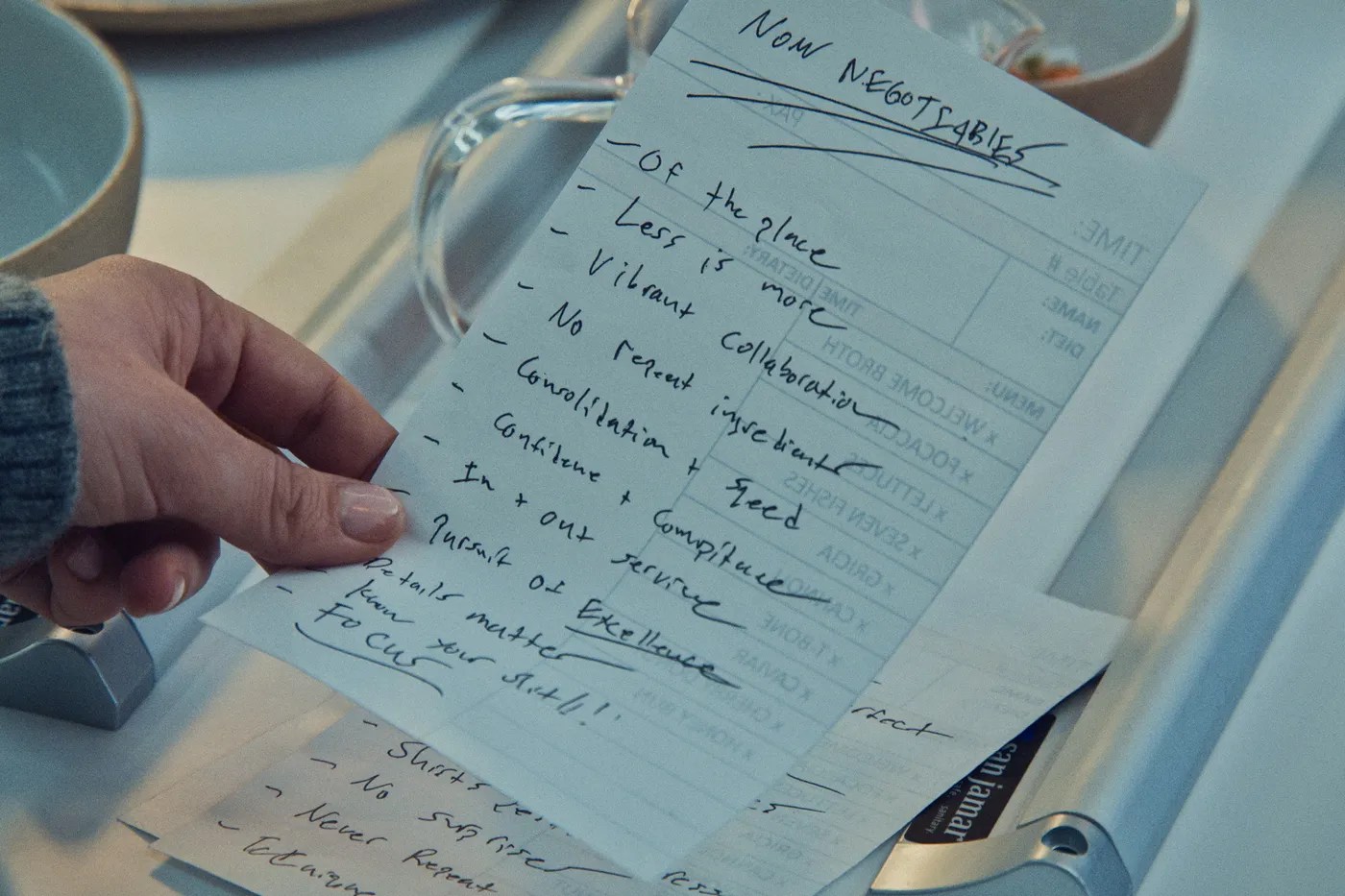
This post is inspired by Episode 2 of Season 3 of The Bear, a drama series about a young chef, Carmy Berzatto, trained in the fine dining world, who comes home to Chicago to run his family sandwich shop after a heartbreaking death in his family. By the third series, the noisy sandwich shop has been transformed into an elegant fine dining restaurant and Carmy is seeking a coveted Michelin star. In this episode, Carmy draws up a massive list of what he calls “non-negotiables”: the things that the restaurant must do on a consistent basis to achieve greatness.

Jeremy Allen White as Carmy Berzatto in The Bear

Looking through the list, while some of the non-negotiables are explicitly related to cheffing and kitchen/restaurant management, a number could apply equally to the musician in pursuit of consistency and excellence in their practice and performance of music.

It is a truth universally acknowledged that noticeable progress, at whatever level you play, comes from a well-organised, consistent, focussed and thoughtful approach to practicing. It’s not quantity (of hours spent practicing) but the quality of practicing that counts.

This, for me, is where Carmy’s non-negotiables come in.

These principles, though originally used in contexts like culinary arts or other forms of craftsmanship, translate beautifully into music practice.

Change the Menu Every Day

Boredom is the enemy of progress, so incorporate variety into your daily practice routine. Instead of doing the same exercises daily or beginning with the same piece in the same place, try different approaches to challenge yourself in new ways.

No Repeat Ingredients

Avoid getting stuck in repetitive patterns. Constantly seek new skills, concepts, and exercises to enrich your practice. Challenge yourself with new materials rather than only practicing familiar ones. For example, if you’re used to playing pieces in a specific genre, try something completely different, like a jazz standard if you usually play classical repertoire.

Know Your Sh*t!

Fully understand the fundamentals of music, including theory, notation, and instrument mechanics. This knowledge helps you interpret music more intelligently and aids problem-solving

Respect Tradition

Appreciate and study the foundational pieces and techniques of your instrument. Understanding the work of past masters and traditional techniques gives you a solid framework of musical knowledge. BUT don’t let tradition or orthodoxy stand in the way of your approach to your music making or your personal interpretative choices. Remember, you can use the pedal in Bach!

Push Boundaries

Explore new techniques, unusual genres, or challenging pieces that lie just outside your comfort zone. This pushes your growth and helps you develop your own musical voice and autonomy as a musician.

Technique, Technique, Technique

Build a strong technical foundation. Mastering technique gives you control, precision, and freedom to express yourself without being limited by physical obstacles. But always remember that technique should serve the music, not the other way. Don’t let technique become the be all and end all of your music practice.

It’s Not About You

Remember that music serves a larger purpose – whether it’s storytelling, emotional expression, or creating a shared experience. Approach practice as a way to honour the music, not just to showcase your skills. If we become too emotionally attached to our music and instrument, it can cloud our objectivity: don’t let a bad practicing session translate into general negativity. Reflect and move on.

Additionally, be open-minded about taking advice from others – teachers, mentors, trusted colleagues and friends.

Less is More

Instead of overplaying or adding unnecessary elements, focus on clarity and purpose in each note. Embrace simplicity and avoid cluttering your performance or practice. For example, avoid false sentiment or the over-use of rubato to add more “expression” – it can sound contrived.

Details Matter

It goes without saying that we should pay attention to small details- dynamics, articulation, tempo changes, phrasing, pedal markings. These details bring music to life and distinguish good from great performances.

Confidence and Competence

Cultivate both confidence and competence through thorough preparation (“deep practicing”). Knowing you’ve practiced well allows you to play with conviction, which listeners can feel.

Constantly Evolve Through Passion and Creativity

Approach each practice session with curiosity, open-mindedness, and a willingness to improve. Use your passion to fuel your creativity and push yourself to develop.

Guest post by Dakota Gale. The latest article in Dakota’s series Notes from the Keyboard, aimed at adult pianists


I recently attended a piano performance, during which I spoke with a 92 year old woman sitting next to me. She’d played and taught piano for decades. When I mentioned that I take lessons online, her eyes widened. “ONLINE lessons? But…that is the most amazing thing!”

She’s not the only one surprised. “Wow, you take lessons online?” is a common response from most people, even after the nuclear proliferation of pandemic Zoom meetings.

Yep, ever since I began taking lessons in spring of 2021, I’ve done them online. My teacher, Antonio, is located in southern Brazil; I’m in the Pacific NW in the U.S, thousands of miles away. And it’s not just me; plenty of people do it, including:

  • Those looking for specific expertise (e.g. Chopin etudes from a professional)
  • Those being careful while going through chemo or with a disease affecting their immune system.
  • Those who travel a lot (tougher if you’re flying, obviously)
  • If you have a favoured, dear teacher, but one of you moves, going online allow you to continue lessons.

Me and Online Lessons

For me, initially I took online lessons because of two things: to save money and to avoid COVID.

Since then, I’ve seen additional benefits. For one, they’re much more time efficient. No travel across town! For parents, I imagine this would be a huge benefit since you’d avoid shuttling kids around. (Actually, one of my friend’s kids is taking lessons with Antonio.)

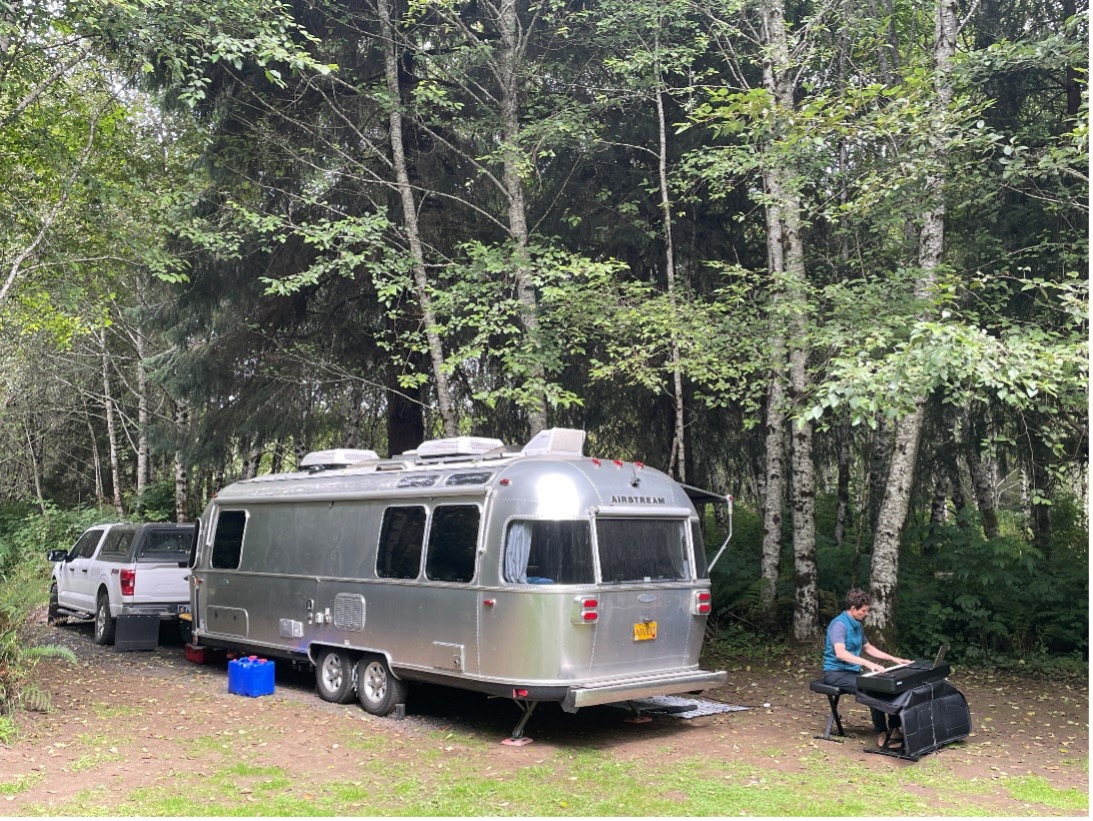
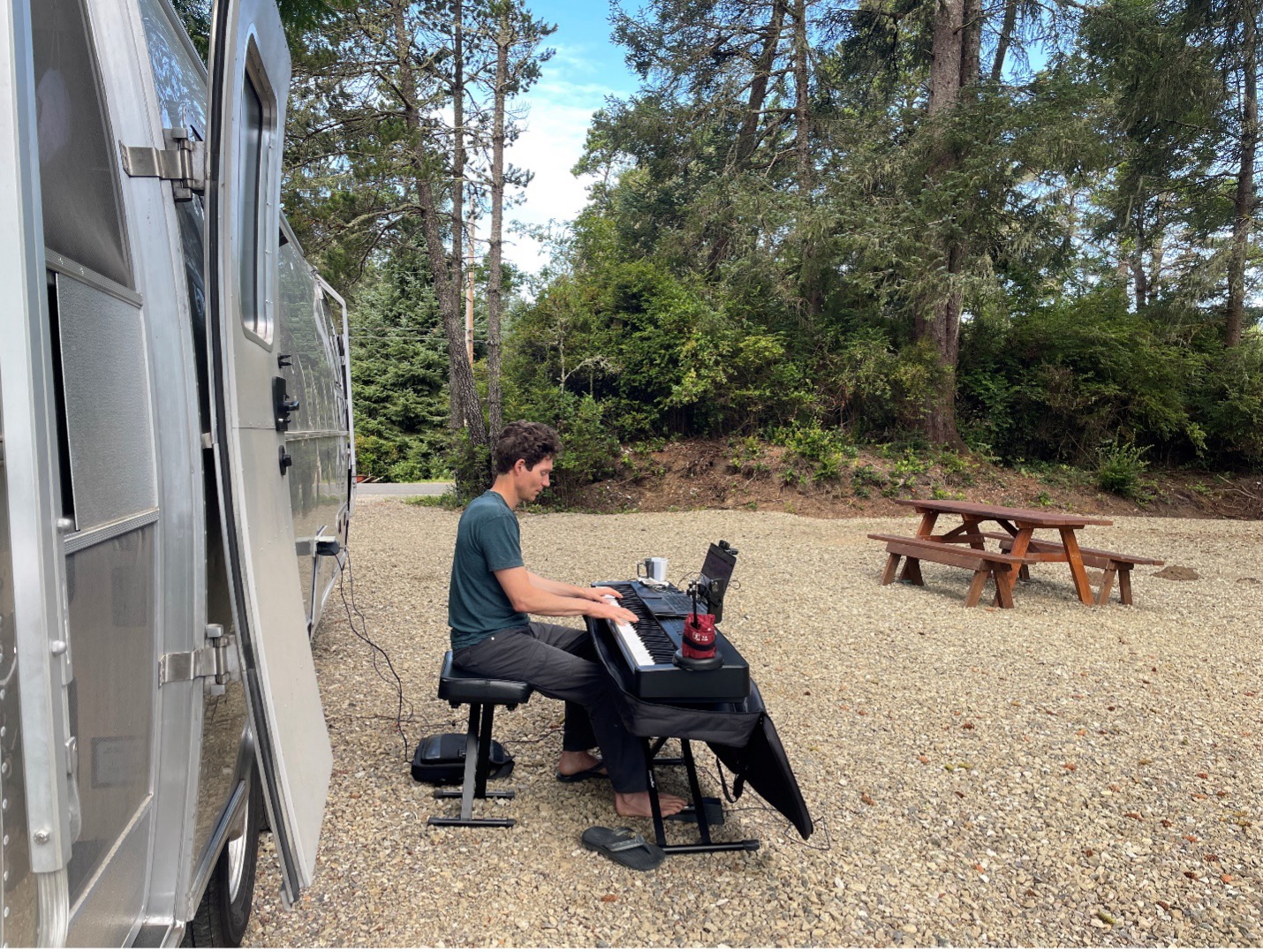
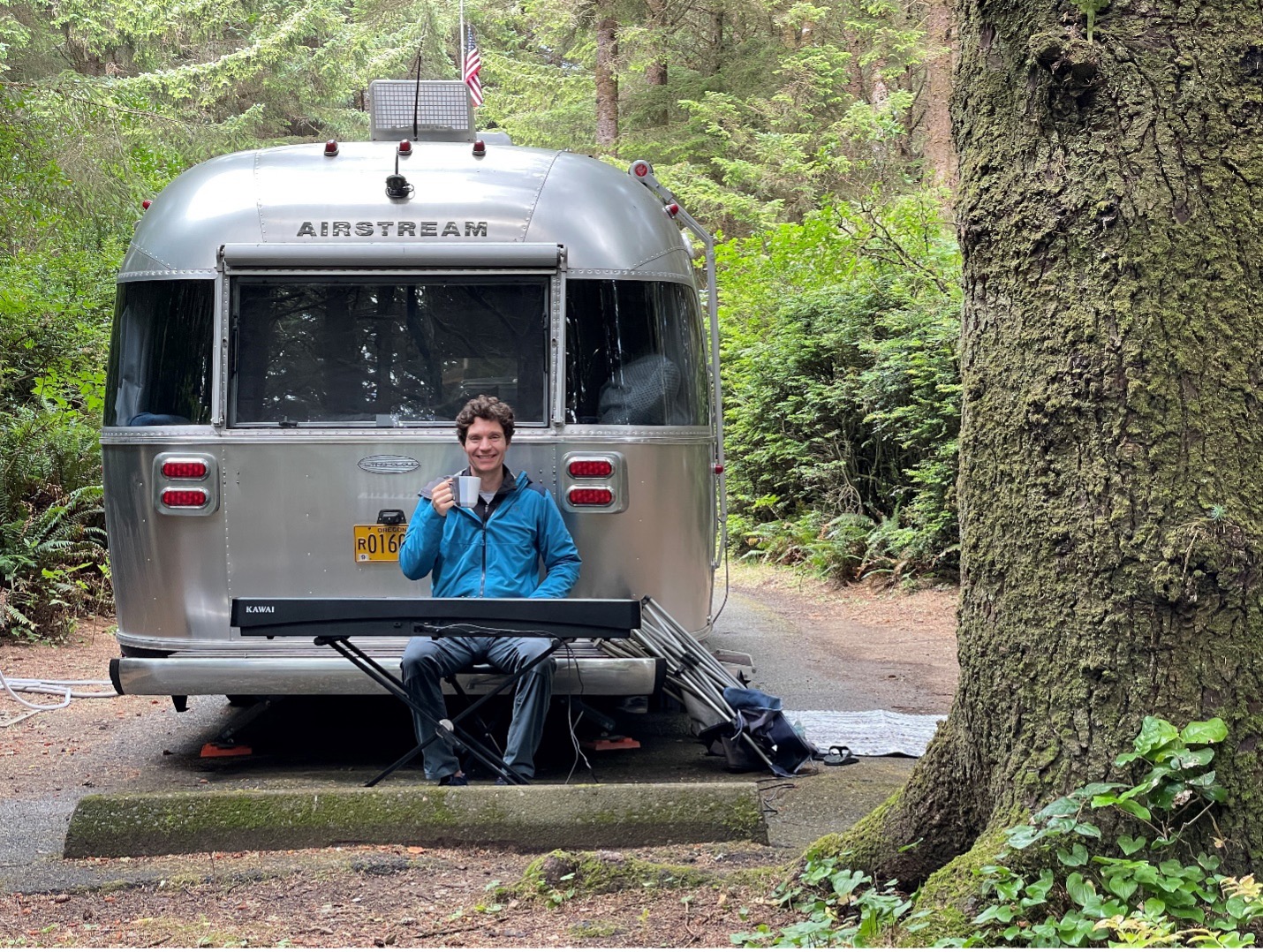
I travel fairly often and like to keep lessons going. In fact, I’m currently rolling around the Pacific NW with my wife for three months in a Airstream travel trailer. Between mountain bike rides, hikes, and hanging with friends, I’m both continuing to play consistently and still taking my weekly lesson. Courtesy of Starlink satellite internet and a digital Kawaii piano, I’m not skipping a beat.

When my teacher is on vacation, I’ve also taken lessons with professionals such as Grzegorz (Greg) Niemczuk, who I found on YouTube. You might be surprised how many YouTubers offer lessons (a friend takes lessons with the popular Heart of the Keys YouTuber.)

You know what makes piano better? Playing outside!

Beyond all those boring logistical things, Antonio being Brazilian brings a fun perspective to my experience. (I’ve learned a few choice phrases in Portuguese, for one!) I’ve also learned about (and love!) Brazilian music that I would otherwise not know, including tangos, the music of Tom Jobim and Ernesto Nazareth, and folk songs arranged for piano.

It inspired me to start a listening quest of different genres and international composers that has deepened my relationship to piano. Perhaps a local teacher would have provided that, but certainly it would have been different.

The nuts and bolts of online lessons

For those wondering how this is possible, allow me to describe the situation:

  • Antonio uses a Yamaha grand piano to teach. On it, he has four cameras for his face, top down on his hands, sideways on his hands, and another on his pedal. He even uses software that allows the camera to track his hands (AI magic!).
  • The sound quality is quite good–the nuances he can hear and comment on astonish me.
  • For my setup, I use a different system depending where I am. At home, it’s my computer with a webcam plus my phone on a stand looking straight down at my hands. While traveling, I just go with my phone on a small tripod set up to the side and occasionally my laptop in front of me. It works great.

The benefit of all this: the only time I’ve missed a piano lesson is when I’ve taken bikepacking trips. I challenge you to carry a full-size digital piano through the mountains…no thanks. A pianist needs to take a break from the keyboard SOMEtimes!

Resources:

To find an instructor, just type “piano lessons online” into any search engine. A few popular services: Superprof or Wyzant; a fellow traveler I met on this trip used Preply to find her ukelele instructor. (If you want to work with Antonio, just ping him on Whatsapp at +55 48 9181-9164.)

Cheers to piano on the road!


This site takes many hours each month to maintian and update. If you find value and pleasure in what I do, why not

I haven’t touched the piano for months. I have a beautiful early 20th-century Bechstein model A grand piano which has been sitting, untouched, in my piano room/office. There is music open on the stand – Schubert’s Piano Sonata in A, D664 – suggesting intent, but I have not played it seriously in over six months.

Why? Lack of motivation, lack of time, yes. But also something which I think is particular to the amateur musician – the knowledge that, unlike the professional musician who must practice regularly to maintain their skill and artistry, one can come back to the instrument at any time and pick up where one left off.

But it can be hard and the first line of that wise saying of violinist Jascha Heifertz – “If I don’t practice one day, I know it…” holds true as much for the amateur as for the  professional musician. The more time passes, the harder it becomes to start over again.

But it’s not impossible.

Rekindling the habit of practicing and playing the piano after a pause, however long, can be both challenging and rewarding. The key to a successful return lies in setting realistic goals, cultivating patience, and reviving your passion for music. Here’s a guide to help you navigate this journey back to the piano:

Set Realistic Goals

One of the first steps in returning to piano practice is setting achievable goals. Begin by assessing your current skill level and recognising that you may not be able to play at the same proficiency as before. Setting short-term goals that focus on gradual improvement, such as playing music that is already well-learnt or attempting a short piece or study, help you reacquaint yourself with the instrument, build confidence and provide a clear sense of progress.

Establish a Routine

Consistency is crucial in developing any skill, and piano playing is no exception. Create a practice schedule that fits comfortably into your daily routine. Practice “little and often”: even 15 to 30 minutes a day can make a significant difference over time. Ensure your practice sessions are regular, but also be flexible and kind to yourself if the demands of daily life/work interrupt your schedule.

Revisit Familiar Pieces

Playing pieces you were once comfortable with can be immensely satisfying and a great confidence booster. It allows you to gauge how much you remember and where you need to focus your practice. These familiar pieces can act as a bridge, easing you back into more challenging repertoire while providing a sense of accomplishment.

Explore New Repertoire

While revisiting old favourites is comforting, exploring new music can really reignite your interest. Choose pieces that inspire you and reflect your musical tastes. Don’t feel you have to learn certain pieces because they are good for you; play the music that interests you. Learning new repertoire not only keeps practice sessions interesting but also broadens your musical horizons and challenges your skills in different ways.

Seek Guidance and Support

If you have taken a long break from the instrument, consider taking lessons, even if only temporarily. A teacher can provide personalised guidance, help you set realistic goals, and correct any bad habits that may have formed during your hiatus. Additionally, joining a music meetup group can offer support, motivation, and opportunities to share your progress with others.

Be Patient and Positive

Returning to your instrument after a break requires patience and a positive mindset. Progress may be slow at first, and you might feel frustrated by the gap between your past abilities and your current performance. Set realistic goals and celebrate small victories – and, above all, remind yourself of the joy that playing the piano brings. With time and persistence, your skills will improve, and the music will flow more naturally.

Enjoy the Process

Ultimately, the journey back to the piano should be enjoyable. Embrace the process of relearning and rediscovering your love for the instrument. Allow yourself to experiment, make mistakes, and have fun. Remember, the ultimate goal is the joy and fulfilment that comes from making music.

Happy practicing!


This site takes many hours each month to maintian and update. If you find value and pleasure in what I do, why not