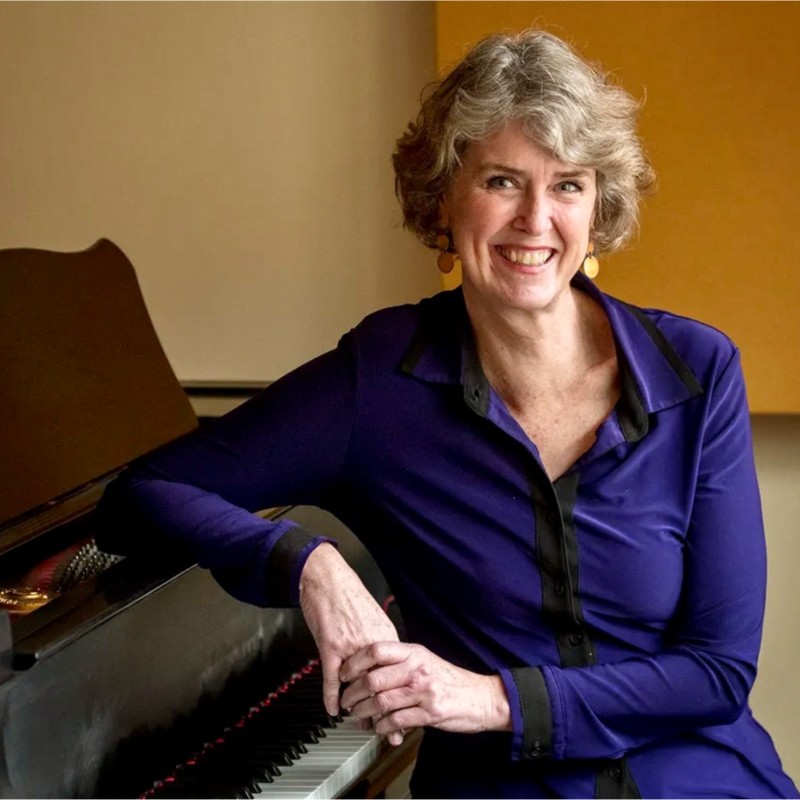
Following one of those wonderfully serendipitous encounters on the internet, I am delighted to present “Notes from the Keyboard”, a series of articles for adult amateur pianists, by Dakota Gale, chronicling his own experiences of learning the piano as an adult.


Four years ago, my wife surprised me with a digital piano for my birthday. I’d mentioned my desire to learn a few times and, ever the muse, she called my bluff.

I couldn’t read music. Finding middle C was a quest. I was a B-E-G-I-N-N-E-R.

And yet…she was right. At 38 years old, I tumbled rapturously into the world of piano. 

Four years later, the honeymoon phase is over, and yet I remain motivated to play every day and am still loving the journey. (<–understatement: I’m head-over-heels for it.)

I even do stuff like learning to do portraits by drawing musicians! (My wife tells me that’s eccentric…) 

I’m playing pieces by Chopin, Debussy, Beethoven, Liszt, and other famous composers that I thought were a decade off. Even facing the inevitable frustrations of piano study, I’m finding joy in piano every.single.day.

Learning piano transcends fun – I feel like I’ve unearthed a gift, a path to access some of the most beautiful music ever written. Accessing the pieces revealed a fountain of satisfaction that isn’t tied to money or achievement, a much-needed oasis of play as an adult.

In fact, I’ll often drop into a flow state for 30 minutes and be surprised when my timer goes off. Where else do we get that feeling once we’re done playing with Legos or mud pies?

You, mega-savvy adult reader, can do it too!

Adults CAN learn to play piano

I share my achievements not to brag (many pianists young and old far outshine my abilities), but to offer hope to adult learners. If you’re telling yourself, “Oh, I could never learn to play” or “I’m not musical” or “only kids can learn piano,” let me persuade you otherwise.

I’m shocked how many people tell me only children can learn. Well, kids are “naturals” at learning because:

  1. They don’t over-complicate things, focusing on foundational blocks that are small and approachable. (Be it music, language, or other skills.)
  2. Kids are able to practice more undistracted hours because an adult provides housing, food, and does their laundry. Their job is to be curious sponges; our Adult Role is often yawn-tastic Tuesdays, repeated.

Adults lack those luxuries. We put pressure on ourselves, try to play songs that are too hard for us, question if the time investment is worth it, and simply don’t have as much time to practice.

I’m an adult. (It snuck up on me.) On top of all the typical adult stuff, I have far too many hobbies. Sometimes friends do annoying things like interrupt my piano reverie to invite me to dinner or on bike rides. *sigh* The inconsiderate louts, I must practice!

And yet by carving out time each day to study piano, in a few months I reached a deeply satisfying level of proficiency that kept me coming back. After four years, I’m frankly astonished sometimes at what my fingers can do.

As a bonus, it’s beautiful for people to listen to (or so they pretend). A skill I’ll enjoy and develop for a lifetime, long after I’m done taking irresponsible risks on my mountain bike.

Beyond that, I’m fired up! I look forward to enjoying creating music the rest of my life and only wish I’d started earlier.


Dear reader, welcome to “Notes from the Keyboard: Adult Piano Chronicles” on The Cross-Eyed Pianist. This will be an ongoing series about my journey learning piano as an adult. I’ll share my journey (ups and downs!) and headaches with pieces and how I resolve them. I promise to absolutely not take myself too seriously—after all this is a hobby, not a vocation.

If you have ideas for topics you’d like to hear about from a dedicated amateur student of classical piano such as myself, please don’t hesitate to reach out. I’m looking forward to sharing this journey with you!


Dakota Gale

When he isn’t playing piano, Dakota Gale enjoys learning languages (especially Italian) and drawing. He also writes about reclaiming creativity as an adult and ditching tired personal paradigms in his newsletter, Traipsing About. He can often be spotted camping and exploring mountain bike trails around the Pacific Northwest.


This site is free to access and ad-free, and takes many hours to research, write, and maintain. If you find joy and value in what I do, why not

Guest post by Jessica Yeartie

To our benefit, there are usually several paths one can choose to arrive at the same end result. Doing so in the traditional way or manner, and the unconventional way. Whichever decision you make is incumbent on the most comfortable way for you in accomplishing something.

To me, I am always seeking the easiest and most convenient way to do something, however I would not perceive myself as lazy. I am just conservative and selective with how I spend my energy. The only thing I exercise to the brink of exhaustion on a daily basis is my brain and thought processes. I can usually just take a nap to recuperate when necessary.

When I had decided I wanted to learn the piano, I knew seeking out a professional teacher to personally instruct me was out of the question, financially and time-wise. My mentors and research consisted of pianists who posted helpful videos on YouTube for beginners and affordable piano books and exercises I could purchase from Amazon.

Due to my circumstances, these choices suited my situation best and I made the best with what I had at my disposal. If aspiring pianists have the funds to hire a personal instructor, I would highly encourage you to do so.

Many tactics I did not learn until much later would have been made aware to me had I had someone to overlook my practice sessions and provide instant feedback I could apply on my own time. Though I think I have gotten on fine enough considering the circumstances.

Like everything in this universe, there are pros and cons when we make these choices. When we choose one thing over the other, we are knowingly sacrificing what could have been had we chosen differently. Sometimes the fear of ¨what could have been¨ can cripple us so much that we just do not make a choice at all.

Some have the opportunity to experience both but I cannot say if that is the default when it comes to decision-making. Although, I can say that hard work can certainly aid with filling in the gaps where personal instruction could have been well-utilized.

Pros

Learning anything outside our immediate area of expertise is a struggle, to say the least. Fortunately the individuals who would consider themselves to be of a more independent nature could definitely benefit from the self-taught avenue.

Adhering to Your Own Schedule

Going solo means you do not have to refer to someone else for when a task should be completed. Finding ways to manoeuvre around each other´s, sometimes very busy, schedules can be time-consuming and hard to negotiate.

Also, life is still going on around us. Many of us have outside responsibilities that come first before giving precious time to what most would consider a hobby. Things like family, relationships, work, household duties, etc. are more than enough to keep the average citizen occupied for the majority of their week.

Of course we definitely need sleep as well, especially me. We are not machines that only need to be recharged when we are feeling fatigued at the end of a long, busy day. Being self-taught can eliminate some of these issues.

Photo by Juan Pablo Serrano Arenas on Pexels.com

No Time Constraints

Typically, teachers expect you to have practiced a certain amount during the week and present that to them when you see them next. Sometimes, the pressure of performing and getting in the required time for a full practice session can be tiresome and anxiety-inducing.

While I immensely enjoyed taking a piano close as a Junior in high school, I hated the weekly tests the teacher would grade us on for the song he selected. I always performed so much worse during the exam than when I was practicing and it frustrated me to no end.

Also, my school did not have enough pianos for each student to have their own so our allotted time slot was much shorter time to accommodate our larger than average classrooms. Now that I practice in the comfort of my own home, I can take as much time as I need to make sure I fully understand a concept.

Working at Your Own Pace

Slow-learners and fast-learners are the bane of the other´s existence. We all have that one subject or skill we excel in and get mildly irritated when others are not. At least that was the case for me in the past. I was even more irritated when I did not understand something and everyone else did, leaving me behind while I struggled.

Some concepts take longer to comprehend than others so rushing them can exacerbate their feelings of inadequacy, leading them to eventually quitting.

On the contrary, moving too slowly can lead to boredom. It is hard for a professional and newbie to come to terms with their individual skill levels and find a way to move forward that satisfies both of their needs.

Working alone means you can work as fast or slow as you need. You can speed up when something comes easier to you or take additional time for more difficult roadblocks without feeling like you are infringing on someone else´s time while still moving forward.

Cons

On the other side, there are some hiccups one should take into consideration before taking the plunge. While there is a considerable amount of freedom that comes with being self-taught, there are also some factors one should think about. Determine whether or not these possible setbacks are something you are willing to take on during your progression.

Lack of Support

One thing that makes starting a new hobby so exciting is meeting new people who have the same passion as you. This can be said about starting a new sport, joining a club at school, or attending weekly community gatherings for a specific project.

What all of these activities have in common is a group of individuals that are physically present. You have others you can converse with as the two of you are working while establishing a relationship.

In the beginning stages, learning an instrument can be kind of isolating if you are teaching yourself. Having a teacher present can remind you that they are there to help and support you when you eventually hit a wall. We can sometimes lose motivation when we have no one holding us accountable.

Lack of Foundation

If you are anything like me, you tend to want to skip the ¨boring¨ stuff and tackle the more exciting lessons. The problem with this is you hit a plateau much quicker due to a lack of knowledge in basic strategies you should have focused on to begin with.

We all have songs in our heads we really want to learn so we convince ourselves, prematurely, that we can learn it at our current level only to receive a slap in the face when you realize you cannot even play both hands at the same time without being out of time.

It takes a responsible person to stave off instant gratification and spend time on the more mundane, but important, aspects that are the very foundation of what they can accomplish in the future.

Little to No Feedback

Unless you asked someone to watch over you who is well-versed in piano and the proper form, you do not have much immediate feedback so you would have to refer to second-hand resources for clarity.

Playing in front of someone can be extremely nerve-wrecking but it is worth it to learn in the early stages which behaviours need to be corrected so they do not turn into bad habits that are nearly impossible to break further down the line.

Don´t shoot yourself in the foot by relying on your intuition in unfamiliar territory. There are lots of resources and videos out there that will inform you on better ways to play arpeggios or the perfect posture to maintain when practicing.

In Conclusion

We are all different. Some thrive in solitude while others, in the company of others. I do not regret that I chose to be self-taught however I definitely believe I could have benefited greatly from having a stable authority present to help me when I struggled.

Ideally, I think the best situation would be to experience both. Have a teacher as a novice player then gradually become more independent as you improve. That is just my opinion, though.

Whatever decision you choose is ultimately up to you unless you have parents who insist on paying for your lessons. I hope whatever path you choose leads you to victory.

Keep playing!


Jessica Yeartie is a US-based writer and blogger.

Find out more

Guest post by Jennifer Griffin Gaul

My mom used to tell a story about me. She said that she would lie in the bathtub at night and listen to me practice piano.

I find this story strange because I honestly have very, very few recollections of practicing. I know I played because I remember the irritation I would feel at competing with the blare of the TV, or my angry older brother yelling at me to stop making a racket. But then there was the idea of “practice”, which was a bit of a fuzzy concept for me. Was it playing things over and over again until I could play it perfectly? Or was it something else altogether? I didn’t really know and there was no one at home who understood it either.

I didn’t start piano until I was 9 years old. We didn’t own a piano and my parents only
experience with music lessons was my brother’s aborted attempts at trumpet, which
left them unenthusiastic about investing in lessons for me. The subject of piano only
came up because they received a call from my best friend’s mother. Mrs. Kim had
called to say that I seemed to spend a lot of time around her piano and she thought
they should have me start lessons. My father balked at the idea of purchasing a piano
for an 8-year-old so I was given a plastic recorder and signed up for recorder lessons. I played recorder for a year and when it became clear that I loved music, they figured
out a way to get a small spinet piano.

I adored my first piano teacher, Mr. Erikson. He was a tall, gangly, bearded man with a
raspy voice. He started me off and we worked together until I was nearly 16 years old.
Every week when my lesson rolled around I’d feel a flurry of emotions. Anticipation was usually the biggest one. Sometimes a bit of shame for not doing the music worksheets he would assign. And also for not “practicing”. I didn’t like to let him down and I knew that practicing was important. I just wasn’t sure how to do it. But I also didn’t want to ask him what it meant because it seemed like I should understand it already.

Something magical always happened in those lessons with Mr. Erikson. Our work
together would absorb me completely. The lesson would flash by as I immersed myself in each new intricacy of music-making and sound. I progressed steadily. I must of practiced, right? How do you progress without it? And yet why didn’t I understand
what it was?

My musical life stumbled after a tearful parting from Mr. Erikson when he moved to
California. Limited for competent piano teachers in my small town in Rhode Island I
had begun lessons with a music professor at the local university. That relationship was life-changing. My weekly lessons became agony. There was no flow or understanding during lessons. Just a series of orders of what I was supposed to do. I was unable to focus because I was so frightened of this teacher. My ability to immerse myself in the music and grow and learn evaporated. Each week became worse as I was berated over and over again with my musical (and perhaps personal) deficiencies.

By this point, I had been accepted into the university at age 16 to pursue a Bachelor of
Music. He was the teacher I needed to work with in order to get my degree. He was
annoyed with me for this early acceptance, which he had been against. He said I
wasn’t mature enough. He was also annoyed with me for being accepted into the
Young Artist Piano Program at Tanglewood over the summer before I started at
university. He had told me I would be wasting the time of the audition committee if I
applied and would never be accepted. I auditioned anyway and spent a month
studying with Robert Taub, surrounded by amazing young musicians who were far
better than I was. They practiced! I was starting to get the concept.

And I DO remember practicing for him. I practiced a lot! But I just couldn’t seem to
progress. I couldn’t connect with the music. And each time I sat down to practice,
determined to show him what I could accomplish, I would just become more
discouraged. I ran scales. I did technique exercises. I worked on the assigned music.
Joylessly and with trepidation, driven by a sense of his seemingly endless disapproval.
It all came to a head during a lesson when I was mucking up the Mozart Sonata he had
assigned. By this point every time I played for him my hands would shake, my eyes
would have trouble focusing and my brain would go blank. In a fit of irritation he told
me that I had no capacity for hard work and I was just someone who liked music but
would never be a musician. He then told me to play it again for him. I couldn’t because
I was crying so hard I couldn’t see the music. He sighed and said “This proves what
I’ve said. Go home.”

I was devastated. My teacher Mr. Erikson came back for a visit that fall. I played for him and he just stared when I finished. “What happened?” he said weakly. Not only could I not play fluidly or with any musicality, I had developed so much tension that I was losing the feeling in my arms and hands. All that practice had done significant damage.

Before he returned to California, Mr. Erikson helped me to make some changes. I
altered my program from a Bachelor of Music to a Bachelor of Arts in music because
that allowed me to drop piano lessons.He had a long consultation with a friend who
had a D.M.A. from Eastman School of Music and set me up with this new teacher. I
began commuting to Boston every Saturday for lessons. I had to relearn how to play
again. Gradually I began to heal. Gradually I started to play again (or was it practice?). I adored my lessons with my new teacher. The sense of ultra focus and immersion
during lessons returned and I made enough progress to be accepted into University of Texas at Austin’s music program where I earned a Master of Music in piano.

So how does this impact my own teaching and the advice I give to parents and
students about the importance of practice?

In my opinion, at every level students need help understanding what they’re trying to
achieve when they practice. That understanding needs to be age appropriate. And it all springs from the quality of the teacher/student engagement during lessons. Working together in a way that feels collaborative, exploratory and uncovers each student’s connection to the music sets students up for better success on their own. Lessons that include regular, honest, and non-judgmental conversations between a teacher and a student about what (if anything) the student achieved in the week. We all know lesson time is precious because there just isn’t enough of it. But it is time well spent for students. Learning to self-reflect. Learning how to engage with sound. Learning to recognize how technique is tied to the sound produced. Learning to immerse themselves in a process that, when it goes well, can make an incredible difference.

Many years ago, I heard a friend joke that “you don’t need to practice if you just play
every day.” And I realized I finally had my answer to how I had made my progress.


Jennifer Griffin GaulJennifer Griffin Gaul is a US-based pianist and educator. She holds a Master of Music in piano pedagogy and performance from the University of Texas at Austin.
Find out more

A post for World Piano Day 2022 on why we LOVE the piano – a compilation of comments received via Twitter and Facebook.

Thank you to everyone who contributed


It’s complete. Since I was a child it’s been the place I go to relax. I’m not a pianist but I can play and it makes me extremely happy. During the first lockdown singing made me sad for all we were missing (especially my co-musicians). I found solace at the piano. (CS, singer)

The colours produced by harmonies in even the simplest pieces. I was teaching a piece from a tutor book to young beginners this week and as soon as they added the LH to produce 3 and 4 note chords something magical happened. (MJ)

The touch of the keys, the sound, the huge variation in textures, the colour of the wood, the space where it sits…..and the fact the whole family have access to it! (RN)

The ability to thunder away one minute then tug at your heart the next with soft, quiet subtlety (T)

Photo by Itay Weissman on Pexels.com

The possibilities I have to play like a whole orchestra, but also very simplistic and moving melodies. The dynamics and the tone forming. Being a one (wo)man player or a chamber musician, working with a singer or giant orchestra… so many things to love about my piano. (FK)

you can see what you’re doing… (TC, composer)

The combination of intuition and control. (EMcK)

You never have to bring it with you. Wherever you go, it’s there. If it isn’t there, you’re in the wrong place. (RN)

Not having to get it out of a box (HW, composer & pianist)

Duration and decay (Kirkdale Bookshop)

A musical instrument and dinner table! (A)

Photo by Steve Johnson on Pexels.com

I like the fact it’s (often) a place as well as an instrument. The room gathers memories, which enrich the music making. I like how you can see all the notes physically even when silent. But most of all I love the sound. Just playing a big C major arpeggio is, to me, a joy. (JD)

It’s mindfulness, it’s meditation, it’s calm. And when headphones are involved it provides a much needed solitude, as I escape into its world. As I mainly improvise, it’s a crafting table, that gives life to new music. I love the tactile connection. The piano is home. (JW)

How do I love thee? Let me count the ways: the sound of a singing treble with the sostenuto pedal, the richness of full chords and the power one feels as they sound, the immense satisfaction of feeling & hearing the clangourous sounds… and so much more! My beloved instrument. (BC)

Photo by Dalila Dalprat on Pexels.com

The amount of opportunity it has to offer, the range and the versatility (ID)

I love the feel of the keys! They are my friends! (BO’R)

…as a medium, the piano is its own self sufficient universe. I don’t think any other solo artistic activity can boast the same level of storytelling or emotional exploration as well as refined pianism does (ES)

The variety of tone colours at your disposal, ability with sustain pedal to play so many notes at once, you almost have the whole orchestra in front of you. As a child I was mesmerised by being able to ‘see’ all the notes at once and wonder about their possibilities, I loved exploring and finding the scales by ear by noting the order of keys and shapes and patterns your hand made, the similarities and differences. (RR)

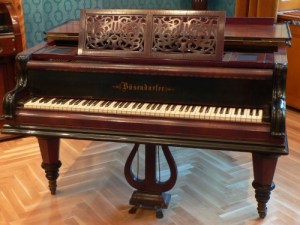
Liszt’s Bosendorfer piano at the Franz Liszt Museum in Budapest

Underneath a grand piano there are all sorts of secret hiding places for valuables (watches, jewellery, money, etc). No other instrument offers this possibility. Imagine trying to stuff a Rolex inside a piccolo or viola? That’s what I love about the piano. I also love the fact that the notes are all there- all you need to do is play them in the right order (takes a bit of skill grant you). A more serious answer – the piano is a glorious instrument of ‘make believe’. It forces the imagination into overdrive – we ‘think’ we’re hearing something which is not happening. Its defects are, paradoxically its virtues.  (JH)

The ability to use so many of one’s senses. I like the fairness factor of piano: you put in a hard work, you get the results. You don’t, it shows too. In life it is not always as fair as that. (JM)

The SOUND. I just bloody love the sound of the thing. Why would anybody want to play another instrument?! (MV)

All of the little tiny parts of the action like a bird skeleton, with their daft names (DG)

The immediate visual appeal it has without even being played; the fact that a mechanical machine that needs no electricity is capable of (in competent hands) making music that elicits emotions in such a profound way. There is nothing as deliciously decadent as a dusty, old upright sitting in a forgotten corner, waiting to be played. And the majestic presence of a grand that is always begging to give all its rich harmonies. The piano can be the best friend and the worst enemy because it seduces you but enslaves you as you try to get more and more depth and richness from it. The piano reveals one’s inner struggles like no other instrument does (MAdB)

The sense of freedom from the world when playing it (JK)

Every time you play at a concert you will meet a new instrument. I love the whole experience of getting to know the instrument and trying to get the best out of it. They are all so unique and it can be so rewarding (WH)

Someone recently asked me “what do you like to play”? Usually people just ask “what do you play.” It was a reminder for me to never forget the “like” and “love” origins of my work, especially during difficult practice days or performances that don’t quite go to plan. (SE)

a deep connection with musicians of the past and the now makes the piano and piano music so life-affirming (AH)