Best known for his BAFTA-winning comedy show, ‘Alistair McGowan’s Big Impression’, in which he delighted audiences nationwide with pinpoint-accurate impersonations of celebrities such as David Beckham, Gary Lineker and Jonathan Ross, Alistair McGowan is now preparing for his most demanding role of all – that of pianist – as he releases an album of solo piano works for Sony Classical.

This debut album features McGowan performing several short classical pieces, all chosen and learned by the actor/impressionist (who could only ever play two pieces) but who then practised for up to six hours a day over a nine month period in his attempt to finally conquer this beautiful instrument, despite already being in his early fifties. Says McGowan: “By taking on the idea of making an album, I hope to encourage people of any age to play the piano, but perhaps particularly those at an age where it’s easy to think that it’s all too late”.

McGowan had started out playing the piano as a boy, but gave it up after only two years in favour of tennis and football. He went on to train as an actor at the Guildhall School of Music and Drama and worked for many years on television, on radio and in the theatre (being nominated for an Olivier Award in 2006), as well as successfully performing around the country for almost thirty years as a stand-up comic.

Having always yearned for the piano, in 2016, McGowan devised the one-man stage show, ‘Erik Satie’s-faction’, based on the French composer’s comedic writings, letters and music, for which he had to learn to play some short piano pieces by Satie and Debussy as an integral part of the show – the first time he had ever played in public. Emboldened by this well-received first public experience, it was not long before he was enthusiastically identifying and learning other short pieces which he felt that he – and others with similarly limited playing experience – could realistically manage.

McGowan notes: “I have become so passionate about the piano over the past three years. It has really taken me over and I have made the time to practise (time I never thought I had) with a few simple lifestyle changes. This album contains a wealth of beautiful music that I think anyone can tackle, given time, passion and determination. Learning to play the piano has been an incredible challenge – often frustrating – but, ultimately, hugely enjoyable and emotional. It’s so satisfying when you realise that you are improving daily. I hope this encourages everyone who harbours a secret ambition take up music -it really is never too late!

McGowan was mentored by concert pianist and ‘Olympianist’ Anthony Hewitt and also attended the exclusive (and very expensive) piano summer courses at La Balie in south-west France. He practised on friends’ pianos and used ice packs to relieve tension and pain in his hands and legs, the result of his long practise sessions.

His solo piano album features music from composers as diverse as Bach, Chopin, Glass, Grieg, Liszt and Satie, together with vocals by Alistair McGowan’s singer wife, Charlie.

Alistair McGowan: The Piano Album is released on 29 September on the Sony Classical label


I never really intended to become a pianist and piano teacher – nor a blogger on classical music and pianism, and a concert reviewer. Sure, I was mad keen on the piano as a child and teenager, completing all my grade exams and enjoying consistent rather than startling success in them. I harboured some desire to go to music college rather than university, but an offhand comment by my music teacher at school, suggesting I was not “good enough” to audition for conservatoire (a comment which still has the power to sting, some 35 years on), set me on a different course at 18: I studied Anglo-Saxon at university and had a career in art and academic publishing for 10 years post-university, until I stopped full-time work to have my son.

But the piano had always been there, in the background, a rather frustrating itch which could not be scratched because my father sold my piano when I left home and I had no instrument on which to practise. I occasionally played a friend’s grand piano but lack of practise led to frustration, and it was not until my mother bought me a half-decent digital piano that my passion for the instrument was rekindled. It was gratifying to discover that music I’d learnt in my teens was still “in the fingers”, if rather rusty, and I began to enjoy the routine of practising once again. Around the same time, I started going to concerts regularly again, something I had enjoyed as a child with my parents, and into my teens, reacquainting myself with repertoire I knew and loved and making new discoveries. A chance conversation with a friend in the school playground while waiting to collect our children led me into piano teaching – that was 10 years ago…..

Alongside this, I felt it was important to improve my own playing, and in 2008 I returned to regular lessons with a concert pianist and professor of piano at one of London’s leading conservatoires. It was daunting initially: I had not been taught for nearly a quarter of a century, and lots of bad habits from my teens and lack of technique were quickly exposed, but the teacher was sympathetic and supportive, and it was satisfying to see my playing improve rapidly under her guidance. Because I had not had a formal musical training at 18, I always (and still do) felt I was trying to catch up with those who’d had that education, and this was a major motivation for taking an external performance diploma, in addition to the desire to continually improve my playing by setting myself the personal challenge of preparing for the diploma. And so in December 2011, some 28 years after I last stepped into a piano exam room, I took my Associate diploma in piano performance. The Licentiate diploma followed in 2013. Both experiences were entirely positive (in complete contrast to some rather uncomfortable exam experiences as a child): I enjoyed the challenge of learning and finessing the repertoire, researching and writing programme notes, and learning how to be a performer (for one is assessed not just on one’s playing but also on stagecraft and presentation, just as in a formal professional concert), and above all, I enjoyed studying with a teacher again and the self-imposed routine of regular practising. Since 2013, I perform quite regularly, in solo concerts and in joint recitals with friends and colleagues. Learning to manage and understand performance anxiety has been a big part of my development as a pianist, and an aspect I know many others struggle with, which is why I organise workshops for adult amateur pianists on coping with anxiety and developing good stage craft.

I think the rather “accidental” path into my current role, in addition to the long period of absence from the piano, has given me the freedom and confidence to fully indulge my passion for the piano and its literature. Had I gone to music college and had to make a career from music as a young woman, I may have lost that spark, that passion. I’ve met a number of professional musicians who have expressed resentment at the heavy demands of their career, which can rob them of their love of the piano and its literature. (Admittedly, I am fortunate in that I do not have to make my main living from music: I have what is fashionably called a “portfolio career” and do several other admin and writing jobs in addition to my teaching.) Returning to the piano in my late 30s, and completing my diplomas in my mid-40s, has brought a maturity to my approach – and in the years when I wasn’t playing I was still listening to music and going to concerts, soaking up all those notes and forming my own opinions about the music I was hearing (which in turn was given a further outlet when I started reviewing concerts for Bachtrack.com).

As an adult pianist, one has the freedom to explore whatever repertoire one pleases, without a teacher bossily insisting on Czerny exercises (been there, done that) or having to play repertoire which one hates (and I suspect many of us can remember, with a shudder, the terrible/dull music we were made to learn as children). We take responsibility for our practising without recourse to others. As we mature we get to know what repertoire suits us (I was very touched at a recent London Piano Meetup Group event when a friend commented on how much a certain piece “suited” me), what we are physically, and mentally, capable of tackling, and as pianists we are incredibly spoilt by the vastness of the piano’s repertoire: there really is something for everyone! While some of us dream of playing Rachmaninov’s Third Piano Concerto to a full house at Carnegie Hall, we gain a great deal of pleasure and satisfaction from working on pieces and presenting them to others at piano clubs, meetup groups, and on courses (where one can meet other piano fanatics and where lasting friendships are forged). We enjoy the challenge of learning a Beethoven sonata, a handful of Bach’s Preludes and Fugues, or a brace of Chopin Etudes, and the sense of achievement when we gain “ownership” of our music, making it our own.

“It’s an overriding passion, not just for the music [but] for the challenge……And the challenge is constant: there’s always a harder piece, you can always take it to the next level, you’re never finished. But there’s also the fact that the piano is your friend; it’s always there. That gathers more significance as you get older: what you can express through it, in a personal language, becomes incredibly important.”

Lucy Parham, concert pianist

Those of us who play at a semi-professional level, advanced pianists, intermediate players, beginners, returners, “Sunday pianists” all share this consuming passion. Eavesdrop on any conversation between members of a piano group and this love is more than evident as members discuss the myriad aspects of the craft of piano: practising, repertoire, exams, concerts, performance anxiety, favourite professional performers and recordings. Because of this, professionals are often quite envious of the freedom amateur pianists have to indulge their passion, to play whatever repertoire they choose and to play purely for pleasure.

Music has known therapeutic benefits and the piano is no exception. Time spent with the instrument can be relaxing, invigorating, inspiring and comforting. A good practise session can feel as beneficial as a run – and we release the same “happy hormones”, endorphins, when we practise, as we do when we exercise. If I haven’t touched the piano for several days, I get tetchy and frustrated, and it’s the first thing I go to when I return home from a holiday. In fact, I don’t know what I’d do without it now, and I am lucky enough to possess a rather fine antique Bechstein grand piano, known affectionately as “Bechy”, who has pride of place in my living room and is treated by the rest of my family like a rather large pet.

If you are something of an “accidental pianist”, or someone who has returned to, or taken up the piano later in life, I would love to hear from you to explore this fascinating subject in more detail. Please feel free to contact me to tell me your story, or complete my Piano Notes – adult pianist interview (word document)


A regular commentator on this blog has asked me to write more on amateur pianism. Here are some honest and occasionally light-hearted thoughts on the joys and frustrations of being an amateur pianist.

Alan Rusbridger’s book ‘Play It Again’ (published in 2013) shone a delightful and inspirational light on the world of amateur pianism, but people have been playing the piano at home and with friends for almost as long as keyboard instruments have been in existence. In the nineteenth century, when advances in design and production significantly reduced the cost of manufacturing pianos, an upright piano in the parlour was the norm for family entertainment, much as the PlayStation or smart TV is today (sadly).

Pleasure

Probably the single most positive aspect of being an amateur pianist is not having to make a living from playing the instrument. Recently, I have begun to paid for solo performances and accompanying, which puts me in the hallowed category of “professional pianist”, but my main income comes from piano teaching, and I wouldn’t have it any different, to be honest. Not having to earn a living from playing the piano means one can truly indulge one’s passion for it. (Indeed, the word “amateur”comes from the Old French meaning “lover of” from the Latin amator.) All the amateur pianists I meet and know play the piano because they love it and care passionately about it.

That is not to say that professionals don’t love the piano too – of course they do, otherwise they wouldn’t do it, but a number of concert pianists whom I’ve interviewed for the Meet the Artist series have expressed a certain frustration at the demands of the profession – producing programmes to order, the travelling, the expectations of audiences, promoters, agents etc, which can obscure the love for the piano and its literature. Because of this, professionals are often quite envious of the freedom amateur pianists have to indulge their passion, to play whatever repertoire they choose and to play purely for pleasure.

Talking of which, the piano has a vast repertoire, more than enough to suits all tastes, a good chunk of which is copyright-free and easily available online from sites such as IMSLP and Pianostreet. One could spend a lifetime learning and playing only the music of, say, J S Bach or Fryderyk Chopin and only scratch the tiniest surface of the piano repertoire. And in addition to solo works, there is music for three, four, six hands to enjoy with other pianists, not to mention being called upon to accompany other instrumentalists and singers…. Really, we are spoilt rotten!

Pain

Being a pianist can be a lonely occupation/hobby (though I like the solitary nature of the instrument) and working alone on that knotty section of Liszt or Hanon exercises can at times be frustrating and demoralising. However, it needn’t be lonely: in recent years the popularity of piano meetup groups and piano clubs, or even informal get togethers at one another’s houses, has created a wonderful community of like-minded people who meet regularly to play for one another, share repertoire and socialise. I co-founded the London Piano Meetup Group and I still attend the group’s meetings when I can. Our drinks and lunches after our informal performance platforms are always noisy with conversations about the music we are working on, concerts we have enjoyed and discovering new repertoire.

Some adult amateur pianists are shy about playing to others for fear of making mistakes and looking foolish, or because of negative experiences in childhood. Piano Meetups and Clubs are a good way of overcoming these anxieties – you quickly discover that most people feel the same and playing to a friendly non-judgmental group of people is an excellent way of overcoming those performance nerves.

Adult pianists may also find it difficult to find the right teacher to support and encourage them. Some adults like to be pushed by a teacher, others need more gentle handling. Many come to lessons with a lot of “baggage” and anxieties, often a hangover from childhood music lessons, and need encouragement and support. Some have rather over-ambitious ideas about their capabilities (I had an adult student who informed me at his first lesson that he was going to play the Rach Three one day!) and want to play repertoire which is too challenging. In such instances, I recommend selecting repertoire that is well within one’s “comfort zone” to give one confidence, while gradually introducing more complex repertoire to extend and challenge one’s abilities, both technical and musical. And no repertoire should ever be considered “off limits” to the amateur pianist: the music was written to be played!

However, the music still has to be learnt and one of the greatest frustrations expressed by amateur pianists is finding the time to practise, especially if you have a busy day job and/or family commitments. We all know that “practise makes perfect”, but what is more important is that practise makes permanent and regular practise means notes are learnt, finessed and made secure. My personal mantra is “little and often” (a shoulder injury means I cannot practise for more than about 45 minutes in one sitting without a break) and I have become adept at sneaking practise sessions in to a particularly busy day or if I am going to be away from the piano for a period of time. It’s amazing what just 10 minutes focused practising can achieve – but you need to know what needs to be done (a good teacher will offer guidance on this and give one tools to practise efficiently and effectively). If you are serious about your piano practise, try and set aside some time every day for it. Alan Rusbridger used to practise before he went to work, shoe-horning a brief 20 minutes on the Chopin G minor Ballade into his busy day. And if you are very serious about your practising, be ruthless about setting the time aside, turn off your phone, and simply shut yourself away with the piano.

alan-rusbridger-chopin-s-015
Alan Rusbridger (photo: The Guardian)

If you don’t have the benefit of regular lessons with a teacher, there are plenty of online resources in the form of blogs, YouTube tutorials, and forums, and there are also courses for adult amateur pianists where you can study with international concert pianists and acclaimed teachers or simply enjoy being amongst like-minded people. Such courses are a great way to meet other pianists and observing others being taught in the masterclass or group workshop setting can be really useful. You can even have a rather special “piano holiday” and stay in luxury accommodation with gourmet food and beautiful facilities (though “mandals” seem to be mandatory for both male participants!). Many of my pianist friends return to the same courses year after year and firm friendships have been forged.

newroom3medium-470x314
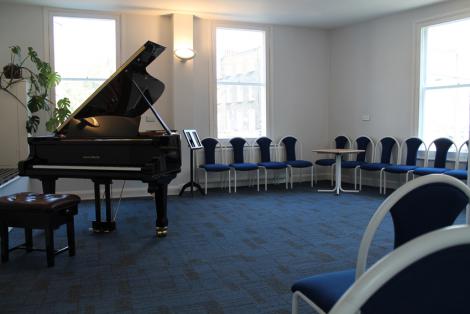
A rehearsal room at Peregrine’s Pianos, London

Not everyone has the luxury of an acoustic piano (upright or grand) but there are some excellent digital pianos on the market now. There are also street pianos at railway stations and airports, and if you crave the sleek elegance of a grand piano, there are rehearsal rooms available to hire for a modest fee and many churches and community centres have grand pianos which are just begging to be played. Seated at that glorious, gleaming expanse of mahogany, you can dream of playing to a full house at the Wigmore or Carnegie Hall.

Above all, love your piano and its wonderful music


If there are any specific aspects of amateur pianism which you would like me to cover, please leave a comment below or contact me

Frances Wilson, author of this blog, is experienced in teaching adult pianists and also runs performance workshops for adult amateur pianists.


Further reading

More than hobbyists: the world of amateur pianism

The Adult Amateur – article on Practising the Piano blog

Street Pianos


Rehearsal rooms in central London

Peregrine’s Pianos

1901 Arts Club

Markson Pianos

Steinway Hall

Bluthner London


I was delighted to rejoin the London Piano Meetup Group (a friendly and supportive group for adult amateur pianists in London which I co-founded in 2013) for the March performance event. We met in the airy upstairs studio at Peregrine’s Pianos where we had the opportunity to play a medium-sized August Förster grand piano (one of the many attractions of the group is the chance to play different pianos). There was, as usual, a varied range of repertoire from Scarlatti to contemporary British composer Cheryl Frances-Hoad, with some impressive and enjoyable Chopin, Debussy, Rachmaninov, Bach, Howells, Liszt, Mayerl and even a drop of “cocktail jazz” (‘A Nightingale Sang in Berkeley Square’). Afterwards, we repaired to The Clerk and Well pub for a jolly lunch and lively piano chat.

newroom3medium-470x314
Upstairs studio at Peregrine’s Pianos

The original motivation for forming the group remains very strong – to provide a supportive and relaxed environment for adult pianists to meet, play for one another, share repertoire and socialise. I’ve made some very good friends via the group, as have others, and it was very nice to reconnect with old friends and make new ones too. The popularity of the group – and others like it – is an indication of how many pianists there are in and around London who enjoy the opportunity to meet and explore new or familiar repertoire. The chance to exchange ideas about practising, taking exams, performing, teachers and teaching, courses, concerts and more is also very important, and many people use the informal performance opportunities as a place to run repertoire by a friendly audience ahead of an exam, diploma, competition or festival performance.

Being sympathetic towards nervous players is a crucial component in creating a “safe place” where nervous or inexperienced players can perform without fear of criticism or negative comments: everyone’s performance receives warm applause and appreciation.

For further information about the London Piano Meetup Group or to join the mailing list to be kept informed about upcoming events, please email londonpianomeetup@gmail.com or find the group on Facebook

Related content

Courses and Summer Schools for Adult Amateur Pianists