Books about piano journeys are rare and valuable – especially those written from the perspective of the amateur player.
A new book, by late-returner pianist and ex-technologist Howard Smith, adds to the genre and does so in a surprising (and delightful) fashion. In this article I list the six books I have read, and compare and contrast the approach each (very different) author has taken in narrating their adventures in pianism. My reading list comprises:
1. Piano Notes, The hidden world of the pianist, Charles Rosen
2. Piano Lessons, Music, love & true adventures, Noah Adams
3. The Piano Shop on the Left Bank, Discovering a forgotten passion in a Paris atelier, Thad Carhart
4. Piano Pieces, Russell Sherman
5. Play It Again, An amateur against the impossible, Alan Rusbridger
6. Note For Note, Bewitched, bothered & bewildered, Howard Smith
 Piano Notes, The Hidden World of the Pianist, by Charles Rosen (first published in the USA by The Free Press in 2002., republished by Penguin in 2004).
The late Charles Rosen, a distinguished concert pianist, music critic and author of The Classical Style and its sequel The Romantic Generation, provides an eloquent description of the ‘delights and demands’ of the piano. The author explores every aspect of the instrument, from the physical challenges of technique to the subtle art of creating a beautiful tone, to the culture and foibles of conservatories and contests. The book is structured as a set of connected essays, scholarly in approach but highly readable and accessible. I read this book when I was beginning a tentative return to the piano in my late 30s and found Rosen’s wisdom inspiring and insightful.
 Piano Lessons, Music, Love & True Adventures, by Noah Adams. Published in 1997 (Delta/Random House), the book explores why a fifty one-year old man would suddenly decide he has to own a grand piano: a Steinway. Adams, a radio journalist and host of NPR’s flagship news program All Things Considered, sets out a month-by-month chronicle of one year spent pursuing his passion for the piano. The book is packed with anecdotes beyond the telling of his own story of obsession, covering such diverse worlds as Bach, Pop, boogie-woogie, and is littered with his recollection of meeting with or speaking to masters such as Glenn Gould, Leon Fleisher and George Shearing. Adams is a consummate writer, and as each month and season in his year long journey spins by, culminating in his surprise ‘Christmas Party performance’ of Schumann’s Traumerei from Scenes from Childhood, he reflects on what could have been. ‘There’s been a secret, hiding in my heart about this piano-learning endeavor: Perhaps I do have a talent and no one knows.’ Adam’s dedication is ‘For all who would play’. Written by an amateur pianist who sets himself on a path to master the piano, this book is an engaging, entertaining and inspiring read whose sentiments will resonate with others on a similar journey.
 The Piano Shop on the Left Bank, Discovering a Forgotten Passion in a Paris Atelier, by Thad Carhart, became a New York Times Bestseller. First published in 2001 the book tells the story of how, while walking his children to school, the author chances upon an unassuming piano workshop in his Paris neighbourhood. Curious, he eventually wins the trust of the owner and is gradually introduced to the complexities of the engineering of pianos old and new, as well as the curiosities of the unique style of ‘trade’ in pianos between dealers, professionals and amateurs who wish to acquire distinctive and beautiful instruments. Along the way we learn much of the rich history and art of the piano, and the stories of those special people who care for them.
The parallel story is how the author returns to playing the piano by acquiring a Stingl grand piano and taking lessons himself – and here the “piano journey” once again resonates with those of us who have taken up, or returned to the instrument later in life.
It’s a captivating read, the boulevards and backstreets of Paris brought to life in an atmospheric and engaging narrative, and and author reveals a special awareness of the special attachment pianists, professional and amateur, have to their instruments. In an appendix titled ‘A Readers’ Guide’, Cahart explains how pianos occupy a special place in people’s lives. ‘Musically, they are unique,’ he explains. ‘But they are also just too big to ignore … Pianos are truly amazing receptacles of memory and emotion for many families’.
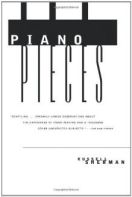 Piano Pieces, by Russell Sherman. Described by The New Yorker as ‘Startling … dreamily linked observations about the experience of piano playing and a thousand other unexpected subjects’. Sherman’s book is cerebral, esoteric and at times philosophical in its ruminations on the physical, metaphysical and emotional activity of playing the piano and being a pianist. It is packed with profound ponderings and thought-provoking insights, and although it is written by a professional pianist, it is relevant to anyone who plays and/or teaches the piano. For example, on coordination he says: ‘Coordination is what the teacher must begin and end with. As I stand next to my student I feel dangerously like a puppeteer trying to guide him or her through the vortex of ideas and feelings. I console myself in the realization that eventually students will internalise this role and learn to master their own fate’. In another ‘thought’ he simply writes: ‘When one plays Beethoven one must serve Beethoven. No, one must represent Beethoven. No, one must be Beethoven’. An unusual contemplation on the piano and what it means to “be” a pianist.
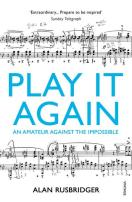 Play It Again, An Amateur Against The Impossible, by Alan Rusbridger, is almost certainly the most well-known of the books in this niche genre. In 2010, the then editor of the Guardian newspaper, set himself an ‘almost impossible’ task: to learn, in the space of a year, Chopin’s Ballade No. 1, considered one of the most difficult pieces in the repertoire that inspires dread in many professional pianists. Written in the form of diary extracts, the book charts not only his adventures with the Ballade, a project he likens to George Mallory attempting to climb Everest “in tweed jacket and puttees”, but also an extraordinarily busy year for his newspaper (The Guardian) and the world in general: the year of the Arab Spring and the Japanese Tsunami, Wikileaks and the UK summer riots, and the phone hacking scandal and subsequent Leveson Enquiry. Despite this, somehow the author managed to find ‘twenty minutes practice a day’ – even if it meant practising in a Libyan hotel in the middle of a revolution. Much of the book is a glimpse into Alan Rusbridger’s “practice diary”, his day-to-day responses to learning the piece. For the serious amateur pianist and teacher, Rusbridger’s analysis, virtually bar-by-bar, is very informative, but you would want to have a copy of the score beside you as you read. There is also plenty of useful material on how to practice “properly” – something Rusbridger has to learn almost from scratch, with the guidance of, amongst others, eminent pianists such as Murray Perahia and Lucy Parham – and how to make the most of limited practice time. Alongside this, we also meet piano restorers and technicians to peer into the rarefied world of high class grand pianos (Steinway, Fazioli), as well as neurologists (with whom Rusbridger discusses the phenomenon of memory), piano teachers, pianists all over the world who have played or are studying the piece, other journalists, celebrities, politicians, dissenters, and Rusbridger’s friends and family.
Another aspect which comes across very clearly throughout is the pleasure of music making and its therapeutic benefits, for performer and listener, and the book is very much a hymn to this. Like the Ballade itself, the book hurtles towards its finale: will the author learn the piece, memorise, and finesse it in time for the concert….?
From Rusbridger’s elevated platform as a high profile journalist with a myriad connections, the book was an immense success when it was first published, due in no small part, one suspects, because the text will appeal as much to those with an interest in current events as it does for amateur pianists chasing a similar virtuosic feat of pianism.
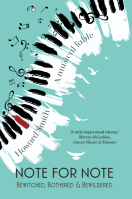 And so we come to the new kid on the block: Howard Smith’s Note For Note, Bewitched, Bothered & Bewildered. Released in 2020 at the height of the Covid-19 pandemic, Smith’s book was described by amateur pianist and performing arts clinician Marie McKavanagh as, ‘A brutally honest personal testimony of a human experience that enriches life via the intimate physical act of working with a musical instrument.’ Over thirty-eight chapters, covering a period of just three years, Smith charts his unexpected transformation from software-geek to musician or, as he points it ‘from the digital to the analogue: from the bits and bytes of the computer industry to the world of melody, harmony and musical performance’. Covering topics as diverse as lead sheets, mental performance, unblocking, the musical ‘fourth’, the circle of fifths, two-five-one progressions, modes and chord-scale theory, theory and practice is blended with what Victoria Williams of MyMusicTheory called ‘captivating story-telling’. The result is a unique memoir and simultaneously an educational text for all amateur pianists, described by educator Andrew Eales (who blogs as Pianodao) as ‘Essential reading for 2021’. However, Note For Note is not a textbook; nor is it a novel. Smith calls it a ‘musical fable’; a message as much about how not to go about learning the piano as it is a guide to best practice. The author claims that every word is true, and I have no reason to doubt him. In the song-writing chapters, for example, Smith enumerates the process of his work with his teachers in composition and lyric-writing, presenting every chord symbol and poetic line as it happened. (One day, he tells me, he will release this music.) Smith’s story (and writing) unfolds as it happened, or as he says, ‘from the theory to the practice’. Devoid of any artifice, perhaps the most surprising aspect of this book is depth of wisdom it embodies for someone who, at the time of writing, had only been playing for a couple of years. We learn that Smith is the proverbial ‘late returning’ amateur, and this reality (and his narrowing ‘window of opportunity’) weighs heavily on him at key points in the text. He returned to the piano, leaving the IT career he loved, after a ‘gap’ of forty-five years, having only achieved a modest ‘grade three’ as a child; a child engineer who found the mechanism of the piano and its ‘physics of sound’ more interesting than any disciplined ‘practice’. Note For Note is a book written by an amateur pianist for amateur pianists, especially those, like Smith, who struggle to make the transition from ‘intermediate’ to ‘advanced’. The author does eventually learn what it means to ‘be a musician’, and you believe him: concert pianist Murray McLachlan, Head of Keyboard at Chetham’s School of Music, called it a ‘A truly inspirational odyssey’. As to how the book came to be written, that must remain strictly ‘no spoilers’.
***
To summarise, each of these books charts the mystery that is our “piano journey” but do so in very different and distinctive ways. Each demands your attention, offering up a rich brew of ideas, topics and insights that will help every pianist (or teacher) at any level to advance their own art and practice.

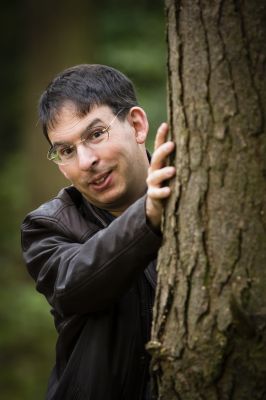




 The Cross-Eyed Pianist