Julian Lloyd Webber, acclaimed cellist and Principal of the newly rebuilt Royal Birmingham Conservatoire, on inspiration, passion and the importance of music education

JLW_green

Who or what inspired you to take up the cello and pursue a career in music?

I always loved the sound of the cello and I found it a very natural instrument to play – unlike the piano which my mother attempted to teach me. Therein lies a lesson: never learn an instrument from your parents!

Who or what have been the most significant influences on your musical life and career?

I wanted to play the cello professionally after I heard the great Russian cellist Rostropovich in concert.

What have been the greatest challenges of your career?

Every performance is a challenge.

You are a passionate advocate of music education? Why do you feel we need proper provision for music education in our schools?

Children deserve a wider education than just a few narrow subjects. They should leave school knowing a lot about the world – and that includes its culture.

As Principal of Royal Birmingham Conservatoire, how do you see this institution’s role in the context of music education in the UK and beyond, and the wider society of the city of Birmingham and the UK in general?

Birmingham is a fantastic city with a great future – soon Londoners will realise that they can have a far better lifestyle for much less cost in Birmingham. Unfortunately that will be the end of the city’s comparatively low property prices. The Royal Conservatoire will be at the heart of the city. We have five performance spaces and we will be running an extensive programme of concerts of every kind of music.

What do you consider to be the most important ideas and concepts to impart to aspiring musicians?

Keep thinking for yourself and never lose your passion for what you do.

As a musician, what is your definition of success?

Bringing music to as many people as possible.
Professor Julian Lloyd Webber is the Principal of Birmingham Conservatoire. Widely regarded as one of the finest musicians of his generation and described by Strad magazine as ‘the doyen of British cellists’, Julian Lloyd Webber has enjoyed one of the most creative and successful careers in classical music today. As founder of the British Government’s In Harmony programme and the Chair of Sistema England, he continues to promote personal and community development in some of England’s most deprived areas. He was elected Fellow of the Royal College of Music in 1994 and – in recognition of his lifelong devotion to the music of Elgar – he was elected President of the Elgar Society in 2009.

At the age of sixteen Julian Lloyd Webber won a scholarship to the Royal College of Music and he completed his studies in Geneva with the renowned cellist, Pierre Fournier. Since then he has collaborated with an extraordinary array of musicians from Lord Yehudi Menuhin, Lorin Maazel and Sir Georg Solti to Elton John and Stephane Grappelli.

Julian Lloyd Webber has premiered more than sixty works for cello and he has inspired new compositions from composers as diverse as Joaquin Rodrigo and Malcolm Arnold to Philip Glass, James MacMillan and – most recently – Eric Whitacre. His many recordings have received worldwide acclaim: his Brit-award winning Elgar Concerto conducted by Lord Menuhin was chosen as the finest ever version by BBC Music Magazine and his coupling of Britten’s Cello Symphony and Walton’s Concerto with the Academy of St Martin in the Fields conducted by Sir Neville Marriner was described by Gramophone magazine as being “beyond any rival”. He has also recorded several highly successful CDs of shorter pieces including Cello Song, Unexpected Songs and – together with Jiaxin Lloyd Webber – A Tale of Two Cellos: “It would be difficult to find better performances of this kind of repertoire anywhere on records of today or yesterday” – Gramophone.

Julian is married to fellow cellist Jiaxin Cheng. He was the London Underground’s first official busker and he was the only classical musician chosen to perform at the Closing Ceremony of Olympics 2012. In April 2014 Julian received the Incorporated Society of Musician’s annual Distinguished Musician Award.

www.julianlloydwebber.com

Guest post by Karine Hetherington

https3a2f2fcdn-evbuc-com2fimages2f335015802f1388701909992f12foriginal

We are on the eve of our performance of Purcell’s baroque opera ‘Dido and Aeneas’. We’ve been in a dress rehearsal for hours and during a short break I close my eyes, wrap a thick woollen scarf about my neck, and play dead while other members of the choir stare at their mobile phones. Am I nervous? Yes! We all are. Up until now the chorus has had the benefit of numbers. On the night however, there will be no hiding – each and every one of us has been working on this challenging opera for months!

This project is the brainchild of Laura Lamph, our mezzo-soprano, who sang the title role of Dido touring with Sestina, the early music ensemble, in Ireland last year. She, together with our exacting Music Meister, Miles Lallemant, head up our three-year-old choir, Aves Cantantes. Songbirds! We are a mish-mash of twenty individuals of different ages and levels of singing experience. But no matter how different we may appear to the outside world, inside the church we sing as one.

When Father Richard Bastable, who is directing, put it to us nine months ago that we were not only going to sing the opera but to stage it in 1980s drug-fuelled New York, I was astonished. I am not averse to challenges, however I had doubts about the project.

One particular choir practice comes to mind. It was raining heavily one September night and there was a thin turn-out of sopranos. Altos were missing their tricky entries in ‘Thanks to these lonesome vales’. Our smooth-voiced tenor went spectacularly wrong singing Belinda’s part not once but three times! Frustrated, he got up, went to the back of the church to pour himself a beaker of pinot noir. He was no doubt getting himself in character for the song ‘Come Away Fellow Sailors’ which follows. As the drunken sailor in Act three, he leads brilliantly.

The basses – well, the basses just looked a bit bemused that evening. And if that wasn’t enough, our Music Meister despairing with our enunciation and phrasing, also had a leaky church roof to contend with. Raindrops plopped into buckets around the piano, which had almost lost a leg. It was being held together with packing tape!

And then into the church bounced fresh-faced Ashley Stafford our musical director ‘number two’. We have already benefited from his singing training in previous concerts. Now his breathing, yoga-inspired exercises and infectious enthusiasm for the score did much to open up our voices and raise our spirits. With sweeping arms he carried us to the next level, allowing Miles, Music Meister one, to concentrate on the details of the score.

Just a few days ago our morale was boosted by the influx of young professionals. These are mostly post grad music students to join us older songbirds. Tall, broad-shouldered Aeneas, Edward Kay, is the perfect romantic lead with a powerful, sensitive, high baritone. His voice melds beautifully with Laura’s controlled, strong, sweet, sad mezzo-soprano. I defy anyone not to shed a tear during a rendering of a drug-induced ‘When I am laid’.

In this transposition of the classical tale of ‘Dido and Aeneas’, her enemy number one is her own self-inflicted drink and drug addiction. Our adaptation however has retained the witches, who in true Shakespeare fashion, wreak havoc and cast spells on Aeneas. Our own red-haired Bonnie O’Callaghan is excellent in her witch-like malevolence, and so is witch number two, Heidi Jost. The Sorceress played by counter-tenor, Alexander Pullinger, is equally arresting and impressive. All the soloists are strong and it is their star presence and vocal brilliance which raises our game.

So here we are with just one day to go. The strings are tuning up around Miles’s harpsichord. Father Richard, director, takes one last look at the New York skyline on stage and then hastily reviews his notes. The pressure is on, for him and for all the performers. We have only had two rehearsals in the magnificent gothic-style, Church of the Holy Innocents near Ravenscourt Park.

I adjust my shoulder pads just wondering whether we can pull it off. Can our amateur/professional collaboration make the impact we hope it will? Yes! I believe we’ve conjured something out of thin air and the gods are smiling on us tonight…

‘Dido & Aeneas’ by Henry Purcell is on Friday 6th October at 8pm at Holy Innocents Church, Paddenswick Road, London W6 0UB. Book tickets


Meet Laura Lamph, who sings Dido…..
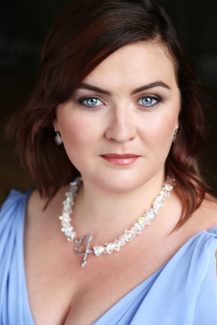
img_0860-683x1024Who or what inspired you to take up singing and pursue a career in music?

I think it must have been my competitive streak. An opportunity arose in school and I thought, I can do that (despite having never sung before) and so began my love of singing and music.

Who or what have been the most important influences on your musical life and career?

My music teacher in school, Ruth McCartney was definitely very important. As well as inspiring me to become a singer, she also taught me the importance of professionalism (I was a little bit wild back then.)

What have been the greatest challenges of your career so far?

Moving to London from Northern Ireland was certainly a challenge but it was also the best thing that I could have done for my career. I sing a lot of choral music and there really is no better place to start than London. Because I was a bit of a random Irish person I was not in the inner circle (everyone knows each other) but I managed to audition and get work and have had the opportunity to work with and meet some amazing people.

I also work abroad quite a lot which means spending a lot of time living out of a suitcase, packing has been a real challenge.

Which performance/recordings are you most proud of?

It is hard to say. When I was about 16 I sang as a soloist with my school choir on Last Night of the Proms (live from Belfast) It was viewed by millions of people but when I look back on it I was so calm and cool and just relishing every moment, I am not sure I will ever feel that again. I suppose it is the joy of youth.

More recently, I played the role of Dido last year for Sestina, the early music ensemble. I made it onto BBC Radio 3’s “ In Tune” programme to sing the Lament. This was quite scary given how many world class recordings there are of this particular piece and how many musicians listen to radio 3 but I reckon I did myself proud.

Which particular works do you think you sing best?

I am a huge fan of Bach, although I am not sure it is what I sing best yet.

I sing English song quite well, a fact that amuses some of my colleagues because of my broad Belfast accent when I talk.

I also do a pretty good Irish folk song.

As a singer, what is your definition of success?

Being able to live is definitely a realistic measure of a success and I have managed so far, although there have been a few scary moments over the years. However, I think the real success is having a job that you love and find fulfilling. It is not always glamorous but it is usually fun and when you sing amazing music with excellent musicians it makes it all worthwhile.

What do you enjoy doing most?

I really enjoy going on holiday funnily enough. I obviously like working but I love having a well-deserved break when I can actually switch off. I have realised how much the whole having a phone and internet really mean that we are rarely switched off from work!

What is your present state of mind?

I think my housemate would say stressed but I think mostly determined. I am excited about lots of things including my singing the part of Dido again for the Brook Green Festival. This time however we have transposed the baroque opera of ‘Dido and Aeneas’ to 80s Manhattan! As the festival organiser too I am anxious for it to be a success. I definitely think organising something and performing in it is quite a lot to take on!
And now meet baritone Edward Kay 

Who or what inspired you to take up singing and pursue a career in music?

I started singing as a boy at the age of seven at Clifton Lodge School in Ealing which had a very impressive choir setup at the time. I remember one day coming back home from school and announcing to my parents that I wanted to audition – nothing much more to it than that!

Who or what have been the most important influences on your musical life and career? 

Tenor Ben Johnson with whom I recently started studying.

What have been the greatest challenges of your career so far?

Changing technique in a rather drastic way in December 2016. It involved pulling out of a large amount of work and much soul-searching.

Which performance are you most proud of?

I performed ‘Abschied’ from Schubert’s Schwangengesang a week or so ago with not much notice. It is particularly tricky as you have so many words to learn….!

Which particular works do you think you sing best?

I am focussing mainly on Italian songs and arias at the moment while I concentrate on learning how to sing. Tosti writes beautiful melodies and, in my opinion, you can’t beat the antique arias like ‘Caro mio ben’ or ‘Per la gloria d’adorarvi’.

As a singer, what is your definition of success?

Being able to convey the emotions, themes and messages that composers create with their music in the most convincing manner and truly understanding how to sing.

What do you consider to be the most important ideas and concepts to impart to aspiring singers?

As an aspiring singer myself I feel uncomfortable ‘imparting’ too much but I would say that you need to have a technique that will last your entire life; you need to listen to your instincts; you need to have a core support network around you and, above all, don’t compare your own journey to anyone else’s

Where would you like to be in 10 years’ time?

Performing around the world singing a mixture of repertoire in various opera houses and concert venues and working with interesting, passionate and inspiring people. And still have time to watch the Formula 1 and the Sunday newspaper on the weekend.

What is your present state of mind?

Positive and excited about the future. Concentrating on practising and have a number of concerts coming up to look forward to. Having the chance to perform a staged work like Dido and Aeneas throws up all sorts of difficulties and with the rather limited rehearsal schedule it presents new hurdles to overcome but it is an opportunity I am relishing and am very much looking forward to the performance.

Laura Lamph sings Dido and Edward Kay sings Aeneas and in ‘Dido and Aeneas’ Friday 6th October 8pm at the Church of the Holy Innocents, Ravenscourt Park. The opera will open the Brook Green Music Festival 6th-Friday 13th October 2017


Belfast-born mezzo-soprano Laura Lamph recently moved to London and enjoys performing with various ensembles there including, Britten Sinfonia Voices, London Voices, Philharmonia Voices and Polyphony. Laura performs regularly with her accompanist Miles Lallemant (another Chamber Choir Ireland alto) in recitals in London and abroad.

As an oratorio soloist, Laura has worked with various directors including Judy Martin and David Hill; she is a featured soloist on discs directed by Eamonn Dougan, Nigel McClintock and Paul Hillier, and has appeared as a soloist on Last Night of the Proms and BBC Radio Ulster Sounds Classical.

Recent solo engagements include Rossini’s Messe Solennelle with Axminster Choral Society, Verdi’s Requiem with Dublin University Choral Society, Dvorak Mass in D and Kodály: Missa Brevis with Ealing Choral Society, and Mozart’s Requiem with Armagh City Choir.

Edward Kay sings Aeneas in ‘Dido and Aeneas’ opening the Brook Green Music Festival. He is currently studying with the tenor Ben Johnson having recently finished the Vocal Studies MA at the Royal Academy of Music.

Future performances include Bach’s Christmas Oratorio with Reading Festival Chorus, Beethoven’s Mass in C in Barnet and Handel’s Messiah with Worcester College Oxford. This August Edward was a Young Artist at the Southrepps Classical Music Festival.

itin-14

Who or what inspired you to take up the piano, and pursue a career in music?

I don’t remember myself NOT playing piano.  As I was told by my parents (non-musicians but avid music lovers) I was drawn to the piano from a very young age. I was not that interested in toys – the piano was my toy. Pursuing a career in music must have been my first teacher’s idea: Natalia Litvinova was and has been a very important influence in my life (musical and not).  My conservatory professor, Lev Naumov, remains to this very day an inspiration and a driving force for my musical endeavors.

What have been the greatest challenges of your career so far?

Can’t put challenges on the scale. Everything becomes a challenge and a reward when done with utmost dedication.

Which performance/recordings are you most proud of?

I believe they are to come. There is a light at the end of the tunnel….

Which particular works do you think you play best?

I try to play works that I play best. 

How do you make your repertoire choices from season to season?

I choose whatever fascinates me hoping my audience doesn’t mind my whims.

Do you have a favourite concert venue to perform in and why?

There are many and they change. I suspect it has nothing to do with geography.

What is your most memorable concert experience?

Once I was scheduled to perform a concerto in Santiago, Chile. At the rehearsal ( fortunately not at the performance itself) I found out that the conductor and the orchestra were playing a different version of the piece. I had to change the concerto on the spot. Will never forget that.

As a musician, what is your definition of success?

I don’t have one. I just want to do my job well.

What do you consider to be the most important ideas and concepts to impart to aspiring musicians?

To be a musician is a privilege. 

Where would you like to be in 10 years’ time?

I hope I am still around in 10 years ( roviding the world is still there as well)

What is your idea of perfect happiness?

Would not be perfect happiness if I were able to explain it.

What is your most treasured possession?

I don’t treasure my possessions. 

What do you enjoy doing most?

I enjoy non-doing most

What is your present state of mind?

Ambivalent


Ilya Itin performs sonatas in D by Schubert and Rachmaninov on Saturday 7th October, part of the London Piano Festival at King’s Place. Further information here

ilyaitin.com

Acclaimed impressionist, comic and actor Alistair McGowan shares his passion for the piano and reveals how he prepared for his debut recording.


What are you first memories of the piano?

My mother had and still has a very good Chappell upright – ‘from Corporation St in Birmingham’. She was always playing the piano when I was young. She was the accompanist at the Evesham Amateur Operatic and Dramatic Society for years and was always playing and practising the score for the latest Rodgers and Hammerstein or Gilbert and Sullivan show they did. She also played a few classical pieces which I would often ask her to play to send me to sleep. She was a fabulous sight-reader and could play almost anything. It breaks my heart that she no longer plays.

My older sister, Kay, learnt to Grade Eight and so was constantly practising. My father and I would listen to her pieces again and again and again as we tried to watch ‘Star Soccer’ in the room next door. It’s the only way to practise but it gave me a very good idea of how hard it is to live with or next door to a pianist. She didn’t touch the piano after her final exam. She is making noises about playing again after all the interest I have shown and I really hope she does go back to it. She was very good!

Did you have piano lessons as a child?

I did two years and passed two grades but stopped when I was 9. I regretted it for the rest of my life and finally took up the piano again for a couple of years in my 30s and then TV stardom got in the way. So, I have only really, finally, finally thrown myself at it again over the last 2-3 years and particularly since being involved in my debut recording project.

What kind of repertoire do you enjoy playing, and listening to? 

Nothing too ‘bangy’ and anything marked ‘lento’! Over the years, I’ve also loved piano music that I can work to and I think the album reflects that. The music is reflective and romantic, spanning everything from Bach and Field via Satie to Philip Glass. I hope it’s good to revise to, to work to, eat to and even to fall asleep to, too.

How do you make the time to practise? 

At first, it was a struggle fitting things in around other work and I had to cut a lot of things out of my life, but I began to love playing and improving so much that I soon didn’t miss reading about and watching endless football or even playing tennis. I watched less television in general with no regret and played less snooker too. I changed a few habits but have simply acquired new ones and made a lot of new friends through it too. Through it all, I kept on swimming as a wonderful release for mind and body!

Do you enjoy practising? 

I have to force myself to do scales and arpeggios and Hanon but otherwise, yes. I had some very good advice from lots of people. Fellow comic, Rainer Hersch, suggested putting a stop-watch by the music and making sure that every fifteen minutes you change your practise to a different piece or a different exercise to keep the brain active and receptive. I tried to do that. James Lisney [concert pianist and teacher at piano summer schools] is very keen on pianists getting up and stretching regularly, which is also very important (though not a good idea in a concert!). I am a little troubled with a sore right thigh and foot from all the pedalling though.

Have you participated in any masterclasses or piano courses? 

The person who got me playing again, the fabulous accompanist Lucy Colquhoun, suggested that I attend a weekend course with Paul Roberts in Sussex. I learnt a huge amount there in three days and realised above all how much I had to learn and that the learning is never done. Paul was just inspirational and in 2015 I went on his week-long piano course in France and then attended two courses in subsequent years at the delightful La Balie (in south-west France).

I also returned to Paul in 2016 for another woodsmoke-filled weekend. As well as learning from such inspirational players and teachers (James and Paul), who both have such a huge knowledge of piano history, it was great to meet other amateur pianists who shared my passion – most of whom were way ahead of where I was – all willing to play and share and talk about this fantastic repertoire that has been left to us by these amazing composers. I also performed in a number of practise concerts in Barnes with my teacher, Anthony Hewitt, and watching Anthony play live was a masterclass in itself.

What have you gained/learnt from this experience? 

Well, obviously, how much I enjoy playing the piano, but also the importance of goals and patience. I’ve gained even more respect for professional pianists and feel I’ve enriched my life and my soul. I have been a little surprised by how much I have enjoyed regularly turning my back on the modern world.

As an adult amateur pianist, what are the special challenges of preparing for a performance? 

Believing that the sound you are about to make is worth listening to. Believing that you know the music and not letting the occasion distract you from listening to the sound you are making with every note. I had moments of being very focused (reading ‘The Inner Game of Tennis’ was a big help), but often heard myself saying ‘What on earth do you think you’re doing?” If you can keep that voice out of your head, you will generally be fine!

How did you prepare the pieces featured on your new disc? 

I worked very hard, bringing each of them to the boil in turn. I did a lot of note-bashing on the electric piano at home but there is no substitute for a real piano for the touch. I was lucky enough to have some sessions in St Mary’s Church in Barnes on their excellent Steinway, which got me used to the touch and sound of the best big pianos. I also went to listen to a good few pianists in concert and learnt a lot from hearing James Lisney, Lucy Parham, Viv McLean and, of course, Anthony Hewitt.

I also listened to and registered recordings of the pieces I was playing – to get to know them intimately – on trains and even, especially, peacefully, in bed.

And how did you find the experience of recording the music?

It was like a lesson, an exam, a recital and the greatest pleasure all at the same time – immensely draining and yet utterly thrilling to hear the music I had learnt and loved coming out of the best pianos in the world !

It was also terrifying knowing that this was the one chance to get each piece recorded. I read a wonderful book called ‘Piano Notes’ by Charles Rosen which has a very helpful chapter on the challenge of recording and refers especially to the need to not to worry about mistakes. They can be covered. My teacher/mentor, Anthony Hewitt, was wonderfully helpful at and about the recordings. My producer, Chris Hazel, was unbelievably supportive, helpful and strict!

I had to pinch myself after each recording. I couldn’t believe what I was being allowed to do. I had been to drama school at The Guildhall and worked at The Barbican Centre tearing tickets as a student. So, to be recording in St Giles Cripplegate, just opposite these two important buildings in my life, felt like some sort of karma. And after the eight-hour sessions, I felt like some sort of korma!

What was your motivation for making the disc?

It was principally the challenge of seeing if I could get to a level somewhere near good enough that people would want to listen to the music I was playing. We all need an incentive and knowing that my playing was potentially going to heard by thousands was a real carrot.

I also hope that the album encourages people to play by showing them the beauty of some well-known and some much lesser-known pieces. I have often felt that virtuoso playing (impressive as it is) can just as easily put people off playing as it can inspire them. I know I heard myself say for many years, “Well, I could never play Rachmaninov’s Third Piano Concerto like that so, what’s the point…?” I really, above all, hope that people who hear the album will say, “I think I could play that” and do so

What advice would you give to other adults who are considering taking up the piano or resuming piano lessons? 

Do it! It has brought me so much pleasure. There are moments of frustration, of course, but, with patience and a lot of hard work, it is just wonderful to be able to play pieces that you’ve loved listening to all your life. I think learning how to learn is as important as learning how to play ; it’s important to get the most from your playing time. Setting goals is also important. Perhaps organise small recitals at home, before friends, in order to give yourself a deadline.

If you could play one piece, what would it be? 

Ah! That changes all the time as I hear more and more piano music that I want to play and as I am improving. Currently, I am in love with Madeleine Dring’s ‘Blue Air’ but find even the opening few bars very challenging. It’s a wonderful evocation of ‘cool’ and sounds like a theme from any 1960s Michael Caine film. It’s unlike anything else I play. I also have an eye on Debussy’s ‘Ballade’ – but that’s a good few years away, I fear !

‘Alistair McGowan – The Piano Album’ is available now on the Sony Classical label and is the impressionist’s debut album


Further reading

Review of Alistair McGowan – The Piano Album

Why go on a piano course?

Courses for pianists

(Photo: usefulvoices.com)

Please do not reproduce this article without prior permission from the author of this blog

©Frances Wilson 2017


