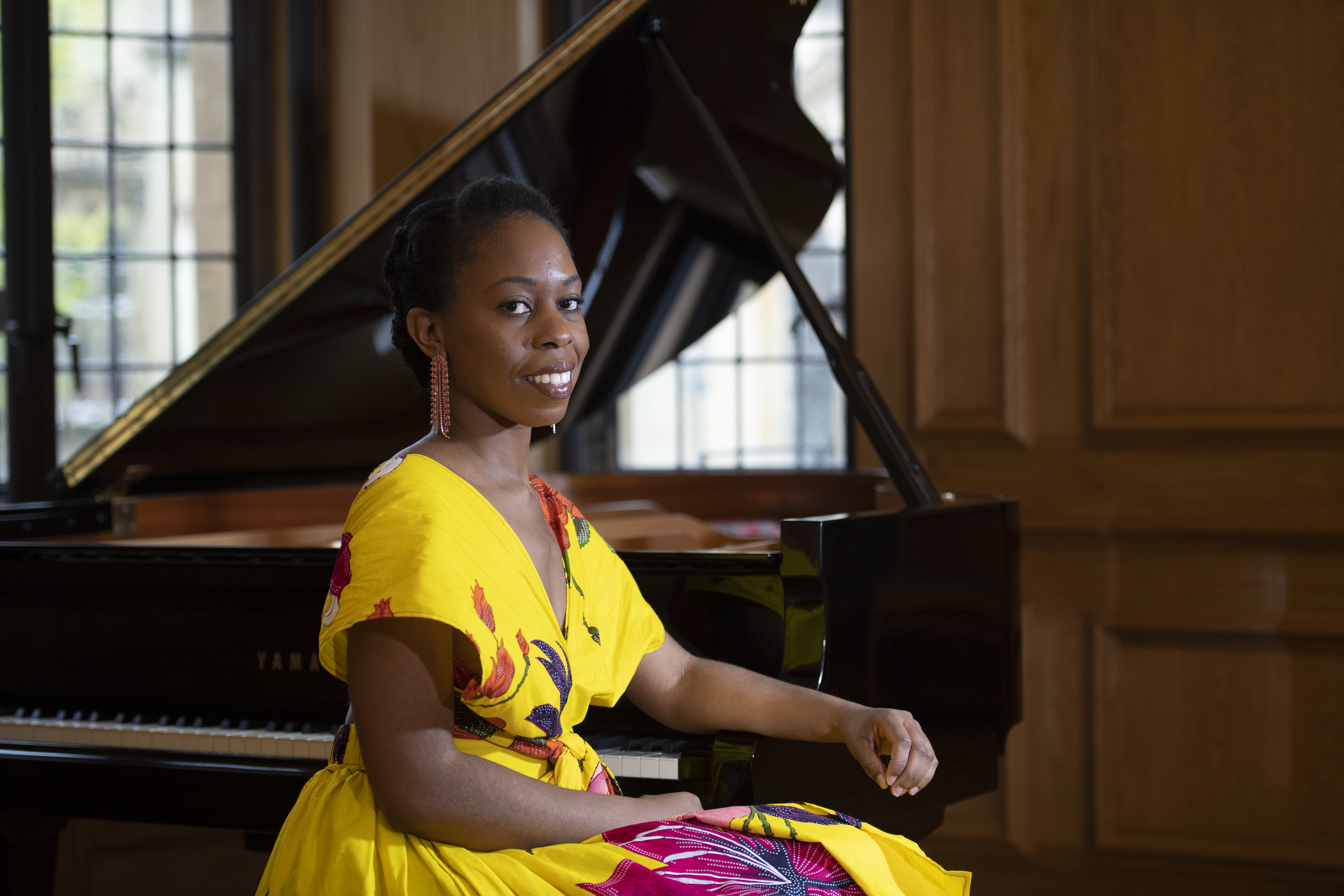
Guest post by Samantha Ege

As a student, I loved thumbing through the pages of a piano collection, whether in a music store, charity shop, or library. Each score was its own rabbit hole. The more obscure, the better. “What else is out there?” I would wonder.

Losing track of time in a music shop feels rather nostalgic now, especially as most scores can be found online. But as a musicologist who spends time with handwritten manuscripts, I still cherish that gorgeously tactile experience. In those moments, I am transported to the feeling of endless curiosity that shaped my early path.

CDs, also an increasingly nostalgic medium, were part of my journey too.

I remember, just before I went to study music at the University of Bristol in 2008, my piano teacher gave me a CD called Kaleidoscope (2001), by the Canadian pianist Marc-André Hamelin. I saw a few familiar names on the track list: Rachmaninoff, Poulenc, and Kapustin. But many others were a revelation. My favourite was Arthur Lourié’s “Gigue.” I was swept up in its thunderous rhythms and harmonic whirlwinds. In fact, I ordered the score from a local music shop in Bristol not long after I arrived.

During my second year, I went to McGill University in Montreal (coincidentally the city where Hamelin was born). In my professor’s Early Twentieth-Century Music class, I encountered a second Kaleidoscope CD. The performer on this 1995 recording was yet another Canadian pianist with a penchant for the obscure: Helen Walker-Hill.

Walker-Hill was also a musicologist. She bridged her pianistic prowess with an interest in classical music’s hidden histories. Her former husband was the Pulitzer Prize-winning composer George Walker. Their son, violinist Gregory T. S. Walker, joined her on parts of Kaleidoscope. The album’s subtitle was “Music by African-American Women” and Florence Price’s Fantasie Nègre in E minor for solo piano (composed in 1929) was the final track.

Both Hamelin’s and Walker-Hill’s Kaleidoscope shaped the patterns of my own work as a musicologist and pianist. As a student, it was not enough for me to hear the music of Lourié without tracking down the score. Similarly, as soon as I heard the Chopin-esque cascades and Negro spiritual influence of Price’s Fantasie, I had to know more.

Today, Price’s story as the most celebrated African American female symphonist of the 1930s and 40s is part of the classical mainstream. This knowledge stems from many efforts over many years to bring her legacy to the fore, including those of Walker-Hill (who died in 2013), and those of the late musicologist and organist Rae Linda Brown (who passed away in 2017). The culmination of Brown’s work – a biography titled The Heart of a Woman: The Life and Music of Florence B. Price – was published three years after her death.

A few months before Brown’s passing, I emailed her to share that I was writing an MA thesis on Price at the University of York (which became my PhD dissertation). Brown encouraged me to visit Price’s archives at the University of Arkansas. In fact, Brown’s warm response arrived when I was already there.

Throughout my archival work, two things captivated me: first, Price had composed a total of four Fantasies Nègres for solo piano, meaning there was more music out there. Second, she was far from an anomaly as a classical composer of African descent.

Regarding the first, the thought of presenting Price’s Fantasies in their entirety took me back to my love of diving into a body of works, like Brahms’ late piano opuses, Albeniz’s Iberia, and Debussy’s Estampes (all favourites of mine as a student). There was something about the heft of a complete collection, which defines so many of our great composers, that I wanted to create with Price. After all, Price viewed her Four Fantasies as a collection. The spiritual beauty of Fantasie Nègre No. 1 in E minor, the Brahmsian introspection of Fantasie Nègre No. 2 in G minor, the velvet colourings of Fantasie Nègre No. 3 in F minor, and the impassioned virtuosity of Fantasie Nègre No. 4 in B minor were all connected.

When I returned to Price’s archives in 2019 to focus on the Fantasies, it became clear that No. 3 wouldinvolve some detective work. The first two pages were all I could find. I therefore had to look for loose sheets of manuscript with similar musical characteristics to complete the score.

Additionally, I noticed that the original version of Fantasie Nègre No. 4 was twice as long and a million times more complex than the five-minute version G. Schirmer had recently published. Price likely shortened and simplified it because short and simple works by women were more marketable in the 1930s. But in the 21st century, it was time to hear what she was truly capable of.

As for the second realisation, I’d always found the notion of a compositional school intriguing, from the First and Second Viennese Schools to The Five and Les Six. Well, Price belonged to an era of cultural rebirth known as the Black (or Negro) Renaissance. What’s more, women were far from minor footnotes. Alongside composers Margaret Bonds, Nora Holt, Betty Jackson King, the Canadian Robert Nathaniel Dett, and England’s Samuel Coleridge-Taylor (who mentored many Black Renaissance composers), Price believed in classical music’s power to generate social harmony.

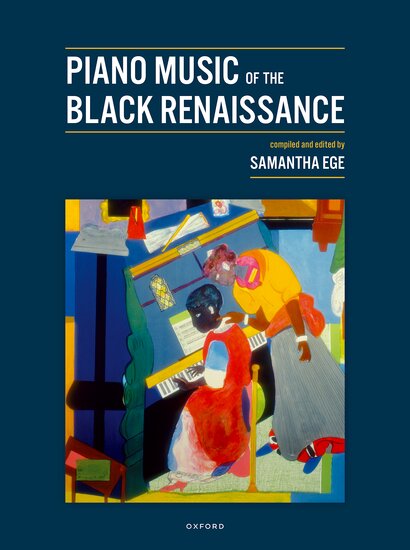
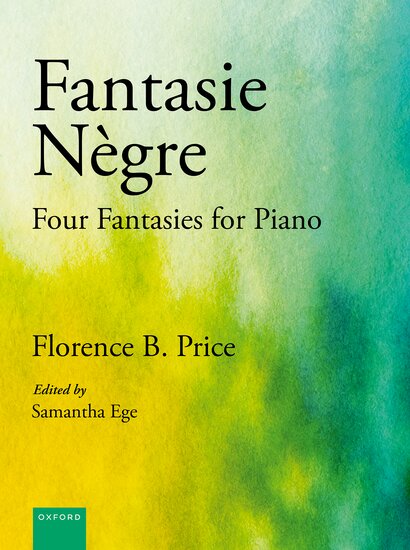
My new sheet music publications – Fantasie Nègre: Four Fantasies by Florence B. Price and Piano Music of the Black Renaissance – celebrate this history. They also carry the imprint of my own prismatic influences, from Hamelin’s adventurous programming to Walker-Hill’s and Brown’s scholarly spotlight on classical music’s “hidden figures.”

I would have loved to stumble across these volumes as a student. But as I look ahead, regardless of whether pianists engage with the physical scores or digital downloads, I am excited for the kaleidoscopic journeys these editions will inspire as curious fingers descend upon the keys.


Samantha Ege is a musicologist, pianist, and author.

www.samanthaege.com

Guest post by Frances Jones

In the days before self-service machines, when library books were issued by hand and date-stamped, I would feel sorry when I opened a book to see it last stamped more than a decade before. I thought of the volume standing slightly lop-sided on the shelf, waiting for a person to stop and take it home. I’ve been feeling a similar way recently, as I take down off my shelf music that I haven’t looked at for years. One such collection is Francis Poulenc’s Three Novelettes, speckled with a scattering of pencil markings and an old PIN for a bank card. So last year I sat down and learned the first of the Novelettes, playing it in an informal concert for my students (they are very forgiving of my significant lapse in regular practice).

Even as I discover more of Poulenc’s piano music, Novelette No. 1 remains one of my favourite works by this French composer. Written in 1927, when Poulenc was about 28, it’s a joyful piece and full of character. The opening melody is serenely beautiful, and it always gives me a sense of calm. Enjoy this for its own sake, it’s saying; just listen, and stop rushing around. It floats over an arpeggiated bassline in C major and although there are discords, they are so subtle as to pass almost unnoticed. There’s then a minor section, where the discordancy becomes more obvious, but it’s over with quickly and after a lyrical passage we’re into a bawdy dance; I can just imagine drinkers stomping round the bar in days gone by. A reflective passage follows and we head away from the party back into the peaceful serenity of the opening theme, with the thick chords near the end sounding bell-like in their brightness.

Novelette No. 2 is, on first hearing, very different. It brings to mind, for me, a company of elves, cavorting around a woodland fire. The upbeat tempo, staccato articulation and use of the piano’s range helps conjure up this image. The melody is so dance-like, but light and quick, suggesting something other than even the most agile of human dancers. Introduced to this revelry is a stately tune that threatens to calm the festivities, but it lasts merely a few bars before tumbling down and jostling with the opening pixie theme, eventually succumbing in a ff glissando. The opening music returns, and the elves dance away into the night, sans relentir.

There is a third Novelette, which was written many years later, in 1959. For me, it feels like a separate piece; it’s based on a theme by Manuel de Falla, and is beautiful, yes, but also nostalgic and reflective with a tinge of melancholy. To me, it’s another example of Poulenc seeming to make the task of composition so easy. The melody soars above the bass and then appears in the middle of the piano before flying up again and ending at peace, or so I like to think.

I was introduced to Poulenc’s music through the ABRSM; Improvisation No 13 by Francis Poulenc was on the Grade 8 piano list around the turn of the millennium and I still have the collection. Written in 1958, this Improvisation is wistful and yearning; a composer looking back, perhaps. Poulenc had a playful nature, but there was a deeply serious side to his character, which is evident in so much of his work (his piano pieces are just a small part of his output). Poulenc’s writing is so expressive, and although there’s a melancholy air scattered across his piano music, somehow I always find it uplifting (with the possible exception of Mélancolie itself, written in 1945). It’s the ability to seemingly pluck a melody out of the air that I love; his writing is both graceful and perfectly formed, and with bursts of humour that show a different side of his personality.

Replaying the Novelettes has spurred me on to find more of Poulenc’s piano music. I love the first Nocturne but haven’t looked properly at the other seven, nor learnt the Impromptus. Despite the fact that attempting any of the above will be a challenge, I can’t wait.

Frances Jones read music at York University followed by a PGCE at Cambridge. She teaches piano in SW London.
Nine Piano Pieces for the Right Hand Alone for advanced pianists by Béla Hartmann

In piano literature, works for the left hand alone have a more familiar history – often born of necessity after injury. Paul Wittgenstein, for example, famously commissioned left-hand concertos from Ravel and Hindemith. Perhaps the most famous music for left hand alone, apart from Ravel’s concerto, is Scriabin’s Prelude and Nocturne for the Left Hand, Op. 9

In his new book, pianist and pedagogue Béla Hartmann places the focus on the right hand, explaining that it “has had very little time spent on it, probably because it enjoys the bulk of our attention in normal piano music. It is certainly true that amongst pianists it is the right hand that must often take a sabbatical or retire completely due to overuse, misuse or pure bad luck, thereby leaving the left hand to keep the show going on by itself. However, the left hand suffers its fair share of injuries and it would seem a shame to neglect those occasions where the right hand may need or deserve to take a solo role.”

Hartmann himself suffered an injury to his left hand, which prompted him to explore create new music for those in need of some right handed challenges.

‘All Right’, a collection of nine piano pieces for the right hand alone, serves both a practical and artistic purpose: it fills a gap in the repertoire and challenges pianists to think differently about technical and expressive possibilities. This suite of nine miniatures is arranged in approximate order of difficulty – Consolation; Chase; Valse Fugitive; Menuet; March; Elegy; Song of the Thief; Etude; Prelude – and each piece has a distinct character, with widely varying styles. For example there’s a classical minuet and trio, a romantic virtuoso showpiece, elegiac moments, and more playful or introspective pieces.

Each piece cleverly balances technical demands with virtuosity and expression, making this music both instructive and enjoyable to play. Often, the right hand is both soloist and accompanist, and the fact that one hand is playing isn’t always obvious – or always foregrounded. Some pieces are energetic (Prelude, Chase), requiring nimble fingers and agility. Others test other techniques such as pedalling (Consolation) where notes in the lower register must be sustained below a chordal motif in the treble (itself a test in legato chord playing). Valse Fugitive, meanwhile, has contrasting articulation in the treble and bass, while other pieces require spread notes/arpeggiation and large leaps.

These pieces are far more than technical exercises. In fact, in their structure and style, they owe something to Chopin’s Études in that they offer the pianist attractive, imaginative and well-crafted music which also tests various pianistic skills. They offer real musical content for both student and teacher, which is rich, varied and emotionally engaging, and could also serve in therapeutic or adaptive contexts, for example, when a pianist’s left hand is injured or needs rest.

‘All Right’ is available from Good Music Publishing where you can view sample pages, listen to audio examples and order the music.


This site is free to access and advert-free, and takes many hours each month to compile and edit. If you find value and joy in this site, please consider making a donation to support its continuance:

The impulse to complete an unfinished work by a composer such as Schubert arises from a blend of artistic curiosity, historical empathy and creative challenge. For many musicians and scholars, an incomplete score feels like a fragment of a larger, untold story – and one that invites further exploration. Incomplete music, such as Schubert’s Unfinished Symphony or the Sonata in F-sharp minor, D571, give tantalising glimpses of musical ideas that may reach to something beyond their surviving pages. To engage with them is to enter a conversation with Schubert’s imagination: reconstructing, interpreting and attempting to extend his thoughts with respect and insight.

Scholars and musicians often study sketches, harmonic trajectories and stylistic patterns to infer how the composer might have continued. For some, this process is an act of homage – an attempt to illuminate what time or circumstance denied completion. For others, it’s an opportunity to test one’s own understanding of the composer’s musical voice and logic, a kind of creative empathy that bridges scholarship and performance.

In the first instalment of his complete recording of Schubert’s piano sonatas, German pianist Martin Helmchen offers his completion of the fragmentary Sonata in F-sharp minor, D571.

Only the first movement of this work exists, and that was abandoned by the composer before it was completed. This is not the first time someone has attempted to complete this unfinished work: pianists including Paul Badura-Skoda, Malcolm Bilson, and Martino Tirimo have sought to realise Schubert’s assumed intentions, drawing hypothetical completions of the music from such separately published pieces as the piece (usually assumed to be an Andante) in A major, D604, and the Allegro vivace in D major and Allegro in F-sharp minor, D570. The question that this sonata poses – and indeed the other fragmentary sonatas by Schubert – is did Schubert stop composing simply because he ran out of time or inclination, or did not have enough money to buy music manuscript paper? But incomplete doesn’t mean insignificant, and Helmchen, clearly appreciating the significance of the fragment of D571 (it is, after all, a very beautiful piece of music), has completed these movements with great care and understanding, inspired by the recordings and the analyses of Paul Badura-Skoda.

On this recording, we now have a complete Sonata D571, scored in four movements, its wistful, almost surreal opening movement – completed by Helmchen – giving way to an elegant, lyrical Andante, a suitably playful Scherzo, and a dramatic rondo finale, also completed by Helmchen, which feels “wholly Schubert” with its shifting harmonies, contrasting textures and moods, and a radiant middle section which briefly recalls the opening movement in its poignancy. The overall result of this completion is convincing rather than speculative, – ‘proper’ music by a musician –  due in no small part to Helmchen’s affinity with the music of Schubert in general (listen to the rest of the disc for a full appreciation of Helmchen’s sensitive Schubert playing). He plays with great maturity, alert to Schubert’s shifting soundworld and innate intimacy, even in the more extrovert movements or passages, and his natural pacing, supple phrasing and clear tone never get in the way of the music. This release, recorded on a modern Bösendorfer 280, with an alluring singing tone, is the first in a series of recordings by Martin Helmchen to mark the 200th anniversary of Schubert’s death in 2028.

Martin Helmchen’s Schubert Sonatas Volume 1 is released on the Alpha Classics label on CD and streaming

Header image: Facsimile of the autograph manuscript of Schubert’s Sonata in G major D894 (British Library)