
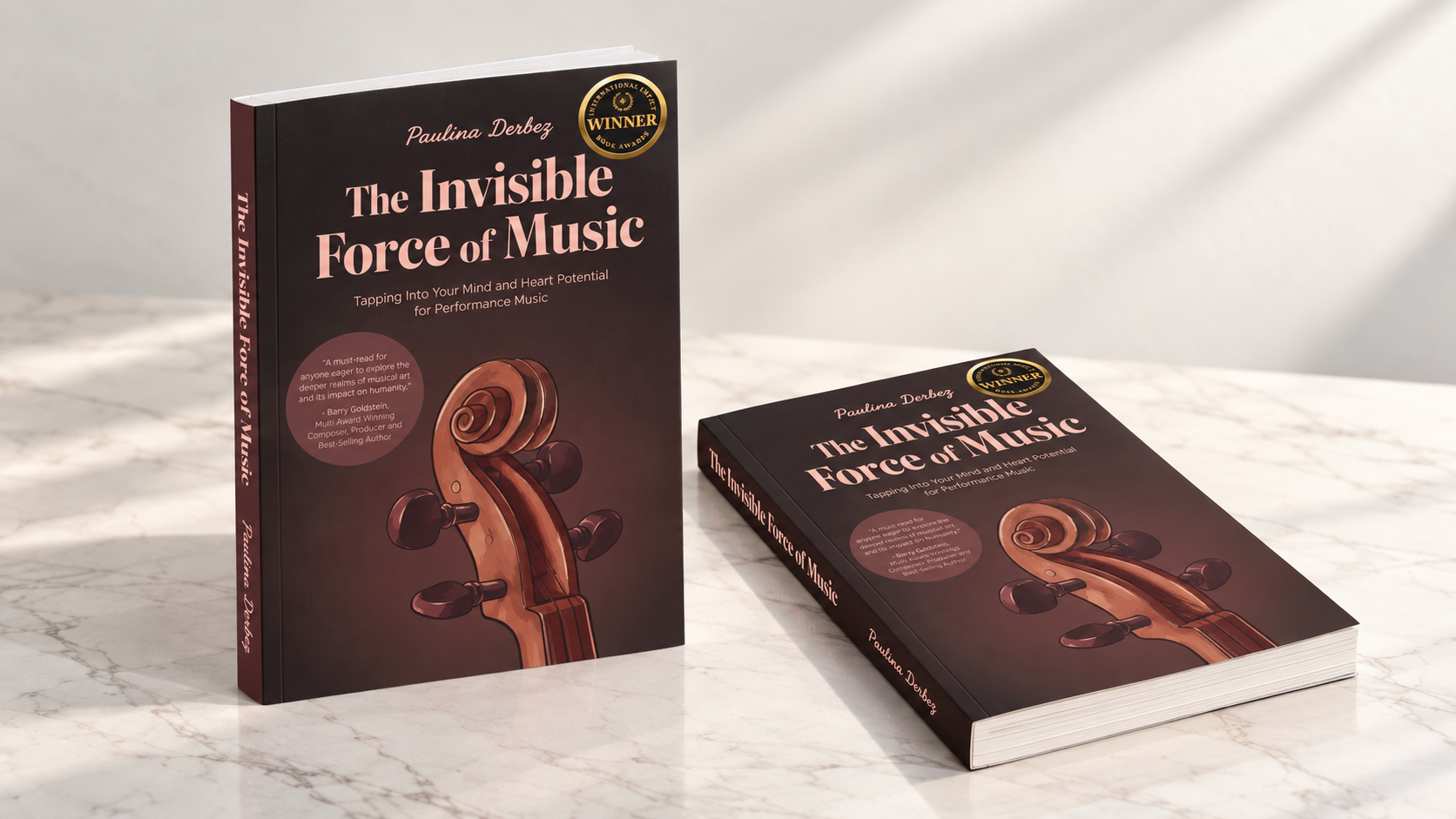
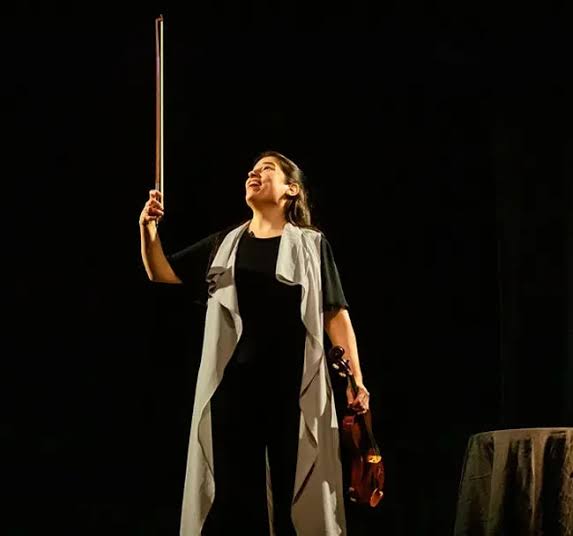
Paulina Derbez is the author of The Invisible Force of Music
What prompted you to write The Invisible Force of Music, and what do you mean by the “invisible force” in the title?
My first book, The Conscious Musician (El Músico Consciente), was published in 2013. Until then, I had worked exclusively with children. However, beginning in 2015, I started working with post-secondary students and I witnessed the significant impact that The Conscious Musician methodology had on their daily practice and stage performance. With each student, I began to notice a change in their relationship with their instrument and with music. Their physical and mental tension began to decrease, making their daily practice more effective and enjoyable and their on-stage performance more liberating. Because of this discovery, in 2017 I decided to pursue a master’s degree in music pedagogy at the Escola Superior de Música in Barcelona. In 2020, I felt the need to write a new book in which I could share The Conscious Musician methodology and its impact on post-secondary students, as well as its psychological and pedagogical foundations.
I firmly believe that music arises from an invisible force that extends beyond our senses. To truly transform the way we perceive the world of sound, I believe it is important for us as artists to connect with that force and to see ourselves as channels through which music can fulfill its mission: to touch the listener’s heart. In this way, a concert can transcend mere entertainment to become an experience of transformation for both the performer and the audience. This is why I believe it is essential to create harmony between our musical intentions, our conscious emotions, and our bodily awareness in every practice session and every performance. In this way we can connect with that invisible force in every music practice and every onstage performance.
You argue for a balance between mind, body, and emotion in music-making. Why do you think these elements have sometimes been neglected in traditional musical training?
Throughout my career as a teacher, I have noticed that the behaviorist teaching philosophy still prevails in music pedagogy. In other words, teachers simply tell students what they should correct without taking the students’ capacity for reflection and metacognition into account. Teachers often think of their students as mere receptacles of information. More generally, there is a tendency to focus on correcting every problem at a purely technical level, without recognizing that each student is an integrated person with metacognitive, expressive, and bodily capacities. The failure to address the whole student can result in physical tension, performance anxiety, and a debilitating fear of making mistakes.
Another issue is the belief that we must practice repetitively for hours every day to achieve results, repeating the same problem passage until it is resolved. The trouble is that repeating a problem passage without understanding why we are struggling with it often leads to frustration and tension. This is what I call mechanical repetition, which rarely produces satisfactory results.
The Conscious Musician methodology emerged directly out of my own experience as a student of teachers who relied exclusively on a behaviourist approach. I felt the need to seek new approaches that would allow me to use my full mental, emotional, and physical potential to support healthy, effective practices and stage performances. Teachers need to guide each student to address any musical or technical challenge first at the mental level, to consciously identify the emotions they wish to express, and to regard the body as the foundation of effective, solid instrumental technique. The goal should be to help students become their own best teachers at home, and to abandon mechanical repetition in favour of conscious repetition that can achieve truly satisfying results.
Many musicians are taught from an early age to regard nervousness or performance anxiety as something to overcome or suppress. Do you think we need to change the way we understand those feelings?
Yes. I am convinced that the way performance anxiety is understood in music education needs to change. This phenomenon is often considered natural, and performers are expected simply to accept it and go onstage with the physical and mental sensations of fear associated with playing in front of an audience, as though these feelings were normal. However, this is beginning to change thanks to scientific research conducted in Spain, as well as initiatives such as the Performance Science department at the Royal College of Music in London, Healthy Conservatoires UK, and the Ibero-American Network of Healthy Conservatoires.
In Spain, one study found that performance anxiety among music students is one of the biggest challenges this population faces in their daily practice. Research into this issue in Spanish music education has received limited attention from the research community. In a sample of 479 students enrolled in post-secondary music programs at Spanish institutions, approximately 39% reported anxiety levels above the theoretical mean, according to a questionnaire specifically designed to assess performance anxiety in musicians. This suggests that pedagogical reflection is needed to implement appropriate curricular training plans aimed at reducing rates of performance anxiety (Zarza, F. J., Casanova, Ó. & Orejudo, 2016)
Rather than normalising performance anxiety, we should acknowledge that it is a problem and propose healthier, more effective ways of taking the stage. It is worth noting that this anxiety does not arise solely from our relationship with the stage but also stems from how we practice every day and from our relationship with our instrument. That is why it is important for musicians to conceive of ourselves as athletes: we should prepare our bodies before every practice, use strategies such as motor imagery rehearsal that enable us to use our metacognitive skills to address challenges, and consciously experience the emotions we want to convey. To achieve this, it is important to create coherence in our heart-rate variability through specific techniques such as heart-focused breathing. Another particularly powerful principle is to visualise our musical performance in detail 15 days before a concert, imagining exactly how we want to play and feel that day.
You write about discovering one’s “true artistic self.” What does that mean to you, and how can a musician develop an individual artistic identity without becoming overly self-conscious?
Within The Conscious Musician methodology, becoming your true artistic self means using your own metacognitive, emotional and bodily capacities so that daily practice becomes an enjoyable process. It also means expressing your artistic message freely and powerfully onstage. This can be achieved by engaging in the self-reflection and visualisation techniques that form part of this methodology. Through the kind of focus that comes from rigorous application of the method, students can begin to engage organically and naturally with their artistic selves, without overthinking it or being excessively self-conscious about it.
Your book combines scientific research with ideas about intuition, emotion, and the more mysterious or transcendent qualities of music. How do you reconcile those different ways of understanding musical experience?
Music is an art and a science, and we need to understand both these dimensions to truly appreciate it. This is precisely one of the objectives of The Conscious Musician methodology: to find a balance between an understanding of the mysterious power of music and the application of the scientific research that can help us develop healthy and enjoyable approaches to performance. We need to ourselves as mediums through which the true power of music can be expressed onstage. For this reason, it is important to take a holistic approach, integrating the technical and the creative, to create harmony between mind, heart, and body.
You introduce the idea of the “coherent concert,” in which the performer creates a deeper connection with the audience. What distinguishes this from simply giving a technically accomplished and expressive performance?
In addition to holding a master’s degree in pedagogy, I have a mentor certification from the HeartMath Institute, which for the past 30 years has been studying the concept of heart intelligence and its impact on our physiology and on others. It has been scientifically demonstrated that our heart-rate variability emits an electromagnetic field that affects the heart-rate variability of the people around us.
The term “coherent concert” refers to a process in which the performer, beyond preparing rigorously for a concert, practises techniques that can help achieve heart coherence. In other words, the performer establishes coherence within themselves in order to radiate that signal to the audience. This is a technique known as the heart lock-in. The performer practises it before going onstage through heart-focused breathing. Once the performer has established heart coherence within themselves, they consciously radiate these coherent waves out to the audience the moment they step onstage. So a coherent concert goes beyond technical quality and expressiveness, as it involves the establishment of a true harmonious connection with the audience that can result in a greater appreciation of the performance.
Do you think the culture of classical music – with its emphasis on accuracy, competition, and comparison – can sometimes prevent musicians from experiencing the very qualities of freedom and connection that drew them to music in the first place?
Absolutely. Music competitions are all about determining winners and losers, which has nothing to do with the positive, all-embracing power of music. Comparing ourselves with others can lead to feelings of inferiority and fear. Over time, these emotions affect not only our physiology but also our mental health. As a result, we may lose our love for our art and the joy we once felt when we began this artistic journey.
It is very important to distinguish the purpose of competitions, which don’t really have much to do with music, from our true mission as artists of sound. Each one of us is unique, with special talents that emerge out of the deepest part of our being. For me, what really matters is to feel that passion for music and to feel that we can convey it freely onstage. I see this in my students when they complete The Conscious Musician academic program. They move from a mindset of comparing themselves with others to simply being themselves onstage and enjoying every musical performance.
If a musician reading your book were to change just one aspect of the way they practice or prepare for performance, what would you most like that change to be?
Their belief system. That is where real change begins. Once a musician examines their own belief system and puts into writing how they see their true artistic self, a change begins to happen. This is a process that necessarily involves developing new daily practice habits. It requires rigorous discipline: applying the teaching principles presented in the book every day and keeping alert so as not to fall back into old habits that prevent us from connecting with the music. We need to embrace a new attitude towards music that engages our genuine metacognitive, expressive, and bodily capacities. I would like readers to take away the idea that they are true creators every time they practice their instrument; they are their own Michelangelo, creating wonderful art onstage.
The Invisible Force of Music by Paulina Derbez addresses the implicit need for a transformation of music teaching with an impact on performing on stage. At the same time, it places an emphasis on the invisible force that lives and breathes in music, proposing a new way of releasing that power in a live performance. In this way, music is not merely a form of entertainment but an opportunity for transformation. Find out more
Discover more from The Cross-Eyed Pianist
Subscribe to get the latest posts sent to your email.



