I first discovered this wonderful set of variations through a concert pianist friend, who performed them in a salon concert some years ago. As a lifetime lover of Schubert’s music, I was struck by how “Schubertian” this music is, especially in the minor key variations, where Haydn finds great emotional depth and expression.

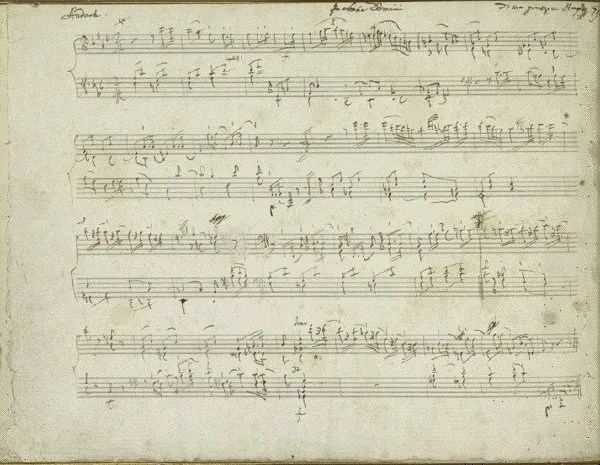
The piece was composed in 1793, and was described as a Sonata ‘Un piccolo divertimento’ in the autograph manuscript, written for a “Signora de Ployer” (probably the pianist Barbara Ployer, for whom Mozart composed the piano concertos K449 and K453). It was written at a time when the pianoforte was developing fast – Haydn would have encountered the new Broadwood piano with its more sonorous bass on his visits to London – and this piece really capitalises on the range and sonority of these bigger, stronger instruments.

Autograph ms of f minor variations

The piece is a set of double variations, with the first theme in melancholy f minor and the second in warm F major. Two variations of each theme and an extended coda follow. While the music may look forward to Schubert’s lyricism and expressivity in its minor key episodes, it is also replete with Haydn’s characteristic wit achieved through articulation, dramatic pauses and embellishments, while his mastery of structure, harmonic innovation, and thematic development is evident throughout.

Haydn achieves a very effective and dramatic operatic dialogue as the music seamlessly transitions between passages of stark intensity and moments of delicate lyricism. For instance, the first variation introduces a more agitated character, with rapid figurations and abrupt dynamic shifts that inject a sense of urgency into the music. In contrast, the following variation may offer a more introspective mood, with subdued dynamics and lyrical embellishments suggesting a more intimate realm of expression.

Despite the relatively constrained harmonic palette, Haydn manages to infuse each variation with harmonic surprises and innovations that keep the player and listener engaged. Whether through unexpected modulations, chromaticism, or clever reinterpretations of harmonic progressions, Haydn demonstrates his ability to push the boundaries of tonal expression within the classical style. The result is a captivating, multi-faceted musical journey.

For the pianist, the music demands a high level of technical proficiency, particularly in terms of finger dexterity and agility. The variations encompass a wide range of technical challenges including rapid passagework and intricate ornamentation which require great precision. Minimal use of the pedal will ensure these passages retain their clarity. The music also requires sensitive dynamic shading to create contrast – from the softest pianissimo to dramatic fortissimo. A keen sense of the overall architecture of the piece will enable the player to balance the main themes with the diversity of the individual variations. Overall, this piece is very satisfying to play and its richness and complexity offers plenty of scope for expression.

Here is Alfred Brendel


This site is free to access and ad-free, and takes many hours to research, write, and maintain. If you find joy and value in what I do, why not

Audiences love this music and playing it is a fascinating challenge

JAMES LISNEY pianist

The music of Fryderyk Chopin has been central to British pianist James Lisney’s repertoire since his Wigmore Hall debut in 1986.

This autumn he is touring some of Chopin’s most beloved piano music, including the Four Ballades and selected Nocturnes, with concerts in Prague, Belgium, the Netherlands, and France. The UK leg begins on 27 September, and includes major venues such as Bradshall Hall at Birmingham Conservatoire and the Stoller Hall in Manchester, and more intimate venues including London’s 1901 Arts Club. Those who cannot attend in person can enjoy a livestream of the programme from St George’s Bristol on 27 November. Full details here

In this podcast, James talks about the challenges and pleasures of playing Chopin, in particular the Ballades, concert preparation, and inspiring amateur pianists….


This site takes many hours each month to maintian and update. If you find value and pleasure in what I do, why not

Olivier Messiaen is widely regarded as one of the most important composers of the 20th century, known for his unique approach to harmony, rhythm, and melody. His music is challenging for any performer, requiring not only technical skill, but also a deep understanding of his unique musical language. The pianists presented here demonstrate a remarkable ability to capture the essence of Messiaen’s music, bringing out its intricate harmonies, colours, textures and rhythms, as well as its emotional depth. Yvonne Loriod Messiaen’s student, muse and second wife, Yvonne Loriod was a highly accomplished pianist in her own right. Many of his piano works were written with her in mind. The Vingt regards sur l’Enfant-Jésus (“Twenty Contemplations on the Infant Jesus”) were dedicated to Loriod, and she premiered the work at the Salle Gaveau in Paris in March 1945. Loriod’s playing is known for its clarity and precision, as well as her ability to capture the essence of Messiaen’s unique style. She recorded several albums of Messiaen’s piano music, including the complete set of Preludes and the Catalogue d’Oiseaux.
Pierre-Laurent Aimard French pianist Pierre-Laurent Aimard is widely recognized as one of the foremost interpreters of Messiaen’s music. Aimard’s connection to Messiaen’s work runs deep, as he was a student of the composer and worked closely with him and his wife Yvonne Loriod. Aimard’s recordings of Messiaen’s piano music are considered some of the most authoritative, and he has performed Messiaen’s works all over the world to critical acclaim.
Angela Hewitt Canadian pianist Angela Hewitt is perhaps best known for her interpretations of Baroque and Classical music, but she has also made a name for herself in more contemporary repertoire, including Messiaen’s piano music. Her recordings of Messiaen’s music are admired for their technical precision and attention to detail, as well as her ability to bring out the emotional depth of the music. Steven Osborne Scottish pianist Steven Osborne has performed Messiaen’s music all over the world, including the Vingt regards and Turangâlila Symphonie. Osborne expertly navigates the intricate harmonies and rhythms in Messiaen’s music with ease, bringing out the complex textures and polyrhythms that are hallmarks of the composer’s style. At the same time, he captures the emotional breadth and spiritual intensity that are crucial features of Messiaen’s music. His performances of the Vingt regards in particular are extraordinarily absorbing, meditative and moving, combining musicality, virtuosity and commitment. (I’ve heard Osborne perform this monumental work twice in London and on both occasions it has been utterly mesmerising and profoundly emotional.) Tal Walker For his debut disc, the young Israeli-Belgian pianist Tal Walker included Messiaen’s Eight Preludes. Composed in the 1920s, they are clearly influenced by Debussy with their unresolved or ambiguous, veiled harmonies and parallel chords which are used for pianistic colour and timbre rather than definite harmonic progression. But the Preludes are also mystical rather than purely impressionistic, and look forward to Messiaen’s profoundly spiritual later piano works, Visions de l’Amen (for 2 pianos) and the Vingt regards. Tal Walker displays a rare sensitivity towards this music and his performance is tasteful, restrained yet full of colour, lyricism and musical intelligence.
Other Messiaen pianists to explore: Tamara Stefanovic, Peter Hill, Jean-Yves Thibaudet, Ralph van Raat, Benjamin Frith, Peter Donohoe
This article first appeared on InterludeHK
This site is free to access and ad-free, and takes many hours to research, write, and maintain. If you find joy and value in what I do, why not

I have written before about how some repertoire is considered “off limits” to amateur pianists, and should remain the preserve of the professional. I think what such an attitude demonstrates is how the “core canon” of piano repertoire is held in high regard, almost to the point of zealotry, and that certain pieces should remain on their exalted pedestals, accessible only of a chosen few. My view has always been that the music is there for the many not the few, that it was written to be played, whether you are a world-famous professional musician or a “Sunday pianist” who enjoys playing in the privacy of your own home. We forget that many of the pieces which now regularly grace concert programmes around the world were intended for a more intimate salon or domestic setting – music to be played for friends and amongst friends, or at home. One piece which seems to reside on the Mount Olympus of piano repertoire is Bach’s Goldberg Variations. Revered by musicians, students, critics, teachers, academics and audiences, the Goldbergs represent music of highest order of complexity, invention, technical challenge, expression and – if one is playing the entire set – stamina One of the foremost reasons for the Goldberg Variations’ esteemed reputation is the sheer technical and artistic mastery the work demands of the pianist. Comprising an intricate series of 30 variations upon a simple bass line, this music presents a seemingly formidable challenge to even the most accomplished pianist. Each variation presents its own unique set of technical hurdles, from rapid hand crossings to intricate ornamentation and virtuosic passages. In addition, the Goldberg Variations are celebrated for their intellectual depth, requiring an understanding of counterpoint, harmony, and structure. Then there is the emotional and expressive depth of this music: each variation is infused with a distinct character and mood. From playful, witty and cheerful to melancholic and introspective, the variations traverse a wide emotional spectrum. Of course these aspects are true of many other pieces, not just those by Bach, but the piano sonatas of Haydn, Mozart, Beethoven and Schubert, for example; Chopin’s Nocturnes; Brahms’ Intermezzi, and much, much more. These are universal aspects which make music interesting and engaging, challenging and satisfying. While the amateur pianist may not be able to tackle the entire Goldberg Variations, individual variations are within reach of the intermediate to early advanced player: the Aria, and Variations 1, 2, 4, 7, 13, 18, 19, 21 and 25 – and all can be played and enjoyed as stand-alone pieces. (The Aria appears in the 2024 Trinity College London Grade 8 piano syllabus, thus bringing this wonderful music to students of all ages, and, perhaps, encouraging further exploration of Bach’s mighty achievement.)
As a starting point for tackling some of the Goldberg Variations, it is worth exploring some of Bach’s other keyboard music, both as a player and a listener. For example, the two- and three-part inventions are a useful lesson in his use of counterpoint; while the 48 Preludes and Fugues demonstrate a wide range of moods and colours. Within the suites, there are movements which recall the Aria of the Goldbergs (for example, the Sarabande from the fifth French Suite). In addition, all of Bach’s keyboard music offers insight into his invention and imagination, his harmonic language and his use of ornamentation to enhance the melodic line.
Learning the Goldberg Variations, whether in its entirety or single variations, is an absorbing, long-term endeavour for any pianist. Be patient and embrace the journey, but never ever believe that as an amateur pianist, you shouldn’t be playing this glorious music! There will be moments of frustration, but perseverance will lead to growth as a pianist, a sense of personal achievement, and a deeper understanding of Bach’s wonderful music.

This site is free to access and ad-free, and takes many hours to research, write, and maintain. If you find joy and value in what I do, why not