
Guest post by Samantha Ege
As a student, I loved thumbing through the pages of a piano collection, whether in a music store, charity shop, or library. Each score was its own rabbit hole. The more obscure, the better. “What else is out there?” I would wonder.
Losing track of time in a music shop feels rather nostalgic now, especially as most scores can be found online. But as a musicologist who spends time with handwritten manuscripts, I still cherish that gorgeously tactile experience. In those moments, I am transported to the feeling of endless curiosity that shaped my early path.
CDs, also an increasingly nostalgic medium, were part of my journey too.
I remember, just before I went to study music at the University of Bristol in 2008, my piano teacher gave me a CD called Kaleidoscope (2001), by the Canadian pianist Marc-André Hamelin. I saw a few familiar names on the track list: Rachmaninoff, Poulenc, and Kapustin. But many others were a revelation. My favourite was Arthur Lourié’s “Gigue.” I was swept up in its thunderous rhythms and harmonic whirlwinds. In fact, I ordered the score from a local music shop in Bristol not long after I arrived.
During my second year, I went to McGill University in Montreal (coincidentally the city where Hamelin was born). In my professor’s Early Twentieth-Century Music class, I encountered a second Kaleidoscope CD. The performer on this 1995 recording was yet another Canadian pianist with a penchant for the obscure: Helen Walker-Hill.
Walker-Hill was also a musicologist. She bridged her pianistic prowess with an interest in classical music’s hidden histories. Her former husband was the Pulitzer Prize-winning composer George Walker. Their son, violinist Gregory T. S. Walker, joined her on parts of Kaleidoscope. The album’s subtitle was “Music by African-American Women” and Florence Price’s Fantasie Nègre in E minor for solo piano (composed in 1929) was the final track.
Both Hamelin’s and Walker-Hill’s Kaleidoscope shaped the patterns of my own work as a musicologist and pianist. As a student, it was not enough for me to hear the music of Lourié without tracking down the score. Similarly, as soon as I heard the Chopin-esque cascades and Negro spiritual influence of Price’s Fantasie, I had to know more.
Today, Price’s story as the most celebrated African American female symphonist of the 1930s and 40s is part of the classical mainstream. This knowledge stems from many efforts over many years to bring her legacy to the fore, including those of Walker-Hill (who died in 2013), and those of the late musicologist and organist Rae Linda Brown (who passed away in 2017). The culmination of Brown’s work – a biography titled The Heart of a Woman: The Life and Music of Florence B. Price – was published three years after her death.
A few months before Brown’s passing, I emailed her to share that I was writing an MA thesis on Price at the University of York (which became my PhD dissertation). Brown encouraged me to visit Price’s archives at the University of Arkansas. In fact, Brown’s warm response arrived when I was already there.
Throughout my archival work, two things captivated me: first, Price had composed a total of four Fantasies Nègres for solo piano, meaning there was more music out there. Second, she was far from an anomaly as a classical composer of African descent.
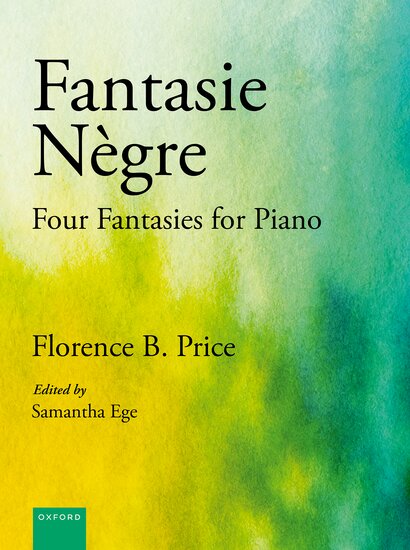
Regarding the first, the thought of presenting Price’s Fantasies in their entirety took me back to my love of diving into a body of works, like Brahms’ late piano opuses, Albeniz’s Iberia, and Debussy’s Estampes (all favourites of mine as a student). There was something about the heft of a complete collection, which defines so many of our great composers, that I wanted to create with Price. After all, Price viewed her Four Fantasies as a collection. The spiritual beauty of Fantasie Nègre No. 1 in E minor, the Brahmsian introspection of Fantasie Nègre No. 2 in G minor, the velvet colourings of Fantasie Nègre No. 3 in F minor, and the impassioned virtuosity of Fantasie Nègre No. 4 in B minor were all connected.
When I returned to Price’s archives in 2019 to focus on the Fantasies, it became clear that No. 3 wouldinvolve some detective work. The first two pages were all I could find. I therefore had to look for loose sheets of manuscript with similar musical characteristics to complete the score.
Additionally, I noticed that the original version of Fantasie Nègre No. 4 was twice as long and a million times more complex than the five-minute version G. Schirmer had recently published. Price likely shortened and simplified it because short and simple works by women were more marketable in the 1930s. But in the 21st century, it was time to hear what she was truly capable of.
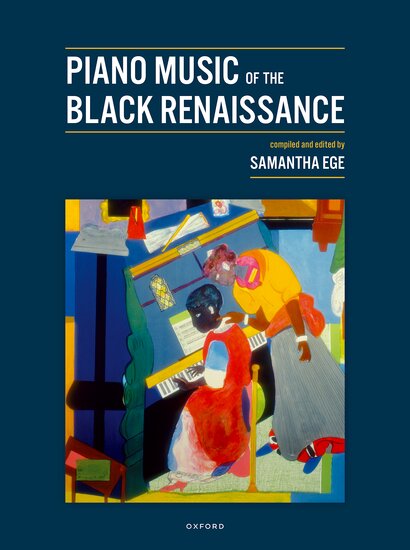
As for the second realisation, I’d always found the notion of a compositional school intriguing, from the First and Second Viennese Schools to The Five and Les Six. Well, Price belonged to an era of cultural rebirth known as the Black (or Negro) Renaissance. What’s more, women were far from minor footnotes. Alongside composers Margaret Bonds, Nora Holt, Betty Jackson King, the Canadian Robert Nathaniel Dett, and England’s Samuel Coleridge-Taylor (who mentored many Black Renaissance composers), Price believed in classical music’s power to generate social harmony.
My new sheet music publications – Fantasie Nègre: Four Fantasies by Florence B. Price and Piano Music of the Black Renaissance – celebrate this history. They also carry the imprint of my own prismatic influences, from Hamelin’s adventurous programming to Walker-Hill’s and Brown’s scholarly spotlight on classical music’s “hidden figures.”
I would have loved to stumble across these volumes as a student. But as I look ahead, regardless of whether pianists engage with the physical scores or digital downloads, I am excited for the kaleidoscopic journeys these editions will inspire as curious fingers descend upon the keys.
Samantha Ege is a musicologist, pianist, and author.

Discover more from The Cross-Eyed Pianist
Subscribe to get the latest posts sent to your email.



what a fascinating article. Enjoyed and intrigued.