Mozart wrote 18 piano sonatas and American pianist Orli Shaham has recorded all of them for the Canary Classics label, the final two volumes of the series being released in February this year. These sonatas have an enduring appeal, for players, both professional and amateur, and audiences alike.

For Orli Shaham the fascination with Mozart’s piano music began at an early age: this recording is the result of an exhilarating 40-year journey through the sonatas, getting to know them intimately, studying them deeply to appreciate their individual characters, and to understand the composer’s musical methods and motivations. “Was he trying out that piano? Was he writing for someone’s daughters? I want that something from every single one of them.” (Orli Shaham)

The recording was made in August 2019 and August 2020, at Mechanics Hall in Worcester, Massachusetts. The timing was deliberate to ensure consistent humidity in the hall: the result is a wonderful clarity and evenness of sound.

The piano sonatas reveal Mozart’s compositional genius in microcosm – from big orchestral gestures and brass fanfares to chamber music textures and eloquent operatic arias. Shaham pays great attention to the changing textures of Mozart’s writing but also his chiaroscuro – those remarkable emotional shifts from light to dark and back to light which occur in phrases or indeed a single bar. This is most evident in the slow movements where Shaham finds particular intimacy, poignancy and depth of expression – for example, as here in the Adagio from the sonata no. 2 in F Major, K.280:

There’s a delightful clarity too, in Shaham’s approach, with impeccable attention to details of dynamics, phrasing and articulation combined with tasteful use of pacing and rubato to create drama (take the opening movement of the sonata K.310, for example, where she takes time to appreciate the increasing operatic tension). There are moments of wondrous spaciousness, especially in the slow movements, where the contrasting hues of Mozart’s compositional palette are really brought to the fore.

I interviewed Orli Shaham to find out more about the pleasures and challenges of recording the complete Mozart piano sonatas

Congratulations on completing your recording of Mozart’s piano sonatas. What have been the particular challenges and pleasures of recording this cycle?

From a pianistic point of view, the greatest pleasure has been feeling Mozart’s hand at the keyboard and the way that he must have used his musculature, the technique. When you play all of these sonatas you feel like you know how it felt to be inside his hands and some of the brilliant ideas that he came up with of getting your fingers around the keyboard in virtuosic and delightful ways.

The complete sonatas run from his earliest maturity to quite late in his output. Therefore, the musical trajectory of how he put together notes, how he was thinking from a formal point of view, how he was thinking of the storytelling of a sonata and how the audience would be engaged throughout that whole time, that’s been a tremendous pleasure to learn from him.

The challenges are many. Mozart had a tremendous technique, so the sonatas are challenging to play because he was such a master of the keyboard and was so free to express himself in so many different ways. Internalizing what that is and getting to the place where I felt comfortable to convey as many of his intentions as possible, was certainly a wonderful challenge from the beginning.

There’s no question that part of the challenge of playing his sonatas is the fact that I’m playing them on a beautiful modern Steinway, which of course he didn’t have access to. While I love that, and it is a pleasure, the question of how do I make this as close to what I think he would have done if he were around in 2020 to record it is definitely challenging and something that I put a lot of thought into.

In terms of the recording sessions of the sonatas, we had a great challenge. Our first session was in August 2019. The world looked quite different when we recorded the second session in August 2020, during the first months of the Covid pandemic, and we came up against quite a lot of challenges. This was before any of the technologies were available for remote recording and remote engineering. We had to use 27 different apps and programs to make that second recording session possible.
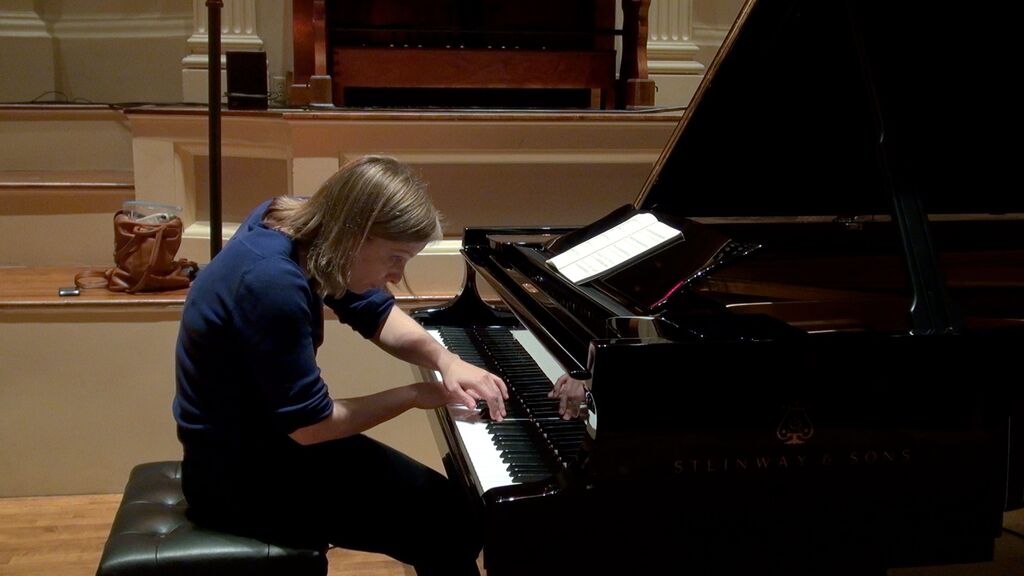
Orli Shaham in the recording studio

A particularly tough moment was when I had just finished playing the first movement of the C Minor Sonata, which is so emotional and such a moment of vulnerability for the performer. I played my heart out, and then there was radio silence from my wonderful producer Erica Brenner hundreds of miles away in Cleveland, because the internet service for the entire neighborhood had failed. Luckily, the audio was captured, and a few hours later, using a lot of workarounds, we were able to continue recording.

Schnabel said of the sonatas “too easy for children, and too difficult for artists”. What do you think he meant by this statement?

It’s a really interesting commentary. I’m not sure I entirely agree with “too easy,” but there are places in those sonatas where the writing is something that makes sense for a student to play because it’s so idiomatic for the keyboard. It will teach you how to use your hand correctly at the most basic level. But at the same time, he’s doing it with such grace and artistry and intelligence that there are layers and layers of meaning to unpack, even with the simplest phrase.

Why, in your opinion, do Mozart’s piano sonatas have an enduring popular appeal, with both artists and audiences?

They have an enduring popular appeal because Mozart had an enduring popular appeal in mind. I love that that’s so, so true. You see it in his letters. He writes to his father, “Don’t worry. I’m putting something in for the really super educated. I’m putting something in for the ones who really don’t know anything about music yet. I’m putting something in for the ones who want to play themselves but aren’t that good.” He thought about everybody and he tried from very early on to consciously put all of that into every sonata, into every work of music that he wrote, actually. I love that he was very mindful of his audience. Of course, that’s part of where he was in time. He was one of the first composers to try to get by without the benefit of somebody’s patronage, meaning he had to appeal to the audience.

Do you have a favourite sonata out of the entire cycle?

Yes. The one I’m playing at the moment.

Orli Shaham’s complete Mozart Piano Sonatas are available in 6 volumes on the Canary Classics label and via streaming

Photo credit Karjaka Studios

Dr Michael Low, pianist and pedagogue, leads a masterclass for advance adult pianists at Coach House Pianos London showroom on 1 June. Ahead of the event, get to know Michael, and your host, Frances Wilson AKA The Cross-Eyed Pianist…..

Michael

Who is your favourite composer for the piano?

There are quite a few! Beethoven, Brahms, Chopin, Liszt, Schubert and Rachmaninoff.

If you have to be one piece of music, you would be…

Either Brahms Opus 5 or Brahms Opus 15.

How do you feel about your upcoming masterclass at Coach House Pianos?

A mixture of excitement and nervousness.

Knowing what you know now, what would you say to your teenage self?

I would put my arm around his shoulder and tell him not to be so harsh on himself. It is okay to doubt yourself from time to time, but someone somewhere believes in you always. Keep going and everything will make sense eventually.

Who is your greatest teacher in your musical journey?

Life itself.

You watch a lot of movies, name the most enjoyable movie portrayal of a pianist (Drum roll)…

It is a three-way tie between Colm Feore as Glenn Gould, Geoffrey Rush as David Helfgott and Michael Douglas as Liberace.

And the performance(s) that annoys you most are:

The Oscar goes to JK Simmons as Terence Fletcher in Whiplash closely followed by Sir John Gielgud as Cyrill Smith (Helfgott’s teacher at RCM) in Shine.

Using one word, describe the interpretation of the following pianists:

1: Barenboim: Prolific

2: Berman: Powerful

3: Biss: Bohemian

4: Bolet: Virtuoso

5: Brendel: Classical

6: Buniatishvilli: Salacious

Name one pianist dead or alive you will travel to the ends of the earth to hear in concert.

Vladimir Horowitz

If you have to be the title of a book…

All God’s Children Are Lost, But Only A Few Can Play The Piano.

Steak of Sushi?

That would depend on who the chef is…

And finally, If I wasn’t a pianist, I’d be…

PGA Golfer


Frances

What is your earliest memory of the piano?

Hearing my paternal grandfather playing Methodist hymns and bits of Beethoven and Haydn on the upright piano in the front room (used only on Sundays) of his home.

Your favourite composers for piano?

An impossible question! But I adore the music of Schubert, Debussy, Beethoven, Liszt and Messiaen. Especially Schubert’s D899 Impromptus, which have been with me since I was about 13….

Most memorable concert experience?

There have been a few – Evgeny Kissin at the Proms in 1997, when he played the longest series of encores in the Proms’ history.

Steven Osborne playing Messiaen’s Vingt Regards sur l’enfant Jesus at the Queen Elizabeth Hall, without an interval. An epic, musical journey.

My students’ concerts.

What advice would you give to your teenage musician self?

Be yourself, trust your musical instincts, and don’t compare yourself to others. It took me a long time to become a self-confident musician (a 25-year absence from the piano didn’t help) and I’m grateful for the support and encouragement from a variety of teachers, including Penelope Roskell and Graham Fitch.

And what advice would you give to people returning to the piano, or thinking of taking it up later in life?

Do it! It’s never too late! And it’s so rewarding.

Why the pen-name The Cross-Eyed Pianist?

When I was thinking about starting this blog, I wanted a catchy title for it. Originally, I thought of The Naked Pianist (at the time Jamie Oliver’s The Naked Chef was popular), but I thought it might attract the ‘wrong’ kind of readers! I am genuinely cross-eyed, and also a pianist.

How did you and Michael get to know one another?

Initially, through our mutual teacher Graham Fitch. We met for lunch in China Town – must be 10 years ago! – and never stopped talking. Although we live on different continents (Michael lives in South Africa) we keep in regular touch via the wonders of modern technology. A shared outlook on music, music teaching, and life in general, and mutual respect, is, I think the basis of our friendship.

What are you most looking forward to at the masterclass with Michael at Coach House Pianos?

The opportunity to hear a variety of repertoire and learn from Michael’s wisdom and experience. And to meet fellow pianists and enjoy plenty of “piano chat”!

Steak or sushi?

Both. Especially if my son (a chef) is cooking!

Join Michael and Frances at Coach House Pianos sumptuous London showroom on Saturday 1 June. Observer places still available – book here

A SEASON TO SING by British composer Joanna Forbes L’Estrange is a brand new 40-minute work for SATB choir/organ or piano, inspired by Vivaldi’s The Four Seasons

Joanna Forbes L’Estrange

A Season To Sing will be published by the Royal School of Church Music (RSCM) in 2025, marking 300 years since the publication of The Four Seasons. This choral re-imagining of Vivaldi’s enduringly popular set of violin concertos weaves texts from poetry and the Bible on the subject of spring, summer, autumn and winter into Vivaldi’s much-loved melodies. It will also include a new setting by Joanna Forbes L’Estrange of Ecclesiastes 3:2 – To everything there is a season. With its seasonal theme, A Season To Sing can be performed at any time of the year, and is expected to become a firm favourite with choirs throughout the world.

Joanna Forbes L’Estrange recalls, “The Four Seasons is the first piece of music I can remember hearing from my childhood. I used to dance around the sitting room to it! I thought a great way to mark its 300th anniversary would be to make it possible for choirs to perform it. Vivaldi’s tunes are so magnificent they deserve to be sung!” 

To make this commission possible, the RSCM is inviting choirs to contribute £300 ($500) each to participate in this project, for which each choir will: 

  • have the opportunity to perform the piece before its general publication
  • meet Joanna Forbes L’Estrange for a Q&A session via zoom
  • be listed in the vocal score as one of the commissioning choirs
  • receive a limited-edition, hardback copy of the vocal score, signed by the composer

This exciting opportunity is open to all choirs, large and small, professional and amateur, and to individual supporters. Deadline for registering – 31 August 2024.

To find out more, please visit

https://www.rscmshop.com/features/a-season-to-sing


Joanna Forbes L’Estrange (b.1971) is a multifaceted musician who performs, composes, records, directs and produces music in a wide variety of genres. Her career began with seven years as soprano and Musical Director of the five-time Grammy® award-winning vocal group The Swingles, with whom she toured the world and produced six albums. Specialising in contemporary crossover music, Joanna is a regular soloist for Mass in Blue by Will Todd (which she recorded for the Convivium label) and Duke Ellington’s Sacred Concert. With the world’s leading orchestras and contemporary music ensembles she performs works by Steve Reich and Luciano Berio and has sung on over 300 film soundtracks.

One of the Royal School of Church Music’s best-selling composers, Joanna was commissioned to compose an anthem to mark the coronation of King Charles III. The Mountains Shall Bring Peace was sung by over 600 choirs around the world including in the USA, South Africa, Australia, New Zealand and throughout Europe and the UK. Her music has been performed and recorded by Tenebrae, The King’s Singers, The Swingles, The Military Wives Choirs, The National Youth Choir and London Voices. Television credits include Fleabag, which featured her 1940s-style song You Are, and Glee, which featured her Moonlight Sonata arrangement, written for and recorded by The Swingles.

Joanna has written many songs and choral pieces in support of equal opportunities for women: We Will Remember Them (for the Military Wives Choirs of Great Britain), A Woman (Wearing Bloomers) On A Wheel (made into a film by the National Youth Girls’ Choir), Suffragette March (part of a larger work, Freedom! The Power of Song, composed in collaboration with her husband Alexander L’Estrange), A place for us maids (commissioned to mark 40 years of female undergraduates at Trinity College, Cambridge), The Three Wise Women (commissioned to mark the 135th anniversary of St Swithun’s School, Winchester) and Byrd Song (commissioned to mark the 400th anniversary of the death of William Byrd). In 2018 Joanna founded the all-female vocal group AQUILA and, in the same year, made history by organising the first ever all-female recording session at Abbey Road Studios in London, recording her single Twenty-first-century Woman for International Women’s Day.

www.joannaforbeslestrange.com

The Royal School of Church Music

The Royal School of Church Music (RSCM) is the Salisbury-based, national, independent charity enabling the flourishing of church music. As the central ‘home’ of church music, RSCM provides relevant education, training and resources to its membership, the wider church, and beyond. It is committed to encouraging the best of music in worship, and to advocating music as a tool for growth of the church.

The RSCM supports thousands of member churches across the UK and worldwide through its international partners. In addition, it also supports many schools and Individual members, and its work is sustained by thousands of Friends, Regular Givers and other donors.

The RSCM is an open, life-long learning organisation, offering face-to-face and distance education and training through its programmes, published resources, courses and activities.

Founded by Sir Sydney Nicholson in 1927, the RSCM’s original emphases were English and choral. Now, in a diverse international context, the RSCM’s work is far broader and more diverse, and aims to make all its work ecumenical in purpose, nature and content.

His Majesty King Charles is the RSCM’S Royal Patron, and its president is The Most Revd and Rt Hon The Lord Archbishop of Canterbury. The organisation celebrates its centenary in 2027.

www.rscm.org.uk

Registered charity no: 312828   

Saturday 1 June 2024, 10am-4.45pm, Coach House Pianos SW6 4SQ

SPECIAL OFFER FOR READERS OF THIS SITE – DISCOUNTED OBSERVER PLACES

A one-day masterclass for advanced adult amateur pianists (Grade 8+) with pianist and pedagogue Dr Michael Low, hosted by Frances Wilson (The Cross-Eyed Pianist) at the sumptuous London showroom of Coach House Pianos. There is much to be gained from observing at a masterclass, including insights into technical and interpretative issues, practicing and performance, in addition to the opportunity to hear a variety of repertoire, including music by Schubert and Debussy.

Observer tickets £10 for the full day (save £5) – click on the image to book or scan the QR code to book


Book now

The event will be friendly, supportive and inspiring, and a great opportunity to observe top class teaching in friendly setting, plus the chance to meet other pianists. There will be plenty of time for discussion, Q&As, and relaxed ‘piano chat’ too.

Coach House Pianos is located at 79-91 New Kings Rd, London SW6 4SQ (nearest stations: Fulham Broadway, Parsons Green & Imperial Wharf). Please arrive promptly. Michael and Frances will be at the front entrance of the showroom to greet you.


Praised for his innovative approach and passionate insight into piano playing, Dr Michael Low’s teaching career in Asia and Africa has spanned almost a quarter of a century. As a student, Michael studied piano with Richard Frostick (the current director of the BBC World Voice Programme) before enrolling as a member of London’s prestigious Centre For Young Musician where he studied piano with the international pedagogue Graham Fitch. He obtained his Honours at Surrey University under the tutelage of Clive Williamson before completing his Masters of Music whilst studying with Nils Franke and Niel Immelman. An International Scholarship brought Michael to Cape Town where he completed his Doctorate under the supervision of South African greatest living composer, Hendrik Hofmeyr. Michael has also worked with numerous eminent teachers and pianists including, Nina Svetlanova, Frank Heneghan, James Gibb, Phillip Fowke, Renna Kellaway, Carolina Oltsmann, Florian Uhlig, Gordon Fergus Thompson, Francois du Toit and Helena van Heerden.
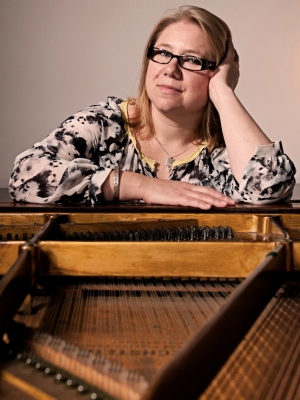
Frances Wilson is an advanced amateur pianist and writer under the pen-name The Cross-Eyed Pianist. Established in 2010, The Cross-Eyed Pianist blog has become “an important voice in the piano world” (Peter Donohoe, international concert pianist) and enjoys a wide global readership with c25,000 visitors to the site per month. The Cross-Eyed Pianist is now one of the UK’s leading blogs on classical music, with a special focus on pianists and the piano.



Frances is an advanced amateur pianist who returned to the piano after a gap of some 25 years, achieving Licentiate and Associate Diplomas (both with Distinction) in Piano Performance in her late 40s. She has studied with a number of acclaimed teachers, including Penelope Roskell and Graham Fitch, and participated in masterclasses, workshops and courses with, amongst others, Stephen Savage, Murray McLachlan and Charlotte Tomlinson.

A passionate advocate of amateur pianism, Fran co-founded the London Piano Meetup Group in 2013, which, 10 years, remains hugely popular with adult pianists of all abilities.