This album contains a wealth of beautiful music that I think anyone can tackle, given time, passion and determination.
-Alistair McGowan
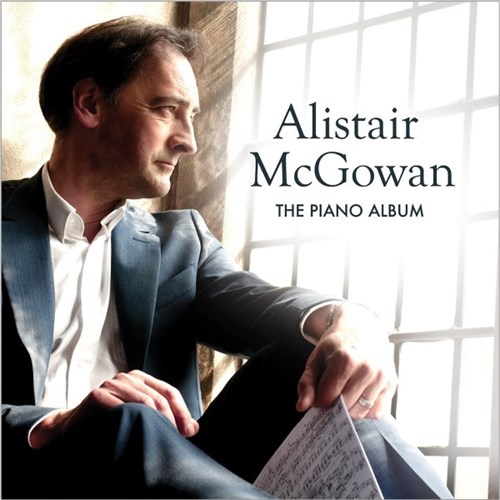
The debut album from Alistair McGowan sees the BAFTA-winning impressionist, comedian and actor in a new role, that of concert pianist. Called simply ‘The Piano Album’, it contains 18 short pieces of roughly Grade 5-6 standard, including works by McGowan’s beloved Erik Satie, mostly romantic or flowing music, and is intended to encourage others to play the piano by offering attractive well-known and lesser-known pieces which are accessible to intermediate level amateur pianists. McGowan feels that hearing someone like him, who returned to the piano as an adult having had only a couple of years of lessons as a child, is perhaps more inspiring than a recording or performance by a top professional playing Rachmaninov’s Second Piano Concerto, which many amateurs “could never play” (AG). Having spent the last few weeks listening obsessively to Krystian Zimerman’s exquisite new recording of Schubert’s last two piano sonatas, which have provided me with much food for thought and yes, inspiration, I am not sure I would agree. But as someone who goes to and reviews many piano concerts by top international artists (Aimard, Perahia, Osborne, Levit, Hough…..), maybe I am not the ideal audience for this disc….
The pieces are played nicely with some good production values, but there is nothing striking about the playing, no moments of insight nor real wonder. Philip Glass’s Metamorphosis No. 5, for example, is pleasant enough. It flows, it’s in time, but it has neither the spaciousness nor relaxed sense of breathing space that a more experienced player or someone who has spent a long time living with and in the music would bring to it. In short, it is rather too “notey” and somewhat laboured. Most of the pieces lack real expressive depth or subtleties of musical colour, and the result is a rather bland trawl through some nice piano miniatures. As a pianist friend of mine remarked, “people with a vague interest in classical piano music who want a “first album” would probably love it. Those of us more used to Perahia, Brendel et al will be less enamoured“.
Having said that, kudos to Alistair McGowan for taking on the challenge of learning, finessing and recording the pieces for this album. Integral to this process were lessons with several concert pianists ,notably Anthony Hewitt and Lucy Parham, and quality time spent at piano courses run by Paul Roberts and at La Balie in France. He has not taken on this project lightly, and his dedication to, and passion for, the piano is to be commended. That alone should be an inspiration to other adult amateur pianists.
The Piano Album is available now on the Sony Classical label
Who or what inspired you to take up the piano and make it your career?
I remember sitting in a school assembly at the age of five, hearing schoolmates perform little piano pieces, and thinking to myself quite definitely, as other children of that age surely do in their inimitable fashion: ‘I want to do that too’! It used to bother me that this initial self-generated impulse to play music was ‘sociological’ rather than ‘musical’, motivated more by the situation and ritual of musical performance than by its content. But much later I realised that what I love doing is to commune and communicate with people through the beautiful world of sound and sound structures. Thus the original ‘sociological’ motivation makes very good sense to me.
The point at which I decided to attempt a professional career in music did not come until the age of eighteen. This resolve came to me a few days after arriving at university to start a degree in Natural Sciences. As I had combined various interests for years throughout my school life, this more serious commitment to music didn’t need to divert me from my scientific studies. In fact, I found the university environment to be ideal in terms of the opportunities it offered for making music with others, broadening my study skills, and meeting colleagues with a wide range of interests. Perhaps not studying music for my degree helped avoid some potentially constraining burdens of expectation.
Who or what were the most important influences on your musical life and career?
I was fortunate to have an outstanding music teacher at primary school. She brimmed with enthusiasm and energy, quickly making music a favourite topic for me. She taught me the piano until I was ten, and as I recall, more than ‘just’ the piano – there was basic theory too right from the start. Her talents extended to composing dramatic works for children – I remember taking part in one, aged eight, as an auxiliary percussionist among a small group of professional freelancers, on one occasion playing a mark tree in an inappropriate improvised manner and far too loudly.
As I became more serious about the piano, several pianists became a great source of inspiration and support, each in their own way. Alexander Kelly, Piers Lane, Irina Zaritskaya, and lastly Maria Curcio, all oversaw and supported my pianistic development. But that development was also brought on by wider musical experience. I played the clarinet, french horn, and composed enthusiastically. At the Junior Royal Academy of Music I joined a piano quartet that rehearsed and performed together for a period of four years. During the summer holidays I would often find myself at semi-staged opera performances and observing voice masterclasses. I can’t unpick what was most important and why, at least not yet.
What have been the greatest challenges of your career so far?
Without doubt it is juggling the demands of performance with those of teaching and of family life. In addition, as someone who is curious about new, neglected, and forgotten works as well as ‘mainstream’ classical repertoire, I need to spend a lot of time learning pieces, and this can be more exhausting than the travel and performance schedule itself. Last year I was preparing Beethoven’s Hammerklavier Sonata and at the same time practising the first two books of Ligeti’s Piano Études – I should probably avoid allowing those two worlds to collide again in order to preserve my sanity.
Which performances/recordings are you most proud of?
With regard to recordings, I don’t know how to answer as I rarely listen to my recordings once they have been released. Perhaps I should, but I am inevitably more concerned with the journey ahead, asking myself how can I improve my performances and deepen my interpretative insights rather than patting myself on the back. This isn’t to say that I don’t take pride in my work, especially if I feel a concert performance or recording session has gone well, but anyone who knows me will tell you I don’t indulge myself.
One performance does come to mind: some years ago I decided to accept an engagement to play Saint-Saens Fifth Concerto at three weeks’ notice. I hadn’t played a note of the work before, but rightly calculated that it was possible to learn and memorise this piece in time. I worked very methodically to ensure I did so. The concert went very well and the performance was released as an unedited live recording.
Which particular works do you think you perform best?
I don’t know the answer – that’s up to my listeners to decide, and I trust them. I have to trust them as much as they trust me.
How do you make your repertoire choices from season to season?
There is no set formula, and I must admit that I am reluctant to make decisions very far ahead. My guiding principles are firstly that I have to be passionate about and deeply involved with the music I am to play, so that I can share it with others effectively; secondly, I like to construct programmes that can feel like a kind of journey, even though they often traverse a huge range of music written over at least two centuries.
Do you have a favourite concert venue to perform in and why?
I am fortunate to perform in some beautiful halls with very good acoustics, but I love the way that each venue (even a dry speech theatre, as occasionally happens) creates a particular set of challenges that demand engagement from performers and listeners alike. For me the moment of communication and the content of the music are much more important than the venue, even though a comfortable venue helps performers and listeners alike.
What is your most memorable concert experience?
There are several: Krystian Zimerman at the Royal Festival Hall performing Ravel’s Valse Nobles et Sentimentales, Chopin’s Ballade no 4 and the Sonata in B flat minor incomparably; Yo-Yo Ma playing Dvorak’s Cello Concerto with the Houston Symphony; Yuri Temirkanov and the St Petersburg Philharmonic in Shostakovich’s Leningrad Symphony at the Barbican; Simon Rattle and the Rotterdam Philharmonic performing Parsifal at the Proms (yes, I stood up for the entire opera, and didn’t feel even a slight ache); Esa-Pekka Salonen conducting a small ensemble in Franco Donatoni’s Hot.
What do you consider to be the most important ideas and concepts to impart to aspiring musicians?
Live your life to the full and never stop searching. You can never know enough, be experienced enough, ‘finish the work’, or be truly satisfied! This is potentially frustrating but also liberating because the process leading up to each performance is what becomes important and enriching. Aspiring musicians should gain the widest possible musical experience, get to know and engage with other art forms, read widely…. You never know where an idea or an inspiration might be lurking, and behind every seemingly simple answer lies a multitude of questions.
Where would you like to be in 10 years’ time?
Doing what I do now, hopefully quite a lot better.
British pianist Danny Driver trained with Alexander Kelly and Piers Lane whilst studying at Cambridge University, with Irina Zaritskaya at the Royal College of Music in London, and completed his studies privately with Maria Curcio. As a student he won numerous awards including the Royal Over-Seas League Keyboard Competition and the title of BBC Radio 2 Young Musician of the Year.
Several things have happened since I started this series of articles about my learning and study of Schubert’s penultimate piano sonata. The first is that after a long period of reflection and time away from the piano following my disappointing Fellowship diploma result, I started playing the sonata again – and with a very different mindset from last year – and the second that I have been commissioned to write a series of articles about the sonata for ‘The Schubertian’, the journal of the Schubert Institute (UK). This allowed me spend more time analysing and studying the music away from the piano, in conjunction with some serious reading and listening, all of which has thrown new light on the music for me and enabled me to approach it differently, and (based on my teacher’s comments at my latest lesson), more successfully.
The following article on the first movement of the sonata combines simple analysis with some personal thoughts on practising, interpretation and musical narrative.
“The performer only has to follow Schubert on his journeys and recognize its various stations”
Andras Schiff
The first movement has a symphonic sweep in its generous breadth, and an appreciation of Schubert’s orchestral writing is essential in approaching this movement, in terms of its textures, implied instrumentation and narrative flow. Much is made of Schubert the spinner of beautiful lieder melodies in his piano music, as elsewhere, but in the later Piano Sonatas we find Schubert the composer of tautly textured string quartets and large-scale orchestral writing. To better appreciate and respond to these aspects of the sonata, my “further listening” on disc and in concert has included the ‘Great’ C major Symphony, D944, the String Quintet in C, D956 (which Schubert composed during the final months of his life), and the String Quartet in D minor, D810, as well as the late piano music (the Impromptus) and of course the other two sonatas which comprise the final triptych. Such listening has proved invaluable in my understanding of Schubert’s distinct soundworld and idioms, and incorporating these sounds and textures into my own interpretation of the piano sonata, alongside my personal “vision” of the work, has enabled me to create a performance which is, I feel, three-dimensional and rich in orchestral detail.
Autograph score of the first draft of the first movement in which the opening sentence is more simplified than the final version
The movement opens with a majestic six-bar sentence comprising declamatory chords in the treble which leaves us in no doubt that this music is in the key of A major: there are no less than 14 A’s in the top voice in this sequence. For me, this opening sentence has all the grandeur and poise of the introductory sequence in a Bach keyboard Partita, and its “stand alone” quality is made all the more impactful by what follows it.
Next a sequence of descending arpeggios, marked piano, which could have come straight out of an impromptu with its idiosyncratic intimacy. The contrast between this section and the opening is striking and is the first example, of many, of Schubert’s musical and emotional volte faces which pepper this work. In bar 8 another cyclic motif is introduced, the short-long “ta-tah” rhythmic gesture (here a crotchet followed by a minim) which feels like a musical intake of breath in surprise or wonder, almost an “ah ha!”. This motif will also appear in various reincarnations throughout the work. It requires precise articulation and little or no pedal so as not to blur the transition from the first note/chord to the second, to retain an element of surprise, and to ensure the upward harmonic movement in the bass is clear; this is particularly important when the motif appears again as a quaver and minim separated by a rest (for example, at bars 23 or 28/9). These apparently tiny details create remarkable breathing spaces and suspensions in the music and clarify the structural expansiveness and improvisatory character that pervade this movement (and also the finale). The suspension from bar 6 is further reiterated in bar 13 and is not fully resolved until the A major harmony of bar 16, where the opening sentence and successive arpeggiated figure interact in another new idea whose bass line reflects the opening sentence in its ascending chords.
In just 50 bars Schubert gives us so much material. Varied, dramatic and contrasting in both weight and pace, it is far more than one would expect to find in the exposition of a traditional Classical-era sonata, and here, as elsewhere throughout the sonata, we see Schubert’s rich inventiveness, his desire to explore new ideas and his use of the piano sonata form as a vehicle for vivid experimentation and wide-ranging emotional impact. The challenge is how to integrate all these ideas while also retaining the improvisatory/evolutionary character of the music. In fact, I prefer to follow Schiff’s suggestion – that one simply follows, responds to, and trusts Schubert’s wanderings, moment-by-moment: as mentioned previously, the cyclic motifs serve as unifying elements in the work, drawing these varied strands together.
The exposition’s second subject, introduced at bar 55, feels more like a traditional second subject: scored in the dominant (E major), it is a simple lyrical melody accompanied by string quartet textures. At the end of this section, one might expect a double-bar and an indication to return to the opening of the music to repeat the exposition, but instead Schubert introduces a turbulent extended chromatic passage leading to a climax of descending arpeggios which recall those from near the opening, followed by a declamatory, orchestral section (mm. 105-111). Despite the sforzando markings, I resist the temptation to give this passage a really full-bodied Beethovenian forte: this is, after all, Schubert not Beethoven, and I feel his dynamics are often psychological rather than purely physical, here suggesting an intensity of feeling rather than sheer volume. Greater emphasis in the bass helps to reinforce this. This section ends on a suspension: a whole-bar rest of complete silence before a passage based on the second subject. This pause needs to feel absolute, with a sense of “listening into silence” (Brendel), to create a magical contrast with the gentle lyricism of the passage which follows and the close of the exposition. The decision then is whether to repeat the exposition (which I do), or proceed straight to the development. Whatever the decision, there is no doubting the impact of the extraordinary modulation in the second-time bar (m 129) where the music moves into C major and the development is heralded by gentle pulsing quavers.
The development section, like the exposition, is not a development in the strict sense of the classical sonata structure: Schubert hardly develops the preceding material at all and instead a last-minute idea from the close of the exposition (mm 121-122) becomes the main motif. The section begins in C major but quickly oscillates between C and B major, which, together with the register in which it is played, creates an ethereal, almost hypnotically suspended atmosphere. The effect is further enhanced by moments of ambiguity in the modulations, where the music hovers momentarily in a minor key, as if passing, albeit fleetingly, into another realm entirely. The LH chords suggest a string accompaniment and should not be too “chugging”. Nor should this section be obscured by too much pedal. I aim for a Mozartian clarity here with little or no pedal: the overall effect should be “heavenly” and dreamlike.
A dramatic descent into the lower registers heralds the further development of this theme in the minor key. Now the atmosphere shifts again, to intimate and passionate, the pulsing quavers remaining as a unifying element. These continue as the music moves into the preparation for the recapitulation, now firmly in the dominant, as if the drama and darkness of the minor section is already long forgotten.
The recapitulation is traditional: it remains in the home key of A major, while the second subject is presented in C major. But at bar 219 the third motif from the opening is stated in A minor and an octave higher. This new variant echoes, momentarily, both musically and emotionally the minor-key sections from the dreamlike sequence of the development before the music moves into warm F major.
The coda restates the opening sentence, but in a much more hesitant manner: marked pianissimo, it is interrupted by whole-bar rests with fermatas, while the left hand imitates pizzicato strings. It feels like a nostalgic reminiscence of the opening sentence and to enhance this, I believe there is justification for broadening the tempo and lingering over certain elements, such as the appoggiaturas in bars 337 or 343, to create a wistful, hymn-like atmosphere. The movement closes with gentle ascending arpeggios, mirroring those from the opening section, the penultimate of which is in B flat major ending on an augmented sixth, which creates a sense of uncertainty, before the final gentle A major arpeggio closes the movement. The question of how to pedal these arpeggios is ambiguous. In both my Henle and Barenreiter scores, there is a pedal mark at bar 349 only. Any pedal I use here is for atmosphere: I like a slight wash of pedal, particularly with the B-flat major arpeggio, but too much will obscure the contours of this sequence. The softly-spoken, somewhat uncertain end to this expansive movement has the curious effect of setting the scene for the second movement without actually pre-empting it at all. When it comes, the Andantino seems distant and alien, so utterly different in character from what has gone before.
Such is the spell of your emotional world that it very nearly blinds us to the greatness of your craftsmanship. – Franz Liszt on Franz Peter Schubert
Select bibliography
Brendel, Alfred, ‘Schubert’s Last Sonatas’, in Music, Sense and Nonsense: Collected Essays and Lectures (London: The Robson Press, 2015)
Fisk, Charles, Returning Cycles: Contexts for the Interpretation of Schubert’s Impromptus and Last Sonatas (Berkeley, Los Angeles and London: University of California Press, 2015)
Montgomery, David, Franz Schubert’s Music in Performance. Compositional Ideals, Notational Intent, Historical Realities, Pedagogical Foundations (Hillsdale, NY: Pendragon Press, 2003)
Schiff, Andras, ‘Schubert’s Piano Sonatas: thoughts about interpretation and performance’, in Brian Newbould (ed.) Schubert Studies (Aldershot and Burlington: Ashgate, 1998)
A new community group on Facebook for those who blog about the piano and those who enjoy reading blogs……
A dedicated space for pianists and writers to share and encourage one another, as well as a focal point where bloggers can share all their latest posts.
This is important, because many online communities don’t like bloggers to link their sites. For example, on Reddit not all subreddit areas welcome blog posts at all, while forums such as Piano World can also react with hostility towards bloggers who share their posts. And even on Facebook, some groups prefer to limit or restrict the sharing of blog links.
And that’s why those who READ blogs will enjoy the Piano Bloggers group as much as those who write them! The aim of the group is to offer a unique space online where interaction between readers, writers and pianists can flourish.
The Cross-Eyed Pianist is free to access and ad-free, and takes many hours every month to research, write, and maintain.
If you find joy and value in what I do, please consider making a donation to support the continuance of the site







 The Cross-Eyed Pianist