tumblr_inline_my8n6n5bii1rpnb7i

Music can form a personal soundtrack to our lives, evoking memories of times past, and a few bars of a significant song or piece of music can create an instant reaction, a ‘tingle’.

Music can arouse very powerful emotions. Psychologists suggest that there is something about the way music unfolds over time, as do emotions, and that when we hear music we re-live the emotional sequence that happened the first time we heard it. This makes music so much more powerful than a smell or a painting: it draws us into a very special sequence of relived experiences. Music also raises our expectations, simply by granting or delaying a bar or beat in a piece, or by leaving a harmonic progression unresolved. We would not be moved by music that always fulfils our expectations; our emotions are at their highest when we are un-expected and when we experience the wonderful delayed gratification that music brings. An abrupt shift of harmony, the dramatic entrance of a soloist, changes in tempo – all these factors can induce a frisson in us, and it is these startling changes in music which have an amazing power to move us, to awaken emotions from ecstasy to deep sadness, or recall significant moments in our lives. Performers too can manipulate the way we experience music, and thus influence our emotional response, through the use of rubato, delayed stresses or accents, the voicing of certain chords, texture, tempo, dynamics and even the performer’s physical gestures.

Certain pieces have seeped into our collective consciousness: Richard Strauss’s ‘Also Sprach Zarathustra’ is synonymous with space travel after it was used in Stanley Kubrick’s film ’2001: A Space Odyssey’, even for those people who are too young to remember the film or the Apollo moon landings. Then there is the Andante from Mozart’s Piano Concerto No. 21, often simply called ‘Elvira Madigan’ after the 1967 Swedish film of the same title in which the music memorably features, or the Adagietto from Mahler’s Fifth Symphony (‘Death in Venice’). Or ‘Nimrod’, from Elgar’s Enigma Variations. Hear just a few bars and one instantly thinks of poppies, the First World War and the annual, sombre ceremony at the Cenotaph in London on Remembrance Sunday. And – dare I mention it? – ‘Nessun Dorma’, now forever associated with excitement of international football. We are constantly bombarded with soundtracks and jingles, musical tags and cover versions, all of which can induce an unexpected “tingle” in us, for this response is not limited to classical music.

There’s also a scientific explanation for the “tingles” which music induces in us. When the music strikes the right chords or harmonies, our bodies make a measurable physiological response: the heart rate increase, the pupils dilate, the body temperature rises, blood moves to the legs and the cerebellum, the “control centre” of body movement, becomes more active. The brain flushes with dopamine, a neurotransmitter, which causes the tingle. This is because music stimulates an ancient pathway in the brain which is activated by rewards, addiction, emotion and motivation: in short, music can affect the brain in the same way as sex, drugs or eating chocolate!

Not everyone experiences tingles when listening to music, and scientists have found that people who possess a personality trait called Openness to Experience tend to experience music more profoundly. Such people have unusually active imaginations, enjoy new experiences, are emotionally intelligent, empathetic, appreciate beauty and nature, seek out new experiences, and love variety. When listening to music, they are able to make mental predictions about the way the music is going to unfold, or engage in vivid musical imagery, and because they are likely to immerse themselves more deeply in the music they are hearing, their response – their “tingle factor” – is more intense.

Regardless of the neuroscience, we all have pieces of music in our personal back-catalogue which are very special to us. Tucked away in the recesses of our minds, these pieces can induce a powerful tingle of recollection, a sort of musical “Proustian Rush” if you will, which can evoke strong memories and take us back to a certain place or significant point in our lives. We should never underestimate the power of music!

Who or what inspired you to take up the piano and pursue a career in music?

Ultimately my parents! However that isn’t quite as simple as it sounds: they were both professionally trained pianists, and I never remember a time when I wasn’t absorbing beautiful music at home from my mother’s fingers, but I didn’t really get to know my father till I was 20. Nevertheless he was in the background guiding my musical training, so I owe my main inspiration to both of them though at different times and in different ways.

Who or what were the most important influences on your musical life and career?

My fabulous teacher from 7 to 11 was Lamar Crowson. Without his thorough grounding I doubt if I would ever have become a pianist as I had a boyish rebellion at around 12 to 16 when I didn’t do any serious practice, at one point giving up playing completely. At that time non-classical pianists inspired me: McCoy Tyner, Thelonious Monk. I still love them.

Later on I was much inspired by some great string players, particularly Sandor Vegh, at Prussia Cove, who enormously influenced my thinking towards a more expressive, less literal and technical (and also less subjective) response. Also György Kurtág, perhaps the greatest musician I have ever encountered..

What have been the greatest challenges of your career so far?

I don’t think anything came close to preparing the UK premiere of the first six Ligeti Études. In their early days they were only printed as a facsimile of Ligeti’s manuscript and I would pore over a single bar for hours just trying to work out what I was supposed to play, let alone play it. The three Beethoven Sonata marathons I did were a challenge, but at least I knew the music already!

Which recordings are you most proud of?

Hmmm – none particularly! Some I can live with – the Balakirev Sonata and other pieces, Weber 2nd Sonata, some chamber music recordings and some of the contemporary two-piano recordings I did with Andrew Ball 20 years ago or more. When I hear, for instance, John Casken’s “Salamandra”, the two-piano piece he wrote for us, I wonder what became of this furiously energetic young man! Though I keep going and still have recording plans, including with my current duo with Mariko Brown.

Which particular works do you think you perform best?

I think that if I stopped to think of it I would neither play those well nor anything else! I try to approach each piece and each performance as if it’s the first time I’ve played it. Nevertheless there have been some recurrent themes and composers I seem to feel more at home with: Beethoven and Debussy – perhaps two very different sides of me.

How do you make your repertoire choices from season to season?

I try to play only music I love and feel I can say something to at a given moment. That can sometimes be a problem if a recital is booked a long time ahead though I usually find I can rekindle the love affair! I need enough variety, though sometimes reality puts a check on that – If you’re playing a Beethoven cycle you basically have to spend most of your time on Beethoven. Certain types of music become less interesting to me to play as I get older, for instance I don’t play much of the more abstract contemporary music any more. On the other hand I’m going to start playing Bach in my 70s.

Do you have a favourite concert venue to perform in and why?

A good concert leaves me on a high wherever it is. Having said which, I’ve only played a few times in the Albert Hall and it was fabulous. Just that unique, electric atmosphere.

Favourite pieces to perform?

Ravel G major Concerto. Oh for another chance to do that!

Who are your favourite musicians?

Fritz Kreisler. David Oistrakh. Arthur Rubinstein. Carlos Kleiber. Martha Argerich. Samson François. Yuja Wang.

What is your most memorable concert experience?

Playing in the garden of the British Ambassador’s residence in Riyadh with an air temperature of 36 degrees, and the Ambassador’s wife’s falcons solemnly listening.

What do you consider to be the most important ideas and concepts to impart to aspiring musicians?

Love, love, love. The more they love the music, and themselves playing it, the more they will want to communicate with their audiences, the more technique they will want to acquire (for the right reasons) and the more closely and accurately they will want to read the scores of these incredibly great musicians who have written their inexhaustible masterpieces for us.

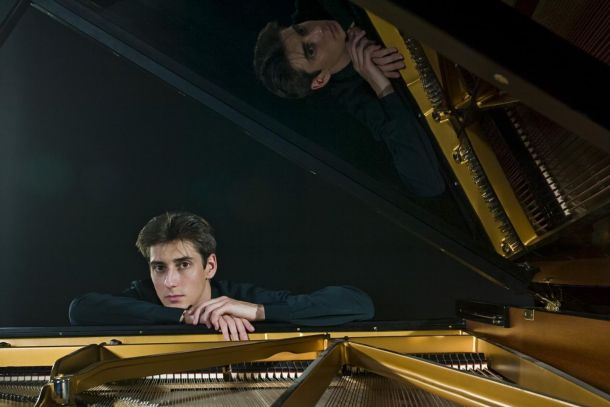
Julian Jacobson celebrates his 70th birthday with a series of Sunday afternoon concerts at St John’s Smith Square, commencing on 22nd October. Full details and tickets here

One of Britain’s most creative and distinctive pianists, Julian Jacobson is acclaimed for the vitality, colour and insight he brings to his enormous repertoire ranging across all styles and periods.

Read more about Julian Jacobson

Julian Jacobson piano: Masterpieces of Beethoven, Schubert and Prokofiev
70th Birthday Concert Series

St John’s Smith Square, Westminster, London SW1P 3HA


Julian Jacobson, who has established a reputation as a pianist of extraordinary breadth and versatility, celebrates his 70th birthday this autumn with a series of Sunday afternoon concerts entitled Masterpieces of Beethoven, Schubert and Prokofiev, at St John’s Smith Square on 22 October, 26 November, 11 February and 11 March 2018.

The series features Prokofiev’s mighty War Trilogy, the 6th, 7th and 8th sonatas – widely regarded as the crowning glory of his output of piano music – a rare opportunity to hear the trilogy performed in sequence in the first three concerts. In the final concert Julian will play four pieces from Prokofiev’s “Romeo and Juliet” and he will be joined by his regular duo partner, the Anglo-Japanese pianist Mariko Brown, in Gershwin’s “An American in Paris”, in Julian’s own virtuoso transcription for piano four hands.

A highly respected Beethoven pianist, Julian’s repertoire is firmly centred on the great classics of the repertoire – in recent years he has become particularly known for his Beethoven cycles and marathons (playing the complete 32 sonatas on three occasions in one day, most recently in 2013). He has also been an acclaimed exponent of contemporary music including jazz (giving the UK premiere of Ligeti’s Études in 1987 among many others), and as a much sought-after duo and ensemble pianist he has partnered many leading British and international soloists. His concert tours have taken him to over 40 countries worldwide and he has recorded more than 30 CDs.

Beethoven’s perennial sonatas: No.14 in C# Minor ‘Moonlight, No. 8 in C minor ‘Pathétique’, No. 23 in F minor ‘Appassionata’ and the Eroica Variations are complemented by major works of Schubert, including the Wanderer Fantasy and his Four Impromptus D899, as well as the Prokofiev.

Speaking about the St John’s Series, Julian Jacobson says: “As a man approaches his 70th birthday – something I thought only happened to other people – he can either try and run away from it or “face the music”. And so I decided I would challenge myself by presenting four programmes of composers I love and have been involved with over many years, celebrating some of their greatest and most loved piano music. There is a time for highways and byways and I have spent many years happily exploring them, but increasingly I feel the need to try and measure up to the pinnacles of the repertoire and see what I can bring to them of myself. I invite you warmly to share my journey!”

Highly regarded by audiences, critics and fellow musicians, György Kurtág remarked during the International Musicians’ Seminar (IMS) in Prussia Cove that: “Julian Jacobson is a possessor of perfection in musical interpretation and this illuminates his chamber music partners as well as his students and all listeners…”

Masterpieces of Beethoven, Schubert and Prokofiev

Four Sundays at St John’s Smith Square, London

Dates and programmes:

Sun 22 Oct 2017 at 3.00pm

Beethoven Eroica Variations op. 35

Schubert Four Impromptus D899

Prokofiev Sonata No. 6 in A op. 82


Sun 26 Nov 2017 at 3.00pm

Beethoven Sonata No.14 in C# Minor ‘Moonlight’

Schubert Sonata in D D850

Prokofiev Sonata no.7 in B flat op. 83


Sun 11 Feb 2018 at 3.00pm

Beethoven Sonata No. 8 in C minor ‘Pathétique’

Schubert Sonata in A D959

Prokofiev Sonata No. 8 in B flat op. 84


Sun 11 Mar 2018 at 3.00pm

Schubert Wanderer Fantasy

Beethoven Sonata No. 23 in F minor ‘Appassionata’

Prokofiev Romeo and Juliet: Ten Pieces op. 75 nos. 1, 4, 6 and 10

Gershwin An American in Paris arr. Jacobson for piano 4 hands

For tickets and further information visit: www.sjss.org.uk

Julian Jacobson www.julianjacobson.com
Source: press release/Jo CarpenterMusic PR Consultancy

Tucked away in a tranquil leafy corner of Great Elm, a small village near Frome in Somerset, is Jackdaws Music Education Trust. Now in its 25th year, Jackdaws was established by the singer Maureen Lehane in memory of her husband, the composer Peter Wishart, and took its name from his most-performed song, ‘The Jackdaw’. Their modest former home is host to a wide variety of very popular short music courses and workshops for adults and children, as well as concerts and opera performances.

Courses take place throughout the year, usually run from Friday evening until teatime on Sunday. The courses are led by inspiring musicians and teachers, and bring together passionate musicians, from the humblest amateur to the aspiring professional, to learn and develop together in a homely, nurturing and friendly environment. Tutors on the popular piano courses include Graham Fitch, Margaret Fingerhut, Julian Jacobson, Philip Fowke, Mark Polishook, Mark Tanner, Penelope Roskell and Stephen Savage. The ethos of Jackdaws is ‘Access-Inspiration-Inclusion’ and the atmosphere and teaching is relaxed, convivial and supportive. Course participants and tutors eat together at a large round table downstairs, meals are freshly made, generous and wholesome, and there are frequent breaks in the teaching schedule, plus free time to practise, socialise or explore the surrounding area. Participants stay with local bed and breakfast hosts in Great Elm  or nearby villages.

I have been meaning to visit Jackdaws for several years: I’d heard so many positive reports of the courses and the place from pianist friends, and a short course with a small number of participants appealed to me. (I have not been tempted by larger piano courses such as the summer schools for pianists at Walsall or Chethams, nor the very expensive summer piano courses in France). It was serendipitous when my regular piano teacher Graham Fitch suggested I go on course called Finding You Voice At the Piano with Stephen Savage. Graham studied with Stephen at the Royal College of Music, and from the outset I found Stephen’s sympathetic and encouraging approach familiar from Graham’s teaching style.

Teaching is organised in a masterclass format which allows all participants to learn by observing one another being taught. We were fortunate in that there were only 4 people on this course which gave each of us the luxury of longer sessions with Stephen and the chance to further explore ideas which emerged from the teaching sessions. And from a piano teacher’s point of view, observing an expert tutor in action is also very instructive.

Our enjoyable mealtime conversations included repertoire, concerts, favourite recordings and artists and piano teaching anecdotes. These convivial interludes in each teaching day helped to forge a sense of shared purpose and musical friendship, which I think really aids learning because one quickly feels more at ease playing in front of others if you’ve shared the same dinner table with these people.


The teaching was of the highest quality: Stephen is expert at very quickly seeing what each person needs to bring their repertoire to life (in my case, a greater richness of sound and drama in the final movement of Schumann’s Fantasy in C, and more continuous energy in the opening movement of Schubert D959), and gave each of us useful advice and suggestions for practising, including strategies to bring security to leaps, chord progressions or rapid passagework. It is always wonderful to see how individuals develop, how their music changes, under the tutelage of a teacher like Stephen Savage, and it gives one inspiration and encouragement to keep going on one’s personal musical journey. In addition, courses such as these are a fantastic opportunity to hear, share and discover repertoire, and a chance to make new piano friends.

In terms of facilities, Jackdaws has a good Steinway grand in the main studios upstairs, a further Bechstein grand downstairs plus several upright pianos, a digital piano, a harpsichord and a spinet. Practice time is booked In half-hour slots using a simple rota and everyone was very good-natured about organising this. There is also free WiFi.

In sum, this was an inspiring, stimulating, enjoyable and highly instructive weekend piano “retreat” which I recommend to any adult pianist but particularly those who have not attended a piano course before or might be unsure about signing up for a longer course.

For further information about Jackdaws piano courses please visit

https://www.jackdaws.org.uk/piano/


A magical place for music making, made more special by playing in such an intimate space, surrounded by beautiful nature……it encourages us to open up

– Wendy

Sharing music with empathetic people who understand what we’re trying to do and what the difficulties are. It takes courage to play at these events but as adult learners we bring our own life experiences to bear on our music  

– Susan

Small, domestic ‘at home’ atmosphere and lovely people

– Mark

It’s about interaction with new people – I really do value that – and it’s humbling to work with people from a multiciplity of professions who come on these courses with their hang ups. But there’s always a way to face these and to really get some focus into their playing. I think the key factors are the ‘craft’ of playing and rhythmic organisation in the music. As a teacher it’s important to be non-judgemental and respectful

– Stephen Savage