sommcd0162Whenever I hear Haydn’s piano music played well, I want to rush to my piano to play it myself. Such was the effect of listening to Leon McCawley‘s new ‘Sonatas and Variations’ disc on the Somm label. Haydn’s piano music is not performed enough, in my humble opinion, so it is a pleasure to have a recording of such quality to enjoy.
A brace each of sonatas in major and minor keys, these works have long been part of McCawley’s concert repertoire, and this shows in his deft and insightful handling of articulation, dynamics and Haydn’s rapid changes of mood. Nothing feels forced nor contrived, and there’s wit and humour aplenty, especially in the C major Sonata (No. 60, Hob. XVI/50) which shows Haydn (and McCawley) thoroughly enjoying his mastery of the instrument and its capabilities. McCawley brings elegance and spaciousness to the slow movements, revealing fine details of inner voices. Haydn’s final piano sonata, No. 62 in E flat Hob. XVI/52, which unlike the last sonatas of Beethoven and Schubert was composed some 15 years before Haydn died, rather than at the end of his life, combines grandeur and exuberance in its opening movement, while the slow movement has a stately nobility. The finale is a lively romp, but despite the rapid tempo, there is never any loss of detail or precision.

The F minor Variations are a delight, at once melancholy and wistful in the minor variations, and gracious, playful and warm in the major ones. Interior details are highlighted and a sense of the overall architecture and narrative of the work is clear. And I am pleased to note that McCawley observes all the repeats, which turns this work into something enjoyably substantial. Throughout there is tasteful pedalling and the piano has a lovely clarity, perfect for this music.

Recommended.

Haydn
Piano Sonatas
No. 53 in E minor
No. 60 in C major,
No. 33 in C minor
No. 62 in E flat major
Variations in F minor Hob. HVII/6
Leon McCawley, Piano

SOMMCD 0162


81u7rrpufwl-_sl1500_The Scottish composer Ronald Stevenson died in March 2015. He was one of the most important composers of our time, a composer-pianist in the grand tradition of Beethoven, Chopin, Liszt and Rachmaninov, probably best remembered for his monumental Passcaglia on DSCH, his tribute to Shostakovich composed in 1962. Stevenson has been compared to Liszt and Busoni: he transcribed many works for piano, and he was also a generous supporter of other musicians and students. His musical language is also redolent of these composers, as well Chopin and Alkan, but always with its own distinctive voice and an awareness of his adopted Scottish heritage.



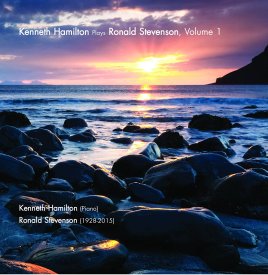
This new disc by pianist and academic Kenneth Hamilton, which marks the beginning of Hamilton’s survey of Stevenson’s vast keyboard output, avoids the really large-scale works, though the Peter Grimes Fantasy is pretty substantial – Stevenson’s own Lisztian operatic paraphrase, in which themes from Britten’s opera are woven into music of expansive, inventive virtuosity and vivid imagination.

The disc works well as a “recital programme” offering an excellent introduction to Stevenson’s varied oeuvre. Alongside the more meaty works such as Beltane Bonfire and Symphonic Elegy for Liszt, there are shorter works, including transcriptions of Scottish folk songs and Three Elizabethan Pieces after John Bull, which are reminiscent of Percy Grainger in the combining of rich harmonies and textures with period music.

Hamilton studied with Stevenson and his understanding of the composer’s personal idioms is evident in his masterful handling of this music: robust and sweepingly romantic in the more bravura works, charming and witty in the shorter pieces with moments of luminous delicacy, as, for example, in Stevenson’s transcription of Rachmaninov’s Lilacs, which is all filigree textures, echoed in the opening of the transcription of Ivor Novello’s We’ll Gather Lilacs.

Recorded on a Hamburg Steinway at the School of Music, Cardiff University, Hamilton achieves a warm resonant sound which is particularly suited to the more expansive, textural works, though occasionally a little too dominant. Overall a most enjoyable disc with comprehensive liner notes by Kenneth Hamilton, which draw on his studies and conversations with Stevenson.

PRIMA FACIE PFCD050 1CD

primafacie.ascrecords.com

it20may20have20been20album20front20cover201500This new album celebrates the piano music of British composer Paul Burnell, spanning 30 years. Paul had recorded and produced previous albums himself, but in this instance he decided it was time to work with another musician, the pianist, composer and recording engineer James Bacon who runs the Piano Recording Studio. The music was recorded on a Bosendorfer Phoenix Imperial 290, fitted with the Phoenix agraffe system pioneered by Richard Dain at Hurstwood Farm Pianos, which gives the piano greater sustain and clarity of sound, especially in the high registers. This makes it ideal for Burnell’s piano music, much of which explores the timbre and sonic possibilities of the piano rather than melody per se.

“Unembellished, unfussy, unsophisticated…..and short” – Burnell’s own programme note for his Plain Pieces, a triptych dedicated to pianist Natalie Bleicher, could be applied to all the music on this album, though I would hesitate to use the word “unsophisticated”. Short, unfussy these pieces might be, but there is sophistication in the careful placing of notes to create subtle shadings, unexpected harmonies and suspended sounds. “Minimalist” is a description which immediately springs to mind on first hearing Burnell’s music, but this is not the frenetic (sometimes irritatingly so) repetitious minimalism of Philip Glass or Michael Nyman, but rather the more contemplative and spare minimalism of composers such as Lawrence Crane, whom Burnell cites as important influence (It May Have Been, Just Before Dawn). The more up-tempo pieces here (Pacer Nos, 1, 2 and 3) owe more to Howard Skempton (another significant influence) in the use of changing chords and sequences to create energy and climactic episodes. There are also echoes of that other great American minimalist, Steve Reich, in Standing in the Rain. Composed in the mid-1980s, the piece features a persistent rhythmic figure redolent of Reich’s Clapping Music and similar compositions.

Paul was kind enough to send me copies of the scores of the pieces featured on this album and it has been a pleasure to explore the music both through listening and playing. The music is accessible (roughly Grade 3-7) and attractive, but not simplistic (see my earlier comments about sophistication) and it takes a skilled and thoughtful pianist to create the considered sounds which Burnell’s music requires. This music also offers the piano student a good introduction to minimalism and provides a jumping off point for further exploration of this genre.

James Bacon brings the works to life on this recording with clarity, sensitivity and creativity – adding a drone to 2 Ping – combined with his technical expertise in the field of recording and sound engineering, and superb state-of-the-art equipment.

Recommended.

‘It May Have Been’ is available from iTunes, Amazon and other retailers as a download or CD, and can also be streamed on Spotify.

Paul Burnell’s Meet the Artist interview will be published shortly.


‘Heading for the Hills’ by Nobuya Monta and Peter Byrom-Smith
a1757970457_10
Performed by Strata String Quartet
Violin 1: Oliver Morris
Violin 2: Alexandra Dunn
Viola: Laurie Dempsey / Alice Billen
Cello: Roderick Skipp

Recorded at Blueprint Studios, Salford
Mixed and Mastered by Gaz Hadfield
Cover design by Louis Barabbas

Debt Records, released July 15, 2016

This first classical release by Debt Records celebrates a groundbreaking East-West collaborative partnership between Japanese composer Nobuya Monta and British composer Peter Byrom-Smith. ‘Heading for the Hills’, a suite in 10 movements for string quartet, is the main work on the album, bookended by Sonata Lamentosa and Sinfonia by Monta. Peter Byrom-Smith’s work, which lends its title to the album, is a tribute to the landscape of the Peak District close to where Peter and his wife Gillian, a poet, have made their home in Glossop in Derbyshire.

“The title of the album was taken from a poem written by my wife Gillian Byrom-Smith. The poem was inspired by the frequent rail journeys we have taken across the flat Vale of York towards the beauty of the Pennines.”

The main six movements of the work are musical images of real journeys between the east and west of England, depicting things the composer observed, or thought he had observed during the course of these journeys (Galleons, Swallows, Raindrops, Heading for the Hills Lanterns, Buds). A Prelude and Postlude were added to complete the work – and the journey – so that the suite works as an entire narrative when performed in concert. No. 7, Buds, was composed by Nobuya Monta and Peter Byrom-Smith.

This haunting, expressive and evocative music contains hints of British minimalist composer Michael Nyman, but without the (sometimes tiresome) insistent repetitions. Byrom-Smith seems more intent on using melody, harmony and dialogue between the instruments to create interesting textures and musical interactions. Motifs are stated, restated and developed, for example the dancing figure which opens over a drone in ‘Raindrops’  develops into a playful, twirling dance between the instruments. Here there are more than a few hints of English folksong and dance before the middle section unfolds in a more contemplative manner. Later, the folksy motif returns and an insistent little fanfare is heard in all instruments. 

‘Swallows’ creates a feeling of space, of birds wheeling and circling in the sky, with its contoured melodic lines and delicate fioriture, redolent of the solo violin line in ‘The Lark Ascending’ by Vaughan-Williams. ‘Buds’ unfolds slowly, just as a flower or plant opens to reveal itself. The final work in the suite, Postlude, recalls themes heard previously in the Prelude and introduces new material to bring the narrative and imagery to its conclusion.

Nobuya Monta’s ‘Sonata Lamentosa’ is an emotional response to the tragedies that have occurred all over the world. The textures here are more florid, the mood more urgent with an almost Schubertian melancholy (cf String Quartet No. 14, ‘Death and the Maiden’), though, as in Schubert, there is also a sense of hope. 

The closing work on the album, ‘Sinfonia’, is also by Monta, and once again seems infused with the moods and motifs of late Schubert and the harmonic and rhythmic piquancy of the early twentieth century (Ravel, Debussy). It utilises contrapuntal textures and the second movement is a thrilling fugue.

‘Heading for the Hills’ – CD or download

Composer Peter Byrom-Smith will featured in forthcoming Meet the Artist interview