Yuanfan Yang – Watercolour (Orchid Classics)

Nicholas McCarthy – Echoes (Leftnote Records)

Andrew Matthews-Owen – Halo: Music for Piano (Nimbus)

5060189560738At just 20, Yuanfan Yang is already a promising pianist and young composer. Winner of keyboard final of the 2012 BBC Young Musician, he has been a prizewinner in many other international piano competitions. The works by Schubert, Chopin and Liszt on his debut disc represent the kind of mainstream showpiece repertoire one expects from competition participants, and the music played is well-mannered and attractive, rather than attention-grabbing. Schubert’s ever-popular B-flat Impromptu has the requisite lyricism and grace, while the opening of Chopin’s darkly-hued Fantasie in F minor, Op 49 is ponderous rather than portentous. The ‘Winter Wind’ Etude and Liszt’s ‘La Campanella’ are despatched with the kind of youthful gusto one would expect from a musician of this age who has been on the competition circuit for several years now: fleet and pristine fingerwork but rather bloodless in interpretation. La Vallee d’Obermann feels too restrained and lacks the grandeur and spaciousness to really recall the profound majesty of the Alps. Far more interesting are the works composed by Yuanfan himself, colourful programmatic pieces inspired by watercolours, whose titles link them to the pieces by Liszt on this disc and also to Philip Cashian’s ‘Landscape’ and Peter Maxwell-Davis’ ‘Farewell to Stromness’, the final work on the disc, which again feels too polite – a little more Scottish lilt would be welcome. Overall, a nicely-presented “recital” disc showcasing Yuanfan’s developing talents as both pianist and composer.


500x500Left-handed pianist Nicholas McCarthy presents an altogether more mature and convincing performance on his new album ‘Echoes’, which features repertoire by Bach and Rachmaninov which he first explored as a pianist in the early part of his career, all in fine transcriptions for the left hand alone. The final track on the disc is Paul Wittengenstein’s transcription of Bach’s evergreen Prelude in C. Like McCarthy, Wittengenstein was a left-handed pianist (he lost his right arm following an injury in the First World War). If you have seen Nicholas McCarthy in concert you will know that as a left-handed player he is incredibly athletic, utilising the entire range of the keyboard. Nicholas is no novelty act pianist; he is a serious concert pianist whose superb technical ability and musicality enable him to create a rich palette of sounds, colours and shadings, from full-bodied fortissimos to delicate pianissimos, and elegant, lyrical cantabile playing (try the Andante from Rachmaninov’s Cello Sonata Op 19 or Bach’s Prelude in C for particularly lovely examples of this). The album begins with a robust and entirely convincing transcription of Rachmaninov’s Prelude in G minor. It loses nothing being played with only one hand, and the same is true for all the pieces on this disc. You would never guess that this music is played with the left hand only, such is the quality and clarity of Nicholas’s sound. The album was recorded on a Yamaha CFX concert grand and the sound quality is direct but never strident with a warm resonance, particularly in the bass. Recommended.


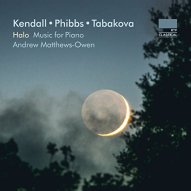
51wyuc5onpl‘Halo’ is Andrew Matthews-Owen‘s first solo disc. A highly sought-after collaborative pianist and song accompanist and noted champion of contemporary music, Matthews-Owen showcases his affinity for this repertoire in this rewarding recording of contrasting works by Joseph Phibbs, Dobrinka Tabakova and Hannah Kendall. Phibbs’ Preludes (2016) were dedicated to Matthews-Owen and are short aphoristic works whose spare simplicity, delicate melodic fragments and piquant harmonies are redolent of Schoenberg’s Kleine Klavierstucke. Matthews-Owen’s directness and clarity allows these short works to speak for themselves. Dobrinka Tabakova’s ‘Modétudes’ – brief “studies” based on the main modes (Dorian, Lydian, Phrygian etc) – are characterful miniatures whose individual musical personalities Matthews-Owen delineates with delicacy and precision, alert to their ever-shifting moods. They are folksy in their idioms and immediately accessible to the listener. Hannah Kendall’s ‘On a Chequer’d Field Array’d’ is a work in three parts, inspired by a game of chess: again, Matthews-Owen is always sensitive to the contrasts and switches of emotion in this music. Tabakova’s ‘Nocturne’ is delightful, delicate and songful, while her ‘Halo’, evoking a lunar halo seen one summer’s night, is powerfully atmospheric (the second movement, ‘To blinding shine’ for example, begins with bright rapidly repeating notes, interjected with a hymn-like motif, somewhat reminiscent of Hovhaness’s Visionary Landscapes, before moving into far more dramatic territory). This disc is a splendid advocate for contemporary piano music from a performer whose understanding of and affinity for this music is clear from the very first note to the last.

Recommended.


Guest CD review by Adrian Ainsworth

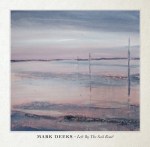
This is a solo piano album of austere wonder. Composer and performer Mark Deeks hails from Northumberland, and in tribute to his home patch, the eight original pieces here are named in the county’s old dialect (the album also includes a cover version of John Ireland’s ‘Sea Fever’). A water theme runs through the record like a river, with tracks named for waves, floods, showers, ice… so we have, in some ways, a tone poem: a suite of works that, over its running time, builds a picture of the North Sea coastline in audio.

To do this successfully, there would have to be a starkness to underpin the picturesque, and MD achieves that balance perfectly – the music is beautiful throughout, but favours sparse reflection over ‘prettiness’. I think listeners of Glass, say, or Satie would find much to enjoy in these pieces: that’s not to simplify and say that MD is ‘like’ those composers – more that he also prizes the effects of a rhythmic pattern, the power of a silence, and the value of unhurried contemplation.

While the album sustains a coherent mood, close and repeated listening reveals the individual personalities of each track, the way they embody their liquid titles. For example, opening track ‘Wǽg’ (‘Wave’) features an undulating rhythm in the bass, perhaps unsurprisingly – but above that, the melody not only turns about itself in an ebb and flow movement, the chords cut across the bassline as if ‘breaking’ onto the shore. While later in the sequence, ‘Scúr’ (‘Shower’) moves the initial, insistent rhythm into the right hand, as if the rain is starting to pitter-patter onto the ground.

The superb ‘Flódas’ (‘Floods’) moves along with a more hyperactive, unpredictable gait, and ramps up the intensity until the melody almost breaks – bursts its banks. While the serene ‘Gyrwe’ (‘Wetlands’) – for me, one of the album’s absolute highlights – allows its left-hand to glide calmly while the restrained, delicately-judged interventions of the right-hand conjure up the momentary drips and breeze-driven disturbances from the reeds and grasses.

I was completely won over by this record’s confident restraint: give it time and drift through its space.

It’s also worth mentioning that, perhaps due to its steady pace and focus on melodic ambience, much of the suite sounds accessible to fellow pianists – and sure enough, Mark Deeks has produced a very limited run of sheet music for the album, available to buy alongside the CD. To buy either – or, let’s not be coy, both, you can visit the artist’s Bandcamp page for the album here.


Adrian Ainsworth writes for a living, but mostly about things like finance, tax and benefits. For light relief, then, he covers his obsessions – overwhelmingly music, but with sprinklings of photography and art – on the ‘Specs’ blog, which you can find at http://www.adrianspecs.blogspot.co.uk

Twitter: @Adrian_Specs

I would say to a young composer – be a rebel! Write something in D major, annoy your professor, but make it so damned interesting and beautiful that he/she has nothing to say; that is the real challenge for us now.

– David Braid, composer

Welsh-born composer David Braid is something of a rebel himself. In his music, he eschews the atonality, dissonance, and complexity which are so often hallmarks (and clichés) of contemporary classical music in favour of a personal compositional voice which draws inspiration from Sweelinck and Dowland to Britten and Messiaen, but which is in itself hard to categorise. It’s melodic and tonal with a spare lyricism and simple harmonic language which recalls early music and the distinctly “English” soundworlds of Vaughan Williams and Britten, as well as folk music with occasional jazz-infused harmonies, but this is most definitely not “crossover” repertoire.

Beautifully crafted and performed with elegance and expression by an ensemble of fine musicians, including mezzo-soprano Emily Gray, flautist Claire Overbury, and clarinettist Peter Cigleris, with David Braid himself on archtop guitar, the music on this album is accessible yet sophisticated. Braid’s archtop guitar, a hollow steel-stringed acoustic or semi-acoustic instrument with a full body and an arched top (hence its name), brings a clean, lute-like sound to the music, redolent of Dowland’s songs and Lachrimae, and the perfect foil for Emily Gray’s translucent mezzo voice. The combinations of instruments are original and intriguing – piano and archtop guitar work together surprisingly well, the piano sympathetic to the smaller voice of the guitar. The refined simplicity of Braid’s music is really captivating and it is a real pleasure to hear music which is immediately engaging to the ear.

With comprehensive liner notes written by David Braid and an excellent sound quality which is both direct and intimate, this album comes highly recommended.

cover28575

Catalogue No: MSV 28575
EAN/UPC: 809730857522
Artists: Claire Overbury, David Braid, Elena Zucchini, Emily Gray, Peter Cigleris, Rossitza Stoycheva, Sergei Podobedov
Composers: David Braid
Release Date: October 2017
Total Playing Time: 76:35

Further information

djceosrw0aaw1e1

I have British pianist Joseph Tong to thank for introducing me to the wonderful piano music of Jean Sibelius: Joseph played a selection of miniatures, ‘The Trees’, at a concert for my local musical society, which revealed the variety and expressive qualities of Sibelius’ writing for the piano, too often overlooked when compared to the statue and popularity of his symphonies.

Joseph is a keen champion of Sibelius’ piano music and has traveled to the composer’s home in Finland to play his piano. In his recordings of Sibelius’ piano works, Joseph seeks to demonstrate the composer’s command and understanding of the instrument through a selection of works written during the main periods of the his creative life. There are crisp textures, folk melodies, rhythmic dances and imaginative part-writing. This volume contains Sibelius’ most significant large-scale work for piano, the Piano Sonata in F, Op 12, and one of his best-loved orchestral transcriptions, the Valse triste, which opens as a melancholy waltz that grows into something more far expressive, romantic and upbeat (though always tinged with poignancy, not unlike Ravel’s La Valse).

The miniatures on this disc, the Six Bagatelles, Five Characteristic Impressions and Four Lyric Pieces have a quirky individuality, with their hints of folk idioms, lyrical melodic inspiration and pianistic challenges. Joseph is alert to the changing characters and moods of these miniature marvels and brings warmth and affection to his sound and interpretation.

In planning the running order for the disc, Joseph wanted to combine “large-scale works with shorter pieces (or sets of pieces) in a way which might mirror a concert programme” and so the recording closes with a fine reading of Sibelius’ early Piano Sonata in F, a large-scale work rich in late-Romantic expression which fully utilises the modern piano’s resources. It has a Rachmaninoff-like spaciousness to it – the piano music of both composers seems to acknowledge and express the vastness of their homelands (even when writing in miniature form), though Schumann is a more likely influence in Sibelius’ early piano writing. The first movement certainly shares Schumann’s extrovert exuberance and brilliance. The middle movement, Andantino, is more restrained, a simple hymn-like melody with an accompaniment of syncopated chords, which becomes more florid in the middle part of the movement. The finale is rambunctious cheerful rondo, driven by its motoring rhythms and busy theme, which ends in virtuosic cascades of notes.

Like the previous volume, this is a rewarding compilation, revealing Joseph’s affinity with the music and its composer in his depth of tone, varied colours and musical understanding. The recording quality is excellent, with an immediacy of sound which suggests a live concert performance (and I was fortunate to hear Joseph perform the Piano Sonata and shorter works at his recent concert at St John’s Smith Square to launch this recording).

Sibelius’ piano music is accessible and satisfying to play, and I urge pianists to seek out this excellent survey.

Recommended