djceosrw0aaw1e1

I have British pianist Joseph Tong to thank for introducing me to the wonderful piano music of Jean Sibelius: Joseph played a selection of miniatures, ‘The Trees’, at a concert for my local musical society, which revealed the variety and expressive qualities of Sibelius’ writing for the piano, too often overlooked when compared to the statue and popularity of his symphonies.

Joseph is a keen champion of Sibelius’ piano music and has traveled to the composer’s home in Finland to play his piano. In his recordings of Sibelius’ piano works, Joseph seeks to demonstrate the composer’s command and understanding of the instrument through a selection of works written during the main periods of the his creative life. There are crisp textures, folk melodies, rhythmic dances and imaginative part-writing. This volume contains Sibelius’ most significant large-scale work for piano, the Piano Sonata in F, Op 12, and one of his best-loved orchestral transcriptions, the Valse triste, which opens as a melancholy waltz that grows into something more far expressive, romantic and upbeat (though always tinged with poignancy, not unlike Ravel’s La Valse).

The miniatures on this disc, the Six Bagatelles, Five Characteristic Impressions and Four Lyric Pieces have a quirky individuality, with their hints of folk idioms, lyrical melodic inspiration and pianistic challenges. Joseph is alert to the changing characters and moods of these miniature marvels and brings warmth and affection to his sound and interpretation.

In planning the running order for the disc, Joseph wanted to combine “large-scale works with shorter pieces (or sets of pieces) in a way which might mirror a concert programme” and so the recording closes with a fine reading of Sibelius’ early Piano Sonata in F, a large-scale work rich in late-Romantic expression which fully utilises the modern piano’s resources. It has a Rachmaninoff-like spaciousness to it – the piano music of both composers seems to acknowledge and express the vastness of their homelands (even when writing in miniature form), though Schumann is a more likely influence in Sibelius’ early piano writing. The first movement certainly shares Schumann’s extrovert exuberance and brilliance. The middle movement, Andantino, is more restrained, a simple hymn-like melody with an accompaniment of syncopated chords, which becomes more florid in the middle part of the movement. The finale is rambunctious cheerful rondo, driven by its motoring rhythms and busy theme, which ends in virtuosic cascades of notes.

Like the previous volume, this is a rewarding compilation, revealing Joseph’s affinity with the music and its composer in his depth of tone, varied colours and musical understanding. The recording quality is excellent, with an immediacy of sound which suggests a live concert performance (and I was fortunate to hear Joseph perform the Piano Sonata and shorter works at his recent concert at St John’s Smith Square to launch this recording).

Sibelius’ piano music is accessible and satisfying to play, and I urge pianists to seek out this excellent survey.

Recommended


pfcd065Lambert’s Clavichord Op. 41 (HH 165)

Howells’ Clavichord Book I (HH 237)

Julian Perkins, clavichord

Prima Facie PFCD065/66

The intimate tinkling twang of the clavichord immediately suggests Tudor galliards and other courtly dances, and songs written to fair ladies and noble knights. Herbert Howells was introduced to the clavichord by Herbert Lambert (1881-1936), a photographer and clavichord maker, and began composing miniatures for the instrument, delighting in its expressive qualities, colours and surprising range of harmonics. His two sets of pieces for clavichord, ‘Lambert’s Clavichord’ and ‘Howells’ Clavichord’, pay homage to Tudor keyboard music such as the Fitzwilliam Virginal Book, with which Howells would have been familiar, and exploit the same textures, gestures, idioms, cadences, piquant harmonies and expression inherent in Tudor keyboard works. Writing about Lambert’s Clavichord in 1928, organist and musical scholar Dr (later Sir) Richard Terry observed: “Mr Howells has absorbed all the wealth and variety of Tudor rhythms, but keeps his own individuality intact. His music is modern inasmuch as he uses chords and progressions unknown in Tudor times, but the spirit of the old composers is there all the while.”

There are galliards and pavanes, fancies and groundes in Howells’ two suites, pieces common to Tudor and Renaissance dance suites, and Howells plays on the organisation of Tudor keyboard suites by giving his miniatures titles such as ‘My Lord Sandwich’s Dreame’, ‘De la Mare’s Pavane’ and ‘Sir Richard’s Toye’. The pieces are warm, witty salutes to Howells’ friends and fellow composers. Howells intended them to be thus – “to my friends pictured (or at all events affectionately saluted) within” – with references to the dedicatee’s own music, or in tribute of their life and work (for example, ‘Finzi’s Rest’ was written the day after Gerald Finzi died and its simple melody is a fitting honour to Finzi’s writing). Meanwhile, in ‘Walton’s Toye’, the opening theme suggests William Walton’s ‘Crown Imperial’, but it is quickly overtaken by rapid quavers which give the piece propulsion and animation. Some pieces are jazzy, replete with unexpected dissonances and satisfying resolutions; others are lyrical and tender. Some pieces stray into the realms of pastiche, but never to the extent that the musical strength and imagination is lost.

There is nothing po-faced or academic about the playing on this double disc album, and Julian Perkins brings vibrancy and colour to his performance, using a selection of clavichords for the recording by Dolmetsch and Goff.

Howells never intended the suites to be confirmed to the clavichord or harpsichord alone, and these pieces are equally delightful on the modern piano (a notable recording by John McCabe is worth exploring for comparison). The pieces are within the reach of the intermediate to advanced pianist.

This is the first complete recording on clavichord of this music, and this new recording is dedicated to the memory of Ruth Dyson, noted pianist, harpsichordist and clavichord player, in her centenary year.

There is some background hiss on the recording (more obvious when listening through headphones), but the instruments themselves sound bright and richly coloured. Comprehensive liner notes by Andrew Mayes, together with a note on the instruments by Peter Bavington and performance notes by Julian Perkins.

Release date: 3 November 2017.

Further information

xl1430177

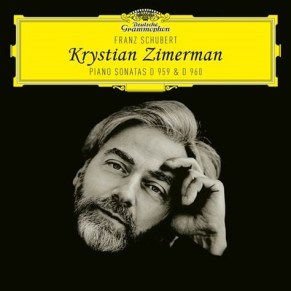
I missed Krystian Zimerman’s London concert last April when he stood in for the indisposed Mitsuko Uchida and gave what was by all accounts a remarkable performance of Schubert’s last two sonatas, works written in the dying embers of the young composer’s life yet imbued with nostalgia, warmth, an intoxicating bitter-sweetness and, ultimately, hope.

It’s rare for Zimerman to come to London; even rarer for him to release a new disc. He feels that high-quality digital recordings have created a homogeneous sound and style, robbing art music of spontaneity and leading audiences to expect perfection on disc and in concert (something I largely concur with, based on my regular concert-going). Thus, he’s very particular about what and when he records. This is his first recording of Schubert’s last two sonatas and his first solo album for a quarter of a century – and my goodness it was worth the wait! The recording was made in Japan using a Steinway with Zimerman’s own keyboard (which, incidentally, he made himself) inserted into the instrument (like the great pianists of the past, such as his mentor Arthur Rubinstein, he travels on the condition that his own instruments and/or separate, particularly-voiced keyboards accompany him, to suit the repertoire he is performing). The result is impressive, the bespoke action producing a sweetly singing tone and wonderful clarity. In the liner notes (which take the form of an interview) Zimerman explains that the special piano action “is designed to create qualities Schubert would have known in his instruments. Compared to a modern grand piano, the hammer strikes a different point of the string, enhancing the ability to sustain a singing sound…..

But of course it’s not just the bespoke action which makes Zimerman’s sound so special. No, there is more, much more to this performance. Overall, there is an immaculate sense of pacing, so sensitive and natural; the first movement of the final sonata, for example, unfolds like a great river plotting its final course, the hymn-like first subject theme imbued with joyful purpose which gives the music forward propulsion without ever sounding hurried (it’s a leisurely mässig). In the first movement of the D959, the grandeur of the opening sentence gives way to the wistfulness and intimacy of an impromptu  – and immediately Zimerman’s sense of phrasing is revelatory, shedding light on details hitherto skimmed over by others and demonstrating a complete understanding of Schubert’s architecture and narrative, both within movements and the works as a whole.

Throughout, there is subtle rubato in his contouring of phrases, thoughtful use of agogic accents to highlight intervallic relationships or strikingly piquant harmonies (so much a feature of Schubert’s late music), a Mozartian clarity in the passage work and repeated chords (for example in the development sections of both first movements) and an understanding of Schubert’s very specific rests and fermatas – attention to tiny details which create remarkable breathing spaces and enhance the structural expansiveness and improvisatory character and modernity of this music. Restrained use of the sustain pedal creates transparent textures, most notably in the slow movements: the Andantino of the D959, too often the subject of musical “psychobabble” and emotional wallowing, has a desolate gracefulness in its outer sections which contrast perfectly with the hysteria of the central “storm”. When they come, the Scherzi (both marked Allegro vivace) are light and ebullient, though Zimerman is always aware that Schubert is often more tragic when writing in the major key. In sum, every bar is carefully considered and insightful, yet at no point does this music sound fussy, overly precious or reverential. This is some of the most natural Schubert playing I have encountered and it suggests an artist with a long association with and deep affection for this music

As regular readers of this blog will know, I have spent the last three years studying and learning Schubert’s penultimate piano sonata, D959. It has become something of an obsession for me, initially forming the bulk of my programme for a Fellowship Performance Diploma and now a piece of music I simply can’t let go of. I have heard many recordings of the sonata from Schnabel and Cherkassy to Andsnes, Leonskaja and Barnatan, in addition to five live performances (including by Piers Lane, Andras Schiff, Richard Goode and mostly recently Paul Berkowitz). When one spends so much time with a single piece of music, one can grow fussy, pedantically so, about how this music is presented in concert and/or on disc – so much so that I have stopped seeking out the work in concert because I listen far too attentively and critically for my own good…..and talking of “Goode”, the one and only live performance I really enjoyed, the one which left me with the feeling that this was how Schubert would have wanted his music performed, was by the American pianist Richard Goode at the Royal Festival Hall in May 2016 (of which more here). In Krystian Zimerman I have found my new benchmark, not just for the D959 but as a demonstration of how Schubert’s piano music should be played.

Very highly recommended

Such is the spell of your emotional world that it very nearly blinds us to the greatness of your craftsmanship

– Franz Liszt on Franz Schubert

Franz Schubert/Krystian Zimerman/Piano Sonatas D 959 and D 960

Deutsche Grammophon

00028947975885

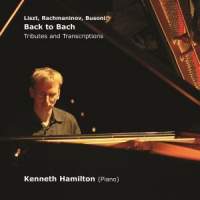
primafaciepfcd061……make it Kenneth Hamilton’s new disc ‘Liszt, Rachmaninov, Busoni: Back to Bach – Tributes and Transcriptions’

Liszt- Fantasy and Fugue on the theme BACH. Variations on a Theme of Bach ‘Weinen, Klangen, Sorgen, Zagen’.

Bach/Rachmaninov – Suite from the Violin Partita in E Major.

Bach/Busoni – Choral Prelude ‘Nun komm der Heiden Heiland’. Chaconne from Violin Partita in D Minor. Chorale Prelude ‘Ich ruf zu Dir, Herr Jesu Christ’.

PRIMAFACIE 061

This rewarding new disc of the music of Bach viewed through the lens of three great Romantic composer-pianists forms the first in the Prima Facie labe’s Heritage Series, which aims to shine a new light on familiar repertoire

Kenneth Hamilton’s imaginative playing is clearly founded on a passion for this repertoire combined with his extensive study of nineteenth-century pianism*, which includes historic recordings by Rachmaninov and Busoni themselves and the reminiscences of pupils of Franz Liszt. Thus one has the sense of very “informed” playing (though it never becomes overly intellectual nor dry). Thus the Bach-Busoni Chaconne features the revisions from Busoni’s own piano roll of the work, while the heartfelt performance of Liszt’s Variations on “Weinen, Klagen” reflects Liszt’s own performance advice, as well as Hamilton’s assertion that the work is an emotional tribute to Liszt’s children Daniel and Blandine, whose tragically early deaths are depicted in the music. But like Mahler’s Kindertotenlieder (Songs of the Death of Children), which this work seems to foreshadow, it ends on a note of hope for future redemption.

The two works by Liszt bookend this satisfying recital disc. Virtuosic in scale, the Fantasy and Fugue on the theme BACH and Variations on a Theme of Bach ‘Weinen, Klangen, Sorgen, Zagen’ pay tribute to the genius of Bach through Liszt’s distinctive pianistic voice, but these are not show pieces. Here we find Liszt at his most serious and ruminative. and Hamilton’s clean, sensitively-nuanced playing reveals the dramatic contrasts in this music from quiet introspection to impassioned gestures.

This contrasts well with the works by Busoni which are played with warmth and refinement, with clear attention to the sophisticated harmonic details and voicing. The Bach/Busoni Chaconne, too often ponderous in the hands of the less skilled, is here grandly expansive, but never heavy. The interior details and individual voices have a lucid clarity which brings the music to life with ever-increasing drama.

Meanwhile, Rachmaninov’s glittering transcription of the Violin Partita in E major provides a joyful and witty interlude. In a way, this is the closest of all the transcriptions presented here to Bach’s original, but infused with Rachmaninov’s inventive, muscular textures (the Prelude has contrapuntal elements redolent of the Etudes-Tableaux) and piquant harmonies.

This is a splendid tribute not only to J S Bach but to the ingenuity and superlative pianism of three great composer-pianists of the golden age, pianism which is matched by Hamilton’s own.

Highly recommended


*Hamilton, Kenneth: After the Golden Age: Romantic Pianism and Modern Performance (Oxford: OUP, 2008)


Kenneth Hamilton is a concert pianist, writer and broadcaster, and former student and colleague of Ronald Stevenson.