For one night only, audiences at the Wigmore Hall were treated to a glimpse of the hall’s origins, in those pre-First World War days when it was Bechstein Hall and home to the German piano maker C. Bechstein’s London showroom.
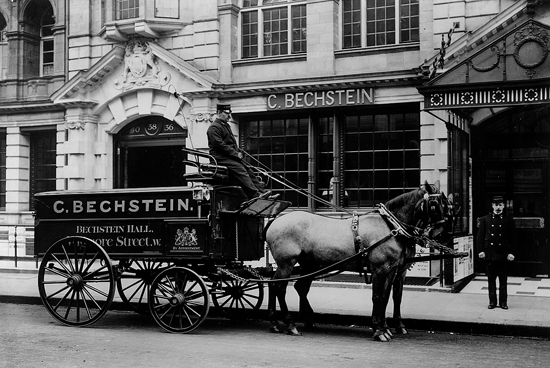
bechstein-hall

When Bechstein Hall opened in 1901, Bechstein was Europe’s leading piano maker (it produced 5000 pianos in 1901),  its instruments preferred by most pianists outside America, where Steinway predominated. The Bechstein piano company built similar concert halls in Paris and St Petersburg to showcase its instruments and the leading performers and singers of the day. With its special barrel roof “shoebox” design, beloved of many musicians, the hall still boasts a fine acoustic, while its small size (its capacity is c600 seats) makes it the perfect place to enjoy intimate chamber and piano recitals.

At the beginning of the twentieth century Bechstein Hall on London’s Wigmore Street was promoted as the best of places for intimate music making, and boasted unrivaled comfort and facilities for patrons and artists with its elegant green room up a short flight of stairs behind the stage (so that singers did not arrive on stage breathless). At the time of its opening, concert life and leisure in general in London were enjoying something of a revolution. Theatres and music halls were opening across the west end, a wide public was being introduced to the experience of shopping for pleasure in the new “department stores” (Selfridges is a mere 10 minute walk, at the most, from Wigmore Street), and with cheap and efficient public transport, it was easy for people to enjoy these delights in the centre of the metropolis. A new breed of international concert promoters, agents and impresarios, such as Robert Newman, who with conductor Henry Wood founded the world-famous Proms, were dedicated to organising high-quality recitals, and Bechstein Hall alone scheduled two hundred concerts a year.

During the First World War, it became increasingly difficult for Bechstein Hall to trade viably. Strong anti-German sentiments and the passing of the Trading with the Enemy Amendment Act 1916 led to the hall’s closure in June 1916, and all property including the concert hall and the showrooms was seized and summarily closed. The hall was sold at auction to Debenhams, was rechristened Wigmore Hall and opened under its new name in 1917. Today Wigmore Hall enjoys an international reputation for high-quality music in an elegant and intimate setting.

To give the modern audience a flavour of those halcyon pre-war days of concertising in London, the French pianist Pierre-Laurent Aimard gave a concert on an 1899 Bechstein grand piano, a piano which may well have been sold out of the Bechstein piano showroom next door to the hall on Wigmore Street.  The concert, which included music by composers active at the time when the Bechstein piano company was at the height of its powers, was preceded by a talk with Pierre-Laurent Aimard, Peter Salisbury, a leading piano technician who restored the piano, and composer Julian Anderson, whose work ‘Sensation’, written for Pierre-Laurent, had its London premiere at the concert.

As Pierre-Laurent Aimard explained, the event was the culmination of a long-held dream: to present a concert of the kind of repertoire and composers – and instrument – contemporary with the hall when it first opened. Peter Salisbury talked about the difficulties of preparing a piano for a specific hall, for each space has its own distinct acoustic and the piano must be adjusted and voiced to suit venue, performer and repertoire. When the 1899 Bechstein was brought into Wigmore Hall, Peter noted how closely instrument and venue suited each other, evidence that Bechstein built concert halls to showcase their instruments at their best – and vice versa!

Prior to the First War, piano design and manufacture was still evolving, and each make had its own distinct sound and character. Bechsteins of this period are notable for their special resonance and projection, which result from their manufacturing process. Pierre-Laurent commented on the piano’s uniquely rich palette of colour and tones, combined with great clarity. Every note seems to have “many overtones”, resulting in an orchestral sound which is rich but not cloying.

For composer Julian Anderson, the Bechstein piano has a special place in his life: his own piano is a 1913 Bechstein, passed on to him from his father, and is the instrument on which he composes. He admitted a “great affection for the Bechstein tone”, and that it has a range of colour which “encourages metaphor” and makes it easier to imagine other sounds or instruments when composing.

The 1899 Bechstein has been restored by Peter Salisbury and retains the original soundboard and bridge. A new mechanical action was fitted to provide technical accuracy, with new hammers voiced according to Bechstein’s original sound concert. An attractive instrument with a polished black case with scrolled details, the piano has turned legs and a fan-shaped music desk. The instrument is 275 cms (9 foot)long, with 88 notes (not all pianos were at that time – my Bechstein has 85 keys), and it took 3 months to rebuild it fully. For Peter the piano represents “a portal to the past, a lost era of tonal distinction”.
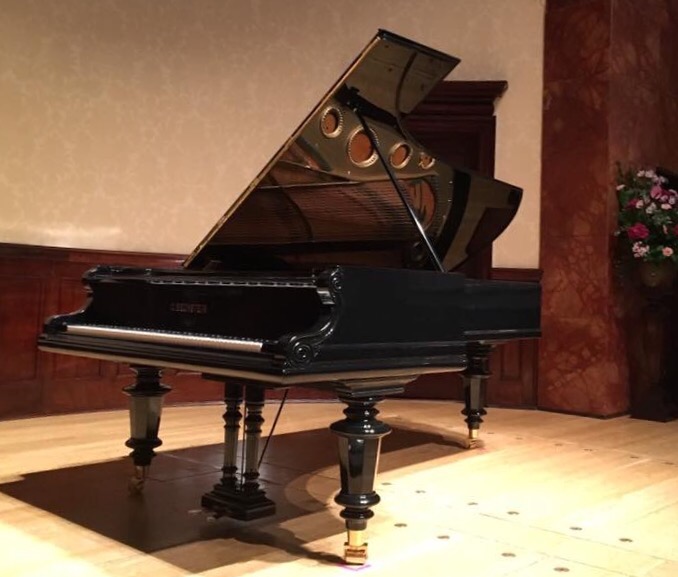
Peter Salisbury’s 1899 Bechstein concert grand on the stage at a Wigmore Hall

After 1910, piano design and manufacture became standardised across makes, and today most concert pianos (most commonly Steinway) have a consistency of sound and touch which enables performers to move fairly effortlessly between a piano in a Tokyo concert hall and one in London or New York. Concert pianos have also grown bigger to project into larger halls, and in the 10 years that I’ve been going t concerts regularly, I’ve noticed the sound of these pianos is, generally, much brighter and often quite strident.

As the owner of a 1913 Bechstein model A, I was very curious to hear this slightly older piano in a concert setting in an acoustic for which it was built. The programme included music by Liszt (the first version of Harmonies poétiques et religieuses), Scriabin and Debussy (both of whom owned Bechstein pianos), Julian Anderson (b.1967)!and Nikoly Obukhov, a colouristic Russian composer whose music bridges the Russian and French compositional traditions of the first decade of the twentieth century. The first half of the concert proceeded without interruption for applause (something with several audience members near me seemed to find quite “difficult”, though I enjoyed the flow of music from one composer to another). From the first notes of the Liszt, I felt I was hearing my own piano in concert – those distinct resonances and layers of colour which drew me to my instrument when I first played it in my tuner’s workshop were made more explicit in Pierre-Laurent’s hands. A surprisingly deep bass resonance, but clear and bell-like, without the chocolatey Sachertorte richness of a Bosendorfer, and a remarkable sustain with unexpected harmonics evident in the sound decay. In the Scriabin pieces, the piano’s multi-faceted sound came to the fore, responding perfectly to Scriabin’s sensual textures with harmonies superimposed on different registers and layered overtones.

The selection of Debussy’s Études was particularly fascinating. Here Pierre-Laurent balanced clarity with tonal sensitivity and the studies burst into to life with delightful shifting colours. The sweet lucid treble was wonderful, so different to the rather strident treble sound one finds in modern instruments, and there were further opportunities to enjoy this sound in the works by Julian Anderson and Nikolay Obukhov. Despite the piano’s resonance and sustain, there was no sense of the sound being too big or overly domineering (again an issue, for me at least, with modern concert grands in medium-sized or small venues). For me, the highlights of the evening, aside from the opportunity to hear this period piano in concert, were the works Debussy and Obukhov – had I not seen the programme, I would have thought the latter was post-Vingt Regards Messiaen, yet this was music written prior to the Russian Revolution, avant-garde and way ahead of its time.
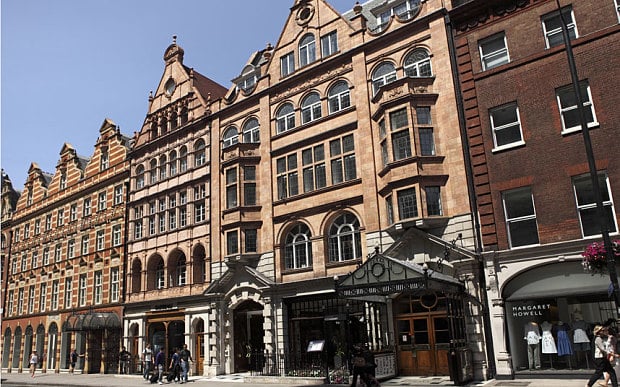
67741286_mandatory_3340468b
Wigmore Hall today (photo: The Telegraph)

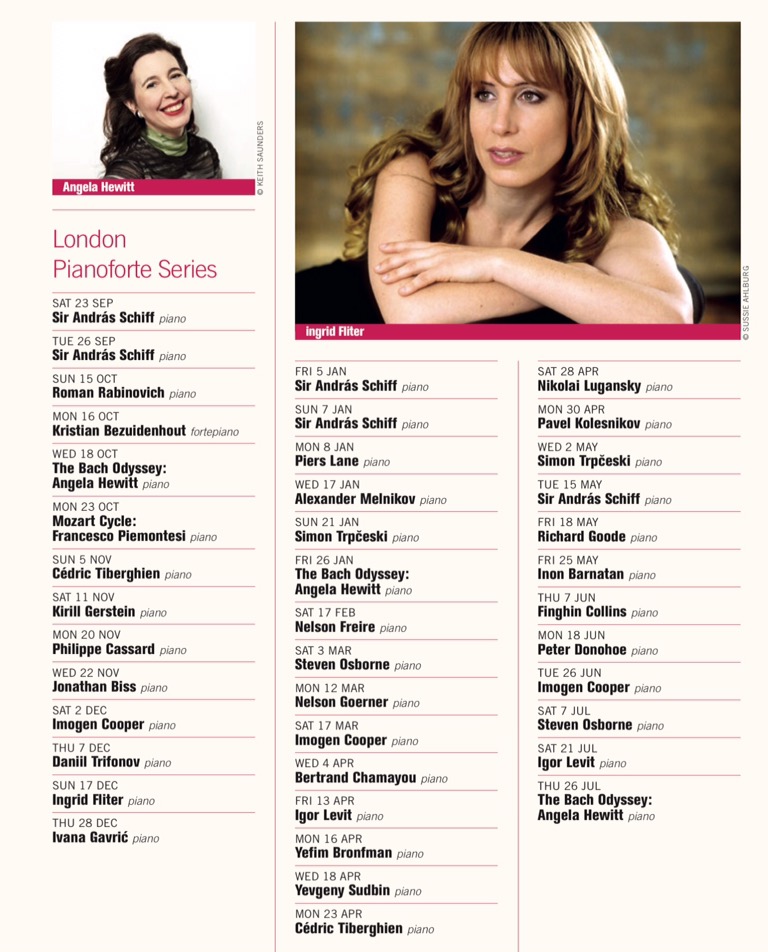
The Wigmore Hall’s 2017/18 season has been announced, and in addition to a really splendid variety of chamber music and performers, piano fans can look forward to a fantastic line up of pianists including Sir Andras Schiff, Peter Donohoe, Imogen Cooper, Steven Osborne and Angela Hewitt, as well as young rising stars Daniil Trifonov and Pavel Kolesnikov, amongst many others. 

Sadly, there are only four women pianists in this impressive roster.

The full list is here: 

Another music-filled year, many hits, a few misses, some new discoveries – musicians, venues, repertoire and people – and a couple of memorable performances of my own, solo and with colleagues…..

January

Pavel Kolesnikov (Wigmore Hall) – What impressed me in Pavel Kolesnikov’s performance was his clarity, control, lightness of touch and musical understanding which revealed the hidden nuances and subtle embroideries in Debussy’s writing. His elegant, sensitive pianism created a concert which was highly engaging and deeply intimate. Review here

The Pink Singers (Cadogan Hall) – a gloriously uplifting evening of fine singing and the premiere of a piece for choir written by a colleague of mine.

Deyan Sudjic (Wigmore Hall) – This was the pianist who asked the Washington Post to remove what he felt was an unfavourable review, and I admit I was curious to hear this pianist after reading about this furore….. Review here

Warren Mailley-Smith (St John’s Smith Square) – A concert in Warren’s series exploring Chopin’s complete piano music.

February

Steven Osborne (St John’s Smith Square) – The first of two wonderful concerts by this exceptional pianist which I enjoyed in 2016. Review here

Piotr Anderszewski (Wigmore Hall) – Always a pleasure to hear this thoughtful and sensitive pianist – and an added pleasure was meeting him briefly after the concert. Review here

Nikolai Demidenko (Cadogan Hall) – Chopin Piano Concerto No. 1. Review here

Mark Swartzentruber (Kings Place) – music by Bach, Ravel and Schubert (D959- one of the may performances of this work which I have been studying)

Divine Fire – The Story of Chopin and Sand told in music and words, performed by Viv McLean (piano) and Susan Porrett (narrator). More about this 7 Star Arts mixed media concert here

Denis Kozhukin (Wigmore Hall) – “sweet sonorities and ravishingly spacious phrases, creating a sense of relaxed ecstasy” Review here

March

Akhenaten (ENO/Coliseum) – an enthralling new production of Philip Glass’s opera. Review here

Leif Ove Andsnes & Friends (Dulwich Picture Gallery) – an engaging and varied concert of music by Nordic composers to coincide with an exhibition of paintings by Nikolai Astrup. Review here

Francoise-Green Duo (St John’s Smith Square) – part of the FG Duo’s Viennese Salon residency, appropriately as I flew to Vienna the day after this concert. Review here

Pierre-Laurent Aimard (Vienna Konzerthaus) – I couldn’t go to Vienna and not go to a concert! A romantic and uplifting performance of Beethoven’s 5th Concerto by PLA.

Nazrin Rashidova (violin) & Daniel Grimwood (piano) (St James’s Piccadilly) – lovely mixed programme of music by Mozart and Poulenc, plus Daniel’s Nocturne, which was, for me, redolent of Liszt and Ravel. Beautiful colourful playing by Nazrin, sensitively accompanied by Daniel. I was lucky enough to hear this fine duo again in November in Wimbledon.

Peter Jablonski (Cadogan Square) – Ravel’s glorious G major Piano Concerto and Gershwin’s exuberant hommage to New York, Rhapsody in Blue, performed by a pianist whom I had the pleasure to meet and interview shortly before the concert.

Beethoven Choral Fantasy Op 80 & Brahms German Requiem – a wonderful performance of Beethoven’s Choral Fantasy by my friend Elspeth Wyllie, followed by an absorbing German Requiem, at St Luke’s Balham

St John Passion/Bach (SJSS) -Polyphony and the OAE, conducted by Stephen Layton. A stunning and very moving performance of Bach’s greatest Passion, on Good Friday.

April

Andras Schiff, The Final Sonatas (Wigmore Hall) – the penultimate piano sonatas of Haydn, Mozart, Beethoven & Schubert. My first encounter with Andras Schiff live in concert. Review here

Iphigénie en Tauride (Drayton Arms Theatre) – startling and immediate “opera in a pub”, by Euphonia Opera Co. Review here

St John Passion/Bach (SJSS) -Polyphony and the OAE, conducted by Stephen Layton. A stunning and very moving performance of Bach’s

Rolf Hind (Wigmore Hall) – unusual and sometimes challenging contemporary music for piano by the pianist with the deepest, most elegant bow in London 🙂

Pierre-Laurent Aimard/Vingt Regards (Milton Court) – my first visit to Milton Court at Guildhall. A remarkable concert in a fine acoustic. Review here

May

The Dark Mirror: Zender’s Winterreise with Ian Bostridge (Barbican Theatre) – a wonderfully quirky yet sensitive and highly atmospheric reworking of Schubert’s late great song cycle. Review here

Concert for North-West Music Trust (Altrincham) – me at the piano in this instance, playing music by Mendelssohn, Cheryl Frances-Hoad and Schubert (D959). My first “proper” concert of my fellowship diploma programme to a very friendly audience and lovely welcoming hosts.

BBC Young Musician Final – an inspiring and uplifting final to the 2016 BBC Young Musician Competition. Review here

Richard Goode – Schubert’s Last Three Sonatas (Royal Festival Hall) – a perfect evening of beautiful piano playing. The finest reading of the D959 for me….. More here

Steven Osborne/The Music of Silence (Milton Court) – back to Milton Court for music by George Crumb and Morton Feldman. Review here

June

The Threepenny Opera (National Theatre) – a delightfully dirty, louche, foul-mouthed and witty production with fine performances by Roy Kinnear and Haydn Gwynne

Piano 4-hands at Conchord Festival (St Mary’s Twickenham) – a new local music festival in Twickenham. Review here

July

Daniel Grimwood/Markson Pianos Series – Sonatas by Schubert, including the great G major, D894, performed on a magnificent Bosendorfer piano by a pianist who really understands this repertoire

August

Louis Lortie/Chamber Prom (Cadogan Hall) – my first live encounter with this pianist whose programme spoke of Italian holidays and sunshine. Review here

Scenes from the End (Camden Peoples Theatre) – one-woman opera with Heloise Werner. Review here

The Makropoulos Case/Proms

September

Proms in the Car Park – a very unusual concert experience: music by Steve Reich performed in a disused multi-storey carpark in Peckham. Review here

Music Marathon (St John’s SMith Square) – I was delighted to have the chance to perform at SJSS, albeit for 15 minutes (!) as part of the music marathon for London Open House weekend. Great to hear and meet other pianists and I made new friends too!

Nick van Bloss (Wigmore Hall) – intense and athletic Beethoven, and lovely to meet Nick in person afterwards

Igor Levit/Beethoven (Wigmore Hall) – the launch of Levit’s Beethoven sonatas cycle. Review here

October

Steven Isserlis & Olli Mustonen (Wigmore Hall) – a chance to catch up with a friend who used to be my most regular concert companion (now resident in Spain).

Liszt’s B minor Sonata – lecture & concert (Kings Place). An insightful and revealing talk by Alfred Brendel followed by a performance of a sonata which I have never liked! Review here

Two-Piano Extravaganza (Kings Place) – Part of the inaugural London Piano Festival, this concert was a feast of high-class pianism. Review here

Don Giovanni (ENO/Coliseum) – a splendidly raunchy production, made even better by our Secret Seats in the front row of the Dress Circle, plus interval champagne!

Quartet for the End of Time (SJSS) – a privilege to turn the pages for my friend the pianist Daniel Grimwood, and to enjoy the pianist’s perspective of this extraordinary work. Profound and moving.

Dina Duisen and Friends (1901 Arts Club) – music for piano and clarinet at my favourite small venue

The Prince Concert with Stephen Hough (Wigmore Hall) – atmospheric and varied songs by Stephen Hough, including the premiere of his ‘Dappled Things’. Review here

November

Steve Reich (Barbican Hall) – Electric Counterpoint amongst other minimalist wonders

Lulu (ENO) – a visually stunning new production by William Kentridge

Winterreise in English (Wigmore Hall) – revelatory performance by Roderick Williams and Christopher Glynn, the English translation bringing a startling immediacy to the narrative of Schubert’s song cycle.

December

Concert for SPIN/Specialists in Pain International (St John’s Waterloo) – I performed in a fundraising concert with a pianist colleague and soprano Anna Cavaliero. A really wonderful evening of shared music making (www.spiners.org)

Melvyn Tan at Spitalfields Music (St Leonard’s Spitalfields) – fine pianism and three premieres. Review here

Helen Burford (St Nicholas, Brighton) – a typically eclectic and imaginative concert of “global exotica” including a Tarantella for Toy Piano by Stephen Montague. Atmospheric,  quirky and elegantly presented

Russian Winter Weekend Concert (Dorich House, Kingston) – Russian music arranged for flute and harp with Alena Lugobvkina (flute) and Anne Denholm (harp) and a chance to explore the Art Deco home of artist Dora Gordine. A delightful evening

In addition, I have also enjoyed….

Discovering the organ at St John’s Smith Square (more here)

Some fine concerts at my local music society by performers including Ben Socrates, Joseph Tong, Peter Murdock Saint and Jennifer Heslop, Jelena Makarova, amongst many others

The Magic Flute (directed by Simon Burney) at ENO. Magical, quirky and beguiling.

Fine performances at London Piano Meetup Group events by people who are not professional musicians but for whom the piano is a passion, an obsession and more….

Brave (and occasionally tearful!) performances by adult amateur pianists at my workshop at the 1901 Arts Club on 3 December

Accompanying one of my students who played Massenet’s ‘Meditation’ from Thaïs in a special retirement mass for her headmistress, and accompanying a friend at her Grade 5 French Horn exam (which she passed with distinction!).

Making new friends via social media who are proving enjoyable and stimulating concert companions.

The launch of the Music into Words project which explores writing about classical music today – next event is on 12 February 2017 with a great line-up of speakers (book tickets)

And I am very much lo0king forward to 2017 when I will hear

Martha Argerich (for the first time)

Daniil Trifonov

Anna Tsybuleva (winner of the Leeds Piano Competition)

Boris Berezovsky

Pierre-Laurent Aimard

And no doubt much more besides…..


Stephen Hough, composer and pianist with The Prince Consort at Wigmore Hall, Friday 28th October 2016

An evening of music for piano and voice by pianist and polymath Stephen Hough, performed by The Prince Consort, with Hough himself playing in the second half, promised to be something intriguing and special, especially as the programme included the world premiere of Hough’s song cycle Dappled Things, dedicated to John Gilhooly, director of Wigmore Hall.

In setting poetry to music, Hough is working within a fine English song tradition that includes composers such as Purcell, Elgar, Delius, Vaughan Williams, Butterworth and Britten, and indeed there were fleeting musical glimpses of these composers within Hough’s works

Read my full review here

20160806_bkp001_0
(picture: The Economist)
