Today has been spent watching others play and being taught. Chets operates an “open door” policy which means you can go and observe other people’s lessons and attend workshops with any of the teaching faculty. From a teaching point of view, watching others being taught is highly informative; equally, as a player one gains useful insights from a teacher working with another student, and workshops/masterclasses like this are also a great way of discovering new repertoire. So, this morning I sat in on a workshop led by pianist and teacher Graham Caskie at which students played works by Liszt and Bach. While looking at the Aria and First Variation from Bach’s Goldbergs, we had an interesting discussion about reverence in music and how certain works are afforded a special elevated status (this is certainly true of the Goldbergs) which can make it harder for us to play them because we feel they must be treated in a particular way, when in fact we should simply take ownership of the music and make it ours. Graham also talked about breathing – both physical and metaphorical – in music. I enjoyed his commentary and advice to the students and found him a very thoughtful and considerate teacher.

After lunch I attended the daily Adult Amateur workshop. This runs every day for 2 hours and is led by Kathryn Page and Philip Fowke (whom I had hoped to see in action but he was rehearsing for the evening’s concerto concert). The Adult Amateur workshops give pianists of all levels an opportunity to play to an audience and receive feedback from the teacher. Kathryn is an enthusiastic, positive and highly supportive teacher who was able to give each participant some very useful nuggets of information with which to work when practising. There were some lovely performances of music by Janacek, Beethoven, Turina, Bach, and Sibelius. Once again, people’s love of the piano and its literature was really palpable.

Tonight’s concerts are all about concertos – four concertos in fact with pianists Seta Tanyel (Addinsell/Warsaw Concerto), Leslie Howard (Tchaikovsky 2), Dina Parakhina (Rachmaninoff/Rhapsody on a Theme of Paganini) and Philip Fowke (Grieg Concerto in A). It promises to be a splendid evening and an excellent way to end my weekend at Chets.
I’m up in Manchester at Chetham’s International Summer School and Festival for Pianists – or “Chets” as it’s affectionately called – for the weekend. It’s my first visit, though I have of course known about the summer school for some years and certain piano friends of mine are regulars here, some returning year after year (one is on his tenth visit!). Said piano friends have been urging me to attend, so it was serendipitous when I received an invitation from Murray McLachlan, who with his wife Kathryn Page runs the two-week event, to attend, primarily to review the public concerts which take place each evening, but also to observe some teaching and general get a flavour of the Chet’s experience.

I have written before about the attraction of attending a piano course or piano summer school and the reasons why people keep returning to Chets were quite clear from my arrival: after 5 hours travelling up from my home on the Dorset coast, I was met by smiling friendly staff at the school and shown to my room in (attendees are accommodated within the school – it’s basic but you don’t spend a lot of time in your room!). In the atrium next to the magnificent Stoller Hall (which opened in 2017), there were groups of people – pianists – talking and laughing, friends greeted one another and there was a palpable sense of excited anticipation about the days to come: the teaching, the workshops, the concerts and the socialising. This is what people come to Chets for.

The rather confusing walk to the accommodation block, the staircases and long corridors reminded me of my first day at university, navigating my way around the hall of residence where I lived, but I suspect within 24 hours I’ll have got the hang of it and it will soon seem very familiar.

A quick change and it was down to Whiteley Hall for the first concert of the evening, a very interesting programme of music with electronics and live visuals, performed Canadian pianist Megumi Masaki with composer Keith Hamel and visual artist Sigi Torinus – a full review will be posted separately. As I was making my way to a seat, I met my friend Noriko and I must say it was good to see a familiar face in the crowd. Afterwards, she, her companions and I went to supper in the school dining hall, another place which brought a rather Proustian rush of memory from university days. By the time we had queued for food, I had got to know Murray, a first-timer who is here for the new piano teachers’ course. He’s never attended a piano course of any kind before, so he’s really jumping in at the deep end having signed up for two weeks!

After supper we made our way back to the Atrium/bar at Stoller Hall for pre-concert chat and drinks before a performance of the Goldberg Variations, then more drinks and socialising ahead of the final concert of the evening, a performance of music for two pianos with Bobby Chen and Douglas Finch. Prior to this concert, I took the opportunity to chat to various people – some were Chets regulars, others were newcomers. All mentioned the quality of the teaching here as a main motivation for attending, plus the convivial atmosphere (the teaching faculty mingle with participants and take their meals in the same dining hall).

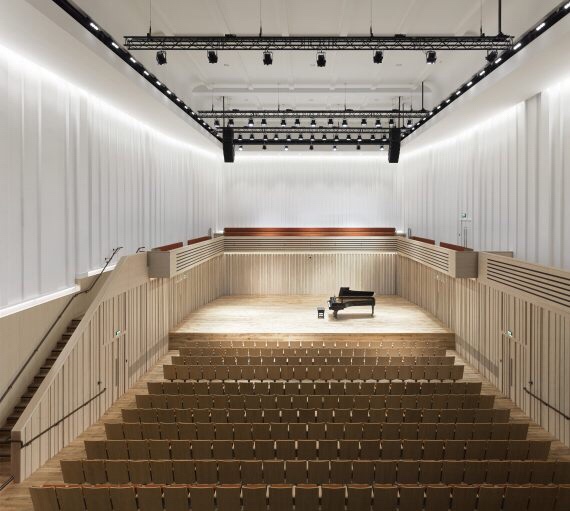
Stoller Hall

The final concert was stunning – as was the venue, a modern “shoebox” hall much like King’s Place or Milton Court, designed by Stephenson STUDIO and the recipient of a national RIBA Award, with wonderful acoustics.

I’ve been here less than half a day and already it’s clear that the Chets experience is pretty full-on. Each day has a full programme of activities from teaching and workshops to public concerts, so now I’m off to bed as I’m rather “piano-d out”!

Guest post by Emma Williams

Finchcocks is a handsome manor house in the Kent countryside, which has been filled with music since its inception in the 18th century.

Until recently, it was home to a living museum of music – which I had visited as part of a private visit. We’d had a marvellous time being let loose on the collection, which included some fine harpsichords and clavichords, square pianos (including one which belonged to Queen Victoria, made by John Broadwood & Sons), fortepianos, and grand pianos by Clementi, Pleyel, Erard and Broadwood. It’s no surprise therefore that I was sad to hear the news that Finchcocks was on the market and its exceptional keyboard museum was to be closed.

But there’s great news: the wonderful musical tradition, established by Richard and Katrina Burnett back in 1971, will be continued at Finchcocks! The new owners have announced they will be hosting regular residential piano courses at Finchcocks, and guests will be accommodated in the stunning, recently renovated 18th Century Coach House.

The first weekend piano course was held in November, run by Finchocks’ Musical Director Dave Hall, who did an excellent job engaging and inspiring a group of advanced intermediate pianists. Finchcocks’ courses will also cater for complete beginners (a welcome addition to the piano course world, as most courses are aimed at advanced players), and there’s a fabulous range of pianos to play on by Steinway, Bosendorfer, Yamaha and Broadwood. In the cellar, there are eight high-tech digital grand pianos.

My lovely piano teacher, Graham Fitch, will also be leading a few piano courses at Finchcocks next year. For more information about courses, tutors and accommodation, please visit www.finchcocks.com

Emma Williams is a keen piano player and recently attended a Finchcocks Weekend Piano Course.


Further reading

Why go on a piano course?

Courses for pianists in the UK and Europe


A three-day weekend course for adult advanced pianists (Grade 7 to post Diploma)

This exciting new course is led by tutors Dominic John and Maureen Galea, and is based in Leighton Park School, just outside Reading.

The emphasis will be on encouragement in a supportive  and friendly environment.

The course consists of individual lessons, workshops, Alexander Technique sessions and Harpsichord sessions.

Accommodation and meals are all part of this exciting course which aims to be a fun but intensive weekend.

The course will give the opportunity to meet other pianists as well as receiving expert tuition.

Course Dates

Thursday 5 April, 2018 arriving between 6 and 7 p.m. for dinner at 7 p.m., to Sunday 8 April 2018 at approx. 5 p.m.  (Times to be confirmed).

Fees

Fees for participants are £475.  Payable on booking

This is a not for profit venture but any profits that may arise will be donated to Help Musicians UK

Further information and booking https://penny560.wixsite.com/aurora

leightonparkschool1
Leighton Park School