The Thoroughly Good Classical Music Podcast invites three people who play, listen or otherwise work in classical music to sit and discuss the subject they love. They’re unplanned conversations recorded as live, very nearly unedited, and more often than not take unexpected twists and turns.
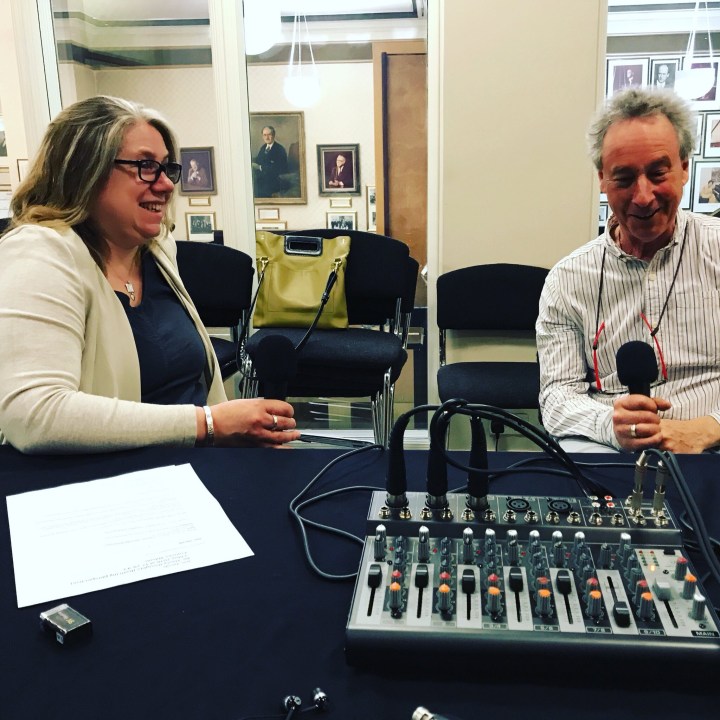
In this the second Thoroughly Good Podcast to which I’ve contributed, Adam Gatehouse, co-Artistic Director of the Leeds International Piano Competition, outlines the changes the competition has undergone since the retirement of Dame Fanny Waterman (the competition’s founder), in addition to more general conversation about communication in performance and why the core canon of the piano repertoire is special.
Facebook was abuzz with reminders of George Li’s touchdown in the Bay Area’s glittering Davies concert hall, a venue that absorbs a splash of pastel beams from the neighboring flagship government building. Glass panels reflect back montages of color that provide a rush of excitement for ticket holders slipping into seats right under the bell.
FB “friends” and faithful George “followers” were page-alerted to a ‘meet and greet’ event in the lobby following the recital. It would be a shower of support for a pianist we’d seen and heard by livestream from exotic locations including Moscow and Verbier. Frames in progress had included George’s Silver Medal triumph at the Tchaikovsky International Piano Competition, magnified on computer screens around the world!
***
The Back Story
From my humble perch in Berkeley, I’d set aside 75 conscientious minutes to get to Davies Hall. It was a conservative travel measure, given lax Sunday train schedules and my propensity to get mired in Civic Center traffic as a clueless pedestrian in foreign urban terrain. (San Francisco’s maze of complex street crossings and intersections, bundled in congestion, had always seriously confused me, impeding on-foot progress in any direction).
Yet, despite well-intended, precautionary travel efforts, I couldn’t have anticipated a vexing single platform BART crisis that launched a crescendo of complications right up to my shaky finish line arrival at Davies. There, at its entrance, my concert companion/adult piano student stood patiently, dispatching block-to-block text messages to keep me on track.
With good luck and concerted teamwork, we made it to our first tier balcony seats just as George advanced toward a shining model D Steinway grand.
It was a pure bliss erasure of prior travails:
Melted deceptive cadences rippled through a crystalline rendering of Haydn’s B minor Sonata (No. 30) as trills and ornaments immaculately decorated clear melodic lines in a liquid outpouring of phrases. The middle Minuet movement was charmingly played passing with grace to a culminating Presto in brisk, bravura tempo with unswerving attention to line, shape, and contour.
Beethoven’s “Appassionata” Sonata in F minor, op. 57, followed with tonal variation and keen structural awareness. The performance was both gripping and directional, wrapped in ethereal tonal expression.
Li’s singular sound autograph permeates his performances amidst an array of varying nuances and articulations. He has what pianist, Uchida terms “charisma” and a singular tonal personality.
Meaning and musical context are core ingredients of Li’s artistry and his wide palette of colors are at his liquid disposal through deeply felt effusions of expression. (While Li is a natural, intuitional performer, his sensitive fusion of aesthetics and intellect is always on display, exposed, as well in media interviews.)
A Presto Classical set of queries elicited thoughtful responses.
The Davies Hall recital, continued after Intermission with a rippling roll-out of works by Rachmaninoff and Liszt, all imbued with a permeating spirit of mature music-making that’s intrinsic to Li’s ongoing ripening process. And as a cap to a memorable evening of inspired artistry, George played his final encore – a pyro-technically charged Bizet/Carmen transcription that drove listeners to their feet in a chorus of BRAVOS!!!
(This snapshot was provided by a friend who had permission to publicly post it, thanks to Li’s generosity and that of his representatives)
In a culminating MEET and GREET event, post-recital, audience members had an opportunity to share IN PERSON enthusiasm and appreciation of George’s artistry, while purchasing the artist’s newly released CD.
For me, a tete a tete with George, provided an opportunity to thank him for his generosity as a teen when he delivered well-conceived responses to my reams of technically framed questions about practicing, technique, and repertoire.
Finally, here’s an encore of gratitude to George for his inspired love of music, and for his reach into our hearts with each memorable performance. Come back soon!
Shirley Smith Kirsten is an American pianist and teacher who blogs at arioso7.wordpress.com
Turkish pianist Can Çakmur has been named the 11th winner of the Scottish International Piano Competition (SIPC).
The 20-year-old receives £10,000, the Sir Alexander Stone Memorial Trophy and the Frederic Lamond Gold Medal, and will perform with the Royal Scottish National Orchestra in their 2018/19 season.
Born in 1997 in Ankara, Can Çakmur has studied at the Hochschule für Music Franz Liszt Weimar, and with Diane Andersen in Belgium. He had won a number of international competitions and awards, appeared in major festivals throughout his native Turkey, and performed as soloist throughout Europe.
Held as a triennial event, the Scottish International Piano Competition this year welcomed 23 competitors from 15 countries across 3 continents. The panel of 8 jurors included internationally acclaimed pianists Steven Osborne and Olga Kern and was chaired by Head of Keyboard at the Royal Conservatoire of Scotland, Aaron Shorr.
Second Prize of £7,500 and the Lawrence Glover Silver Medal went to Florian Mitrea, 27, from Romania. Florian also won best performance of Gordon McPherson’s The Pounding Room, a new work commissioned as the test piece for this year’s competition. Georgian born Luka Okros, 20, now based in the UK, took home the Third prize of £5000 and The Douglas McKerrell Memorial Prize. Finalists prizes were supported by SIPC Patrons and Friends, Merchants House of Glasgow, the McKerrell family and Arnold Clark.
The three finalists all performed a concerto on a Fazioli piano with the Royal Scottish National Orchestra, under Thomas Søndergård, at the Glasgow Royal Concert Hall on Sunday 10 September. This is the first time a Fazioli piano has been the choice of piano for 100% of the finalists in an international competition.
The concert, dedicated to the memory of Lady Marion Fraser, was recorded by SIPC media partner Classic FM for a Full Works concert to be broadcast at 8pm on Tuesday 19 September 2017. Videos of the performances can be watched here: https://www.youtube.com/channel/UCDefVF-0-xILpoh-Sxki9xA/videos
Since launching in 1986, the competition has enabled many talented young musicians to gain recognition at an early stage in their professional careers, many of whom have gone on to international acclaim including Tom Poster (2007), Katya Apekisheva (1998), Charles Owen (1995), Susan Tomes (second prize 1986) and Graeme McNaught (first ever winner 1986).
Held under the auspices of the World Federation of International Music Competitions, SIPC is only one of three major international piano competitions held in the UK, and the only one in Scotland.
Applications are now open for the Dudley International Piano Competition 2017
2017 marks 50 years since the Dudley International Piano Competition (DIPC) was first suggested. It then evolved in 1968 from piano classes at the Dudley Festival of Music and Drama, with a concerto final, and was held annually until 1989 when it became a biennial event and from 1991 to 1995 it was opened to competitors from overseas. The Dudley International Piano Competition then took a break and re-emerged in 2000 as a competition with a recital final open to pianists of all nationalities studying or resident in the British Isles.
Many past winners, including Benjamin Frith, Andrew Wilde, Graham Scott, Paul Lewis and Mishka Rushdie Momen have gone on to establish successful careers and past competitors have included internationally acclaimed pianists Ian Hobson, Peter Donohoe, Joanna MacGregor and Timothy Horton.
The 2017 competition once again features a concerto final at the world famous Symphony Hall, Birmingham, accompanied by the internationally renowned City of Birmingham Symphony Orchestra conducted by Michael Seal.
The jury, chaired by Gordon Fergus-Thompson, consists of distinguished pianists and teachers, including John Humphreys, Andrew Wilde, Siva Oke and Lucy Parham.
The deadline for entries for the 2017 competition is 9th June 2017. Please visit the DIPC enter page for more information.
PRIZES 2017
Concerto performance opportunity for the three finalists at Symphony Hall, Birmingham with the City of Birmingham Symphony Orchestra.
The Cross-Eyed Pianist is free to access and ad-free, and takes many hours every month to research, write, and maintain.
If you find joy and value in what I do, please consider making a donation to support the continuance of the site







 The Cross-Eyed Pianist