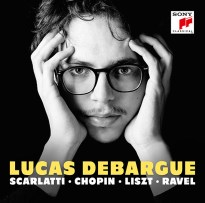
Lucas Debargue: Scarlatti, Chopin, Liszt Ravel (Sony)
Escape all the noise and fall out of Brexit and the Conservative Party leadership wrangling with this exquisite debut disc by Lucas Debargue, the young French pianist who came fourth in the prestigious Tchaikovsky International Piano Competition in 2015.
Weightless elegant Scarlatti opens this album which was recorded live at the Salle Cortot in Paris, Debargue’s first concert in his hometown after the competition. His sense of pacing, evident in the Scarlatti sonatas, really comes to the fore in his reading of Chopin’s Fourth Ballade, where he balances delicacy and poetry with drama to create a performance which is both intimate and expansive. The real impact comes when he holds the music in suspense: it feels natural and unpretentious. His performance of Gaspard de la Nuit, the work for which he received much enthusiastic acclaim during the competition, is equally impressive. His clarity of touch and tone combined with that wondrous pacing brings a silky sensuality to ‘Ondine”s watery arabesques while ‘Scarbo’ is less grotesque, more puckish and playful, though no less dark for it. In between these movements, ‘Le Gibet’ is seven minutes of restrained desolation. His Liszt is a proper waltz instead of the headlong frenzy some pianists give to this work. The Grieg is like an encore, a calming salve after Liszt’s twirling rhyhms. The Schubert is as intimate as you like, as if Debargue is playing just for you – and playful too, reminding us that Schubert was a composer of dances and Ländler. And in a neat piece of programming the album closes with Debargue’s variation on the Scarlatti Sonata in A which opens the album.
At the Tchaikovsky Competition, the Moscow Music Critics Association awarded him their prize for “the pianist whose incredible gift, artistic vision and creative freedom have impressed the critics as well as the audience”, and his debut disc demonstrates these attributes in spades.
The Dulwich Music Festival is now in its fifth year. It is an annual event that takes place several times during the year to provide performance and feedback opportunities for pianists, harpsichordists and fortepianists. In 2016, the Festival comprises two separate events:
The Clementi House Piano Competition – a chance to perform in the London home of pianist and composer Muzio Clementi. Alongside the competition, there will be concerts by leading harpsichordists and fortepianists. 6th March 2016
The Piano Competition – a full day of classes from beginners to advanced and adult recital classes. 11th June 2016
These events are designed to celebrate the piano (and harpsichord and fortepiano) and to encourage enjoyment and progress amongst players of all levels.
Repertoire has been carefully chosen to allow complete beginners the chance to gain their first experience of performing to a friendly and welcoming audience. We seek out innovative repertoire by contemporary composers who also adjudicate the classes. In addition to the contemporary repertoire, we also have graded classes and recital and exhibition classes. The piano competition is well established and fully booked months in advance. We recommend early booking. Some of the June classes are already fully booked.
I am delighted to be involved with the Dulwich Music Festival once again in 2016 as an adjudicator, a role which offers me the opportunity to hear young pianists in action in a variety of repertoire.
Full details about the Festival can be found here:
Much has been written about the young French pianist Lucas Debargue, a finalist in the 2015 edition of the prestigious International Tchaikovsky Competition. The concept of him being “self-taught” (until relatively recently) has been debated across a number of articles, together with his rather unusual technique (“Scales played with only the thumb and index finger and his pinkie sticking up as daintily as Hyacinth Bucket’s” – The Spectator, 18/7/15) and glorious sound. He’s not out of the traditional mold of the international competition winner (commences piano studies at a young age, undertakes rigorous study with a master teacher and progresses to the “Three C’s” of Conservatoire, Competition and Concerto) – and he didn’t even wear a tie during the final! In an honest and touching interview with Ismene Brown of The Arts Desk, Debargue comes across as a sensitive and intellectual young man for whom music is profoundly important, not just in terms of beautiful sound, but also as a “a place to live in. It’s about real emotions, real sensations”.
Let’s just clear up a few inaccuracies. In ‘The Spectator’ article quoted above, he is described as “the man who came last”. He didn’t come last. He achieved what most can only dream of: he reached the final of the most prestigious piano competition in the world. That he did this following only four years professional study with a Russian master teacher (Rena Shereshevskaya) is remarkable. (And by the way, it doesn’t really matter that his scale fingering is unusual: there is no “one size fits all” fingering scheme, because hands and fingers come in different sizes.) Now everyone is asking what next for this extraordinary young man?
It is at this point that I start to worry for a talented and obviously sensitive young man like Lucas Debargue. He is not the first, and certainly won’t be the last, young artist to be thrust into the limelight before he is ready. Unlike the other competition finalists, he has not undergone the long and rigorous traditional professional training which would prepare him for the concert platform: he still needs to hone his stagecraft and, more importantly, learn how to deal with the journalists, agents, promoters, and fans who besieged him as the competition progressed – and continue to. The classical music industry is not a particularly pleasant place, and the world of international pianism is highly competitive, almost ruthlessly so. At the big competitions, representatives from the big artist agencies are waiting to scoop up the winners and runners up, offering tempting contracts, a slew of international engagements, recording deals and more (look how much Martin James Bartlett, winner of the BBC Young Musician of the Year 2014, has done since his win, including several performances at the Proms, and he’s only just 19; he has, however, undergone a professional training in specialist music school and conservatoire). It’s true that success in an international competition can make an artist – but it can break one too. From the moment one chooses the life of the international concert pianist, one lives in the public eye: every performance and recording is held up for scrutiny, and one is under almost continual pressure to meet the expectations of agents, promoters, fickle audiences, critics and fans. The life of the concert pianist is tough, restrictive and lonely. In addition to the many hours of solitary practise, there is the traveling, nights spent in faceless hotels, fine historic cities viewed through a fog of fatigue, never having the option to be less than perfect, even if one is ill or tired, knowing that one is judged on one’s last performance (here I recall the unpleasant hoopla surrounding Ivo Pogorelich’s London concert in February). The pressure can be unbearable if one is not equipped to handle it. (Read Charles Beauclerk’s excellent and sympathetic biography of John Ogdon for some brutal insights into the life of the international concert pianist. For Ogdon, the piano was his saviour and his tormentor, and there is no question that the pressure of so much traveling to perform around the world contributed to his breakdown.)
Add to this that peculiarly British fascination with the maverick, the eccentric, the tortured genius with the unconventional “backstory”. We risk endangering Debargue further by holding him up as curiosity, instead of allowing him to develop and mature in his own time. There is something very authentic about his playing, his particular soundworld and his special and personal connection to the music which has clearly touched people.
Lucas Debargue plays Ravel – ‘Gaspard de la Nuit’
In his interview with Ismene Brown, Debargue talks of having few friends and little support from his family. His teacher was his mentor and supporter, encouraging him to take a tilt at the Tchaikovsky Competition and saying when he got through the first round “It doesn’t matter when you pass or not, it’s really good that you are here to play and I am grateful and proud of you.” He has yet to develop the necessarily resilience, thick skin and artistic temperament to survive the “wild west” of the international concert circuit, and I only hope that whoever he chooses to manage him, should he decide to go down that route, is sympathetic and puts his well-being before all else. Otherwise, I dread to think what might happen….
So please let’s allow him – and others like him – to develop at his own pace to emerge onto the international circuit, should he choose that path, when he is truly ready. To conclude this article, I think it is worth quoting a comment on Peter Donohoe’s piece for Slipped Disc about the competition (Peter was a juror this year):
Aside from all of this, what happens to each of these young artists remains to be seen. How will they carry on with their studies as musicians? Which repertoire will they cultivate? Will they develop chamber music careers, teaching, new works, recordings? This is what is most important as they begin to soul search and decipher how and what they will contribute to the world of music outside of the usual parameters. (Jeffrey Biegel)
Read Peter Donohoe’s thoughtful and intelligent article here
I seldom select concerts to review based on performer. An interesting programme is usually what will pique my interest, and this was certainly true when browsing the Wigmore’s spring season of concerts: it is unusual to find Ligeti and Messiaen in the same programme. I didn’t know the performer and was unaware at the time of booking the concert that he was first prize and gold medal winner of the prestigious Arthur Rubinstein International Piano Master Competition.
Winners of competitions are often paraded before audiences with the promise of greatness. Generally young performers poised on the brink of an international career, too many may offer a bland synthesis of music, technically polished but lacking in insight or maturity. Not so Antonii Baryshevskyi, a young pianist from Kiev, whose impressive Wigmore Hall debut combined pristine technical facility and consummate musicality in a challenging and highly varied programme.
The Cross-Eyed Pianist is free to access and ad-free, and takes many hours every month to research, write, and maintain.
If you find joy and value in what I do, please consider making a donation to support the continuance of the site

 Lucas Debargue: Scarlatti, Chopin, Liszt Ravel (Sony)




