The concerto is one of the greatest corners of the pianist’s repertoire. A showcase for performer and instrument, it’s an opportunity for the composer to capitalise on the combined forces of soloist and orchestra, often with thrilling and highly expressive results. The concerto format inspires great music and is a spectacle for the audience, and the genre continues to tempt composers today. The romantic image is of the soloist doing battle with the orchestra, but in most instances piano and orchestra are collaborators, creating wondrous musical conversations and exciting contrasts of sound, texture and mood. Instruments may have changed since Mozart’s day, but the genre itself is perennially popular with musicians, composers and music lovers alike. For performers, the biggest challenge in playing these very popular concertos is breathing new life into very well-known and much-loved music.

Careers are made with concertos, and for the professional pianist, playing concertos represents a significant part of one’s working life. Most pianists will aim to have several concertos “in the fingers” from an early point in their career, with some retaining over 50 by the time they are established. Competitions require concerto playing too, and certain works have become staples in the competition and international concert repertoire, a sign of their enduring appeal and ongoing challenges to pianists – and their popularity with audiences.

Here are 6 great piano concertos which are regarded as the “must learns” for soloists, and “must haves” for concert programmes.

Beethoven – Piano Concerto No. 5 in E flat – the ‘Emperor’

A heroic nickname for a heroic concerto. Composed from 1809 to 1811, the work is poised on the cusp of romanticism in its scale, virtuosity and richness of expression while also harking back to its classical antecedents in Beethoven’s skilled handling of the piano concerto form. Two dynamic outer movements bookend a slow movement of infinite beauty and ethereal serenity, which inspired Schumann in the last movement of his Fantasie, Op 17.

Grieg – Piano Concerto in A minor

This is Grieg’s only piano concerto but it has justly joined the rank of “great” and “must learn”. Composed when he was only 25 and inspired by a performance by Clara Schumann of her husband’s concerto, the influence of Schumann is clear from the outset in its sweeping gestures, emotional contrasts and lyricism. But while Schumann’s writing is sophisticated and romantically introspective, this is the work of a young man making his mark with a grand musical statement, weighty and serious. There are high virtuosic elements and adventurous piano writing, inspired by Liszt and Tchaikovsky (big octave passages, for example), but the work has a naturalness too (the finale is a Norwegian folk dance!). Assured and commanding, its anthemic outer movements combine vitality and poignancy while the middle movement is a graceful, soaring Adagio which overflows with heart-warming loveliness.

Mozart – Piano Concerto No. 27 in B flat, K595

Mozart’s final piano concerto inhabits quite a different world from the powerful and bold concertos of the 1780s when Mozart enjoyed a golden time as a concert pianist. Compared to its predecessors, the K595 is pared down, but with a harmonic language that is sophisticated and daring. Full of muted colours and supple textural interweaving of solo instrument and orchestra, its beauty and melancholy looks forward to the romantic lyricism of Beethoven’s fourth Concerto and beyond. With fewer virtuosic frills and extrovert gestures than Mozart’s earlier concertos, the challenges the pianists lie in its restrained character and elegant simplicity of expression.

Rachmaninov – Piano Concerto No. 3 in D minor, Op 30

Composed in 1909, Rachmaninov’s third piano concerto is considered one of the greatest and most challenging in the standard repertoire and is respected, and feared, by many pianists. Monumental and treacherous in scale, gorgeously romantic and highly expressive, the pianist to whom it was dedicated – Josef Hofmann – never performed it in public. Instead, it was premiered by Rachmaninov himself in New York, and its fearsome technical difficulties reflect the composer’s own transcendent prowess at the keyboard. With forty-five minutes of almost continuous playing for the soloist, the renowned English pianist and teacher Cyril Smith likened the sheer physical effort of playing it to shoveling several tonnes of coal! For many pianists, this concerto represents the ultimate “trophy” performance.

Ravel – Piano Concerto in G major

The piano was Ravel’s favourite instrument, and while the Piano Concerto for the Left Hand is profound and significant, his G major concerto was intended to satisfy the box office, the frivolous showpiece could he take on tour. Opening with the famous single “whipcrack”, it contains all the elements fashionable and clichéd at the time of writing – jazz idioms and harmonies, dissonance, neo-classicism and mechanical moments – but it’s brilliantly done and finely-crafted. Written “in the spirit’, Ravel said, ‘of Mozart and Saint-Saëns”, the exuberant, jazz-infused outer movements are offset by a slow movement of serene beauty and transparency.

Tchaikovsky – Piano Concerto No.1

The triumphant opening chords of this concerto followed by the first theme are amongst the most famous bars in all of classical music, heralding a work of sublime romanticism, dramatic expansiveness, invention and emotion, full of memorable themes and glorious textures. Composed in 1874 during a very productive period in the composer’s life, the concerto was premiered in Boston in 1875 by Hans von Bulow (Nikolay Rubenstein, Tchaikovsky’s favoured pianist, rejected the work as badly written and refused to play it). Tchaikovsky later revised the work in 1888 and it is this version which is most commonly performed today. In 1958 it became the first piece of classical music to sell a million records when the pianist Van Cliburn made an impassioned recording of the concerto. After the grandiose opening movement, the middle movement serves as a lyrical slow movement and a scherzo, while the finale is a breathless rondo based on a Ukrainian song. The works succeeds on every level: the virtuosity of the piano part is matched by vivid orchestration while the intricacies of the work are balanced by Tchaikovsky’s beautiful melodies.


This article first appeared on the Interlude HK website
8-16 June 2019 – Clarendon Muse, Watford, Hertfordshire

The inaugural Master Music Piano Festival & Competition takes place across two weekends in June 2019 at Clarendon Muse in Watford and aims to promote local talent by offering young musicians a superb platform to experience and participate in fine music-making.

Featuring a set of unmissable recitals by leading young pianists of their generation including Ji Liu, Nicholas McCarthy, Artur Cimirro and Michael Harvey. The Master Music Festival will also host competitions scheduled for all ages and levels of performance ability together with a special Children’s Concert. Alongside much-loved core repertoire, the featured artists will also showcase their own new compositions and arrangements with their published sheet music available.

The Festival is the brainchild of Benjamin Williams, Director Of Master Music Publications, a new publishing house designed to promote original compositions, transcriptions, interpretative editions and educational resources by the world’s finest contemporary musicians. As well as the beautifully produced environmentally-friendly scores, Master Music Publications offers a wealth of additional information, biographies, context and a link to an online study guide with useful tips, videos and a discussion section.

Festival Programme:

Nicholas McCarthy – Piano Recital – June 8th, 7pm

British pianist, Nicholas McCarthy was born without his right hand and only began to play the piano at the age of fourteen. He went on to study at the prestigious Royal College of Music in London, becoming the first left-hand-only pianist to graduate in the college’s history. A passionate educator and motivational speaker, McCarthy champions left-hand alone repertoire, music that developed rapidly following the First World War as a result of injuries suffered on the battlefield. Expect an awe-inspiring recital of repertoire ranging from Bartok to Gershwin via Scriabin and Strauss. Notes McCarthy: “I’m absolutely thrilled to be part of the first Master Music Festival and to be able to play alongside other esteemed artists from the piano world. As one of the few disabled artists in the classical industry, it gives me great pleasure to be able to share the music that I love so much with new audiences and hopefully even inspire people along the way”.

Artur Cimirro – Piano Recital – June 9th, 7pm

Brazilian pianist, Artur Cimirro enjoys an eclectic career as a composer, arranger, writer and art critic. He has composed works for piano, orchestra, choir, chamber ensemble, opera and ballet and his transcriptions and arrangements, dedicated to the left hand, deal with the exploration of new horizons in piano technique. They include notably ambitious projects, such as Liszt’s 12 Transcendental Etudes for the Left Hand Alone. As part of his recital, Cimirro will present a striking array of his own compositions and arrangements.

Michael Harvey – Piano Recital – June 15th, 7pm

A compelling and sensitive musician with a rare combination of intelligence, flair and charm” is how acclaimed pianist Leslie Howard described pianist, composer and teacher, Michael Harvey. Harvey has dazzled audiences at prestigious venues around the world with his virtuosic technique, individual sound and charismatic personality. His recital is bound to offer pianistic brilliance, creative sensitivity and a kaleidoscope of colours. Says Harvey: “I am looking forward to communicating with the audience at the inaugural Master Music Festival by sharing stories, pieces and some of my own compositions, several of which will be world premieres!

Ji Liu – Piano Recital – June 16th, 7pm

Praised by Pianist Magazine for his “sensitive and unpretentious musicality” and described as “a major talent” by Classical Source, Chinese pianist, Ji Liu has positioned himself as one of the brightest stars in classical music today. In addition to topping the classical charts on numerous occasions, he also delights audiences around the world, from the Royal Albert Hall in London to Carnegie Hall in New York with his thoughtful and intelligent recitals. Be sure to expect a sensational evening of music making at the highest level. Ji Liu commented: “It is my great privilege to work with Master Music Publications and to be involved with the very first festival. It is encouraging to see both new and core classical music presented in the festival and how they can meet and support each other. I very much look forward to sharing my musical thoughts and performing for everyone.

Children’s Piano Concert – June 8th, 3pm

This eagerly anticipated children’s concert will feature pianist Ji Liu, who will perform a collection of fun pieces for piano, including Schumann’s Kinderszenen and a narrated solo piano performance of Prokofiev’s popular ‘Peter and the Wolf’. This will be an enjoyable, educational event for children.

Piano Competitions – June 8th 4-6pm and June 15th – 2-6pm

On June 8th and 15th, the festival will feature piano competitions for all ages and abilities. Each participant will receive valuable and constructive written feedback. Medals, certificates and prizes up to £150 will be awarded to participants who achieve 1st, 2nd and 3rd place. The adjudicator will be Steinway and Classic FM/Global artist, Ji Liu. Entry forms are available here

Benjamin Williams, Director Of Master Music Publications added: “It has been very exciting and a great privilege for me to bring these incredibly talented international artists together for this unique festival that all can enjoy”.

Venue: Clarendon Muse, 70 Rickmansworth Rd, Watford WD18 7JA

Full details of the festival

The winner of the Hastings International Piano Concerto Competition, one of the UK’s most prestigious international music prizes has been announced in Hastings, UK.

Fumiya Koido 003
Fumiya Koido Winner of the 2019 Hastings International Piano Concerto Competition

First prize winner was Fumiya Koida from Japan who gave a stunning performance of Ravel’s Piano Concerto in G major with The Royal Philharmonic Orchestra and won a cash prize of £15,000 plus future concerto performance engagements with the Royal Philharmonic Orchestra and additional performance opportunities in both the UK and the USA.

Second Prize Winner was awarded to Maxim Kinasov from Russia, who gave an impressive performance of Tchaikovsky’s Piano Concerto No.1 in B flat minor Op.23 and received a cash prize of £7,000. Kinasov also received the special ‘Orchestra Prize’ voted for by players of the Royal Philharmonic Orchestra and in addition will receive future performance engagements.

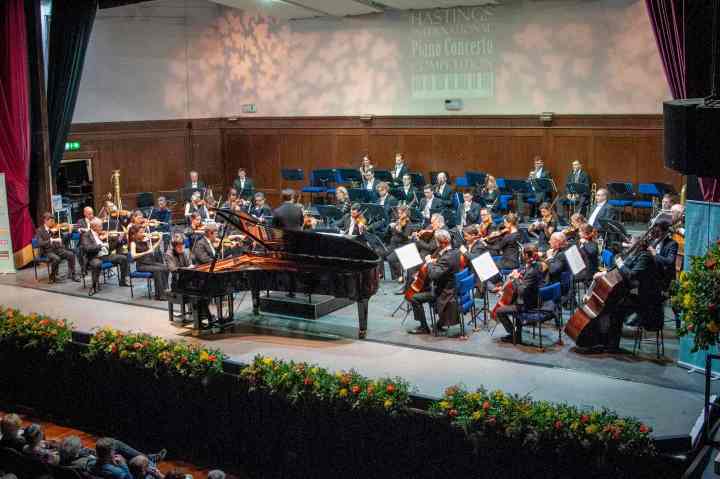
Now revered as one of the UK’s premier classical competitions, the competition took place in the creative hub of Hastings, culminating in a live 2 day sell-out final at The White Rock Theatre with 6 finalists all playing a full concerto with the RPO, one of The world’s most revered orches-tras.

The competition becomes a biennial event from 2019 and continues its relationship with The Royal Philharmonic Orchestra, one of the world’s leading orchestras,
The 2019 competition enjoyed national and international reach with over 176 entries from 26 countries, with live auditions having taken place in Japan, China, USA, Italy and in the UK. 49 contestants were invited to compete during the competition stages in Hastings, with winning performers being selected to compete in the semi-final and the live finals.

Addtional Prize Winners are as follows:

Third Prize – Eric Guo – Canada
Fourth Prize – Yunanfan Yang – UK
Fifth Prize – Sylvia Yang – New Zealand
Sixth Prize – Alexander Yau – Australia

Special Prize of £1,000 Awarded to a British Contestant reaching the Final –
Yuanfan Yang

Congratulations to all the prize winners


(source: A-Star PR)

logoTo the House of Commons this week for the launch of this year’s Hastings International Piano Concerto Competition (HIPCC), at a gala event hosted by Hastings and Rye MP Amber Rudd. Not only was this an opportunity to see inside the House of Commons (which was fascinating and intriguing), it was also a chance to find out more about the revamped competition, catch up with musical friends and colleagues, and make new connections.

The HIPCC has its origins in the Hastings Music Festival which dates back over 100 years, and early winners of the piano classes include Ronald Smith and Philip Ledger. By the 1960s, the concerto class had begun to attract talented students from the UK conservatoires, and in 1968, Frank Wibaut took first prize with a performance of Beethoven’s ‘Emperor’ Concerto at the start of his long and distinguished career.

Sadly, the concerto class dwindled in popularity and by the 1990s had disappeared altogether. But in 2005 Philip Ledger (Director of Music at King’s College Cambridge from 1964 – 1982) conducted the Sussex Concert Orchestra for the first ever Final of the revived HIPCC, and was Chairman of the Jury until 2011 when Frank Wibaut took over the role and also that of Artistic Director.

Today the HIPCC is one of the UK’s leading piano competitions, and this year’s competition has attracted 176 entries from 26 countries, with live auditions in Japan, China, USA, Italy and in the UK. 49 contestants have now been invited to play in Hastings betwee 21 February and 2 March, culminating in the concerto final with the Royal Philharmonic Orchestra on 1 and 2 March.

The association with the RPO has been secured for the next five years, a collaboration which includes note only the compeition final in Hastings but also concerts as part of the new Festival of Piano which will take place during non-competition years. The orchestra will also provide performance opportunities for the competition laureate as part of the RPO’s residency at Cadogan Hall, and the orchestra’s UK touring programme. And there will be community and education outreach projects to keep music and music making at the centre of activities in Hastings, a town which has enjoyed a cultural resurgence in recent years.

We are proud to have such a vibrant and creative town in Hastings. Celebrating classical music has made this town a strong hub for musicians, ensuring the support of local, national and international bodies. – Amber Rudd, MP

Whatever your view of music competitions, there is no question that they are a signficant part of the international music scene and are very much here to stay. For many young musicians, competitions are seen as part of their professional training and can be the gateway to a successful career on the concert platform and in the recording studio. (One pianist, who is a regular on the competition circuit and a former HIPCC participant, told me that competitions encourage him to learn repertoire very carefully, and that without his success in a recent international competition, he would not have been able to release his debut recording.)

Education outreach programmes, masterclasses and music making activities within the local community beyond the rarefied confines of the concert hall, such as the HIPCC is planning (and the revamped Leeds competition has successfully delivered) serve as healthy reminders that classical music is for everyone and give people who may not normally experience classical music the chance to engage with and explore it, right on their doorstep.

The HIPCC aims to make Hastings the go-to place for classical music on the south coast.

The final of the HIPCC takes place on 1 and 2 March in the White Rock Theatre, Hastings. Full details here


If you enjoy the content of this site, please consider making a donation towards its upkeep:

Buy me a coffee