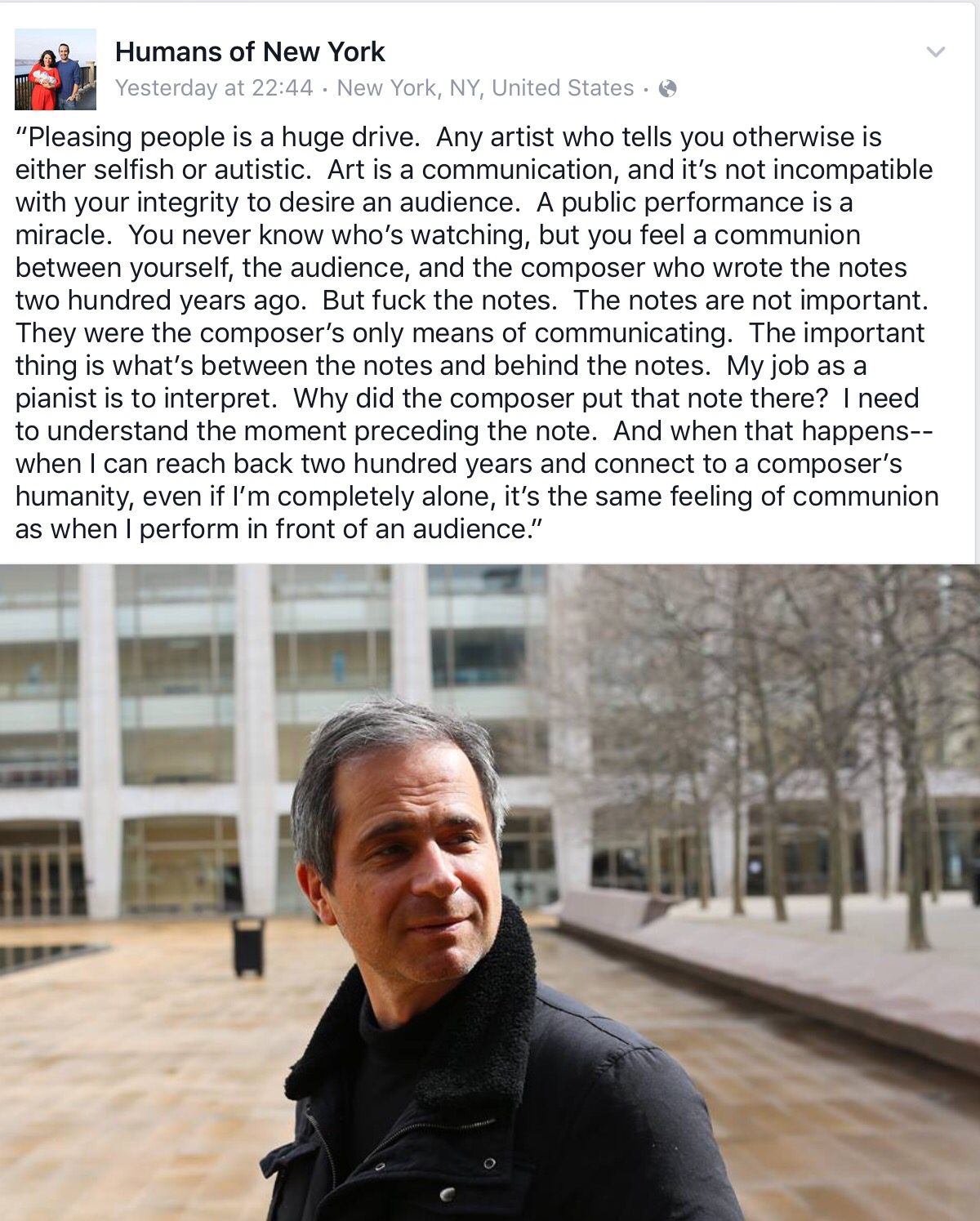
In this guest post Roman Rabinovich explores the interrelationship between the visual and performing arts and composition
Ever since I was a kid I have loved creating things, whether sculptures out of randomly found objects and dirt (I didn’t yet know about Robert Rauschenberg), improvising little character pieces on the piano, or compulsively drawing my family members and friends. It seemed at first that these were unrelated and separate activities, but I soon realised that they all came from the same impulse – the need to create my own emotional world in which I could freely express myself. I imagine that most kids are like this, but sadly many stop as they grow older.
I come from a family of musicians and piano playing was the only activity for which I had proper teachers, so I would say I’m primarily a pianist who also paints and composes. That is not to say that I’m less serious about painting and writing music. In fact, I had a difficult time deciding what I would do when I grew up. I’m happy I didn’t have to choose.
Performing and composing are two seemingly different processes. We perform music that composers notate with black dots on the page. However, these black dots are not music. Music emerges only when a performer transforms notation into real sound. A performer’s goal is to get into the composer’s world and mind, similar to an actor who seeks to inhabit a character role. We are taught to analyse a composer’s every mark with uncompromising detail and base our interpretation on the clues the composer leaves us in the score. But just following what’s written in the score is not enough. A compelling performance breathes life into and shines new light on a work. In this sense, performance becomes an act of creation. The process begins with imagining the sound in one’s mind. Fingers are the last factor. As András Schiff said, “fingers are just the soldiers, the General is the mind”.
In composition, on the other hand, there are no instructions; the possibilities are endless. There are rules of counterpoint, voice-leading and form, but the whole “game” is about creating one’s own rules and then breaking them. Every piece follows a different process and it has its own inner logic so there are no shortcuts. Sometimes the process is quick and smooth but more often it is painfully slow and daunting. I feel that it is quite unproductive to impose ideas on a piece. It has to unfold naturally and it takes time for the narrative to unveil itself. When in a state of flow, it feels like a piece writes itself, and as a composer I just listen to what it has to say.
Composing helps me understand how the great masterpieces were crafted. Through this process I also learn so much about myself. I love making these “sound sculptures” and I love the struggle it takes to create art: to be completely lost and not know how to proceed; to try out different options before gradually landing on the right solution. It is a fun way to spend a day. When I wake up, the first thing I do is go straight to the piano. It is a productive time to improvise and explore musical ideas while the brain and the body wake up. There is no inhibition, expectation, nor doubt yet. Often after a few hours of work I hit a wall and it is very helpful to take a walk. Somehow things come into focus when you are outside and moving. No wonder most composers were avid walkers.
I have always been fascinated with painting because, unlike music, it is permanent. The main difference between visual art and music is the perception of time. Music unfolds in real time. When you experience a live concert and the last chord ends, that’s it, it will only remain in your memory. With visual art you take time to absorb it. You can go away, come back and the painting will still be there, unchanged. You change; the painting doesn’t. Taking time is part of your experiencing it. One of my favourite things is to look at a painting, analyse it, and try to figure out how a great master organised two-dimensional space and made it look three-dimensional. In the last few years I’ve been making images on my iPad. It’s a new and exciting medium, and it works differently from paints on a canvas, because you are drawing with light. It is a completely different sensation. When you are drawing on paper or painting on canvas there is a limit to the number of layers before it starts to look overdone. In a similar way, a musical passage can be out of balance if there are too many notes in a chord and all the notes are played with the same volume, making it difficult for the listener to know what to listen for. With digital painting, you have unlimited layers and textures at your disposal.
Just like music, painting is about space and spatial relationships. Our perception of sound changes in relation to the space we are in. We have a visceral reaction to it. The same music will be perceived entirely differently depending on the venue in which it is performed – a small chapel will sound worlds apart from a 3,000-seat hall. Similarly, a painting’s effect is totally dependent on the space, lighting and framing around it.
Music is an abstract language and most of the time it doesn’t need any help from other art forms. However, sometimes I find it useful to visualise structures in music, especially if it is a long and complex piece. For example, when one plays a Bach fugue, one can envision a great cathedral and observe it from the bottom to the top. It all starts with one brick at a time, as with one voice at the beginning of a fugue, and slowly, layer by layer, develops into a marvellous structure. Similarly to decorative art, which has threads or visual motives, composers like to develop pieces from small and simple cells.
In my piece ‘Memory Box’, a suite of six miniatures which I performed at my recent Wigmore Hall recital, music and art merged. The opening movement, “Forgotten dreams”, is based on one of my oil paintings, and part of a series called Memory Box. My piano piece came out of the same creative impulse as these paintings – they are cousins, if you will. In this work I explored the theme of dreams, fantasies and the subconscious. Both the music and the painting are quite fragmented. They are full of gestures and bits and pieces that never seem to resolve and evoke a dream-like state.
Despite the discipline and the daily work routine, it is important for me that whatever I create comes from a place of spontaneity and playfulness. We must not forget to have fun and stay curious. For me, the initial impulse in a creative act has to be instinctive, whether it is improvising or just throwing colours at a canvas. I want to see how the art materials respond, or how the notes react. I can edit things later, but I try to compose with no concrete thoughts – they are often distracting and limit the imagination. I like to keep the integrity of this initial impulse as much as possible. We live in a crazy world full of distractions and it is rare to have a moment of quiet, a moment of being fully present. Art is a very powerful thing and it can give these moments, this sense of purpose to anyone at anytime.
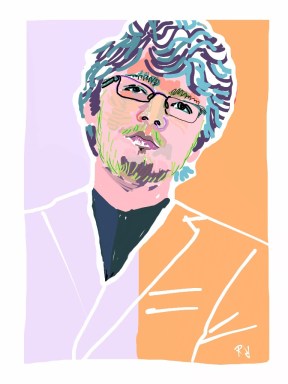
Roman Rabinovich was born in Tashkent, Uzbekistan; raised in Israel; and is now based in the USA. A multifaceted musician, praised by the New York Times for his “uncommon sensitivity and feeling”, Rabinovich is also a composer and visual artist, and often creates artwork to enhance his musical performances.
Full details at: www.romanrabinovich.net