Unearthed manuscripts reveal a new side of the eccentric French composer, brought to life by pianist Alexandre Tharaud in a recording of previously unheard works
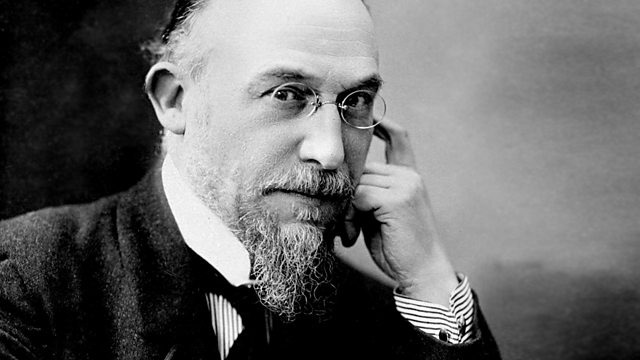
A century after the death of Erik Satie, 27 never-before heard works are released to the public for the first time. The landmark digital album, Satie: Discoveries, performed by acclaimed pianist Alexandre Tharaud, is now available on Erato, just days ahead of the centenary of Satie’s death on 1 July 1925.
Erik Satie
The collection sheds new light on one of music’s most enigmatic figures. Reconstructed from forgotten manuscripts and unfinished sketches, these pieces, ranging from playful cabaret songs to minimalist nocturnes, were originally written by Satie for performance in the bohemian cafés of Montmartre, where he worked as a pianist in the late nineteenth century.
The album is the result of painstaking musicological research by Sato Matsui, a Japanese composer and violinist, and James Nye, a British musicologist and composer. The duo independently tracked down lost materials in the Bibliothèque nationale de France and a private archive in Boston, piecing together and reconstructing Satie’s sketches into fully performable scores. Some of these are to be published by Éditions de la Fabrique Musique.
Among the newly discovered gems are pieces in the same free, minimalist style of Satie’s Gymnopedies and Gnossiennes (for example, Réflexions nocturnes and Autour du 1st Nocturne). Other works draw on familiar dance styles, (including several Parisian Valses), the café-concert song and operetta arias (‘Le Champagne’, ‘Pousse l’amour’ and ‘Chanson andalouse’).
Further pieces reveal a more experimental Satie, such as the Esquisses bitonales (Bitonal Sketches) or the Soupirs fanés (Faded Sighs), a collection of miniatures with evocative titles such as ‘Poil’ (Hair), ‘Barbouillage’ (Daubings), ‘Familial désespoir’ (Domestic Despair) and ‘Souvenirs fadasses (Dusty Memories).
Though most of the tracks feature pianist Alexandre Tharaud performing solo, three also feature the acclaimed Serbian violinist Nemanja Radulović. Radulović’s violin takes on the role of the singer in a mélodie and two cabaret songs where the lyrics are now lost.
In addition to these 27 world-premiere recordings, two already familiar pieces are included: the hypnotic ‘Chinese Conjuror’ from the ballet Parade, for piano four hands with Gautier Capuçon, and the ‘Chanson andalouse’, originally intended for the never-performed operetta Pousse l’amour. The ‘Cancan Grand-Mondain’ (High-Society Cancan) from La Belle Excentrique is recorded here in a new version for solo piano by Tharaud himself.
Alexandre Tharaud said of the album: “Satie remains very much an enigmatic figure today, held in enormous regard at the same time as being largely misunderstood and almost unknown…it is up to us to look beyond the Gnosiennes and the Gymnopédies, to try our sincere best to get closer to the music and to pay real attention.”
Satie: Discoveries is out now on Erato on all streaming services
I’ve never found it easy to keep New Year’s resolutions. Often, they are admirable but just not sufficiently motivating and are inevitably dropped before ever really achieving anything. Last year, though, I decided I would practice the piano more often and also give a concert, however low-key, for my students, most of whom were under the age of 10. One of the pieces I re-learnt and performed was Germaine Tailleferre’s Impromptu, a wonderfully spirited piece with an oft-repeated motif that ducks and dives through many keys before finally coming to rest with a ritardando and arpeggiated passage alighting on the tonic.
Rediscovering this piece led me to think of Tailleferre’s First Piano Concerto. I say rediscovering because Germaine Tailleferre’s music was the subject of my undergraduate thesis, back in 2005. It wasn’t long before I was listening to the concerto, now much more easily available on Youtube, and recalling an afternoon spent poring over the score in the dimly lit depths (or so it seemed to me) of the British Library.
Tailleferre wrote her first piano concerto in 1924 and, in a departure from the Romantic style of her earlier pieces for piano, embraced the neo-Classicism that had been emerging in France in the early years of the 20th century and that she had deployed in her string quartet of 1919. As far as I’m aware, there has been just one recording to date, by the University of California Santa Cruz Orchestra:
The first movement is in sonata form, but foreshadows the neo-Classical style of Stravinsky in his Dumbarton Oaks Concerto with its similarity to concerto grosso. The instrumentation, too, is reminiscent of earlier times, with strings, trumpet, horn, oboe, bassoon, flutes and timpani. The piano and orchestra start together in the first bar, and the musical themes are shared in a joyful back and forth full of counterpoint and syncopation. The opening theme, a descending melody with a repeated rhythm, is heard over a staccato bass which really bounces along and immediately conjures up a sense of exuberance. Later on, the harmonies are more Romantic and the piano is more obviously accompanied by the orchestra, but the melody is still propelled by a driving rhythm. The joyous, energetic character returns as the opening material is repeated, exchanging fragments of melody, overlapping and answering, until the final bars.
The second movement has a different feel. Indeed, when I was researching this work for my thesis, I was so struck by the similarity of the slow movement to the slow movement in Ravel’s Piano Concerto in G, that it led me to consider the influences that this concerto may have had upon Ravel. (Ravel wrote his concerto in 1934, and the two composers were good friends). This is a subject for another time, but it makes for an interesting discussion. The movement starts with solo piano, and a continuously evolving melody which defies a clear sense of beat and only becomes clearer when the flute enters in bar 4. This emphasis on melody harks back to the earlier style of her piano works, in which melodies evolved over a more static bass line. It’s a beautiful movement, wistful and yearning; it builds to heavy chords, anguish almost palpable in each, and subsides, the strings accompanying the piano to resolve onto a major chord, the sun shining again on the rain-soaked pavement (if you’ll excuse the weather analogy).
We return in the third movement to the uplifting character of the first and indeed, to a more obviously neo-Classical style. But it’s not without its individualism. The themes are characterized by off beat rhythms that cut through the texture but there is lyricism, too, always urgent, pushing forward, both orchestra and soloist involved in an intense communication. There’s a joyful, ascending
piano melody, followed by a conversation with the flute and oboe and, finally, a cadenza where the pianist emerges into the limelight. However it’s the interweaving of the melody through the orchestral parts, specifically flute, oboe and trumpet, that I really enjoy in this movement. Towards the end, the syncopated motif is shared around the orchestra, the soloist running up and down the piano in scalic passages until the trumpet breaks through the texture to end with a triumphant flourish.
Tailleferre’s Piano Concerto was premièred in London by Alfred Cortot in 1924. Although performed many times in the decade following its publication in 1925, the work has not since achieved a fraction of the commercial success enjoyed by other 20th century concertos. It perhaps just doesn’t quite have that level of virtuosity attained by other composers, such as Ravel in his Piano Concerto in G, or Shostakovich in his First Cello Concerto. Its neo-Classical style and lack of a really prominent part for the soloist may also have contributed to its gradual disappearance from the concert platform. However, the more I (re)listen, the more I’m drawn to this work which appears like a burst of musical sunshine from the Paris of the 1920s. I’d love to hear it performed live. Perhaps now, 100 years on, might be the time for its renaissance.
Frances Jones read music at York University, followed by a PGCE at Cambridge. She is Music Lead at a school in West London and also teaches piano.
Playing Debussy on his Blüthner was a ‘head-spinning experience’ – guest article by Michael Johnson
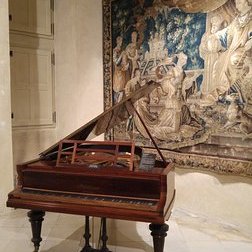
French pianist François Dumont has still not quite recovered from ‘the excitement, the anxiety’ of playing “Clair de Lune” on Debussy’s own Blüthner piano in a remote French museum.
Dumont is one of the select few pianists ever allowed to touch the instrument, now fully restored and in mint condition. It was his credibility as a Debussy player that persuaded museum management to grant access.
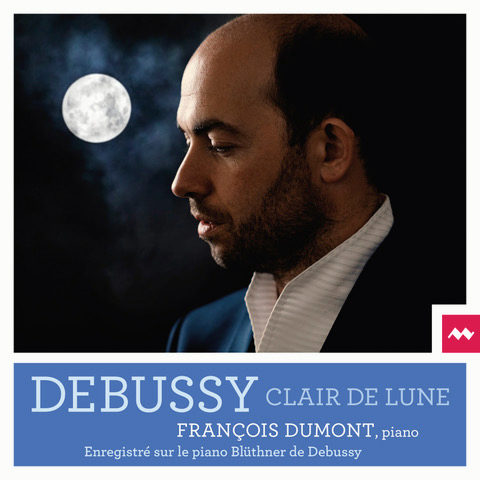
Dumont has just released his new CD of Debussy piano music (Clair de Lune LaMusica LMU035) played on the vintage Blüthner at its resting place in the Labenche Museum in Brive-la-Gaillarde, not far from Bordeaux.
He recalled in our interview (below) how it felt to press a few keys the first time. ‘I sat down and timidly put my fingers on the keys… and it was just magical!’
The sound is indeed unique to the modern ear, a resonance intentionally soft and continuous, unlike the more glassy pedaled attacks of a Steinway grand. Dumont says changing to a nineteenth-century Blüthner is fascinating and deeply satisfying musically. Personally, I grew accustomed to his recording only after four or five hearings.
He puts the Blüthner to work on selected parts of Debussy’s Bergamasque Suite, Estampes, and Children’s Corner. His sensitive playing is as touching in the pianissimo as in forceful fortissimo. He recalled for me that he did several takes of “Clair de Lune” before he was satisfied. ‘I repeated it until I found the ethereal colours, the warmth of the melody I was looking for,’ he said.
Dumont thus joins a stellar group of established Debussy interpreters from the twentieth century and more recently performers such as Daniil Trifonov, Angela Hewitt and Steven Osborne. A busy recording artist, he has made about 45 CDs across a wide range of repertoire..
Dumont’s talent is in great demand in Europe where he maintains a punishing schedule of solo recitals and ensemble dates, as well as chamber orchestra works, in the United States, Latin America, China, Japan and South Korea.
Here are excerpts from our email exchanges about the new Debussy CD and the original Blüthner piano featured on it:
How long had this ancient Büuthner piano been idle? Shouldn’t it be falling apart?
Debussy bought the Blüthner in 1904 and kept it until his death in 1918. It was acquired by the Labenche Museum in Brive in 1989 and was fully restored, keeping the original strings and most of the original action
Are you the first pianist to be granted access to it?
There have been some others but very few. For me, it was an unbelievable privilege – a head-spinning experience – to have had access to it.
How were you chosen?
One needs to have real credibility and experience in playing Debussy to get the authorization. The museum generously offered me the use of the piano for the CD.
What is your memory of first sitting down and touching the keys? Were you nervous, excited, worried, afraid?
I will never forget that moment. I had travelled all the way from Lyon, over four hours by car, just to try the piano for an hour. I was very excited but also anxious. How would it sound, in what state would I find it? Would I feel comfortable creating my own sounds? I was afraid of being disappointed. I didn’t quite know what to expect.
It must have been a kind of electric feeling.
Yes, I sat down and timidly put my fingers on the keys… and it was just magical! I played my whole program without stopping. I was completely drawn to the originality and variety of colours.
Did you feel a spooky connection with Debussy, his ghostly presence hovering over you?
Yes, I suddenly felt I was transported to Debussy’s time, hearing the sounds as he was hearing them, playing the instrument he was playing. It is actually quite intimidating. Just imagine, some of the works on my CD, like “Children’s Corner”, were probably composed on this very instrument. A considerable amount of his music was seeing the first light of day on that Blüthner. It must have been like a laboratory for him.
How has the Blüthner design evolved since the 1850s?
The design and mechanics have indeed evolved, together with the sounds aesthetics, style and repertoire. Of course there is the question of parallel strings; now Blüthner uses crossed strings, like almost all modern manufacturers.
Why is the “fourth string” so important?
One of the specifics of the Blüthner piano is that string, called the Alicot. In the high register, instead of three strings, you find a fourth one that is not struck by the hammer. It resonates freely, by sympathy. creating a richness of color and vibration across all 88 keys.
How do you rate the Bluthner compared to the more dominant brands?
One has to remember that at Debussy’s time Blüthner was one of the most prominent brands, together with Bechstein, Erard and Pleyel. I find that Debussy’s Blüthner has a very beautiful range of colors, from bright to mellow to dark. It offers much more individuality than many modern instruments.
But isn’t it a smaller model, intended for the salon, not the concert stage?
True, when it comes to dynamic power you cannot compare it to today’s main brands. It is a chamber instrument, not even a half grand. It suits perfectly the room where it is now, surrounded by the museum’s beautiful tapestries.
What is the real value of the fourth string?
I am very seduced and intrigued by it, as it adds an element of resonance, a way of blurring the sounds, in the good sense. It is ideal for, let’s say, Romantic or Impressionistic music. I am not sure it would suit Baroque or Classical repertoire as well.
Does this fourth string alter other aspects of your playing, such as pedaling, control of dynamics or intense listening as you play?
Absolutely, many aspects are affected. Principally, you actually don’t need heavy pedaling, as you have a natural aura around the sounds. So you can keep precise pedaling, or sometimes experimentiation, to create really astonishing, impressionistic effects.
Don’t you have to work hard to control the sound you produce?
Yes, you have to listen very attentively, as the resonance is sometimes unpredictable. It is quite capricious, so you constantly need to adapt, which is artistically challenging but also very inspiring.
What musical qualities have you been able to draw from the Blüthner that you could not create with, say, a Steinway?
Well, the Steinway is so perfect, even, smooth and powerful at the same time, with absolute tone control. Debussy’s Blüthner is quite the opposite – capricious, uneven, with a very different character to each register. There is always a surprise with the Blüthner, which creates an element of risk which artistically pushes you to go further. For “Clair de Lune”, which we recorded at night, I had to do several takes till I found the ethereal colors, the warmth of the melody I was looking for. This piano has a unique vibration and warmth. You can really make it sing.
How did the piano affect your interpretations of the three Debussy cycles you chose for your CD?
I felt I was inspired to be freer, with more personal rubato and more creative with colors. On this piano you can really paint the tones.
But you cannot push it to produce, for example, the Russian School of “fast and loud”?
No, it cannot provide huge power but you can achieve many pianissimo dynamics, and subtle changes of sound and articulation. I also realised that some of colors were quite bright and contrasted, not just the pastel qualities usually associated with Debussy. This instrument taught me a different aesthetic, and pushed me toward greater flexibility and individuality.
Will other pianists be tempted to apply for access ?
Yes, I am sure that other pianists will be tempted by this wonderful adventure which brings us closer to Debussy and gives some insight into the interpretation of his works.
Fauré, Poulenc, Messiaen: Preludes & Nocturnes – Tal Walker, piano
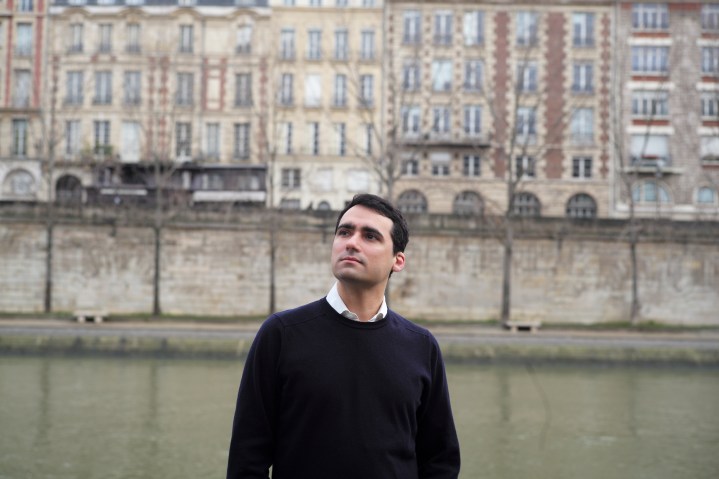
A keen advocate and performer of French piano music, the young Israeli-Belgium pianist Tal Walker explores three masters of French pianism in his debut disc of music by Fauré, Poulenc and Messiaen.
The idea of miniatures (Preludes and Nocturnes) written by French composers at the beginning of the 20th century has always interested me. These are improvisatory-like pieces, rather short and therefore combined in a cycle. These pieces give free rein to the composer’s imagination and reveal a sometimes more secretive side of their personality. – Tal Walker, pianist
The disc takes the listener on a fascinating musical journey, charting these three composers’ exploration of the miniature form and revealing connections within each cycle, while also demonstrating their own distinct musical voices and soundworlds, from the perfumed late romanticism of Fauré to Poulenc’s witty neo-classicism to Messiaen’s mystical harmonies and exotic rhythms.
Fauré composed his set of nine Preludes at the end of his life. Historically overlooked by performers, these miniatures are infused with the richness of late 19th-century romanticism yet look forward to modernism in some of their tonalities and harmonies. Highly imaginative and improvisatory in nature, they hark back to the Preludes of Chopin in their variety, fleeting moods, lyricism and whimsical charm. Tal Walker responds to the mercurial nature of these pieces with fluency and nuance, allowing the listener to enjoy and appreciate the multi-layered textures of these tiny gems.
Poulenc’s Nocturnes were composed between 1929 and 1938, and unlike the nocturnes of John Field or Fryderyk Chopin, these pieces are ‘night-pieces’ more in the manner of Bartok’s The Night’s Music. Some are dream-like, almost childlike in their simplicity. Others are nostalgic, some are humorous and ironic (No. 4 in C minor, for example, is a wry waltz), and many evoke the various personalities of the composer’s friends and intimates, either in the form of a miniature musical portrait or a dedication. There are touches of Stravinsky in the harmonic language in some, while others are richly melodic. The many moods and contrasting voices of these delightful pieces are showcased in Walker’s thoughtful, sensitive playing.
The Eight Preludes of Olivier Messiaen were composed 1928-29. They are clearly influenced by the impressionism of Debussy, with unresolved or ambiguous veiled harmonies, and parallel chords which are used for pianistic colour and timbre rather than definite harmonic progression, but Messiaen’s Preludes are also mystical rather than purely impressionistic, and look forward to his great and profoundly spiritual piano works, Visions de l’Amen (for 2 pianos) and Vingt regards sur l’enfant Jesus. In this suite of early pieces it is already clear that Messiaen was carving a distinct compositional voice of his own with his distinctive modes, birdsongs and a profound sense of mysticism and spirituality.
.
It is perhaps in these pieces that Tal Walker really shines most of all, revealing his skill, musical intelligence and maturity. Whereas in the pieces by Fauré and Poulenc we find a warm lyricism, to the Messiaen Walker brings a slight stridency and brightness of tone (a very ‘French’ style of piano playing) which highlights the many contrasting colours, timbres and textures of this music.
This is an impressive and rewarding debut disc and a fascinating hommage to French pianism by a young pianist who was taught by, amongst others, Madame Françoise Thinat, who herself studied with or was influenced by Yvonne Loriod (Messiaen’s second wife), Marguerite Long (who premiered Fauré’s Preludes), and Yvonne Lefébure. This musical heritage is evident in Walker’s thoughtful, nuanced playing, as if he has fully absorbed the great tradition from the past and melded it with his own personal artistic vision.
Fauré, Poulenc, Messiaen: Preludes & Nocturnes is available on the Collection Cabinet de curiosités record label and also on Spotify
An earlier version of this review appeared on the InterludeHK website
The Cross-Eyed Pianist is free to access and ad-free, and takes many hours every month to research, write, and maintain.
If you find joy and value in what I do, please consider making a donation to support the continuance of the site