Piano pieces inspired by Erik Satie
 2016 marks the 150th anniversary of the birth of Erik Alfred Leslie Satie, and to celebrate this occasion British composer Richard Fowles has released a personal hommage to Satie and his musical orginality.
Today Satie’s Three Gymnopedies are amongst the most well-known and much-loved music for piano, but during his lifetime, Satie was relatively unknown to much of the musical world. An unremarkable student, he was bohemian by nature, sceptical of established ideas and authorities, and was considered lazy by his teachers. Despite his relatively low profile during his lifetime, Satie helped shape the music of the 20th century: he was an inspiration and mentor to the group of composers known as “Les Six”, which included Poulenc, Milhaud and Honegger, and influenced contemporaries such as Debussy and Ravel who recognised him as a “new spirit” with a highly original approach to composition. It was not until the mid-20th century that his work became more widely known and appreciated, thanks in part to the endorsement of American composer John Cage.
Composer Richard Fowles was encouraged to pursue this composing project by his piano teacher at Brunel University, Sally Goodworth, after he wrote a couple of Satie-inspired pieces as a student. The result is a suite of 16 piano miniatures in part inspired by Satie’s own music (Knossienne Nos 1-3 being the most obvious, where the eastern melodies of the original Gnossiennes are woven into a harmonic framework redolent of the original, but never an imitation of it) and also by the composer’s life and unusual personality. For example, ‘Sea Bird’ (track no. 6) was the nickname given by Satie to his uncle Adrian, like Satie an eccentric character and an important figure in Satie’s early life. The music juxtaposes quirky melodies which unusual harmonies to create a work which is moody, enigmatic and witty.
In fact, wit pervades these charming miniatures, particularly in the triptych ‘The Velvet Gentleman’ which references aspects of Satie’s attire with which he was most associated, including his identical grey velvet suits:
On most mornings after he moved to Arcueil, Satie would return to Paris on foot, a distance of about ten kilometres, stopping frequently at his favourite cafés on route. According to Templier, “he walked slowly, taking small steps, his umbrella held tight under his arm. When talking he would stop, bend one knee a little, adjust his pince-nez and place his fist on his lap. The he would take off once more with small deliberate steps.”
Robert Orledge, Satie Remembered. French translations by Roger Nichols.
See also: “A Day in the Life of a Musician” by Erik Satie
From: ‘Daily Routines’, a blog by Mason Currey (published in book form as Daily Rituals)
In many of the pieces, Fowles mirrors the “walking beat” that seems to pervade many of Satie’s own piano pieces, a meter which may have been the results of his “endless walking back and forth across the same landscape day after day . . . the total observation of a very limited and narrow environment.” (Roger Shattuck, in conversation with John Cage).
Other pieces in the collection are more melancholy: ‘A Walk to the Chat Noir on a Snowy Day’ conjures up the solitary figure of Satie, dressed in his grey velvet suit, making his customary walk to a favourite haunt in the centre of Paris. Meanwhile the set called ‘Biqui’ recalls Satie’s relationship with Suzanne Valadon and his feelings of devastation when the affair ended. Each piece is offered in Andante and Lento, the slower metres and repeated chord motifs lending a desolate yet intimate atmosphere to the music.
‘Sylvie’, the final track on the disc, is named after one of three poems written by Satie’s friend J.P. Contamine de Latour that Satie put to music in 1886.Its jazz harmonies and winding melody is infused with a tender, almost elegaic air.
Throughout the collection, Fowles avoids pastiche by offering us the essence of Satie’s music, and some of his contemporaries, viewed through the lens of own originality and inventiveness which fuses eastern melodies with sensuous perfumed harmonies.
The music is performed on this disc by pianist Christina McMaster, whose affinity for this type of music is evident in her crisp articulation, preciseness of touch, and an acute sense of pacing which brings the music to life with vibrancy and atmosphere. And there is an added bonus, for pianists may also purchase the collection as sheet music (roughly Grade 6-8 level). Fowles has scored the music in a traditional way and also without barlines, à la Satie.
There is much to enjoy in this evocative collection, for those who love the piano music of Satie, and for those who are just beginning to explore it.
The sheet music is available now. Order here
The CD is released on 8th April.
Sample tracks here
Richard Fowles is an English composer, guitarist and teacher. He has worked as both a composer and session musician in some of the UK’s biggest recording studios and has provided the scores for a number of films and television programmes. He is also an in demand orchestrator. ‘Un Hommage à Erik’ is Richard’s debut album and book.


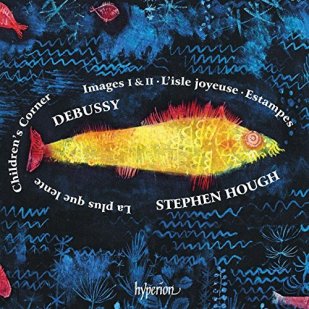 …….make sure it’s Stephen Hough’s new disc of piano music by Debussy (Hyperion).


