By Michael Johnson

The quirky mind of composer Erik Satie continues to inspire, amuse and annoy us 100 years after his death, and musicians still cannot quite decide what to make of him. For sure, they can’t ignore him, if only because his monumental Vexations is returning from obscurity in lengthy performances and recordings by well-known keyboard artists in Europe, the United States and Asia.

Igor Levit gave pianophiles a rare musical treat at the Southbank Centre in April 2025, leaving the hardy spectators in the audience mentally exhausted after 840 repeats of this one-page bagatelle. He took four or five short “loo breaks”, but kept himself going onstage with bottled water and a bowl of grapes. (He had previously livestreamed the work from the B-sharp studio in Berlin during the Covid-19 pandemic in 2020 in what he described as “a silent scream” to highlight the plight of artists hit by lockdowns.)

Igor Levit performing Vexations during the Covid pandemic in 2020

Levit kept his bearings during his Southbank centre performance by showing up with a bundle of photocopies of the score, discarding one at a time as he plowed through the piece. By the end, the stage floor was covered with 840 scattered copies.
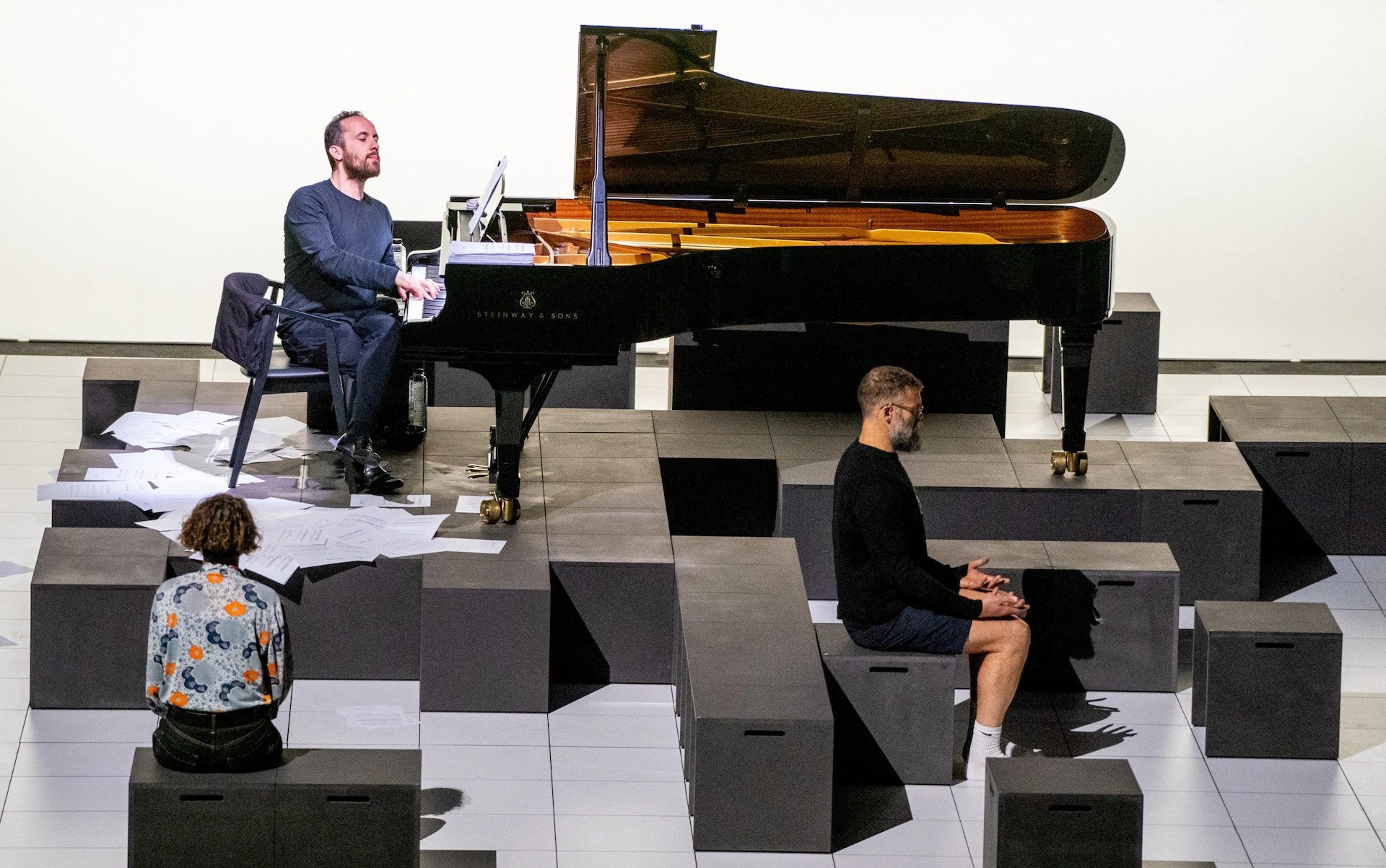
Igor Levit performing Vexations at the Southbank Centre Credit: Pete Woodhead

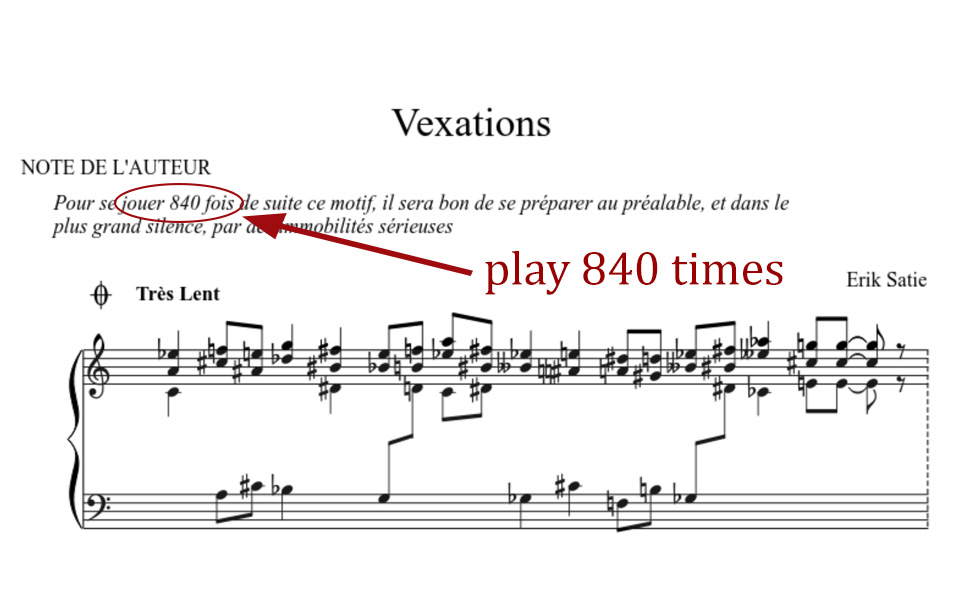
Here is the haunting melody Satie created :

Wrote one spectator: “ I was at Queen Elizabeth Hall just to witness his performance. It was so, so, so intense!”

A couple of years earlier, the young Italian pianist Alessandro Deljavan had sat in the studios of record company OnClassical in Pove del Grappa, filling 12 CDs in 14 hours 28 minutes. He recalled the “intense experience” for me recently. “I felt almost possessed. My mind drifted between shadowy, undefined figures and total emptiness.”

Other pianists also remember hallucinating, and one reported seeing what looked like “animals and things” peering at him between the notes on the sheet music.

One commentator on YouTube ended up deeply conflicted: “This is actually an empty song. Nothing makes sense … Illogical. Sad. Devoid of feeling. I loved it.”

An English critic found the best poetic language. It is a piece of “meandering melancholy,” he wrote. Others report a “spiritual transcendence” evolving from the strange world Satie had created.

OnClassical founder and pianist Alessandro Simonetto is in the process of completing the most extensive project ever devoted to Satie’s complete piano works. Progressively appearing online, he says, it has already reached 30 million streams on Spotify.

Simonetto, a Satie enthusiast of note, calls Vexations “arguably the most extreme and elusive work in the entire history of music”. Living and working out of Pove del Grappa in the province of Vicence, he may eventually bring out a boxed set covering Satie’s complete piano works including at least the one page sample of Vexations. At the moment the project exists only digitally.

Simonetto presided at the marathon recording session with Deljavan, recalling for me that the experience was like an Edgar Allen Poe horror story, with the“ceiling slowly lowering on the pianist’s head”.

Yet the unlikely attraction of this longest piece in piano history refuses to die. More than 20 CDs have appeared in the past few years offering Vexations in part or in full, straight or modified versions. Two prominent French pianists, Jean Marc Luisada and Jean Yves Thibaudet have performed the piece, with all repeats.

Most reviewers have judged the full Vexations experience an endurance test, a prank or a stunt that Satie just tossed off without a second thought. He was known in the creative ferment in 1020s Paris for his musical jokes. He seems to have slid it into a drawer and never heard it played.
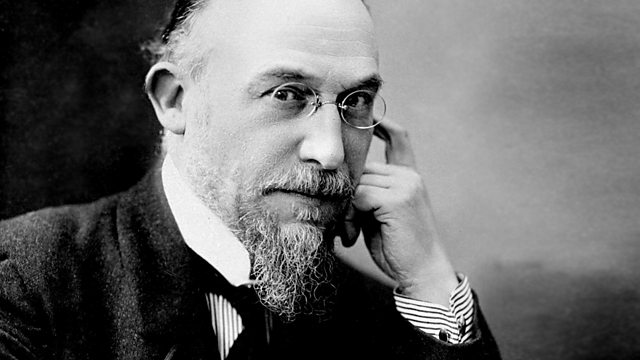
Erik Satie

It’s the mental strain of non-stop repetition that leaves today’s pianists limp as a wet rag, except for Deljavan and the remarkable Levit. Indeed, Satie advised all pianists who try the full version to devote 20 minutes of silent meditation before starting. This became a feature of many modern performances.

But about 40 years ago English pianist Peter Evans played Vexations non-stop for 15 hours, suddenly quitting at repeat No. 593, and hurriedly left the stage without explanation. He later wrote that “people who play it do so at their own great peril”. The performance was completed by another English pianist, Linda Wilson. She later wrote that with each iteration Evans felt his “mind wearing away”. Observers wrote that when he left the stage he was “in a daze”. He recalled that his mind was filling with “evil thoughts”.

A notorious and frustrating episode occurred at Leeds College of Music in 1971 when another team of pianists managed to keep going for 16 hours and 30 minutes, ending at midnight only because school regulations closed the building. One of the team players, Barbara Winrow, explained to a journalist the “real sense of frustration which we felt, and the players’ remarkable reluctance to stop” before they reached the 840 mandated repeats.

A memorable milestone was reached in 1974 in Budapest when a team of pianists played in rotation for 23 hours. The team included at least two young players who went on prominent careers and are still performing today, Zoltan Kocsis and Andras Schiff.

Tracing the chequered past of this work is a major detective job. Musicologists return to the mysterious origins periodically. The manuscript was not played in full until more than 20 years after his death. Who acquired it, when, where, how or why did it change hands? Lawyers today call it a task of establishing the “chain of provenance”.

After gathering dust for years, it came back to life in the hands of John Cage who rescued it and encouraged others to participate in rotations. He first published the one-page treatment in the magazine Contrepoints in 1949. He was the first to interpret Satie’s written instructions as meaning the 840 repeats must be played without interruption – either solo or in rotating teams of pianists.
Cage organized the first public performance of the full version with more than a dozen pianists in rotation. His spectacle in 1963 in New York put his team through 18 hours and 40 minutes of continuous repetition.

John Cage

But can it be played from memory? A vide on clip on Youtube shows Cage declaring that he was never able to memorize it. Other pianists have found it so contrary to accepted compositional norms that they could not absorb it either.

The late English music scholar Richard Toop performed the piece in its entirety several times but took care to approach each run-through with a fresh eye. But he too had a memory block. “Even after a performance,” he wrote, “I was unable to play more than a few beats from memory.”

Tracing the people who had possession of the original score, passing it from hand to hand, is impossible today due to the passage of time and the individuals involved. It is said to be with the Satie Archives in Honfleur, in the Calvados Department three hours northwest of Paris.

Guest post by Frances Jones

One of the bonuses of teaching is that from time to time you are introduced to new repertoire. Sometimes, you get the opportunity to change your view of a composer that was really only based on a passing experience. 

A pupil of mine has recently been learning a piece by Cecile Chaminade, a composer whose music I had until now associated with a flautist house-mate practising diligently in the run up to a recital. A beautiful work, the Concertino, but the flute can be surprising loud in close quarters. 

Cecile Chaminade (1857-1944) composed throughout her life, and left a large number of piano works, in addition to orchestral music and songs. The piece that my pupil learnt, and that inspired me to explore Chaminade’s music, was the Idylle, Op. 126, No. 1, from her Album for Children of 1907. It has a melody that becomes a real ear worm; marked bien chanté, it does indeed feel very singable. It’s such a satisfying piece to play; the melody in the right hand is accompanied by a simple enough bass line helped along with discreet pedalling. The middle section requires a little more diligent practice for the aspiring Grade 4 pianist (the piece has recently been on the ABRSM Grade 4 syllabus) and the writing is never dull; the melody wings its way onwards, and for a glorious minute or so you can be flying over the rooftops, your spirits lifted. The opening melody returns to round off the piece and you sense in the pupil the confidence that familiarity brings. Immediately the pupil’s playing is more assured, expressive, even playing around with tempo and the placing of the notes. 

I think it was the singable melody that piqued my curiosity, and made me want to know more about Chaminade’s music. The piece I found first was her Serenade Op. 29, written in 1884. After listening to this you can see why Chaminade’s music has been described as charming. The opening melody is gentle, almost like a lullaby, and is supported by pleasing harmonies in the accompaniment. The second melody has a similar rhythmic pattern and is more searching but still holds a tender quality. They are both such beautiful melodies that the whole piece really works. Both tunes use similar rhythmic patterns and accompaniments, but it’s the subtle melodic development as well as changes in articulation that keeps this piece interesting. The music finally fades away to ppp and a tonic chord, dusk having fallen and the musicians taking their leave. 

The next work of Chaminade’s I listened to, which really threatened to take the attached description of ‘charming’ and hurl it out of the window, was her Arabesque No 1, Op. 6, from 1892. It’s a tempestuous piece, technically much more difficult than the Serenade. Chaminade was a pianist, studying with teachers from the Paris Conservatoire, and later performing her works in Europe and the United States. I can imagine her sitting at the keyboard, absorbed in her music, taking the audience with her on a journey through delicate flourishes and big chords, carried along by a melody that is seeped in the Romanticism of her Russian and German contemporaries. 

Her Caprice-Impromptu, despite being one of her later works, written in 1914, is also decidedly Romantic. Chaminade, like her near contemporary Rachmaninov, remained broadly consistent in her style whilst many composers around her responded to new influences. Indeed, the Caprice-Impromptu has hints of Rachmaninov in its melodic writing. Like the Arabesque, there’s a sense of urgency and although the first section is playful as the title of the piece suggests, the melody that follows in the second section is at once both yearning and lyrical. Chromatic scales in octaves add to the sense of drama and the composer makes full use of the expressive range of the piano; the music ranges from fortissimo to piano and dolce

Chaminade’s music is characterized by its melodic writing and chromaticism; it’s Romantic, yes, accessible, maybe, but no less interesting for that. Chaminade was a prolific composer and her piano works are both imaginative and musically satisfying. I can’t wait to discover more. 


Unearthed manuscripts reveal a new side of the eccentric French composer, brought to life by pianist Alexandre Tharaud in a recording of previously unheard works

A century after the death of Erik Satie, 27 never-before heard works are released to the public for the first time. The landmark digital album, Satie: Discoveries, performed by acclaimed pianist Alexandre Tharaud, is now available on Erato, just days ahead of the centenary of Satie’s death on 1 July 1925.

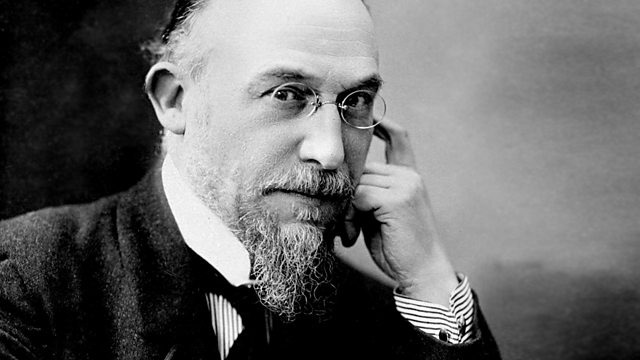
Erik Satie

The collection sheds new light on one of music’s most enigmatic figures. Reconstructed from forgotten manuscripts and unfinished sketches, these pieces, ranging from playful cabaret songs to minimalist nocturnes, were originally written by Satie for performance in the bohemian cafés of Montmartre, where he worked as a pianist in the late nineteenth century.

The album is the result of painstaking musicological research by Sato Matsui, a Japanese composer and violinist, and James Nye, a British musicologist and composer. The duo independently tracked down lost materials in the Bibliothèque nationale de France and a private archive in Boston, piecing together and reconstructing Satie’s sketches into fully performable scores. Some of these are to be published by Éditions de la Fabrique Musique.

Among the newly discovered gems are pieces in the same free, minimalist style of Satie’s Gymnopedies and Gnossiennes (for example, Réflexions nocturnes and Autour du 1st Nocturne). Other works draw on familiar dance styles, (including several Parisian Valses), the café-concert song and operetta arias (‘Le Champagne’, ‘Pousse l’amour’ and ‘Chanson andalouse’).

Further pieces reveal a more experimental Satie, such as the Esquisses bitonales (Bitonal Sketches) or the Soupirs fanés (Faded Sighs), a collection of miniatures with evocative titles such as ‘Poil’ (Hair), ‘Barbouillage’ (Daubings), ‘Familial désespoir’ (Domestic Despair) and ‘Souvenirs fadasses (Dusty Memories).

Though most of the tracks feature pianist Alexandre Tharaud performing solo, three also feature the acclaimed Serbian violinist Nemanja Radulović. Radulović’s violin takes on the role of the singer in a mélodie and two cabaret songs where the lyrics are now lost. 

In addition to these 27 world-premiere recordings, two already familiar pieces are included: the hypnotic ‘Chinese Conjuror’ from the ballet Parade, for piano four hands with Gautier Capuçon, and the ‘Chanson andalouse’, originally intended for the never-performed operetta Pousse l’amour. The ‘Cancan Grand-Mondain’ (High-Society Cancan) from La Belle Excentrique is recorded here in a new version for solo piano by Tharaud himself.

Alexandre Tharaud said of the album: “Satie remains very much an enigmatic figure today, held in enormous regard at the same time as being largely misunderstood and almost unknown…it is up to us to look beyond the Gnosiennes and the Gymnopédies, to try our sincere best to get closer to the music and to pay real attention.”


Satie: Discoveries is out now on Erato on all streaming services

Source: press release

Guest post by Frances Jones

I’ve never found it easy to keep New Year’s resolutions. Often, they are admirable but just not sufficiently motivating and are inevitably dropped before ever really achieving anything. Last year, though, I decided I would practice the piano more often and also give a concert, however low-key, for my students, most of whom were under the age of 10. One of the pieces I re-learnt and performed was Germaine Tailleferre’s Impromptu, a wonderfully spirited piece with an oft-repeated motif that ducks and dives through many keys before finally coming to rest with a ritardando and arpeggiated passage alighting on the tonic.

Rediscovering this piece led me to think of Tailleferre’s First Piano Concerto. I say rediscovering because Germaine Tailleferre’s music was the subject of my undergraduate thesis, back in 2005. It wasn’t long before I was listening to the concerto, now much more easily available on Youtube, and recalling an afternoon spent poring over the score in the dimly lit depths (or so it seemed to me) of the British Library.

Tailleferre wrote her first piano concerto in 1924 and, in a departure from the Romantic style of her earlier pieces for piano, embraced the neo-Classicism that had been emerging in France in the early years of the 20th century and that she had deployed in her string quartet of 1919. As far as I’m aware, there has been just one recording to date, by the University of California Santa Cruz Orchestra:

The first movement is in sonata form, but foreshadows the neo-Classical style of Stravinsky in his Dumbarton Oaks Concerto with its similarity to concerto grosso. The instrumentation, too, is reminiscent of earlier times, with strings, trumpet, horn, oboe, bassoon, flutes and timpani. The piano and orchestra start together in the first bar, and the musical themes are shared in a joyful back and forth full of counterpoint and syncopation. The opening theme, a descending melody with a repeated rhythm, is heard over a staccato bass which really bounces along and immediately conjures up a sense of exuberance. Later on, the harmonies are more Romantic and the piano is more obviously accompanied by the orchestra, but the melody is still propelled by a driving rhythm. The joyous, energetic character returns as the opening material is repeated, exchanging fragments of melody, overlapping and answering, until the final bars.

The second movement has a different feel. Indeed, when I was researching this work for my thesis, I was so struck by the similarity of the slow movement to the slow movement in Ravel’s Piano Concerto in G, that it led me to consider the influences that this concerto may have had upon Ravel. (Ravel wrote his concerto in 1934, and the two composers were good friends). This is a subject for another time, but it makes for an interesting discussion. The movement starts with solo piano, and a continuously evolving melody which defies a clear sense of beat and only becomes clearer when the flute enters in bar 4. This emphasis on melody harks back to the earlier style of her piano works, in which melodies evolved over a more static bass line. It’s a beautiful movement, wistful and yearning; it builds to heavy chords, anguish almost palpable in each, and subsides, the strings accompanying the piano to resolve onto a major chord, the sun shining again on the rain-soaked pavement (if you’ll excuse the weather analogy).

We return in the third movement to the uplifting character of the first and indeed, to a more obviously neo-Classical style. But it’s not without its individualism. The themes are characterized by off beat rhythms that cut through the texture but there is lyricism, too, always urgent, pushing forward, both orchestra and soloist involved in an intense communication. There’s a joyful, ascending

piano melody, followed by a conversation with the flute and oboe and, finally, a cadenza where the pianist emerges into the limelight. However it’s the interweaving of the melody through the orchestral parts, specifically flute, oboe and trumpet, that I really enjoy in this movement. Towards the end, the syncopated motif is shared around the orchestra, the soloist running up and down the piano in scalic passages until the trumpet breaks through the texture to end with a triumphant flourish.

Tailleferre’s Piano Concerto was premièred in London by Alfred Cortot in 1924. Although performed many times in the decade following its publication in 1925, the work has not since achieved a fraction of the commercial success enjoyed by other 20th century concertos. It perhaps just doesn’t quite have that level of virtuosity attained by other composers, such as Ravel in his Piano Concerto in G, or Shostakovich in his First Cello Concerto. Its neo-Classical style and lack of a really prominent part for the soloist may also have contributed to its gradual disappearance from the concert platform. However, the more I (re)listen, the more I’m drawn to this work which appears like a burst of musical sunshine from the Paris of the 1920s. I’d love to hear it performed live. Perhaps now, 100 years on, might be the time for its renaissance.


Frances Jones read music at York University, followed by a PGCE at Cambridge. She is Music Lead at a school in West London and also teaches piano.

