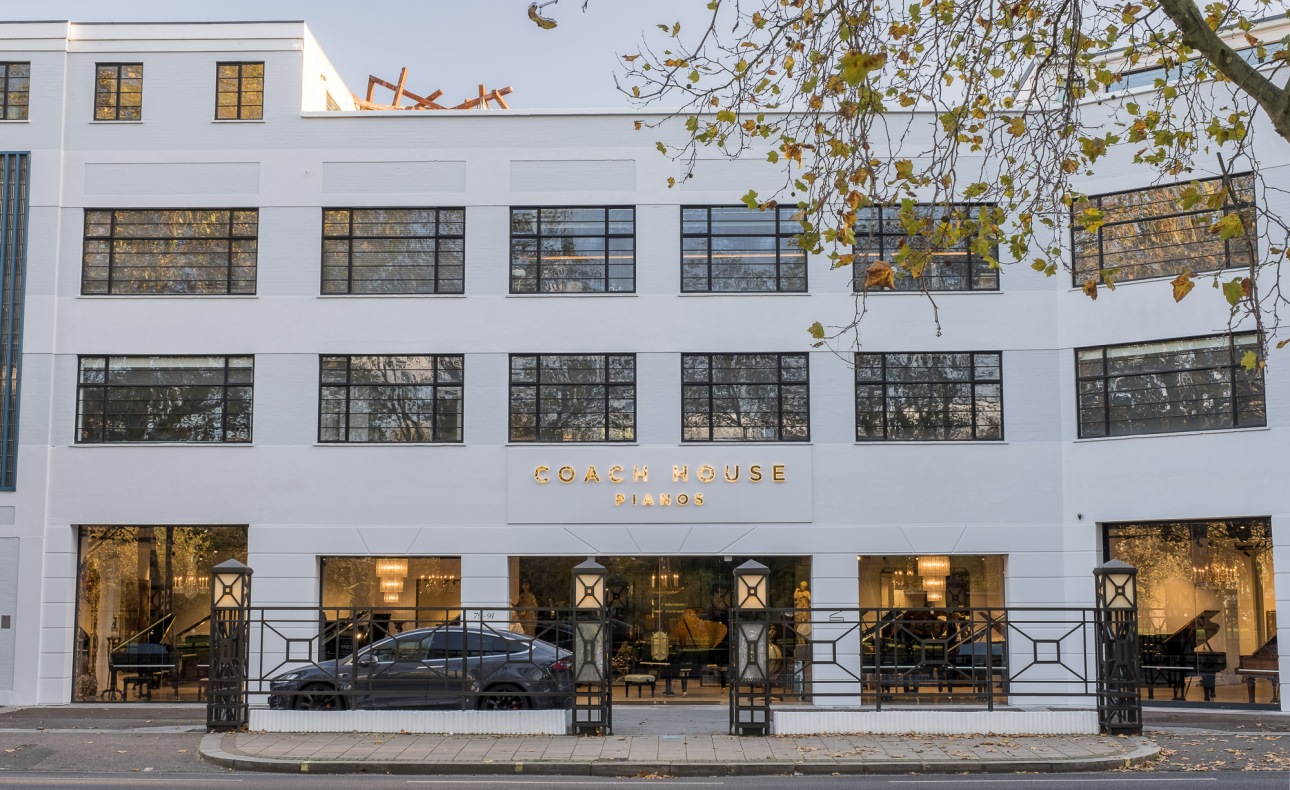
Coach House Pianos (CHP), a well-established family-run piano business based near Swansea in Wales, opened its glamorous London showroom on the New Kings Road the day before the UK went into the second Covid lockdown in November 2020. Not the most auspicious start to its new London retail venture, one might think, yet the lockdown proved beneficial to CHP: with so many people confined to their homes, many turned to music, and the piano in particular, to pass the time.
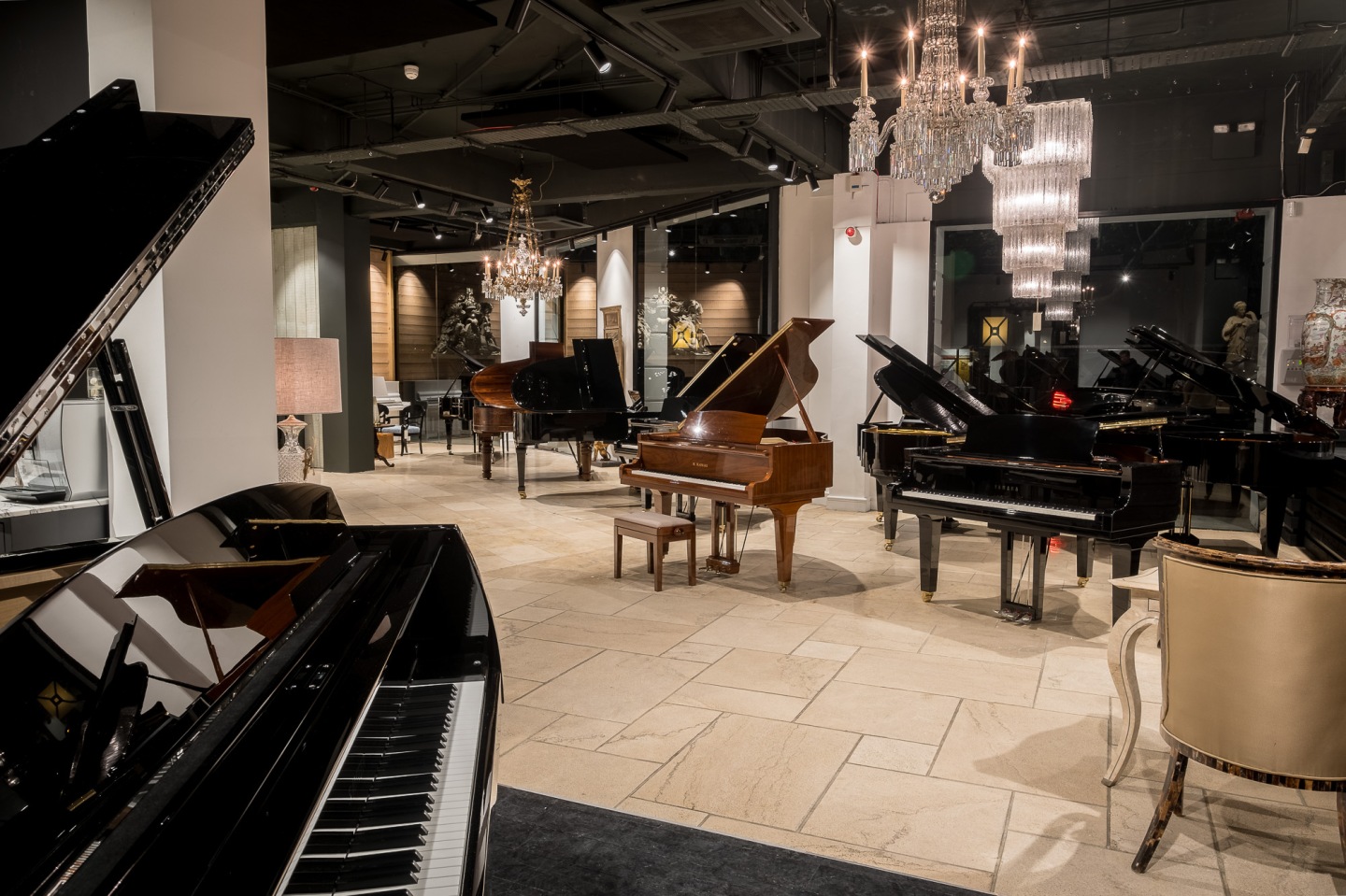
It’s a mark of CHP’s success and business savvy that they now have a London outlet – and one that is not hugger-mugger to the other major piano retailers. The showroom is in the Talisman Building, a striking white Art Deco building just a few minutes walk from Fulham Broadway and Parsons Green tube stations. The spacious, elegantly-decorated ground floor space is heaven for pianists and piano lovers, with a splendid range of some of the finest marques and instruments, and helpful, friendly staff.
I got to know CHP through my friend and (occasional) duo partner, Lee. Like me, a keen advanced amateur pianist, I visited CHP’s Welsh showroom just over 5 years ago to help Lee choose a new grand piano. We were in London a week ago to select another piano for him, an upgrade since he now has the space for a larger instrument. He had set his heart on a Shigeru Kawai, but on arrival at CHP’s London showroom, we were invited to play any, and indeed all (if we so desired!) of the pianos on display there.
CHP keeps Steinway, Bosendorfer, Sauter and Yamaha brands at its London showroom. Although most of the pianos on display are grands, of various sizes and prices, there are also uprights and even digital instruments, so the piano hunter has plenty of choice, and ample opportunity to compare instruments too.
Buying a piano, and especially a grand piano, is a significant undertaking – and not just in terms of financial outlay. Even though modern pianos are made to standard specifications, there are inevitably – because these are instruments made of natural products like wood – differences within a particular maker and model. Lee and I really understood this when we went to the Yamaha selection centre in Milton Keynes in 2018 to try 6 C3X grands – each one was different, in terms of both tone and touch). So the opportunity to try different pianos, and a range of repertoire, is very important.
In addition to the freedom to play so many fine instruments, CHP’s staff are friendly and knowedgeable – and there is absolutely no hard sell. They appreciate that buying a piano is a significant purchase for many people and they are keen for their customers to find absolutely the right piano.
Although it felt as if we had been let loose in a piano sweet shop, there was serious business too and it was important for Lee to make the right decision with regard to his new piano. So we played solos to one another, and our “party piece”, Schubert’s D940 Fantasie, and listened to one another playing various instruments from different parts of the showroom. We compared notes (no pun intended) over lunch and then Lee went back inside the showroom, a decision made.
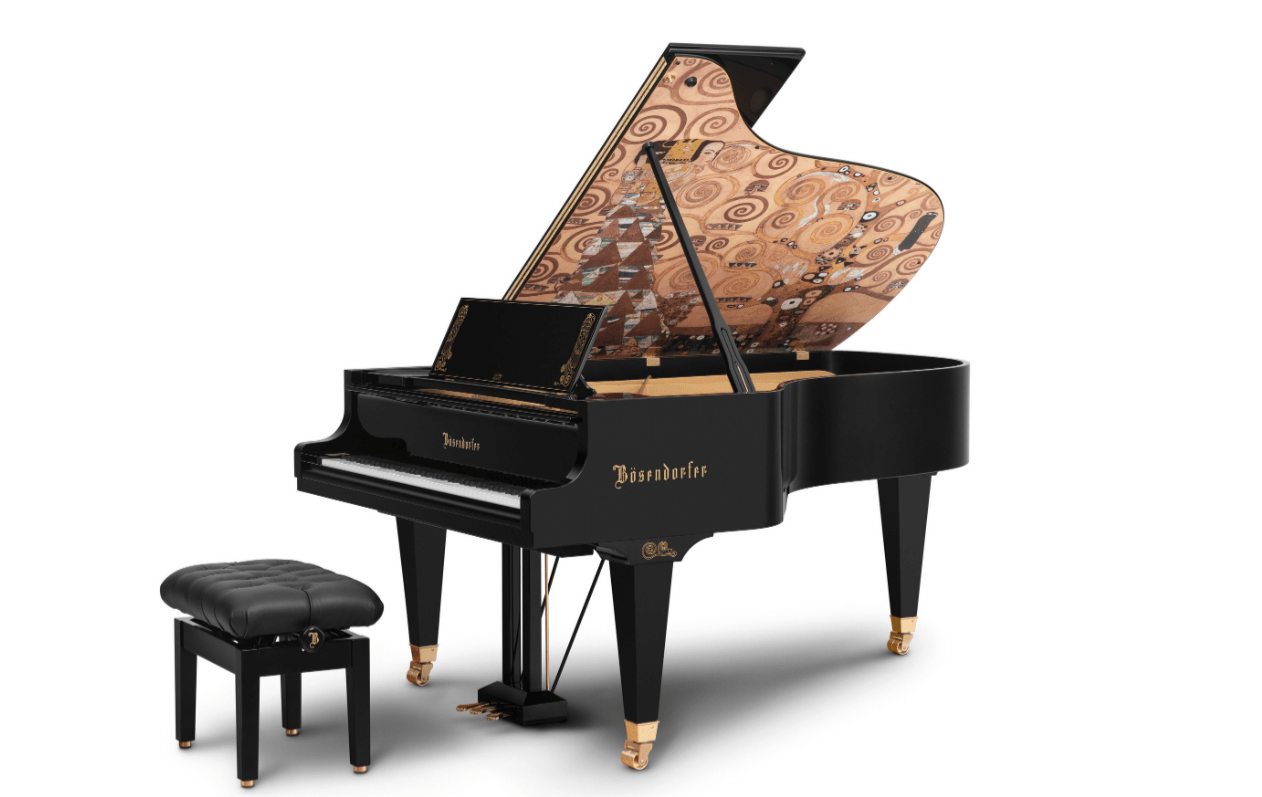
Klimt Tree of Life art case Bosendorfer
In all my encounters with CHP, I have been impressed by the level of customer service and knowledge of the staff. Add to this, a beautiful London showroom (which has space for recitals and other events), and now pianophiles and piano hunters need not travel so far to seek the perfect instrument.
Owning a really fabulous grand piano is what most pianists dream of and aspire to. I remember when I used to have a ropey old upright with candle holders on the front, and a whiff of old timber dating back to circa 1925. It was good enough to start me off learning at the tender age of 12, but I used to daydream about owning a big black gleaming beast of a piano, with bright brassy wheels and a thunderous tone that could silence orchestras, or reduce the listener to tears with its ineffably sweet tone and colour. That was 1982, and of course I gave up playing 3 years later after achieving the dizzy heights of grade 5 It wasn’t until I was 38 that I rekindled my love of the piano, and I realised that the black beast daydream still burned strong and bright somewhere inside of me. Thus, my piano buying journey commenced. Some 10 years later, I have been lucky enough to have owned 5 grand pianos since then, of which number 5 is the latest incarnation. Alas, during this journey of piano enlightenment, I realised that not all black shiny pianos are created equal, and so I set about buying “the one” – the piano to rule them all (within the limits of my living room and the tolerances of my neighbours).
So, how does one go about buying the piano of one’s dreams when there are so many to play and choose from, and with huge budget considerations to factor in?
Tip one – Go as big as possible within the constraints of the room the piano’s going to be in. This is not for volume. I could make an enormous sound on my previous small grand – a wonderful Boston 163, which one of my students now has in her possession. A long piano gives you far more tonal range and colour than a small grand. In fact, I found that I can play quieter on my bigger grand than I could on my old 163. This is particularly noticeable in the bass, where long sustaining notes are much easier to maintain with half pedalling.
Tip two – Maximise your budget. You’re not going to find anything that resembles your dreams under £10,000, and anyone who’s telling you otherwise is lying. Even then, this is only the start of your journey, and you’ve got to keep going. Unless you’ve got a spare £25000 plus lurking under your bed to start off with, there are ways to upgrade your piano to better models. I was advised by my lovely (now sadly deceased) piano teacher Denise Patton, to go to Coach House Pianos in Swansea, who would “sort me out” with a decent grand (they are simply the best for thousands of miles – try them). They have an upgrade price promise plan, where you can trade in a piano bought from them, and they will honour the amount paid for it originally, less VAT, towards a better model. This was the route I chose, and I’ve encouraged my students to follow suit.
Tip three – Keep your budget to yourself. There are big discounts to be had out there, and deals are there to be made. Never accept the price on the piano – go for those discounts that are hidden. You have the money after all, and the piano dealer wants it.
Tip four – Play as many pianos as you can. Travel widely to different dealers and don’t expect to find “the one” there. Be open-minded and accept the disappointment of travelling hundreds (yes, hundreds) of miles and not finding “the one” – despite having the cash in your account and ready to go. I made this error once, and bought a complete donkey of a piano. It was horrendous, and the only one where it made me so angry I threw all my sheet music around the room in utter wrathful agitation.
Tip five – Beware the black and shiny ones. There are some dreadful pianos on offer (their name may sound German in an attempt to woo you over with that engineering thing the Germans do so well), but they’re manufactured elsewhere, usually in Asia. These pianos play like you’ve taken the action out, given it a good kicking, left it out to weather over winter, and then had a go at tuning it yourself (because you’ve seen the tuner do it and it looks a doddle).
Tip six – Try, try and try before you buy. When you’ve found what you think is “the one”, don’t buy it yet. Try it with at least 5 or 6 pieces of contrasting test music. This needs to be music you can play to a very high standard, is technically sorted, and you know exactly the sound you want the piano to make. This is crucial. My own test pieces are Ravel Sonatine, Chopin Berceuse, Scarlatti Sonata in C major Kk420, Rachmaninov Etude Tableau in C minor Op 33/3, and the opening bars of the first movement of the Waldstein Sonata. Your potential new musical soulmate must be able to do exactly what you want in all your test pieces. Disregard it if it fails. Be ruthless. Try again on a different day but maintain your standards – if it still fails to deliver, walk away.
Tip seven – Take a piano mate with you (I had the esteemed Cross-Eyed Pianist as my buying companion), and ask them to play their test pieces. Listen to the sound that is emerging from the instrument. Close your eyes and actively listen to it as if you were listening at a concert. Move around the piano and listen to it from lots of different vantage points in the showroom.
Trying out pianos at Coach House Pianos’ showroom in Swansea
Tip eight – Don’t buy the one you see in the dealer’s showroom. If you’re going to be spending a lot of money on a new piano, you must try as many of the models you are considering as possible. I played a total of 10 new Yamaha C3X’s before settling on “the one”. After playing 5 pianos at Coach House’s showroom, the team there arranged for me to spend half a day at the Yamaha selection centre in Milton Keynes where I had another 5 pianos to try – all the same model that I wanted, all beautifully set up and tuned, in a decent sized concert room. Even then I had a tough job deciding between number 1 (a sweet, and oh so beautiful tone), and number 3 (ravishing tone and velvety touch), before being ordered to play number 5 by a somewhat impatient Mrs Cross-Eyed Pianist because I had ignored it up until then. With the first chord of Schubert’s last piano sonata, I realised that this was the piano of my dreams. It’s a surreal moment and one I hope all pianists will experience.
Tip nine – Consider different makes. If your attention is focussed on a Steinway Model A, I strongly suggest you try the new Yamaha C3X range. Under the fingers, there is very little, if any difference in these 2 models. They are the same size, but the Yamaha is about £30,000 cheaper – and in my opinion, you absolutely do not get £30,000 more piano with a new Steinway A.
I adore my new Yamaha C3X, and I hope you find the piano of your dreams too. There is something incredibly special when you find “the one” – a connection that is effortless. For me it took 30 years – and my own journey has only just begun….
Lee Varney is a keen advanced amateur pianist and piano teacher. He has collaborated with The Cross-Eyed Pianist on a number of projects, including charity concerts for SPIN and Hannah Lindfield, and performance workshops for adult amateur pianists. He is currently working towards a Licentiate Performance Diploma. In his other life, Lee is an anaesthesia practitioner at a leading London teaching hospital.
The Cross-Eyed Pianist is free to access and ad-free, and takes many hours every month to research, write, and maintain.
If you find joy and value in what I do, please consider making a donation to support the continuance of the site






 The Cross-Eyed Pianist