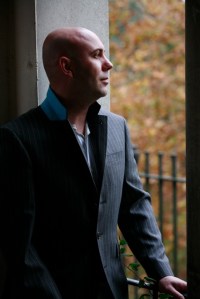
Who or what inspired you to take up composing, and make it your career?

My main motivation for composing has been the arrival of my children, which although taking up a great deal of time – has been a constant source of inspiration. In addition to this, I am very inspired by the countryside. When I began composing my latest album ‘Summit’, I was living very close to Richmond Park and I took much inspiration for the music during misty morning walks in the park. I am also very inspired by the area close to where I live now and I have tried to reflect the openness and beauty of the Chiltern Hills.

Who or what were the most significant influences on your musical life and career as a composer?

I have been greatly influenced by working with my piano and composition students who have drawn my attention to all manner of composers and musicians both in ‘pop/rock’  genres and classical. I have also been influenced by working with rock and jazz musicians in a band environment where freedom of expression is sought and encouraged.

What have been the greatest challenges of your career so far?

Recording my last album ‘Summit’ took a great deal of time and patience over many months.

What are the special challenges/pleasures of working on a commissioned piece?

Commissioned work is an incredibly challenging task as often you do not have sole creative input into the final work. It is a collaboration of at least two or more people all with differing opinions on the final outcome. These challenges can be incredibly rewarding however and can lead to unexpected outcomes.

What are the special challenges/pleasures of working with particular musicians, singers, ensembles and orchestras?

Composing can be a lonely pursuit so I always enjoy collaborations with other musicians. in 2008, I worked with a singer on an album of folk music which was a really enjoyable collaboration.

Which works are you most proud of?

I am most proud of my latest album of solo piano music ‘Summit’ written to reflect my love of the countryside and dedicated to my one year old daughter. Although I have released it as a CD, I primarily wrote it with the pianist in mind. I am very keen that my music should be interpreted and re-composed by the pianist.

Do you have a favourite concert venue?

I love venues which are ‘unconventional’ like outdoor venues. Last year I performed in a disused barn in the middle of a corn field which was great fun and very atmospheric.

Who are your favourite musicians/composers?

I love Bach for the truthfulness and inventiveness of expression. In particular, I am incredibly impressed by the way they solved structural problems in seemingly effortless ways. Modern composers I have taken influence from are John Tavener and Yann Tiersen.

What is your most memorable concert experience?

Watching sir Simon Rattle conducting Beethoven’s 5th (from the choir stalls so I could see every expression on the conductor’s face) and feeling my daughter wriggle in my wife’s belly.

What do you consider to be the most important ideas and concepts to impart to aspiring musicians?

Take advice and instruction in an objective and critical way. It is important to remember that ‘you’ are the musician – it is your creativity and musicianship that are the most important aspects of your performance or composition.

What are you working on at the moment?

I am busy working on my second album of solo music, due to be published in late 2015.

What is your most treasured possession?

My piano and my violin.

www.rogerproctor.com

(photo: Gautier Deblonde)

Who or what inspired you to take up composing, and pursue a career in music? 

I started as a jazz bass player having become very interested in jazz as a teenager. I had studied classical piano from the age of 5, but took up the bass when I was 18.  I only started to compose in my early twenties and for this move it was the work of John Cage that was the key inspiration.

Who or what were the most significant influences on your musical life and career as a composer? 

Initially it was Cage.

What have been the greatest challenges of your career so far? 

There have been many, but perhaps writing my first opera, a setting of Euripides’ Medea in Ancient Greek was the most challenging as it was the first thing I’d ever written for orchestra, for the stage, for the human voice and I’d only ever seen one opera live. In addition I was my own publisher and I had only 8 months to write it while teaching full time…

What are the special challenges/pleasures of working on a commissioned piece? 

The main challenge, which is in fact a pleasure, is to get to work with many very different artists  – both with performers, choreographers, opera directors etc.

What are the special challenges/pleasures of working with particular musicians, singers, ensembles and orchestras? 

It is, again, the encounter with artists of real quality and I have to find what works best for them; that is to say, I always take account of their characters both musical and otherwise.

Which works are you most proud of?  

I’m not really proud of any of them! There are works that I think are of greater significance but I never proud of my own achievements though I take pride in the successes of others – my children for example.

Who are your favourite musicians/composers? 

My favourite musicians are the members of my own ensemble, who are the finest singers and chamber music players I know, and with whom I have chosen to work. There are many composers whose works I enjoy and admire but none would be “favourites”!

What is your most memorable concert experience? 

There are many, but I would single out two. One was a concert performance of my first opera by BBC Scottish Symphony orchestra 11 years after the opera performances. The other was touring an old piece of mine, The Sinking of the Titanic, during the centenary year of the sinking, when I included my four children in my ensemble (my three daughters on viola, two cello; my son on double bass)

What do you consider to be the most important ideas and concepts to impart to aspiring musicians? 

There are two:

Always keep and open mind and a spirit of enquiry (so as not to develop predictable routines) and make sure that you have a secure musical craftsmanship ( so that you are able to express your ideas without difficulty of technique).

Where would you like to be in 10 years’ time? 

I would like to be still alive and well, and in our home with my entire family on the Pacific coast of Canada (where we live for part of the year)

What is your present state of mind? 

Alert and as serene as possible

Gavin Bryars presents ‘The Bass in My Life’ with Daniele Roccato, double bass, who performs works by  Stefano Scodanibbio, Giacinto Scelsi, Ivan Fedele, Franco Donatoni, Daniele Roccato and Gavin Bryars at the Italian Cultural Institute London tonight.  The event is part of the Suona Italiano residency to promote Italian music. Further information here

“… The music of Gavin Bryars falls under no category. It is mongrel, full of sensuality and wit and is deeply moving. He is one of the few composers who can put slapstick and primal emotion alongside each other. He allows you to witness new wonders in the sounds around you by approaching them from a completely new angle. With a third ear maybe. . .” –Michael Ondaatje

Gavin Bryars’ full biography

www.gavinbryars.com

_MG_8764Who or what inspired you to take up composing, and make it your career? 

I don’t recall the initial trigger(s) to take up composing but there was always a strong desire from about the age of seven to put dots onto the page.  Similarly, the decision to make a career appears to have been there from an early age in some form – it just always seemed to be the path I was destined to follow.

Who or what were the most significant influences on your musical life and career as a composer? 

There are key figures and key works that have become significant in my musical life – those being Bach, Stravinsky, Debussy, Messiaen and more recently, Jonathan Harvey, George Crumb, Anton Webern and Matthias Pintscher.

What have been the greatest challenges of your career so far? 

The process of composing itself is by far the greatest challenge of my career to date.  Self-doubt and anxiety has often crippled my creative output for months on end.  I’ve also never been a composer to repeat the same technical trick over and over in my writing.  Every new piece presents a new problem to solve and each time the solution requires a different approach.  Perhaps this explains why I write so slowly.

What are the special challenges/pleasures of working on a commissioned piece? 

I rarely write without a specific request for a work (with or without payment) and that brings with it certain pleasures such as working closely in collaboration with a musician or ensemble to develop a specific idea or sound.  The biggest challenges are always the deadlines and time-frames that often appear to get in the way of the creative flow.  It seems to be a common issue amongst artists, yet I am finding more and more that these goal posts can serve as great motivational forces when hitting a creative dead end.

What are the special challenges/pleasures of working with particular musicians, singers, ensembles and orchestras? 

I’m always interested in exploring new sounds often through the combination of electronics and acoustic forces.  Working with particular performers, especially those who have developed new performance techniques or use extended instruments, is really exciting because as a composer I get to try out sounds that perhaps nobody has written and heard before.

Which works are you most proud of?  

There are a few recent works that have been significant for me because they represent either a change in style or in the way I approach writing. Music of the Spheres (2006) for piano and planets  was a real labour of love due to hundreds of hours spent trawling through data files from NASA’s Voyager spacecraft in order to find a few gold nuggets that could be turned into something of musical interest.  Despite all the effort, I am very happy that performing piano alongside a sonic representation of our solar system is accessible to anyone from about Grade 2 piano upwards.  Escape Velocity (2006) for accordion and string quartet is also an important work because it represents both a change in style that felt very comfortable for me but also because it demonstrates an attempt to explore and ultimately integrate two different instrumental forces into a single sound world. Fata Morgana (2007) for cello with Hyperbow, ensemble and live electronics is another key work as it represents the culmination of several years of research exploring the application of sensors and performance data in shaping and controlling the evolution of accompanying live electronics. It was also the first time I began to feel confident with my expanding musical language and with writing expressively at the extreme ends of the cello’s range. In this work, I felt that I had finally begun creating a more unified and meaningful connection between the expressiveness of the performer and the resulting reflections from the electronics through the aid of the sensors – something that has been a developing working method for me ever since.

Do you have a favourite concert venue? 

Not at all – I’m always grateful for a performance, wherever that might be!

Who are your favourite musicians/composers? 

In addition to those composers I mentioned earlier who were of most influence in shaping who I am as a composer, I would include Ockeghem, Pergolesi, Prokofiev and some contemporary heavyweights such as Schoenberg, Ligeti, Boulez, Crumb, Magnus Lindberg, Helmut Lachenmann, Unsuk Chin, Harrison Birtwistle and GérardGrisey.

As for performers, I wouldn’t say I have any favourites as such.  Moreover, I just really appreciate and admire performers generally as I gave up myself after completing my undergraduate studies due to stage nerves.

What is your most memorable concert experience? 

There are three that are particularly memorable for me – the London Sinfonietta’s 2008 QEH performance of Grisey’s complete Les espaces acoustiques; the Sinfonietta/Royal Academy 2013 RFH performance of Stockhausen’s Gruppen; and the Britten Sinfonia’s astonishing performance of Birtwistle’s Yan Tan Thethera at the Barbican this May.

What do you consider to be the most important ideas and concepts to impart to aspiring musicians? 

In the words of Joseph Campbell, “follow your bliss”.  If you don’t feel utter joy and a sense of deep passion for something, change direction and try something else.  Life’s too short!
_MG_8646_cropped

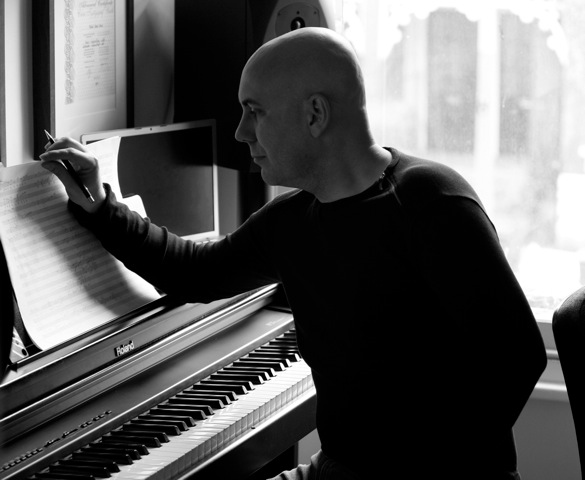
Tell us a little more about your new work ‘Morphosis’, recently premiered by Zubin Kanga. What was the inspiration/creative impulse for this work? What were the particular challenges of creating and performing this work? 

I’ve wanted to work with the wonderful Zubin for many years.  He’s a real collaborator and that excites me because it affords me space to try new things and to make mistakes – essentials in the quest for new methods of creating and working.  Zubin knew of my work with sensors and electronics so it seemed a perfect collaborative partnership.

Much of my recent work is fundamentally concerned with this notion of meeting points – of fusing apparently opposing sound worlds; moulding, mixing and states of flux. I see my work as becoming more sculptural of late – where musical ideas grow outside of their original form, then take an unexpected turn and morph into something else, perhaps falling back temporarily to allow the electronic reflections to come to the fore only to suddenly re-emerge with a fresh direction that overwhelms all proceeding shapes.  This concept of flow, of coursing and of flux is also at the base of Morphosis. Musical objects begin as simple chords surrounded only by their electronic reflections that are subtly influenced by the movement of the performers hands (the sensors being attached to the back of the hands and transmit three-dimensional movement data to the live electronics).  These musical objects are presented several times as if one is looking at a single object from different angles. They are joined together by the morphing states of the electronics into what I hope is a flowing musical argument that is both visually and aurally engaging.

Working with live electronics is always a challenge but is particularly so with the addition of sensors.  Speed is critical!  Six channels of data from the performers hands must stream into the laptop once every 20ms.  This data must be refined for musical processes.  Each movement must be carefully calibrated and assigned to a particular parameter of a digital sound process.  Vast amounts of number crunching are performed in tiny segments of time and any blip in the system results in either a click in sound or a fatal system crash.  All this must be performed from just a single laptop that gets slower the more processing is added.  As a composer, the months of computer programming can become unbearable.  Many challenges emerge: Which should I write first – the music or the electronic effects?  How will the sounds change if I do not fully know how the performer will try to control the sound through the sensors?  How can I impose limits on what the performer will do with their hands to shape the sounds?  All these questions push my creative process to the edge – something I fear yet something I crave too…. living on the precipice…. creating something new, something never before uttered…. it’s the ultimate drive….

Where would you like to be in 10 years’ time?

Southern Italy full time – writing more than I teach

What is your idea of perfect happiness?

Acceptance of myself and everything external

What is your most treasured possession?

My mind – all else is temporary

What do you enjoy doing most?

Dancing 4am, hot sand between the toes, cool breeze on the skin – Italian beach

What is your present state of mind?

Buzzy and tired – it’s 4.30am!

Patrick Nunn (b.1969, Kent, UK) studied composition with Frank Denyer at Dartington College of Arts, Gary Carpenter at the Welsh College of Music and Drama, and Simon Bainbridge and Jonathan Harvey whilst completing his PhD in Composition at the Royal Academy of Music (funded by a PRS Scholarship).

He has been the recipient of many awards including the Birmingham New Millennium prize for Sentiment of an Invisible Omniscience (2010), the Alan Bush prize for Transilient Fragments (2008), a British Composers Award (solo/duet category) for Mercurial Sparks, Volatile Shadows (2006), and the BBC Radio 3 Composing for Children prize for Songs of Our Generation (1995).

Patrick’s music has been performed widely in the UK and on the continent and has featured at more than fifty festivals worldwide. He has worked with a diverse range of collaborators, including the BBC Concert Orchestra, National Youth Orchestra of Great Britain, Kreutzer Quartet, Thalia Myers, Piano Circus, Icebreaker, Ballet Rambert, Gogmagogs, Composers Ensemble and New London Children’s Choir.

Under the auspices of Tod Machover (MIT), Nunn, in his role as Hyperbow Researcher at the Royal Academy of Music, wrote two new works incorporating Diana Young’s (MIT) Hyperbow design: Gaia Sketches for solo cello and live electronics (finalist in the New Media category, British Composers Awards 2006); and Fata Morgana for cello, ensemble and live electronics. Nunn presented the collaborative process between composer and engineer in a research paper alongside Young at the 2006 NIME conference at IRCAM.

In addition to his extensive work as an educator, Nunn has recently completed two ABRSM commissions for their Spectrum series, as well as a new work for the Tempest Flute Trio. His work Prism was nominated for the solo/duo category for the 2009 British Composers Awards and Pareidolia I for bass clarinet, electronics and sensors has been shortlisted in the Sonic Arts category for the 2012 Awards. He currently holds the position of Lecturer in Composition at the Royal Academy of Music. His music is published by Cadenza Music and the ABRSM, and also features on Red Sock Records (Music of the Spheres), NMC (Prism) and the Sfz label (Gonk).

© Patrick Nunn (Nov 2012)

www.patricknunn.com

Photo credit: Nick Fallon


Oliver photoWho or what inspired you to take up composing, and make it your career? 

Like a great many other composers, the initial impetus or inspiration to write came from a deep-seated desire to emulate (and often imitate!) the music I had encountered in childhood and adolescence, through performing and learning music – in my case, through brass bands, orchestras and youth opera (I was blessed by the fact that Leeds County Council has an amazing music service with many inspirational teachers). Over time, I discovered the great power of music to express ideas about the world and about oneself, and this awoke in me the desire to make composition my vocation.

Who or what have been the most important influences on your composing and your musical career to date? 

My initial passions were fired by the English pastoral school, perhaps best represented by Vaughan-Williams and Holst. After this, I went through a Steve Reich phase (pun intended!), which had a very substantial impact upon my development, since it led me to realise that tonality could still be used in original and meaningful ways. Subsequently, I underwent a somewhat obsessive infatuation with Wagner, whose protean use of a wide variety of musical influences to create dramatic works of enormous philosophical depth planted in me the ambition to write opera. At this point, I re-discovered Benjamin Britten, who I came to see as a composer who had achieved equal dramatic mastery and psychological understanding, but in a more English and down-to-earth manner.

What have been the greatest challenges of your career so far? 

Undoubtedly my first two operas. Through these, I have learnt how to synthesise all my musical influences and gradually, from naïve beginnings, to write music and libretti which not only work poetically and musically but which also function well dramatically on the stage. Organising the performances and staging productions was just as much a challenge as the actual composition. For my first opera, The Nightingale and the Rose (after Oscar Wilde), written while I was still an undergraduate, I combined an orchestra of RCM students with the hundred-strong Yorkshire Philharmonic Choir and professional opera singers. My children’s opera, The Owl who was Afraid of the Dark (after Jill Tomlinson), then involved co-ordinating sixty primary-school children from around Cambridgeshire with professional musicians, as well as singers from Cambridge University, which was an even more formidable logistical challenge, since it meant one had to deal not only with some fairly mischievous young spirits, but also with their anxious parents!

What are the particular pleasures/challenges of working with individual artists, ensembles or orchestras? 

I always enjoy working with musicians and artists to bring a project into being. I would consider myself the entrepreneurial type, and tend to gather together a team of creative people to build a project around a dramatic conception. Collaboration involves a balance between allowing plenty of creative freedom to the individuals that you are working with, whilst striving to direct everybody’s energies towards a mutual goal. Maintaining this balance without creating too many frictions and tensions is always a challenge; the trick is to find people who share your ideals.

Please tell us more about your  opera Pincher Martin

Pincher Martin is an operatic adaptation of William Golding’s novel and poetic masterpiece. Recreating on the stage the existential plight of a marooned naval officer who struggles to survive first in the ocean, then on a lonely rocky islet in the middle of the Atlantic, has stretched my imagination to the limit, and has required the use of devices and technology which were previously unfamiliar to me. Throughout the course of the drama, we will be using a silver-screen movie-style cinematic backdrop, both to aid us in realising difficult scenarios such as a man drowning in the Atlantic, and to evoke the drama’s World War II setting.

Just one example of how this will work in practice is a scene in a moving motorcar, where the protagonist terrifies a woman with his dangerous and aggressive driving in a terrible attempt to make her acquiesce to his desires (yes, this is in the book…!). Musically, I have accompanied this scene with continuous unpitched and then pitched fluttertongues in four solo brass instruments, to evoke the sound of a car engine, first stationary and then in faster and faster motion. In terms of staging, this coordinates with the film, in that what is displayed on the screen is the view seen from the back seat of a car, first shaking very slightly as the car is parked in a layby with its engine idling, and then changing as the car moves off down the road. This is combined on-stage with the set, which in this case consists of a car bonnet behind which the protagonists will sit, with the backseat view behind them on the film. The bonnet itself is half-car, half-rock-like in substance, so that we can move expeditiously from a scene taking place on the rocky islet to this memory scene in the car, whilst also suggesting to the audience that the rock is actually an imaginary environment created by Pincher’s subconscious, and that we are dealing with scenes from his past life, which he is recalling during his purgatorial existence on the island.

Using this synthesis of music, film and staging to bring William Golding’s story to life has been an incredibly difficult challenge, but one which I am very glad to be undertaking, as it has expanded my creative world substantially.

What do you consider to be the most important ideas and concepts to impart to aspiring musicians/composers? 

To be yourself whilst learning from others.


Oliver Rudland is an English composer based in Cambridge, UK, known for his accessible style of modern composition. His operas have received particular attention and critical acclaim.

His latest opera, ‘Pincher Martin’, based on the novel by William Golding, was staged at the RCM Britten Theatre in July 2014: ‘This is an eloquent, succinct opera… In music and design…, Pincher Martin pinched and gripped. This opera deserves to live.’ (The Times: ★★★★)

‘Rudland appears to have achieved that rare and valuable object: a contemporary work that is both challenging yet accessible. Despite its disturbing subject matter, Pincher Martin is lyrical, inventive, and above all a thoroughly engaging work.’ (Bachtrack: ★★★★)

His first opera, ‘The Nightingale and the Rose’, after the story by Oscar Wilde, was staged at the Carriageworks Theatre for four nights in 2008 by Leeds Youth Opera. ‘Exceptional talent…Oliver is going to be a big name in the future.’ (Yorkshire Evening Post)

In 2011, his children’s opera, ‘The Owl who was Afraid of the Dark’, based on the classic story by Jill Tomlinson, was staged at the Cambridge University Church, and received very positive reviews from critics and the local community alike: ‘This was children’s opera at its best; it was fun and accessible to people of all ages and backgrounds.’ (GSM News)

‘Benjamin Britten, his Noah, and bad-tempered God must almost regret that a couple of owls made their way into the ark to reproduce themselves towards so effective a rival opera.’ (Music and Vision)

His chamber works have been performed at the Cheltenham International Music Festival, the Southbank Centre, and the DiMenna Center (NYC), as well as at other venues worldwide. His trombone sonata, ‘The Conquests of Zeus’, commissioned by Matthew Gee, principal trombonist of the London Philharmonic Orchestra, has been performed widely across Europe.

Oliver is currently Composer-in-Residence with the London Choral Sinfonia. He is also working towards a new large-scale, two-act opera due for completion in 2020.

Further information: www.oliverrudland.com
