It’s Baroque Month over on Bachtrack, with a selection of articles exploring repertoire and those who perform it…..
Long regarded as the most serious and ambitious work for keyboard, the Goldberg Variations display J S Bach’s exceptional knowledge of the many different styles of music of his day, and his own exquisite performing techniques. Originating from a simple idea – a beautiful aria over a ground (repeating) bass – the thirty variations present the history of Baroque music in microcosm: lavish displays of modern, fashionable expressive elements of the high Baroque, with just a hint of Classical idealism, together with magnificent structure and formal beauty. There are dances and canons, riddles and doodles, lightning flashes and filigree arabesques. Not until Beethoven’s Diabelli Variations was a similar work conceived on such a scale from a seemingly simple initial idea.
I was expecting to hear a friend of mine, Charles Tebbs, perform Bach’s ‘Goldberg Variations’ at the delightful Sutton House Music Society on Sunday evening, but sadly Charles was unwell. A frantic call for a replacement went out on Facebook, which I happened to see and respond to. I am not suggesting for one moment that I “saved” the concert, but serendipitously, Daniel Grimwood whom I suggested as a replacement, was available and stood in at very short notice to perform an all-Bach programme. It is a mark of Daniel’s professionalism that he betrayed not an ounce of unpreparedness. He introduced the programme engagingly, highlighting various aspects of the music and describing the first half of the programme (Bach’s Italian Concerto and the fifth French Suite in G) as being “the jolly music”.
The Italian Concerto was indeed jolly, with precise yet sprightly passagework, crisp articulation and nuanced voicing. Daniel also plays the harpsichord and this is evident in his sensitive touch and terraced dynamics. The middle movement had a sombre grandeur, with an elegantly-turned improvisatory melodic line floating atop the bass. The closing movement poured forth like an exuberant mountain stream, rich in orchestral textures and vibrant contrasts.
More of the same in the Fifth French Suite, whose Sarabande shares the same soundworld as the Aria from the Goldberg Variations, and which Daniel played with grace and delicacy. Other notable features were the most charming and spontaneous ornaments in the repeated sections of the movements. The closing Gigue had the necessary forward propulsion, a dancing column of energy running through the entire movement.
After the interval, the Sixth Partita in sombre E minor. This, as Daniel explained, is Bach’s nearest equivalent for the keyboard to the St John Passion or the B-minor Mass, and is a work of great seriousness, mystery and profound musical thought. The opening Toccata begins with a dramatic “rocket” figure, a rising arpeggio flourish which colours the first section before the music moves into a darkly dramatic four-part fugue. All the movements display vocal textures, particularly the closing Gigue, whose rhythmic anomalies Daniel demonstrated in his introduction. This was an authoritative, thoughtful and vibrant performance, providing a wonderful contrast to the more positive music of the first half.
Sutton House Music Society is based at Sutton House in Hackney, east London, which is owned by the National Trust. Built in 1535, the house holds a fascinating juxtaposition of oak-panelled Tudor rooms, Jacobean wall paintings and Georgian and Victorian interiors, and audience members can enjoy a tour of the houseahead of a concert. The music society attracts both established and up-and-coming artists, performing a wide variety of repertoire, and the 2014/15 season concludes with a concert by the Roskell Piano Trio in music by Mozart, Shostakovich and Schumann. Concerts take place in Wenlock Barn, an early 20th-century addition which was built specially for events such as concerts.
Further information about the concert and the Society here
On a fine mid-September afternoon a group of adult pianists, piano fans and music lovers gathered at Craxton Studios for a recital and talk by acclaimed pianist, teacher and writer Graham Fitch.
Craxton Studios, a beautiful Arts & Crafts house in Hampstead, north London, has an important musical heritage and is therefore the perfect place for concerts and gatherings of musicians. Originally built by the artist George Hillyard Swinstead for his family and as his art studio, the house was bought by Harold Craxton and his wife Essie in 1945 after they and their family were bombed out of their home in St. John’s Wood during the Blitz. Professor Harold Craxton OBE was an eminent and much-loved pianist and teacher (he was a Professor at the Royal Academy of Music), and those of us of a certain age will know his name from ABRSM editions of Beethoven and Co, edited by him and Donald Francis Tovey. The house on Kidderpore Avenue became a meeting place for musicians to come together and the house became a focal point for the artistic and musical milieu of London. This tradition continues today, as the house is used not only for concerts but also rehearsals, auditions and as a film location.
When Harold Craxton died in 1971, a trust was established in his name to support young, extremely talented musicians embarking on a professional career.
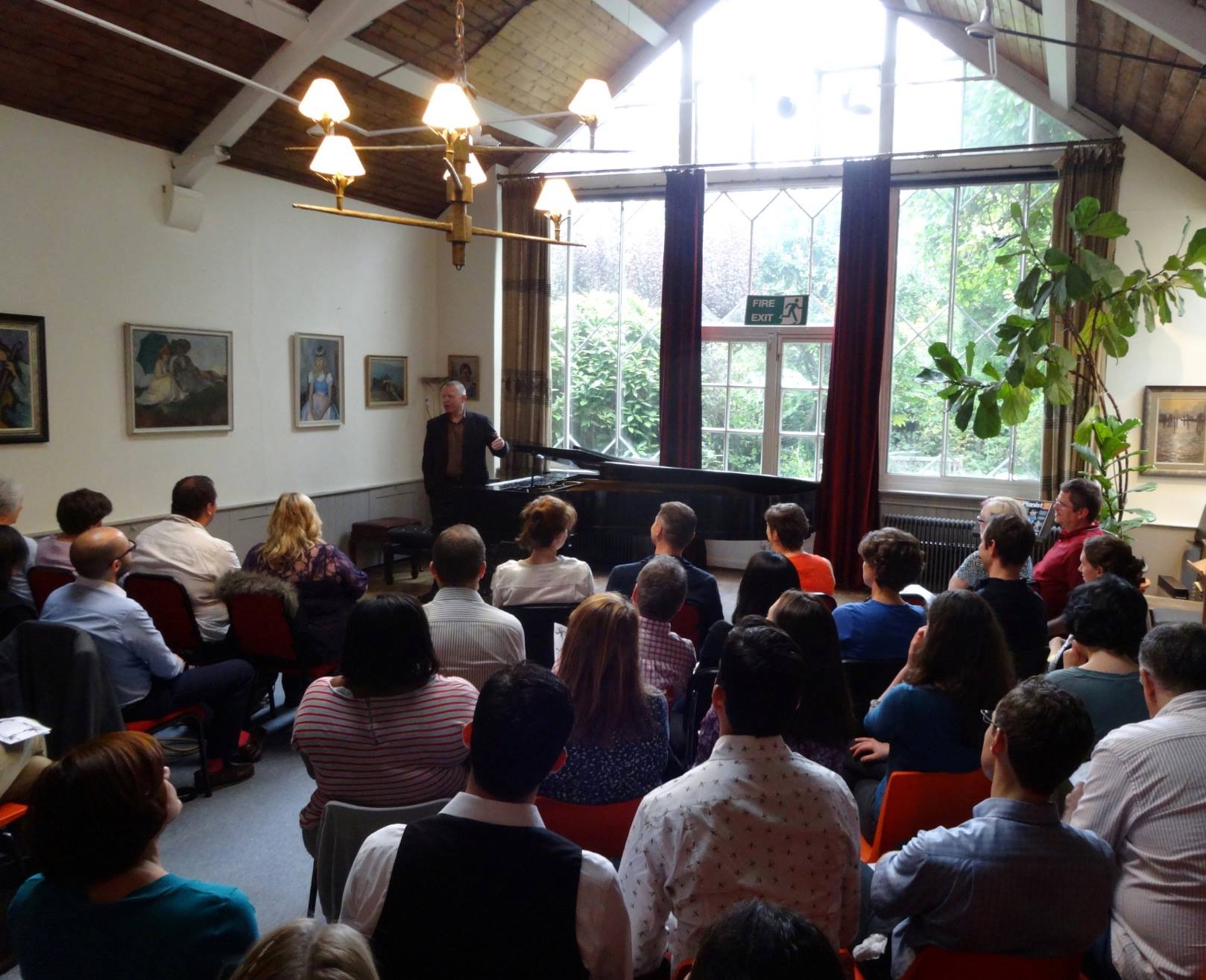
I first visited Craxton Studios in December 2013 for a concert by pianist Sarah Beth Briggs. I was impressed by the warm atmosphere and particularly the special ambiance and decor of the venue. Concerts are held in the artist’s studio, a large airy room at the back of the house, adorned with paintings, which looks out over the garden. The piano, which was Harold Craxton’s own instrument, is an early 20th-century Blüthner. (There is another grand piano in the small rehearsal studio on the top floor of the house.) The Craxton family still manage the property and it continues as a lively hub for musical activities in London.
‘Notes&Notes’ with Graham Fitch was a new concert concept for the South London Concert Series. I have always found concerts in which the performer introduces the music most interesting, and I find audience members enjoy hearing anecdotes about the music or why particular pieces are important, and as such offer something more personal and interesting than a standard written programme.
Graham Fitch introducing his programme
Graham’s programme consisted of Bach’s Partita No. 1 in B-flat and the French Suite, No. 5 in G, both popular and accessible works, and Haydn’s Piano Sonata No. 50 in C, Hob. XVI/50, written while the composer was living in London. Graham introduced the music, explaining that Bach was drawing on a tradition of presenting a suite of stylised dances popular at the time (Allemande, Courante, Sarabande, Gigue etc). He also described his first encounters with this music and his studies with Andras Schiff, who has received high praise for his own intepretations of Bach, and who “gave” Graham the ornaments in the French Suite. Graham also explained that there is no “right way” to play Bach and that a romantic interpretation is as valid any other.
Graham combines a vibrant, colourful sound with an ability to highlight all the different strands of melody, voices and interior architecture in the music, together with subtle use of pedal, sensitive phrasing and restrained rubato. As his introduction to the Haydn Sonata, he explained that Haydn was working with John Broadwood, the London piano maker, and the Sonata shows the composer experimenting with the range of possibilities afforded by an English piano (as opposed to the Viennese instruments which Haydn had previously been used to). Graham’s performance sparkled with wit and humour, while the middle movement had a lovely arching melody, warm and supple.
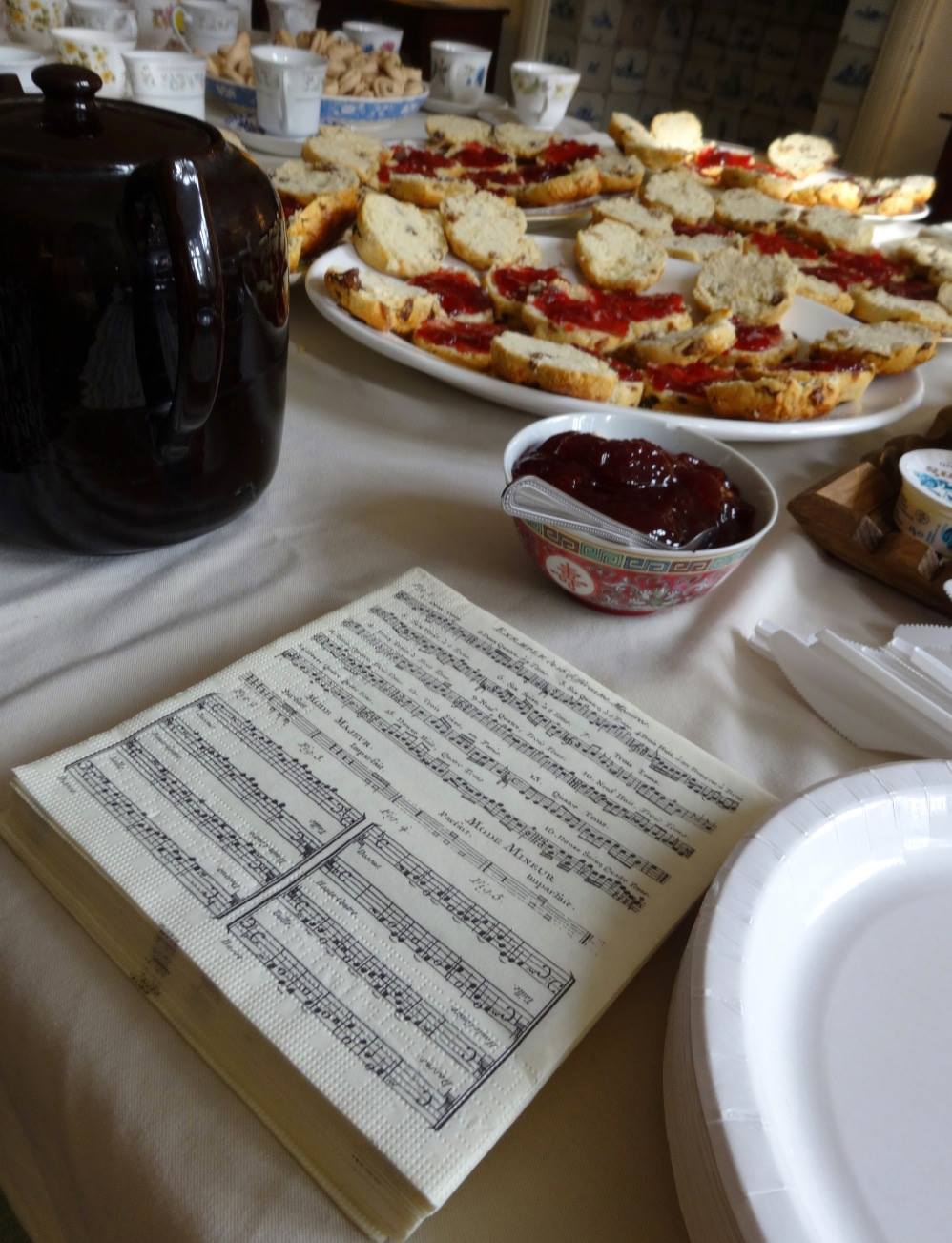
Afternoon tea & scones
After the music came the tea party and guests gathered in the dining room to enjoy tea and scones (with clotted cream, of course) and the chance to meet Graham and talk to other pianists and piano fans. There were many friends amongst the audience and the house was full of conversation. Some people even went to try the piano, before the studio was cleared ready for an audition the following day. The general consensus was that this was a really lovely event, combining music, words and conviviality, and we hope to host a similar concert at Craxton Studios next year.
Bach wrote his Inventions as exercises for amateurs and students of the keyboard (including his own sons), as he put it in a preface. The works were intended as an introduction to counterpoint and to demonstrate to the student that both hands could have equal importance in a piece of music.
For many young piano students, these short works are their first contact with Bach’s music and can lead, certainly in my own case, to a lifelong love of Bach’s music, in particular his keyboard music. They offer a wonderful introduction to contrapuntal writing and Bach’s musical wit and inventiveness, and offer valuable insights for further study of works such as the Well-Tempered Clavier, the Partitas and the French and English Suites. In spite of all this, these minor miracles are rarely performed in concert.
Simone Dinnerstein’s new recording for Sony Classical of the Inventions (BWV 772-786) and Sinfonias (BWV 787-801) makes a convincing case for the elevation of these works from student studies to concert pieces, for her reading is anything but dry and academic. While they may be all about form (as distinct from the Partitas and French and English Suites which are dances), Dinnerstein brings vibrant colour and life to these modest works, highlighting their individual characteristics and differences through the sensitive use of tempo, articulation and rubato. Some are sprightly and open-hearted, others introspective and thoughtful. Throughout, her tone is pure and bright, her interpretation honest and unfussy, allowing the beauty of Bach’s writing – and, at times, his modernity – to shine through. In the Sinfonias, with their three-voice writing (sometimes called “three-part inventions”), the sound is richer, more textural, warm but with no loss of clarity. The final Sinfonia, in B minor, is fleeting and witty, with the ghost of a harpsichord in the resonance and strummed sound which Dinnerstein brings to this work. No longer student exercises, Dinnerstein turns these short works into album leaves to be enjoyed and savoured.
The Cross-Eyed Pianist is free to access and ad-free, and takes many hours every month to research, write, and maintain.
If you find joy and value in what I do, please consider making a donation to support the continuance of the site

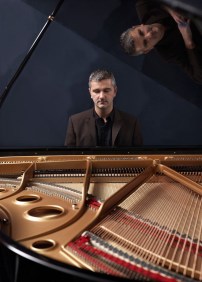 I was expecting to hear a friend of mine, Charles Tebbs, perform Bach’s ‘Goldberg Variations’ at the delightful Sutton House Music Society on Sunday evening, but sadly Charles was unwell. A frantic call for a replacement went out on Facebook, which I happened to see and respond to. I am not suggesting for one moment that I “saved” the concert, but serendipitously, Daniel Grimwood whom I suggested as a replacement, was available and stood in at very short notice to perform an all-Bach programme. It is a mark of Daniel’s professionalism that he betrayed not an ounce of unpreparedness. He introduced the programme engagingly, highlighting various aspects of the music and describing the first half of the programme (Bach’s Italian Concerto and the fifth French Suite in G) as being “the jolly music”.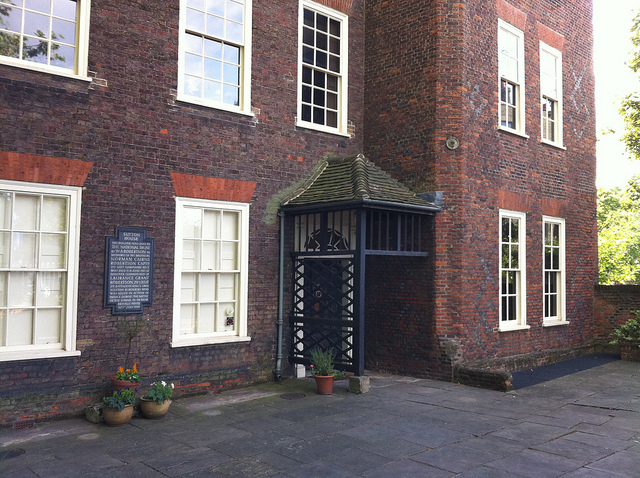






 The Cross-Eyed Pianist