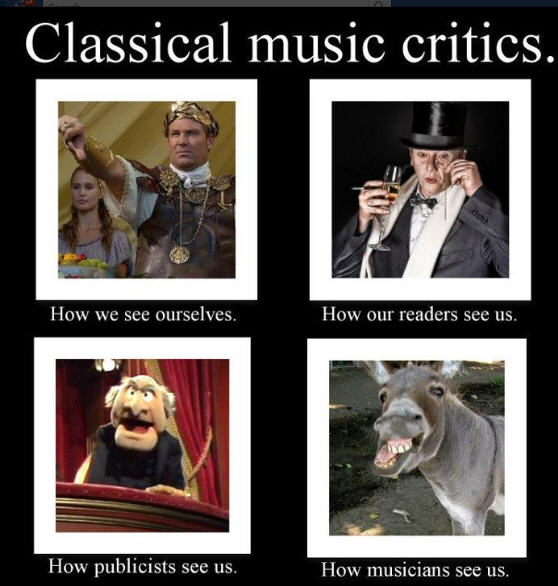
Reviews, and critics, are curious things. As Lisa Hirsch says on her blog ‘Iron Tongue of Midnight’, music reviews and music criticism serve the following purposes:

  • Journalistic: recording what happened and when and by which musicians
  • Opinion: recording a critic’s opinion (we hope a highly informed opinion) of what happened
  • Contextual: placing what happened within some historical and musical context
  • Preservation: enabling people in the far future to get a look at what happened, why, and the impression it made

Good reviews don’t make personal comments on the performer (recall the storm around the very negative comments about the physical appearance of singer Tara Erraught), nor allow the writer’s personal taste to rule the review (i.e. reviewers shouldn’t give a negative review just because they don’t like a particular composer or work: they should be able to put aside such likes or dislikes to offer an objective comment on the performance). Good reviews offer the writer’s considered opinion of the concert: was it effective and did it work? Which parts stood out, which did not? But at the end of the day, a review is one person’s view on someone else’s interpretation.

Some years ago I attended a concert of music by Musorgsky and Liszt by Georgian pianist Khatia Buniatishvili at London’s Wigmore Hall. For many members of the audience, and some critics it was a coruscating display of imaginative and risk-taking pianism, the Liszt pieces in particular performed with the kind of vertiginous virtuosity which Liszt himself may well have approved of. One critic didn’t like the concert, describing the playing as “rash” and “immature” and ended his review with the comment “on the question of whether Buniatishvili can ever be a serious artist, the jury is very much still out” (full review here). A few days later, Khatia Buniatishvili responded to this review with some remarks on her personal interpretation of the pieces (read her response here)

Ms Buniatishvili’s detractor in ‘The Guardian’ had just as much right to give her three stars as ‘The Evening Standard’ critic did in awarding her five stars. And she had every right to reply to her detractor. But I wonder whether such a rebuttal serves any real purpose in the great scheme of things. An international artist like Khatia Buniatishvili will play many concerts in many cities across the world and be heard by many hundreds of people, some of whom are critics and reviewers. A single concert is just a day in the life, and a single negative review is unlikely to make or break an artist.

The violinist Patricia Kopatchinskaja had, for awhile, her own way of dealing with negative reviews. One page of her website was a ‘trashcan’ for negative reviews through which she responded to factual errors and rebuked lapses of taste. She also demanded to know who – herself or the critic – had spent longer studying the score or living with the composer.

Some artists simply don’t bother to read their reviews, and some have agents, managers, mentors and partners who filter the reviews. Performers have to have the courage of their convictions, to get up on stage day in day out and give concerts without worrying unduly what reviewers and critics are going to say. Fundamentally, concerts are about sharing music and entertaining the audience, not playing to please the critics. Without an audience, there would be no concerts (and without concerts, there would be fewer reviewers!).

An informal poll amongst the musical/journalistic community with whom I interact online revealed that most performers felt responding to reviews was a waste of time and that one should hold one’s head high and move on. The only time when a response may be justified is if the review contains inaccuracies or comments which can be construed as slanderous or unduly personal, or where the reviewer has made assumptions about the performer’s lack of form without proper justification or being in possession of all the facts (for example, if the performer is ill, but no announcement is made ahead of the concert). For the purposes of this debate, I am quoting some of the comments by colleagues (musicians and critics/reviewers):

“the dynamic in all this has changed substantially with social media. The critic makes a public statement and the artist can, if he or she so wishes, make a public statement back without having to do anything as cumbersome as, say, write an open letter. These days, artists, both talented and less talented, can succeed by simply getting the public behind them without any help from PRs and record companies.”

This is a good point: social media has had a huge impact on the way artists and performances are received, and has “democractised” reviewing: everyone can be a critic or reviewer these days, with tweets and Facebook/YouTube “likes”

“this whole issue goes round and round and round and round. There are critics. Some are good, some not so good. Some are helpful, some not. Some, sometimes, offend intentionally or otherwise. All get it wrong sometimes, some more than others. But better to be written about than ignored. So there are critics.”

“I have only once responded to a critic. And that is because he was inaccurate and commented on a discography which doesn’t exist. Beyond that, I just play and don’t give a flying duck what anyone thinks – I’ve been at a piano since I was a toddler and have earnt that right. Many/most critics have been to a certain mileage of performances and done a certain amount of reading/research and have an impressive general knowledge of all things musical. They have earnt the right to write. The best any of us can do is go to live concerts and make up our own minds” (a musician)

And a reviewer writes:

When I review, I arrive at the concert wanting to enjoy it and assuming that the performer will give sincerely of their best. Intelligent listening will always find flaws as well as good things, and it’s dishonest to misrepresent the experience; but there are ways of phrasing this – and still keeping it lively and readable (the critic has as much of an obligation to their audience as the performer has to theirs). I’ll only hand down a slating if I detect actual cynicism.”

I return to my earlier comment: a review is just one person’s opinion and is neither right nor wrong. Confident artists know this and are able to move on from a negative review, looking ahead to the next concert. And some artists will always divide critics…..


Unknown

Who or what inspired you to take up the piano and make it your career?

We had an upright piano at home as my mother studied at the musical school. I was trying to play something on it at the age of four and asked my parents to bring me to musical school.

Who or what were the most important influences on your musical life and career?

My teachers – Yuri Slesarev, Dmitri Alexeev, Boris Petrushansky, Oxana Yablonskaya and Aquiles Delle Vigne.

How do you make your repertoire choices from season to season?

I try to create an interesting programme, making an unusual combination of pieces or adding some not overplayed compositions. In future I want to play more contemporary music. Unfortunately, I don’t have that much time for working on it now due to learning more “core repertoire”.

Do you have a favourite concert venue to perform in and why?

I really enjoyed playing in Concertgebouw in Amsterdam, Teatro Colon in Buenos Aires, Mozarteum in Salzburg, Triphony Concert Hall in Japan. Those halls have an amazing acoustics.

Favourite pieces to perform? Listen to?

I love every single piece I am performing and I am convinced it has to be like that.

I listen to a lot of orchestral and chamber music. Now my favourites are Schubert and Tchaikovsky Symphonies, piano trios by Beethoven, Mendelssohn, Brahms, Arensky, etc.

Who are your favourite musicians?

My favourite pianists are Emil Gilels, Vladimir Horowitz, Dinu Lipatti, Grigory Sokolov.

Vitaly Pisarenko gave his first public recital at the age of six. His initial musical training was in Ukraine (in Kiev with Natalia Romenskaya and in Kharkov with Garry Gelfgat). From 1999 to 2012 he studied at the Central Music School and State Tchaikovsky Conservatory in Moscow with Yuri Slesarev. From 2009 to 2012 he also studied with Oxana Yablonskaya at her Piano Institute in Italy. Since 2012, Pisarenko has been studying with Dmitri Alexeev at the Royal College of Music. He completed his Master’s degree at the RCM (with distinction) in 2014; and is currently studying at the RCM for an Artist Diploma and is an Emma Rose Scholar supported by a Kenneth and Violet Scott Award. He is also studying at the Piano Academy in Imola, Italy with Boris Petrushansky.

In 2008 (aged 21) he won First Prize at the Eighth International Franz Liszt Piano Competition in Utrecht. Since then he has performed as a soloist with leading orchestras and ensembles, and as a recital soloist, throughout the world.

The Keyboard Charitable Trust is funded entirely by voluntary donations. Detailed information about the Trust may be found on its website.

(photo credit: Julia Wesely)

For the Wigmore neophyte, I doubt I could have selected a better concert to introduce my companion for the evening to the delights of London’s “sacred shoebox”: Georgian pianist Khatia Buniatishvili dazzled in a highly accomplished performance of music by Mussorgsky’s ‘Pictures at an Exhibition’ and a selection of short virtuosic works by Liszt.

Read my full review here

Who or what inspired you to take up composing, and pursue a career in music?

I’ve liked making up music since I was young. It became the thing I most liked doing, so I just carried on doing it. Parents were always supportive.

Who or what were the most significant influences on your musical life and career as a composer?

I worked for my uncle John Hardy in Cardiff between degrees, and still do from London. He has a refreshing, inspiring attitude to other people and to music.

Many teachers, in various different ways. The performers, writers, directors and other artists I work with. My colleagues and students at The Conservatoire.

What have been the greatest challenges of your career so far?

Picking up work after finishing education. Dealing with uncertainty. Carving out time to compose in. Writing music can be challenging but it’s a relatively familiar, safe space to be in.

What are the special challenges/pleasures of working on a commissioned piece?

It still feels like a huge privilege knowing that someone wants your music – that the notes you’re writing are already wanted by someone. And they’re going to take those notes seriously and invest time and energy and feeling, to bring those notes to life.

Deadlines are useful too, for helping to justify keeping other people waiting for other work!

What are the special challenges/pleasures of working with particular musicians, singers, ensembles and orchestras?

I love collaborating with musicians and artists in other fields. Discovering some of their artistic voice, their sound, their craft, their ideas – taking these and digging into them and finding something new for both parties, hopefully.

Which works are you most proud of? 

It’s always the most recent few works, so brass & percussion piece Torque, chamber piece Black Sea, short opera Adrift, unpitched percussion solo Drawing, vocal ensemble piece The Sickness of Angels.

Who are your favourite musicians/composers?

At the moment – Screaming Maldini, Richard Causton, The Organelles, Laura Mvula, Ligeti.

What is your most memorable concert experience?

Thomas Ades’ violin concerto Concentric Paths performed by Pekka Kuusisto with the Britten Sinfonia in February 2012. And many Organelles gigs back to sixth form days!

What do you consider to be the most important ideas and concepts to impart to aspiring musicians?

Be genuine. Be resilient. Work with the best people you can. Don’t be satisfied too easily.  Say yes to everything until you can afford to say no to things. Make your own opportunities. Don’t believe the world owes you a living.

Where would you like to be in 10 years’ time?

Here, but with a bit more room.

What is your most treasured possession? 

Dog.

Ed Scolding is a versatile composer with a strong interest in collaboration and drama. His concert music has been described as as ‘subtle and polished’ (Bachtrack) and ‘succinct, witty and apt’ (Norwich Evening News), and film music as ‘intense but under-stated… extraordinarily effective’ (Richard Paine, Faber Media Music).

Recent projects include Thrown for Sinfonia Newydd, percussion solo Drawing which won the Nonclassical Composition Competition, Black Sea for The Hermes Experiment supported by Bliss Trust / PRS Foundation and a score featuring Dermot Crehan’s Hardanger fiddle for short film The Blood of The Bear which has been screened in festivals across the UK and Europe including at the BFI and the Barbican Centre.

Collaborative projects include short opera Adrift produced by Gestalt Arts, work with rock band Screaming Maldini and electronic producer Hem (aka Geoim), a Mozart flashmob for Welsh National Opera, music for Third Stage Dance and for Anna Jordan’s play Freak.

Ed’s music has been recorded by the BBC National Orchestra of Wales, broadcast on BBC Radio 3 and BBC Radio Wales and performed by Exaudi, Music Theatre Wales, London Sinfonietta, Ayre Flutes, Aisha Orazbayeva, Ksenija Sidorova and Anne Denholm at Nonclassical, Southbank Centre, St. John’s Smith Square, Norfolk & Norwich Festival, Monmouth Festival, Cardiff Music Festival, Bath Fringe Festival and Wales Millennium Centre.

A keen teacher, Ed is Assistant Director of Music at The Conservatoire, Blackheath, with responsibilty for the Saturday Music School and strategic direction, and teaching GCSE and A-Level music and music technology, theory, composition, technology courses and workshops.

Living in London, Ed keeps close links to Wales through his work as Publishing, Projects and Web Manager for quintuple BAFTA Cymru award-winning composition company John Hardy Music and sister label Ffin Records. Ed is a Council Member of the ISM and a member of the ISM Special Interest Group for composition. He examines Rock & Pop grade exams for Trinity College London, with exam tours completed in Thailand, Malaysia, UAE and Spain and throughout the UK.

Born in 1985, Ed graduated in 2008 from Royal Welsh College of Music & Drama with First Class Honours then completed MMus Composition with Distinction and the LRAM teaching diploma at the Royal Academy of Music in 2011 with support from sources including Arts Council Wales, Seary Charitable Trust, Ismena Holland Award and Harvey Lohr Award.

www.edscolding.co.uk


