A tribute from Divine Art Recordings

Described by The New York Times as “a man whose nature was designed with pianos in mind”, Anthony Goldstone was recognised as one of Britain’s most respected pianists. This exceptional musician passed away 2 January at the age of 72. As a major figure in the Divine Art Records catalogue (as well as recording for Toccata and previously Olympia and Gamut) both as a soloist and duo partner with his wife Caroline Clemmow, he will be very sadly missed. Held in the highest esteem by critics worldwide, for some reason he never quite achieved the international media recognition he deserved. Divine Art is currently working on Goldstone’s last solo recording which is likely to be released in the summer (“Piano at the Ballet, Vol. 2”) and also the re-release of the stunning 7-CD set of the complete works for piano duet by Franz Schubert, which when first issued by Olympia in 1999, established Goldstone and Clemmow as Britain’s leading piano duo.

Born in Liverpool, Anthony Goldstone studied at the Royal Manchester College of Music, now the RNCM, which later honoured him with a Fellowship, where his piano professor was Derrick Wyndham, and later in London with Maria Curcio, one of Schnabel’s greatest pupils – which incidentally makes him a sixth-generation pupil of Beethoven. Inspired by this wonderful heritage, Goldstone always regarded the classics and Romantics as being at the heart of his repertoire; this is illustrated by two specific CD projects: a series of rare Russian Romantics – Rebikov, Lyapunov, Arensky and Glière – and a series of six CDs devoted to the major solo works of Schubert which were very highly praised: “Goldstone is a native speaker of Schubert in the highest degree. This is perhaps the greatest version of the work [Sonata, D. 959] I have ever encountered, either live or on disc.” – Fanfare, USA. His series of solo CDs for Divine Art have ranged from Beethoven and Mozart to 20th century British composers (all with new completions and including many rarities and premiere recordings) to transcriptions from ballet and opera, all of which have received the highest accolades.

International prizes in Munich and Vienna and a Gulbenkian Fellowship launched him on a busy schedule of recitals and concertos. His travels took him to concert appearances in Europe, North and South America, Asia, Africa and Australasia, prestigious festival invitations and many broadcasts. Numerous London appearances included important solo recitals and Promenade Concerts, notably the 1976 Last Night, after which Benjamin Britten wrote to him, “Thank you most sincerely for that brilliant performance of my Diversions. I wish I could have been at the Royal Albert Hall to join in the cheers.” This was one of four Proms appearances.

Complementary to the mainstream repertoire was his avid interest in exploring intriguing musical byways – not only unknown works by acknowledged masters, leading to première recordings and performances of works by Parry, Sibelius, Bruch, Franck, Mendelssohn, Dvořák, Holst and many more but also unjustly neglected nineteenth-century composers such as Goetz, Herzogenberg, Alkan and Moscheles.

A personal reflection from Divine Art founder and CEO Stephen Sutton:

“Tony first told me of his illness back in the summer of 2016; it had developed rather quickly and long term treatments were scheduled, but sadly liver failure brought his life and creativity to an early end. Until the very last week, he was writing to me about his projects, retaining an amazing level of wit and even frivolity in what must have been extremely difficult circumstances, referring to the ongoing Schubert Duets project as ‘Sherbert Dips’.

I first met Tony and his wife Caroline, who I am also honoured to call a friend, in late 2000 (if I recall correctly without digging up files!) when he approached me about the release of his recordings of Schubert solo piano works; I believe he had been introduced by one of our other artists. Long story short – we issued three double CD sets of the Schubert Masterworks which received the most wonderful reviews, and led to my encouraging Tony and Caroline to submit more projects. This they did in spades: both solo and duo recordings appeared at the rate of two or three a year, forming the backbone of our piano repertoire. And while Tony was not enamoured of the avant-garde, his delight in finding unpublished manuscripts and unfinished pieces, which soon became new performing editions, matched our own ethos of expanding the recorded repertoire, not only in new music but from all ages. His completions of unfinished works by Schubert, Mozart and others also garnered much praise for the seamless ‘invisible joins’ – testament to Tony’s high skill as a composer. Through the years Tony and Caroline (though we met but infrequently) became very special to me; for the quality of musicianship and performance, but also efficiency and speed in providing detailed program notes – models of their type – that avoided the delays and foot-thick files that some projects seem to engender! Always a perfectionist, our main quibbles usually centered around whether an apostrophe in a certain typeface should be curly or straight. What most customers (and critics) have not realized, because we did not promote the fact, is that practically all of the Goldstone recordings were made by Tony himself at his local church of St John the Baptist, Alkborough, which has housed the couples’ twin Grotrian-Steinweg instruments for many years. To do this and be given so much praise for sound quality is another facet of Tony’s skill and dedication.

In the early spring of 2016 Tony presented his last solo recording; this will be released later this year as ‘Piano at the Ballet, volume 2’. (In fact, the contract for this project, which he signed last week, arrived in my office today – 4 January). Whilst still a fantastic performance by any standard, I could tell that it was not Tony at 100%. I said nothing but was less surprised to hear, some months later, of the illness that was afflicting him. As well, the 7-CD box set of Schubert’s Complete works for piano duet is in progress for release in early summer. Both recordings will be suitable memorials to a wonderful musician, and a lasting gift for Caroline.”
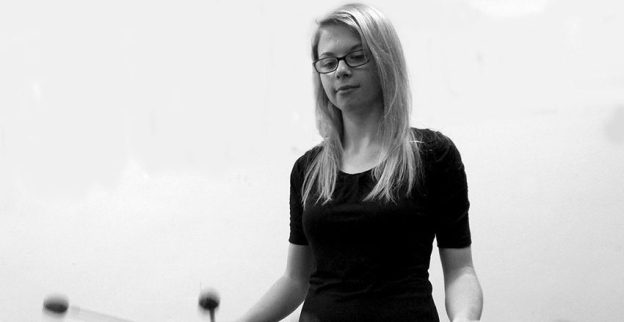

 

12-january-miriam-kitchener-e1479482811548

Who or what inspired you to take up percussion, and pursue a career in music?

I was introduced to music at a very early age and so it was instilled in me right from the start. I began with piano lessons, however at the age of 9 I decided that the drum kit was my true calling, and the rest is history!

Who or what have been the most important influences on your musical life and career?

I have had many inspirational teachers throughout my education who have nurtured my musical learning in many different ways and have all influenced me in my musical life and career.

What have been the greatest challenges of your career so far?

The greatest challenge for me is becoming accomplished on as many different percussion instruments as I can – there are so many to choose from!

Which performance/recordings are you most proud of?

As part of a percussion quartet, we spent a day recording three pieces in November 2016 in preparation for a competition in May. We encountered many unusual setbacks in the lead up to the recording and on the recording day itself including a power cut, despite this I feel that we did a really great job and I’m really looking forward to hearing the results.

Which particular works do you think you play best?

I really enjoy the performance aspect of being a soloist and find that the more unusual the piece of the music, the more I enjoy it and therefore the better I play it! At the moment, I’m working on a piece for body percussion and mime called Ceci n’est pas une Balle. It’s a really energetic piece that requires a lot of audience interaction and is really exciting to perform.

How do you make your repertoire choices from season to season?

I choose repertoire based on what I appreciate listening to and what I feel will work best with my musical personality. Above all, I choose pieces that I know I will enjoy playing and performing to an audience.

Do you have a favourite concert venue to perform in and why?

For orchestral playing, I really enjoy the atmosphere of Birmingham’s Symphony Hall, the vast space is thrilling to perform in. Small solo venues can also have the same thrilling effect, with much more intimacy between performer and audience.

Favourite pieces to perform? Listen to?

I’ve recently been introduced to an array of traditional Irish folk music and am enjoying both listening to and playing along to (with the aid of my bodhran) some awesome tunes. There are lots of great bands/artists on the Irish scene who mix traditional tunes with contemporary beats, some great ones to listen to are: Donal Lunny, Flook, Kila, and Planxty.

Who are your favourite musicians?

My favourite musicians are the percussionists and educators who I have had the chance to meet and work with during my education. These are the people who I can consolidate about my career and who will give honest and accountable opinions. They are the musicians who work tirelessly day in day out to make a success of their own careers, they are exceptional players and can give some of the best advice a fellow musician could ask for.

What is your most memorable concert experience?

This would probably have to be my very first visit to the proms when I was a younger. The vastness of The Royal Albert Hall was mesmerising and I can remember being particularly in awe when the orchestra played The Storm from Britten’s Four Sea Interludes.

What do you consider to be the most important ideas and concepts to impart to aspiring musicians?

Make yourself as versatile a musician as you possibly can. There are so many opportunities out there for musicians to take, not just as a performer. Immerse yourself in all aspects of music, from community work to concert organising, from being a session musician to creating your own folk band. Do as much as you can and experience as much as you can, while you can. Above all, make sure that you continue to enjoy all that you do!

What do you enjoy doing most?

Aside from all things musical, I enjoy going rock climbing and bouldering as often as I can. It’s great fun and important to occasionally take myself away from the musical world.
Miriam graduated from Birmingham Conservatoire in June 2016 with a First Class Honours degree in Music Performance; she is now studying for her Master’s degree at the same establishment. Miriam has worked with many percussion teachers and educators from around the world including Adrian Spillett, Alexej Gerassimez, Ney Rosauro and Colin Currie to name but a few. Miriam is a versatile percussionist with interests stretching from the Irish Bodhrán to the music of Latin America; from orchestral playing to solo repertoire. Miriam also has keen interests in learning and participation projects within the wider community and the arts management that surrounds them.


Applications are now open for the Dudley International Piano Competition 2017

2017 marks 50 years since the Dudley International Piano Competition (DIPC) was first suggested. It then evolved in 1968 from piano classes at the Dudley Festival of Music and Drama, with a concerto final, and was held annually until 1989 when it became a biennial event and from 1991 to 1995 it was opened to competitors from overseas. The Dudley International Piano Competition then took a break and re-emerged in 2000 as a competition with a recital final open to pianists of all nationalities studying or resident in the British Isles.

Many past winners, including Benjamin Frith, Andrew Wilde, Graham Scott, Paul Lewis and Mishka Rushdie Momen have gone on to establish successful careers and past competitors have included internationally acclaimed pianists Ian Hobson, Peter Donohoe, Joanna MacGregor and Timothy Horton.

The 2017 competition once again features a concerto final at the world famous Symphony Hall, Birmingham, accompanied by the internationally renowned City of Birmingham Symphony Orchestra conducted by Michael Seal.

The jury, chaired by Gordon Fergus-Thompson, consists of distinguished pianists and teachers, including John Humphreys, Andrew Wilde, Siva Oke and Lucy Parham.

The deadline for entries for the 2017 competition is 9th June 2017. Please visit the DIPC enter page for more information.

PRIZES 2017

Concerto performance opportunity for the three finalists at Symphony Hall, Birmingham with the City of Birmingham Symphony Orchestra.

£4,000 1st Prize
£3,000 2nd Prize
£2,000 3rd Prize

£750 4th Prize

£250 Audience Prize

£250 each semi final prizes

Somm Debut CD Recording
(to be offered at the discretion of Siva Oke)

Full details of the competition can be found on the DIPC website

Wishing all my readers around the globe a very happy and musical 2017.

Forthcoming articles and features on The Cross-Eyed Pianist include:

  • Meet the Artist interviews with BBC Young Musician 2016 finalist, the vibrant saxophonist Jess Gillam, composer Bernard Hughes, and pianist Danny Driver
  • Following The Accidental Pianist, further articles on the myriad aspects of being a pianist, including The Patient Pianist, The Sensitive Pianist and The Doubting Pianist (feel free to suggest other topics for inclusion in this series)
  • ‘Approaching the Concerto’ – reflections from a variety of soloists, including Stephen Hough, Dinara Klinton and Alissa Firsova, and conductor Tom Hammond ahead of a series of concerts featuring piano concerti by Beethoven, Grieg and Brahms, conducted by Tom Hammond.
  • The continuing journey through Schubert’s Sonata in A, D959 (read more about this project here)
  • Music into Words mini conference – following the successful launch of the Music into Words project in February 2016, Frances Wilson (The Cross-Eyed Pianist) and Simon Brackenborough (founder and editor of the Corymbus blog) host a half-day mini conference exploring the great variety of writing about classical music today. Guest speakers, audience discussion and Q&A, and plenty of opportunities for networking and socialising. Further information and tickets here
  • An opportunity to hear acclaimed pianist, writer and teacher Graham Fitch perform the complete Goldberg Variations, plus a special post-concert talk and audience Q&A, hosted by The Cross-Eyed Pianist

And much more besides…..

Readers are welcome to suggest topics to be covered and guest posts are invited – feel free to contact me

