Musicians need to practise and rehearse. Finding a place to rehearse can be a problem, especially if you don’t have a separate space in your home (flatmates are not always amenable to 100s of repetitions of Liszt!) or if you are travelling. Tutti Space offers a simple yet ideal solution. The brainchild of Grabriel Isserlis, here he explains what motivated him to create this new platform and community for musicians:

My family have been in music for generations. I like to say that before I learned English, I learned the language of music. I have always been surrounded by music: at home, on family holidays, my family even performed chamber music as part of our Christmas celebrations. However, as much joy as music brings, I was always very aware of the less wonderful side of it: the challenges it produces for people who dive in full time. After a brief decade, trying to escape the music in my blood, I gave in and returned, albeit from a different angle. During that time, I had trained in visual arts, audio engineering, and programming, and decided to combine my knowledge and passions into one.

I spent over a year analysing the different issues that plague musicians, listening to my friends and family talk about all the frustrations they experience. Throughout that time, a number of key issues were most apparent but only one of them sparked a twinkle in every eye when I shared my potential solution: “AirBnB for Rehearsal Spaces.” That simple idea has grown into Tutti and has so much potential ahead of it – we’re just getting started.

Tutti Space operates on a similar premise to AirBnB: those with space to rent advertise it on the platform. Those seeking rehearsal space can search No money changes hands – everything is organised within the platform – and users rate one another using a feedback system. So like AirBnB, the success of the platform is predicated on goodwill, good behaviour and positive feedback. Those seeking rehearsal space search the listings and make contact with the host via the site. And those with space where musicians can rehearse, from a little-used piano in a living room to a fully soundproofed music studio, can make money from hiring out their space. Just as AirBnB, no one can book your space without your approval: if someone books your space, you will be notified immediately and have 3 days to accept or reject the request.

If you list your space before 2019, Tutti Space will provide a photographer to take quality photos of your venue/space, free of charge.

One can pay upwards of £20/hour for a music practice room in London. Tutti Space offers competitive pricing together with the opportunity to build communities and create connections.

The site is clearly designed and very easy to use. Tutti Space is an inspired yet simple solution to the musician’s perennial problem.

Visit the Tutti Space website

504_internal_1
504 – an independent, affordable venue that provides space to rehearse, run workshops, teach classes, host meetings or auditions. Rent this space via Tutti Space

Who or what inspired you to take up the piano and pursue a career in music?

I fell in love with music and the piano at about 4 years old when I first heard it played by a teacher at my kindergarten. I still remember that magical moment.

Who or what have been the most important influences on your musical life and career? 

When I was about 12, I had a brief period of study with a concert pianist in Hong Kong who inspired me to see music as a vocation. I have been very fortunate to have studied with some wonderful teachers and mentors, including Joan Havill and Robert Silverman. The writings of Schumann, and letters of Brahms have also been a huge influence on me. Launching MusicArt  in 2015 was a crucial step in my career which opened up many new opportunities to collaborate with, and commission works from, contemporary visual artists, choreographers, and poets, who shape my current work in music.

What have been the greatest challenges of your career so far?

It was a great challenge to combine performing with pursuing my doctoral research on the musical aesthetics of Schumann and Brahms at the Guildhall School/City University of London. Another challenge was launching MusicArt to collaborate for the first time with a painter, composer, and an art gallery. I learned from these two experiences to never give up and that challenges often lead to good things!

Which performance/recordings are you most proud of?

It was unforgettable to do a live broadcast for Classic FM from my own living room to commemorate Mozart’s 225th anniversary in 2016. It was very intimate yet reached out to so many people at the same time.

With my ensemble Minerva Piano Trio, I am proud of our year-long residency at St John’s Smith Square 2016/17. We joined forces to commission a new arrangement and dance choreography of scenes from Ravel’s Daphnis and Chloe for piano trio and dance. Our revival of the rarely performed Brahms’ Piano Trio in B major, Op. 8 (original version) was also one of the highlights for me during this residency.
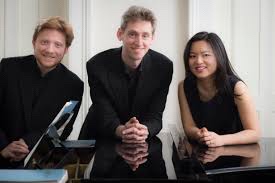
Minerva Trio © Anthony Dawton

Which particular works do you think you play best?

I tend to choose pieces that speak to me on a personal level. Dinu Lipatti once said that it’s not enough to like the piece you play, but the piece must also like you! I play a wide range of repertoire but have a soft spot for Schumann, Brahms, and Ravel.  As long as I can make a connection with the sound world of a particular piece, then I feel inspired to share it.

It is thrilling to premiere a new work as there is a sense of freedom in communicating a piece for the first time. I love the collaborative aspect of working together with a composer, which is very creative and exciting.  That connection I mentioned before then extends to a kind of real affinity with the composer.  At the moment I am working with Hong Kong-born British composer Raymond Yiu.

How do you make your repertoire choices from season to season?

I build on my core repertoire every season. In the past, I would tend to be more composer-focused. If I started to play one piece by Schumann, I would then aim to cover his entire output in order to gain a better understanding of the composer’s language. These days I am interested in finding ways to create dialogues between different works in a programme.

While I love my core repertoire for concert programmes (for example, I will be playing Beethoven, Schumann, and Ravel at St Martin-in-the Fields in December), I am also constantly looking for new stimulants for something adventurous.  For my next MusicArt concert I will present a world premiere concert-installation ‘Conceptual Concert in Three Acts’, inspired by the collaboration between Robert Rauschenberg and John Cage and performed within an exhibition of their works at Galerie Thaddaeus Ropac.  It will involve the music of John Cage, an installation of sound and spoken dialogue, and a new musical work created in collaboration with composer Raymond Yiu and poet Kayo Chingonyi.

Do you have a favourite concert venue to perform in and why?

I had a fantastic experience playing Arvo Pärt’s Fratres at an open space outside Central St Martins for a fashion show in London with a few hundred people in the audience. Since then I am happy to play anywhere as long as it is aesthetically pleasing or stimulating to the senses in some way, not just acoustically.

Who are your favourite musicians?

I have huge admiration for Leonard Bernstein, especially since I discovered his Eliot Norton lecture series, The Unanswered Question. He said, ‘The best way to know a thing is in the context of another discipline.’ Like other great musicians, he reminds one that music and humanity are inseparable.

What is your most memorable concert experience?

For me, playing Beethoven’s Emperor Concerto at LSO St. Luke’s in London was as special and memorable as playing John Cage’s 4’33” while silently reading a poem at an art gallery. I don’t think I can choose between the conventional and creative approach to playing concerts, as I love both.

As a musician, what is your definition of success?

Success is constantly achieving what I set out to do. It’s important to me to generate creative ideas on a regular basis, work with people whom I admire, and create unique experiences for the audience. When I can do these things continuously at a high level, then I am happy.

What do you consider to be the most important ideas and concepts to impart to aspiring musicians?

Treat music as an art form that demands the utmost dedication and discipline. Career is by no means guaranteed. After you finish training and studying at the conservatoire or college, your colleagues and collaborators become, in a way, your teachers. Learn to listen through playing with others.

What is your most treasured possession?

The Yamaha C3 grand piano that I have had since I was 12. It has travelled with me from Hong Kong to Vancouver to London. I had wanted a grand piano from the very beginning, and my mother promised if I reached Grade 8 she would buy me one. It turned out she started saving for it from the day she promised, so she could afford it, just in case! That was a great motivation and I made sure to get it as quickly as possible.

Video links:

Debussy  – https://www.youtube.com/watch?v=epJymUc2rDY

Brahms: Intermezzo in A major, Op. 118, No. 2 https://www.youtube.com/watch?v=OImMONM78TI

Music by Arvo Pärt – Für Alina

Poem by Zaffar Kunial – Sunlight

https://www.youtube.com/watch?v=iG-g7bfLpec

ERDEM
London Fashion Week SS14

Annie Yim, pianist
Richard Birchall, cellist

https://www.youtube.com/watch?v=4rTeQ8Iaqnc

John Cage the Lover and Poet (audio)

https://vimeo.com/193910760

OR

John Cage Dream (1947)

https://www.youtube.com/watch?v=PEknsWJLp-o

Scenes from Daphnis and Chloe (2017)
Minerva Piano Trio
Thomasin Gülgeç, dancer
Estela Merlos, dancer

https://www.youtube.com/watch?v=PdsMBr1JfBw

Michael Parekowhai’s ‘Maori’ Steinway

Recently I had the opportunity to play a rather special Steinway grand piano as part of the fascinating ‘Oceania’ exhibition at London’s Royal Academy of Arts.

He Korero Purakau mo Te Awanui o Te Motu: story of a New Zealand river was created by New Zealand sculptor Michael Parekowhai (b.1968) as part of a larger artwork for the 2011 Venice Biennale exhibition. The title of the sculpture refers to a 1920s New Zealand novel which in turn was the inspiration for Jane Campion’s film ‘The Piano’ (1993). The artist is insistent that the piano should be played and wherever the instrument is on display – whether in London, its home at the Museum of New Zealand Te Papa Tongarewa in Wellington, or on tour in other exhibitions – the piano is kept in tune so that members of the public may play it. For the artist, the art work comes to life when played and performance is crucial to it:

There is no object I could make … that could fill a room like sound can…….. the actual piano just kind of melted away.

Michael Parekowhai

I knew it was an old instrument when I sat down to play it; its keys are ivory with a creamy patina of age, and it has a light action, suggesting a lot of use in its former life. After I’d played it, I decided to do some digging to find out more about the instrument and discovered its rather unusual provenance.

The original instrument was a 1920s Steinway Model D, sold in London and shipped to New Zealand half a century later. Inside the body of the piano was a pencilled dedication: “Dear friends, may this beautiful instrument bring you happiness and inspiration. All my love, Lili Kraus, London, Christmas 1959.” Lili Kraus was a Hungarian concert pianist, noted in particular for her interpretations of Mozart and Beethoven, Chopin and Bartok. After time spent in a Japanese prisoner of war camp during the Second World War, she moved to New Zealand, where she became a British citizen and spent many contented years performing and teaching. She finally settled in the US, where she died in 1986. For me the encounter with the piano felt curiously serendipitous, for only last week I had been reading about Lili Kraus’s premiere of Schubert’s ‘Grazer’ Fantasy (about which more in a later article), and listening to her recordings of this little-known work….

The sculptor Michael Parekowhai regards pianos as a statement of high Western art and has used them in other artworks (for example, ‘The Horn of Africa. A seal balancing a piano on its nose’). He acquired this Steinway in 2002 and asked Auckland-based piano restorer David Jenkin to see if he could do anything with it. There is a tradition of “art case” pianos, with painted or other decoration, inlays and marquetry, or the use of particularly striking wood such as walnut or bird’s eye maple. Michael Parekowhai’s carved piano certainly references this tradition, but takes it to an extreme, such is the richness of the carving and its symbolic narrative. Unlike other art case pianos, the lid is pierced by the carving and thus the sound emerging from the instrument is diffused. The piano was restored, including a new soundboard, to ensure it was playable and a new oak and mahogany rim was created to take the carving. It is Parekowhai’s sixth piano sculpture and took more than 10 years to make. At the 2011 Venice Biennale it was exhibited as part of a larger display exploring New Zealand’s cultural history entitled On First Looking into Chapman’s Homer. The installation included two other grand pianos but these were not in playable condition, merely used as sculptures. The title of the work is taken from a poem by John Keats and by utilising ‘Toi whakairo’, traditional Māori carving on an item deeply emblematic of European culture and craftsmanship, it references ideas of discovery and exploration, the supposedly “civilising” mission of Europeans to New Zealand and its surrounds, cultural exchanges between the old and new worlds, and New Zealand’s post-colonial situation.

he-korero_17-te-papa-install
‘On First Looking into Chapman’s Homer’

In his sumptuously carved grand piano – an instrument originally built in Germany – Parekowhai shifts the cultural focus: the carvings fully take ownership of the piano, literally and metaphorically, transforming a European instrument, which held pride of place in the nineteenth century drawing rooms of New Zealand and Europe alike, into a work of ornate Maori symbolism and colourful story-telling, while also making a thought-provoking and witty commentary on notions of European colonialism and cultural appropriation.

When I played the Maori piano, I had just come from a weekend of house concerts given very much in the tradition of the nineteenth-century European salon, with an attentive audience formally seated in the music room of an English country house. I had never played a piano in a busy gallery space before, where people were wandering around looking at the exhibition. My performance felt secondary to the exploration of the artworks on display, and I wanted my mini programme of pieces by Pärt, Sibelius, Schumann, Bach and Corea to feel like a background to the exhibition, rather than expecting people to stand still and listen. In fact, the experience was very mixed: despite a lot of noise of people walking through the exhibition, there were moments when a sense of attentive listening was palpable. At other times people walked around the piano to examine the carving in more detail and take photos. Some stood behind me, looking at the music, or peered into the belly of the instrument to see the hammers in action or to marvel at the wonderful light effects and shadows created by the pierced carving. The sound of the piano being played drew people into the space in which it was exhibited, and the gallery setting allowed people who may not necessarily go to classical concerts to experience music in an informal yet meaningful way. I felt very secondary to the instrument, yet also part of a bigger, collective artistic and musical experience. The piano was on show, not the music, and certainly not me, and I like to think this is the effect the artist wants to achieve with his work.


Oceania continues at the Royal Academy of Arts until 10 December.

Read a review of the exhibition


Image: He Korero Purakau mo Te Awanui o Te Motu: story of a New Zealand river, 2011 by Michael Parekowhai. Piano, wood, ivory, brass, lacquer, steel, ebony, paua shell, mother-of-pearl, upholstery. Te Papa Tongarewa, Wellington, NZ.

Conceptual Concert in Three Acts with Annie Yim, piano

Annie Yim, piano; Raymond Yiu, composer; Kayo Chingonyi, poet

Thursday 13th December 2018, 6.30pm at Galerie Thaddaeus Ropac, Ely House, 37 Dover Street, London W1S 4NJ

Pianist Annie Yim is the creator of MusicArt London, a conceptual concert series which combines music with poetry and visual arts, creating interesting and unexpected dialogues and connections between the works in the programmes and across creative disciplines. Programmes include works by 21st century composers, often juxtaposed with historical masterpieces, spoken word, sound and video installations, dance and art. Her innovative artist-led concerts, often presented in collaboration with others, multiply artistic roles and dissolve boundaries across media.

Yim’s forthcoming MusicArt event, ‘Conceptual Concert In Three Acts’ on 13 December in London, features a world premiere concert-installation with composer Raymond Yiu and poet Kayo Chingonyi as well as piano music and spoken words by maverick composer John Cage. The performance takes place in the Galerie Thaddaeus Ropac London, which is showing a new exhibition of American artist Robert Rauschenberg’s ‘Spreads’ and ‘Ryoanji’, an installation by John Cage, Rauschenberg’s close friend and long-time creative mentor and collaborator. The Conceptual Concert takes its inspiration from the art and life of Rauschenberg and Cage, and pays homage to their work and joint creative impulses through music and words.

The specially composed concert-installation inspired by the work of Rauschenberg and Cage focuses on dialogues – musical and spoken, historical and contemporary, space and time, visual and aural interactions. Intended to be cumulative and cyclical, this new composition comprises unexpected combinations of influences and traditions, uncovering themes in Rauschenberg’s Spreads that have been incorporated into our process.

– Annie Yim

In Rauschenberg’s work content is often ambiguous. His ‘Spreads’ series comprise wooden panels to which he variously applied acrylic paint, paper and fabric collage, solvent-transferred images, coloured or mirrored plastics and everyday objects such as fans, pillows, buckets and lights, and thus blurred the distinctions between different media such as photography, painting, printing and sculpture by combining them all in one work. Taking inspiration from Rauschenberg’s artistic process and collaborative spirit, together with his exploration of layering, fragments, memory, resonances and integration, Yim and her co-collaborators interweave music and words, blurring the boundaries between traditional roles of musician, composer and poet. Like Rauschenberg’s work, these “sound events” suggest several narrative outcomes or associations to the listener or viewer.

Cage too blurred and pushed boundaries. An iconoclast like Rauschenberg, he challenged preconceived notions of how music should be presented in performance and questioned what actually constitutes “music” and “sound”. His Winter Music, dedicated to Robert Rauschenberg and included in Annie’s concert, utilises musical collage, chance and indeterminacy, leaving decisions about the presentation of the music to the performer. His infamous 4’33”, which concludes Annie’s programme, was directly inspired by Rauschenberg’s White Paintings, whose seemingly “blank” canvasses change depending on the light conditions of the rooms in which they are hung. 4’33 is, in effect, an “aural blank canvas”, reflecting the ever-changing ambient sounds surrounding each performance, and onto which performers and audience may place their own interpretation and responses, complementing Rauschenberg’s contention that an artwork is incomplete without the presence of the viewer (or audience). The audience will be invited to participate during Annie’s performance of 4’33”, further confirming Rauschenberg’s assertion.

Conceptual Concert in Three Acts

Presented in collaboration with MusicArt, Thursday 13th December 2018, 6.30pm at Galerie Thaddeus Ropac, Ely House, 37 Dover Street, London W1S 4NJ. Admission free.

MusicArt London http://musicart.london/

Annie Yim http://annieyim.com/

Video

Dream by John Cage from an earlier MusicArt performance

https://youtu.be/PEknsWJLp-o


Header image: Palladian Xmas (Spread) by Robert Rauschenberg 1980. Solvent transfer, acrylic and collage on wooden panel with mirror and electric light (Galerie Thaddaeus Ropac London)


