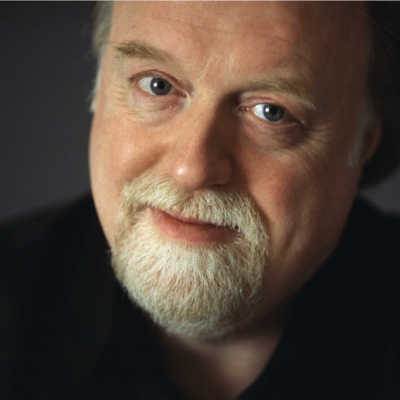
Who or what inspired you to take up composing, and make it your career?

I can’t remember exactly, but I just got more and more into music as a child – hearing my mother play the piano, listening to my parents’ collection of vinyl recordings of Chopin, Beethoven etc., improvising along with my paternal grandmother on the piano: sort of soft jazzy honky-tonk type things. Before I could read music (I started lessons quite late) I would experimentally fill up music paper with random notes and try to get my mother, or my neighbour down the street in Winnipeg to try to play it for me. Eventually I figured out how to make it sound better, and started to be able to play the stuff myself. When I was about nine, I remember announcing at the dinner table to my parents and two sisters that I wanted to become a composer, if not a psychologist, which was my second choice. But I ended up becoming a pianist first.

Who or what were the most significant influences on your musical life and career as a composer?

Though I’m mostly self-taught as a composer, I received encouragement and help from S.C. Eckhardt-Gramatté and Peter-Paul Koprowski, and my musical and aesthetic grounding was greatly influenced by my piano teacher William Aide. My mother introduced me to lots of books when I was young – from ‘Wind in the Willows’ to novels by Joyce Carol Oates. I think this helped me develop creative instincts. Though I never got to meet him, Glenn Gould – with all his individuality and eccentricity – had a profound effect on me growing up. As far as the musical canon is concerned, the inventiveness, depth, and universality of Beethoven’s music grabbed me in my teenage years, and still does. I think of him as the beginning of the modern musical age. My personal interpretation of the term ‘modernism’ is that the individual voice of the composer can deliver ‘truths’ which have a value beyond their fashionability, enjoyability or marketability. There is also J.S. Bach and Mozart, of course, and Schubert, Schumann and Chopin are recurring passions. Of the more recent composers, Bartok, Shostakovich, Ives, Messaien, Xenakis, Weill, (pre-America), Ustwolskaya, Vivier, Feldman, Janacek and Mompou have all offered something special to me. Ronald Stevenson, who I am fortunate to have gotten to know in the last few years, has been an inspiration not just because of his own music (including his masterful Passacaglia on DSCH) but also through his open-mindedness to a wide range of lesser-known music which he’s shared with me – including some wonderful choral folksong arrangements by Percy Grainger.

What have been the greatest challenges of your career so far?

As a player, performing Bach’s Well-Tempered Clavier Book 2, Ives’ Concord Sonata and Beethoven’s op. 106 ‘Hammerklavier’ Sonata. Those experiences (including the task of memorising) helped develop my imagination and sense of structure – not only for composing, but for improvising. Balancing a career performing and composing has itself been a challenge, and I’m still trying to grapple with that. Improvising, besides being an artistic end in itself, has played a mediating role in this inner conflict. Perhaps one of my biggest challenges as a composer was finishing my first ‘opus’ – a piano sonata – in my last year at Juilliard, when I was also busy entering international competitions as a pianist. It was a kind of act of faith to switch gears in this way and start composing seriously. If my improvisation class teacher hadn’t taken me aside and said to me ‘look, from what I’ve heard you do, I think you should consider becoming a composer’, I may never have taken that plunge. It was the last, and practically the only thing he ever said to me in that class, and I’m still grateful for that. My first film soundtrack (Painted Angels, Jon Sanders dir.1999) scored for chamber orchestra was a similar plunge in the dark – very stressful yet exhilarating. From a curatorial perspective, the few festivals I’ve organised posed different challenges – perhaps the most hair-raising being the biggest ever Frederic Rzewski retrospective ever mounted – the first day beginning with the first (and only?) complete performance of his solo piano work ‘The Road’, lasting ten hours. His big compliment to me at the end of the two weeks was to say I was ‘one of the crazy people’.

What are the special challenges/pleasures of working on a commissioned piece?

I haven’t had many commissions, but I particularly enjoy it when there is an element of collaboration. My Viola Concerto (Night Love Song) which was premiered in Toronto last year had two collaborative angles – firstly, working directly with Rivka Golani developing the viola part and secondly working with musical and historical/mythical material from the Blackfoot – specifically the ‘Blood’ tribe in Alberta.

What are the special challenges/pleasures of working with particular musicians, singers, ensembles and orchestras?

Well, Rivka who I just mentioned was (and is) very inspiring. I also recently worked with a young Canadian pianist, now studying in Germany, Everett Hopfner who played my Preludes and Afterthoughts – fantasy-transcriptions on Chopin’s Preludes op. 28 across Canada after winning the É-Gré Competition in Brandon – Canada’s most important competition for contemporary music. To feel such enthusiasm and empathy from a young performer just starting out in his career is something that really lifts the spirit. I guess these are the positive experiences, which I tend to remember and look forward to. What I can find a bit difficult to deal with at times is when performers don’t try to read between the notes on the page – to go beyond the score and ‘interpret it’, which is after all what performers are meant to do!

Which works are you most proud of?

Usually the one I’ve just finished – in this case Three Chorales for piano (which Aleksander Szram will be recording next year as part of a CD of some of my piano and chamber music). I just hope that I can keep developing.

Do you have a favourite concert venue?

I’ve never thought about that much. But one of the worst, I think, was a place that used to be called the ‘Communist Club’ in Warsaw. I played a concert there on an abominable piano in 1980 during the Chopin Competition. I was told afterwards that Richter had just come to town a couple of weeks earlier and asked to give an impromptu recital there. That humbled me!

Who are your favourite musicians/composers?

I mentioned some earlier, but out of the myriad musicians I admire, I’ll also say Rudolph Serkin and Sergiu Celibidace.

What is your most memorable concert experience?

Hearing Jesse Norman sing Wagner’s Liebestod and Strauss’ Four Last Songs with an orchestra in London, Ontario when I was about 19. It wasn’t just the singing, which was overwhelming enough, but her stage-presence, and the magisterial slowness of her entrance.

What do you consider to be the most important ideas and concepts to impart to aspiring musicians?

Try to be open-minded. Opinions are easy to form, and aren’t worth much. But you also have to learn discernment. This might seem paradoxical, but there is a fine balance required – the kind of thing that Zen philosophy seems to be dealing with.

Be generous to others, and as far as possible disinterested in your dealings – doing things for the betterment of the art of music and society rather than entirely for your own career. I think James MacMillan shows an admirably healthy attitude in his interview for this series when he says he never thought of music as a ‘career’.

What are you working on at the moment?

A piece for erhu (a 2-stringed Chinese ‘violin’) and piano for a Canadian duo.

Where would you like to be in 10 years’ time?

Somewhere where I could experience both solitude and friendship in equal measure.

What is your idea of perfect happiness?

Solitude and friendship. And, more specifically, lying on a nice quiet beach somewhere with my wife and two daughters.

What is your most treasured possession?

Music.

What do you enjoy doing most?

Making music.

What is your present state of mind?

Tired, happy and just a little uneasy

Douglas Finch was born in Winnipeg, Canada, and began improvising, composing and performing on the piano from an early age with the help of his mother. He later continued studying with Winnifred Sim, Jean Broadfoot and at the University of Western Ontario with William Aide. After receiving a Masters from Juilliard in New York under Beveridge Webster, Douglas won several awards and was a finalist at the Queen Elisabeth International Piano Competition in Brussels.

After moving to London, he co-founded The Continuum Ensemble in 1994 and has collaborated in premiering many new works. He appears regularly with the ensemble at the Spitalfields and other Festivals and at the Southbank Centre, featuring composers such as Julian Anderson, Georges Aperghis, Henri Dutilleux, Charles Ives, Claude Vivier, Errollyn Wallen, Iannis Xenakis and many others.

He has composed for piano, chamber ensemble, orchestra, theatre and film and his score for the feature film ‘Painted Angels’ , was described in The Independent as ‘an extraordinary triumph of artistic will’.

Interview date: November 2013

A guest post from Jane Shuttleworth

Among amateur musicians, we choral singers are an incredibly lucky bunch. We get to perform with top professional soloists, conductors and orchestras in the country’s best concert halls, without needing music college degrees and whilst still being able to do regular day jobs that pay the mortgage. When I was invited to contribute to this series, there were any number of memorable performances I could have chosen: my first ‘Messiah’, in the Royal Albert Hall; Bach Passions with professional baroque players; a Remembrance day War Requiem in Toronto; another ‘Messiah’ with Ben Heppner; Mahler’s Eighth Symphony… I’ve chewed through a fair proportion of the choral repertoire, but the piece I’ve chosen to write about comes from one of the works that has thus far eluded me – Haydn’s ‘Creation’.

The chorus, “The Heavens are telling” closes Part One of Creation; it was a staple of my church choir’s repertoire when I was a young girl soprano, and we often sang it either as an anthem during a service or at concerts. Everything about it delighted me, particularly the sheer exuberance of the opening phrases, and the madcap dash to the end when the words all tumble out with increasing urgency and the harmony ratchets up the tension; and the simple fact that it was really loud. But the contrasting trio sections with their graceful fluidity, their cast of angels and air of mystery enchanted me too.

To this day, it’s a bit of a mystery why I joined the choir: I think it was mainly to escape Sunday School, but I had always enjoyed trying to sing along with hymns. One of my earliest memories is standing on a pew next to my father, trying to sing a hymn and asking him what all the words meant. I wasn’t particularly good at singing – the school choir-mistress had made that quite clear. But David Strong, the choirmaster, was willing to take on any trebles who wanted a go, and he put in extra time with us before adult choir practice to help us learn our parts.

And this is really the point of this article. Thanks to that early experience of good Anglican choral music, I have spent my whole life singing in choirs; church and chapel choirs, big choral societies, and smaller chamber choirs. I’ve sung in big concert venues, a fair number of cathedrals and have been moved to all extremes of the emotional compass by music I’ve sung. And it’s all thanks to David Strong, that organist who took the time and effort to bring children into his church choir, and just as importantly to let us sing the same music as the grown-ups. This sort of thorough, accessible and (most importantly) free musical education is so hard to come by and should be valued, supported and lauded wherever it can be found.

I only realised just how grateful I was to David Strong when I heard last year that he was seriously ill, and I was glad that I had the opportunity to get back in touch and thank him. He died a few days before I sang my first St Matthew Passion, in Durham Cathedral, and some of the tears I shed during that concert were tears of gratitude.

We sang plenty of other good repertoire but “The Heavens are telling” captured my childhood imagination so strongly that it’s the piece that sums up my early choir years, and whenever I hear it, I think of my 10-year old self, singing out with more enthusiasm than accuracy, and still oblivious to just how much amazing music-making I had ahead of me. And if I ever get to sing Creation, I’ll be thinking of David…and probably resisting the temptation to attempt the soprano line that I used to sing with such delight.

Jane Shuttleworth is a singer, recorder player and writer, reviewing
for Bachtrack, Early Music Review and her own local music website
Music in Durham (www.musicdurham.co.uk). She currently sings alto in
The Durham Singers, a 40-voice chamber choir specialising in
unaccompanied music, and in Voces Usuales, an occasional cathedral
choir.


‘Music Notes’ is a new occasional series, mostly comprised of guest posts, in which contributors discuss favourite or significant concerts, performances, artists, recordings or musical experiences. More ‘Private Passions’ than ‘Desert Island Discs’, the series is an opportunity for people to share their love of music and attempt to explain why certain pieces, places and artists have such distinct resonances and associations for them. Further information about the series here:

https://crosseyedpianist.com/2014/04/29/music-notes-a-new-occasional-series/

On Saturday 24th May I attended a workshop for piano teachers hosted by the Faber Music Academy/Faber Music, in association with Alfred Music and Edition Peters, as a guest of Edition Peters. The all-day event featured lectures by Pam Wedgwood, Andrew Higgins and Roy Howat, and concluded with a recital by pianist Daniel Grimwood. My friend and teaching colleague Rebecca Singerman-Knight accompanied me – and we met a number of other teaching friends and colleagues at the event. Rebecca has co-authored this review of the day with me (her comments are in italics).

The morning session offered opportunities for two publishers (Faber Music and Alfred Music) to showcase their method books. Pam Wedgwood from Faber used her slot to introduce her new 3-volume ‘Piano Basics’ Course (a 2-level course with accompanying ‘workout’ book offering technical exercises).  Pam is well known to UK piano teachers as the composer of many engaging and popular pieces in a variety of styles which are accessible to children and adult learners.  Her session included entertaining examples of games that can be played in lessons to reinforce rhythmic and pitch awareness away from the piano bench and I expect that all teachers present gained some fun ideas to take back to their studios.  She also played some of her own compositions which would certainly appeal to young learners.  However, ultimately I was left with the feeling that the session was little more than a marketing exercise for her own books, particularly towards the end as one book after another was presented.  Overall the overt marketing undermined what was otherwise a fun session. 

Andrew Higgins from Alfred Music followed, a refreshing change in that the Alfred books were used purely as examples to illustrate a truly inspirational session.   ndrew’s focus was the teaching of harmony – in particular chords and chord progressions – to allow students to fully explore musical concepts, develop improvisation and composition skills, and to gain a deeper understanding of repertoire. He demonstrated a wide variety of teaching ideas that would enable students to fully understand how harmony works across music of all genres – a highlight being how a popular Adele song used the same harmonic progressions as Beethoven’s ‘Waldstein’ Sonata!    

The contrast between the two morning sessions reflected the dilemmas faced by UK piano teachers today: I speak as one relatively new to the profession, having been teaching for just over a year, and as a current student of EPTA-UK’s Piano Teachers’ Course.  Although Andrew Higgins did not push the Alfred books to the participants, in response to a question he did state that Level 3 of the Premier course equated roughly to a Grade 1 standard. The first two levels of this course each contain two method books. Therefore, a teacher using this course (myself included) would go through five books before their students reached an approximate Grade 1 standard. In doing so, Andrew Higgins’ presentation made it clear that they would receive a good introduction to the use of chords, chord progressions and harmonic knowledge and be well on their way to being well-rounded musicians who could use this knowledge in improvisation and composition as well as being able to tackle the standard of repertoire needed at a Grade 1 level. In contrast Pam Wedgwood’s Basics book (in common with other UK methods) contains only two volumes and states that this will get a student to Grade 1 standard.  However, there is less in the way of work on chords and their progressions (a knowledge of which is not a prerequisite for passing early exams) and a scan through the books revealed that new concepts appeared to be introduced very quickly with little reinforcement before moving onto the next.  Whilst I have no doubt that in the hands of a good teacher this method would be successful in getting a student to Grade 1 standard I do feel that this can be rather a narrow objective for beginning piano students.  On the EPTA course we are told that it should take roughly three years from being a complete beginner to passing Grade 1 in order to develop really secure musical concepts.  This is roughly how long it would take to work through the Alfred method books and other, similar methods from the US (e.g. Piano Adventures).  However, in the UK many teachers feel pressure from parents to enter their children for exams earlier and it is common for grade 1 to be reached in 18-24 months or less.  Books such as Pam Wedgwood’s will appeal to teachers who aim to move their beginning students through the exam system quickly – which is a really valid approach for many students, particularly those for whom music is (or will become) a serious subject of study.  But it was refreshing to be reminded that there are other, very different, approaches available for teachers who want to take more time with their students in the early stages of their learning to explore many different musical ideas and concepts, not only those necessary for passing formal exams. 

The afternoon session began with a fascinating talk by renowned pianist and scholar Roy Howat, who has recently edited new Editions Peters editions of works by Debussy, Ravel and Faure. His highly erudite yet accessible talk focused on the piano music of these three great French composers, and highlighted the difficulties encountered by editors, and pianists, in trying to produce a ‘definitive’ urtext edition. By examining scores and earlier editions, Roy demonstrated how detailed analysis of source material and editorial notes can impact on the performance of these works, and how certain markings on the score have often been misunderstood or misinterpreted by performers. I found his comments on meter in Debussy’s music particularly interesting in which he showed how Debussy “wrote in” rubato, thus negating the need for exaggerated rubato or obvious adjustments to tempo by the performer. His talk was peppered with amusing anecdotes and pictures of the composers as well as demonstrations at the piano.

The event closed with a short recital by pianist Daniel Grimwood (who is an Edition Peters artist). His enjoyable, varied and engaging programme began with a work by Czerny, a composer more usually associated with piano studies and exercises, and included shorter pieces by Liszt, Blumenfeld and Henselt (also a composer of studies and exercises). He concluded with a crystalline and atmospheric encore of ‘Ondine’ from Ravel’s Gaspard de la Nuit.

This was a most enjoyable, stimulating and inspiring day, and an excellent opportunity to connect with other teachers and friends and colleagues in the profession.

impact of editorial and source research on performing the music of these great composers – See more at: http://www.fabermusic.com/news/faber-music-academy–piano-workshop-day-inspiration-for-inspirational-teachers15042014-1#sthash.0RQ8aTFv.dpuf


What is your first memory of the piano?

Growing up in Malaysia, my first memory of the piano was not a particularly happy one. When I was about 7 my parents decided that I should begin formal music lessons. Unfortunately I had a teacher who was neither sympathetic nor encouraging. I remembered being constantly shouted at and whacked for playing wrong notes (perhaps there was a clash of personality between the two of us…) and I will never forget writing 5 pages of treble and bass clefs (both front and back) as well 6 pages of middle C! (and to think that my students complain when I ask them to write 2 lines!). Needless to say I gave up the piano very quickly. Even though I don’t want to admit this (as I pride myself on being a purist), it was a few years later when I heard a recording of ‘Ballade for Adeline’ played by Richard Clayderman (who was practically the greatest pianist in the world according to all Malaysians at the time) that inspired me to play the piano again. Shortly after my encounter with Monsieur Clayderman, my parents introduced me to the ‘Yellow River’ Piano Concerto, the one piece of music my mother listened to and loved while she was 6 months pregnant with me (perhaps you can say that my musical education started way before I was 7). My family then emigrated to England in 1988. There I met the teachers who started me on the journey to where I am today.

Who or what inspired you to start teaching?

To be honest, I never saw myself as a teacher; all my life I wanted to be on the stage, to be a pianist, a performer. I think this had much to do with the glamour of the concert platform and never having the opportunity to work with brilliant teachers. I am from a culture (and period in time) where it was normal for a teacher to humiliate and belittle a student and it was not until I lived in England that I came in contact with fantastic teachers who changed my opinion about teaching. The real advice to start teaching came from the mother of a good friend, Ricki Lombard (Ricki’s son Benn is a brilliant pianist who studied with Martino Tirimo in London). Ricki heard me ‘play through’ a recording programme and told me afterwards that perhaps I should also look into teaching as (in her humble opinion) I have a ‘knack’ with children. (I had not written progamme notes for the performance but instead introduced each piece before playing) Ricki was convinced that I am able to introduce Classical music to the ‘little ones’ (in her own words) while at the same time make learning fun and enjoyable. With hindsight I must say that the best part about Ricki’s advice was that I listened and looked into it!

Who were your most memorable/significant teachers?

I do not believe that there is such a thing as one teacher for everyone. Every teacher has something to contribute and therefore it is difficult to say who my most significant (or memorable) teacher was. All of them played an important part at a certain point of my musical and pianistic development. My first teacher in England, Richard Frostick (currently the Artistic Director of British Council’s World Voice) set a high standard of technical attainment and instilled in me the discipline of musicianship. When I joined London’s CYM (Centre for Young Musicians), I was extremely fortunate to study with Graham Fitch, who is (sweeping statement perhaps) a genius of a teacher. The attention to detail in Graham’s teaching is really something to behold – especially when it comes to producing endless layers of musical colours within the most complex of musical structures. Graham was also obsessed (I meant this in the most complimentary sense) with the musical line and his for respect for the musical text was a real eye-opener. My teacher at Surrey University, Clive Williamson (a wonderful exponent of the 20th century repertoire) taught me the discipline of rhythm and what it means to play what is written as oppose to what I think is written. I will never forget Clive saying to me ‘Michael, you have the easiest yet hardest job as a musician, all you have to do is to play what Beethoven has written.’ My teacher after Clive, Nils Franke, showed me that music (and playing the piano) is not something that is entirely detached from life itself, whereas Niel Immelman taught me what it is like to work more independently. I consider my Doctorate supervisor – Hendrik Hofmeyr – a musical genius in every sense of the word. I learnt from Hendrik the ability to go for the ‘guts’ of the composition as well as the ability to read the musical score (in the more profound sense of the word). In other words, don’t just play a crescendo when you see a crescendo, what comes before the crescendo? What comes after it? What musical effect that the composer is trying achieve by writing such a marking? I have very fond memories of my times at CYM, especially of the teachers who took the monthly piano studio classes – John Biggs, Catherine Riley, Petra Casen, Peter Croser and Julie Taylor. I also considered it a privilege to have played for eminent musicians and teachers such as Nina Svetlanova, Frank Heneghan, James Gibb, Phillip Fowke, Renna Kellaway, Florian Uhlig, Gordon Fergus Thompson, Francois du Toit and Helena van Heerden. The prominent American Rabbi Harold Kushner noted in one of his books that everyone carries within themselves one or more piece of the jigsaw which will go towards helping others. None of my teachers could have made the impression that they had without the work of their predecessors.

Who or what are the most important influences on your teaching?

All my teachers played an important influence when it comes to my own teaching. I think it is worth mentioning that as well as being great teachers they are also wonderful human beings. This meant that all of them were able to communicate and get their ideas across very successfully. I remember Richard Frostick told me to be ‘an artist’ instead of a pianist, a view echoed by Clive Williamson (when we were working on Tchaikovsky 1): “‘For goodness’ sake, Michael, you have proved that you can play all the notes, now be a musician!” Both Richard and Clive’s statements made little impression at the time until I came across an interview given by the eminent Chinese pianist Fou Ts’ong – “In life, one must first be a man, then an artist, then a musician, and finally a pianist.” Fou Ts’ong was right, of course. Art and music have always been a reflection of life, whereas life has never been about just playing the piano! If one has not had certain life experiences, how are you supposed to translate them into playing and performing, or teaching, for that matter? I recall saying to one very talented and musical student, ‘I am happy that you enjoy practising, but please do yourself a favour and go and have some fun! Go and do something an eight-year-old is supposed to do! Funny though this may sound, I also learn as much from my students as they learn from me. Furthermore, one of my hobbies (since my student days) is comparing interpretations by various artists, finding out which performance ‘works’ for me. I also enjoy interacting with my colleagues, often swapping ideas on the methodology of teaching and how to achieve ‘breakthroughs’ with certain students. I do not take it for granted that I work with so many terrific musicians and I am learning all the time.

Perverse though this may sound, it is occasionally enlightening to come across bad musicians and teachers (some of the posts on YouTube are quite extraordinary, to say the least!). Looking at these can be aesthetically reassuring as they show me what not to do, both as a musician and an educator.

Most memorable/significant teaching experiences?

It is difficult to say which is the most significant or memorable teaching experiences because there are so many of them! I am very fond of the interaction with my students at Western Province Preparatory School and Herschel High School as all of them are so different – and to see their progress is extremely rewarding. I particularly enjoy the sense of honesty and directness when it comes to working with children (they often tell you what they think and you know exactly where you stand with them) – maybe this is because I am still a child at heart! (My sister once remarked that although my real age may be 35, my mental age is 15.) It warms my heart that quite a few of my former students still keep in touch, and it is always wonderful to see what they are doing with their life. What makes me really proud is that many of them still love their music and have kept up their piano playing even though they have not chosen music as a career. I was also in Singapore recently working with students from Kawai Music School Elite, which was an incredible opportunity. It was particularly interesting to see the differences between the East and West in terms of musical mind-set and culture. Also amongst my memories was the very first time I entered students for ABRSM exams and all of them came back with Distinctions and Merits. There was also the occasion when a former student greeted me in a shopping mall; I will never forget his words after I embarrassed myself by not being able to recall his name: ‘Dr Low, I’ve only had four piano lessons with you, but I so enjoyed them and will never forget you.’

What are the most exciting/challenging aspects of teaching adults? 

I have often been asked by adult students if there is a ‘cut-off point’ when it comes to starting piano lessons, and I always tell them that one is never too old (or in the case of Benjamin Button, too young) to learn something new in life – my most elderly student is a seventy-year-old lady who absolutely adores her piano lessons. Perhaps the most challenging aspect about teaching adults is to ask to them to be patient (especially as most of them find it difficult to set aside a daily practising slot). I recall falling in love with the game of golf a few years ago and spending many hours on the driving range (with my golf coach) trying to learn the mechanics of the golf swing. At the same time it was particularly humbling to see junior golfers as young as ten who could swing the club so naturally! Learning to play the piano is exactly the same: if you have never played before, don’t expect everything to come at once; it sometimes takes a while to learn how to utilise the muscles in your hands. I will never forget Graham telling me in one of our first piano lessons that I am in charge of ‘ten circus monkeys and I am the ringmaster.’ Like most things in life, I truly believe that if one persists long enough, then things will happen, but – and this is the important part, especially for those who find it difficult to practise every day – practice does not make perfect, practice makes permanent. If (for whatever reasons) you don’t feel like practising, then rather don’t, as that will set you back in the long run. My colleague Marianne McLean has a good analogy for this: she likened unproductive practising to having a virus that gradually took over your computer.

What do you expect from your students?

One word: Commitment. I do not mind in the slightest what level the student is at or how talented the student is, as long as they approach piano playing with a sense of responsibility, then I am happy. I do not believe in enforcing a strict practising routine on students because I always believe that one practices because one wants to. You don’t play the piano for your parents or your teacher(s), you play for yourself. It took me a long time to grasp this, until one of my teacher told me ‘Michael, if you must play the piano for someone, then do it for Jesus, but even Jesus may have reservations…’) I truly believe that the happiest people in life are those who do things with commitment – whether it is going to church, being a parent, running a business, playing a golf shot, or doing a questionnaire J.

What are your views on exams, festivals and competitions?

In my opinion they can be very good if one approaches them with the right mind-set. Performing is such a fickle and (at times) highly stressful activity that is almost impossible be ‘on the money’ every time one appears on stage – Vladimir Horowitz once noted in an interview that the secret about performance is that you have to be feel great on the actual day itself! If you play in a competition and don’t get to the next round – it doesn’t necessarily mean that you are a bad musician or a bad pianist, it could just be that it is not your day. Similarly, if you enter a competition and win, it doesn’t automatically guarantee a performing career as there is a distinct difference between being able to play your competition programme stunningly and having a repertoire that is able to consolidate your prize-winning engagements. Furthermore, competitions can be full of subjectivity, for every Argerich, Berezovsky and Perahia, there must be at least fifty international prize winners who never consolidated their performing career. Niel Immelman always encourage his students to go listen to the next round of a competition whenever they get eliminated, in Niel’s words, ‘one of the two following things will happen; either the student will learn a lesson or they will disagree with the jury’. I am tempted to add that if the student is lucky enough – sometimes they will end up learning a lesson and disagreeing with the jury! Exams and festivals can be very useful as they give the student something to work towards. However, the candidates also need to approach them with the correct mind-set – a person that scores 128 for his/hers ABRSM exam is not an inferior musician to someone who scores 132. This is because like competition, the marks can be very subjective and different examiners look for different things. There have been occasions when I felt that the exam mark is by no way a reflection of the student’s effort and there have been occasions when I thought the examiners were perhaps a touch generous with their marks. I remember telling a few students a couple of years ago, ‘In my opinion your score of 30/30 is unacceptable, there is no such thing as perfection in my book when it comes to performance’. At the end of the day, if competitions and exams can be approached with a positive attitude, then I am all in favour of them.

What do you consider to be the most important concepts to impart to beginner students, and to advanced students?

For beginners there are a few things: I considered it important to teach any beginner student the importance of rhythm: to make them count out the beat explicitly – sometimes to the extent that I ask them to nod along with their counting (to quote Hans von Bulow, ‘In the beginning there was rhythm’. It is only when I am convinced that they have understood the rhythmic construction of the composition that I am open to discuss the concept of interpretation. I feel that this is particularly important, as there is a difference between playing what is written, as opposed to what you think is written. I have come across quite a number of students with the following mind-set when learning a piece of music, ‘Let me first get the notes and then I will get the rhythm’; to which I response, ‘Surely you never eat your sushi first and then have your soya sauce? Or the other way round for that fact, the two of them goes together!’ Equally important to impart to a beginner (or anyone else for that matter) is the love for music, along with all the discipline that comes with learning an instrument. This (in my humble opinion) has become even more important in an age of social media and instant gratification: why should you practise the piano for 25 years with the prospect of perhaps becoming a good musician, when you can be on Idols and be famous the next day? One doesn’t teach the piano in order to turn every student into the next Lang Lang (the world wouldn’t be big enough for starters) although it is always a privilege to work with talented students. Similarly, one doesn’t learn the piano in order to be the next pianistic superstar. One learns the piano (and other musical instrument) because along with acquiring the mechanics on how to play the piano, one also attains a set of life skills which will make you a better person. These include grit, persistence, integrity and honesty amongst many others. As for teaching more advance students – one merely play the role of a ‘facilitator’, not to impose one’s ideas on the student but instead to present the student with different opinions on interpretation. This could be finding a hidden melodic line within a complex musical composition, highlighting a bass line, or helping them to overcome a particular technical problem.

What are your thoughts on the link between performance and teaching?

For me, I felt that I became a better performer after I started teaching. Up until then my playing was plagued by the lack of internal rhythm (this has much to do with not being taught the importance of rhythm at a young age) and the situation reached its all-time low (no pun intended here) when a very famous professor told me to ‘sort out my rhythm or never play the piano again’. Perhaps you can say that this has something to do with ego and reputation, but when I started teaching I don’t want any of my students to go down the same route where I have been. Even more so, how hypocritical will it be if I am constantly preaching the importance of rhythm but neglect the same thing in my own playing? So I changed my mind-set and approached learning pieces differently, instead of worrying about the technical challenges I concentrate on getting the rhythmic structure before anything else. It was hard work and humbling at the beginning, but as things begin to fall into place, it is almost like curing my playing of cancer – the real eye-opener came when I revisited old repertoire and realised what I had originally conceived rhythmically wasn’t quite what the composer had in mind! The rhythmic discipline in my playing is now more important than ever having recently put together a chamber ensemble to perform and record the last eight Mozart Piano Concerti (amongst other repertoire). Looking back, what was said to me might be harsh but it was exactly the thing I needed to hear.

No disrespect to teachers who only teach, I strongly believe that only those who perform can bring a different dimension to their teaching when preparing the student for a performance and exam. Performance preparation and performance itself can only be taught by those who are constantly involved in performing. All of us are the world’s greatest pianist within the confines of our practising room, but how many of us can rise to occasion when we are asked to play in front of a mike, a video camera, or an audience? And sometimes we have to perform in front of all three!

Who are your favourite pianists/pianist-teachers and why?

The list is endless, but I will try! From Ax to Ashkenazy, Arrau to Argerich, Berman to Barenboim, Gilels to Gulda, Arthur Rubenstein to Sviatoslav Richter, plus everyone else in between! I truly believe that everyone has something to say, it just so happens that some of us have just a bit more to say than others.

As a teenager, Michael studied piano under the guidance of Richard Frostick before enrolling in London’s prestigious Centre for Young Musicians, where he studied composition with the English composer Julian Grant, and piano with the internationally acclaimed pedagogue Graham Fitch. During his studies at Surrey University in England, Michael made his debut playing Tchaikovsky’s First Piano Concerto in the 1999 Guildford International Music Festival, before graduating with Honours under the tutelage of Clive Williamson. In 2000, Michael obtained his Masters in Music (also from Surrey University), specialising in music criticism, studio production and solo performance under Nils Franke. An international scholarship brought Michael to the University of Cape Town, where he resumed his studies with Graham Fitch. During this time, Michael was invited to perform Tchaikovsky’s First Piano Concerto for The Penang Governer’s Birthday Celebration Gala Concert. In 2009, Michael obtained his Doctorate in Music from the University of Cape Town under the supervision of Hendrik Hofmeyr. His thesis set out to explore the Influence of Romanticism on the Evolution of Liszt’s Transcendental Etudes. Michael has also worked with numerous eminent teachers and pianists, including Nina Svetlanova, Niel Immelman, Frank Heneghan, James Gibb, Phillip Fowke, Renna Kellaway, Carolina Oltsmann, Florian Uhlig, Gordon Fergus Thompson, Francois du Toit and Helena van Heerden.

Michael currently holds teaching positions in two of Cape Town’s exclusive education centres: Western Province Preparatory School and Herschel School for Girls. He is very much sought after as a passionate educator of young children.

http://michaellow.co.za/