
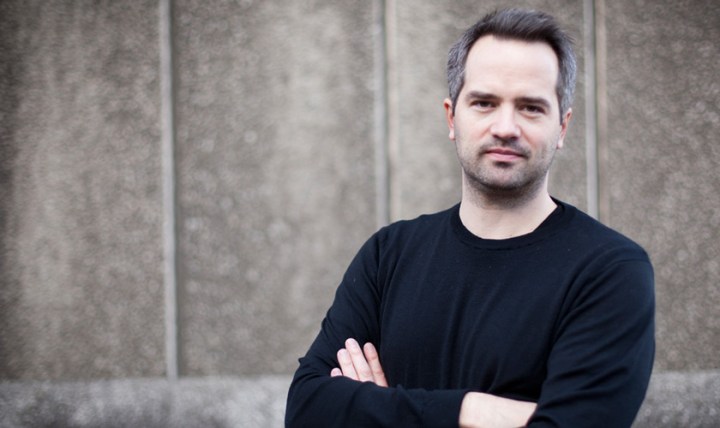
©Peter Jablonski
Who or what inspired you to take up the piano and pursue a career in music?
I never took a conscious decision to have a “career in music”. Music was all around me when I was little. I was interested in sport, but my father was a musician, classically trained, from Poland. He came to Sweden in late 60s as the leader of his own jazz quintet, so there was a lot of music at home – jazz and also classical. I grew up with music. I started playing drums early on and that was what I was going to do. I toured and played drums.
At 6 I started having piano lessons with my dad, and then I discovered this amazing instrument and its possibilities, and that got a hold of me. At 11 I went to a Polish piano teacher at the college of music in Malmo. The way he spoke about music – about the smell, sense, colours, pictures of the music – it just opened my mind. And after 4 years study with him I was a pianist.
In my last year at the Royal College of Music, I got a record contract. I had good people around me but I never took a conscious decision to pursue a career in music. It was a need – I couldn’t be without it
When I started on the professional circuit I felt uncomfortable with the “business” side of it – i.e not to cancel, not to use music if one wants to. Things that felt to be anti-artistic to me as a young musician …. I love music, I love being with it, practising, playing. You get into this groove on the professional circuit which can be difficult for a young artist
Who or what were the most important influences on your musical life and career?
In a purely practical sense it was Vladimir Ashkenazy. In a way he “spotted” me, and he is the reason I didn’t have to go down the competition route (I and some colleagues applied for the Tchaikovsky competition in our final year at college). My first recordings with Decca were with Ashkenazy. I encountered him by chance through my Swiss manager who lived in the same village as him. My manager took him a tape and he listened and said he wanted to hear me. It was pure luck.
I did a few local competitions, but I was spared that world. I was lucky enough not to have to go down that route. And I came out of college at the time when recordings still mattered in your career.
What have been the greatest challenges of your career so far?
From a practical standpoint, when you are younger and thrust in to the limelight, the challenge is finding the time to get the repertoire learn and to be a human being. I have a rebel in me that didn’t like being on the road. I loved playing and I liked the solitude. I have a family, a daughter, I basically missed the first 2 years of her life. I struggled with that. I want to live with the music, enjoy it, chew on it, be with it, but the modern career does not allow it. But I think most young performers find this. I wanted other things in my life – family, friends, freedom, I wanted to enjoy the music.
But of course there is an adrenaline high connected with that life. I have colleagues who play 100 concerts a year, but that would just kill me and my love of the music. Some people are at odds with the “career” side of being a pianist. When you’re on the road and you play a lot, you get to a state of readiness and you’re ready always – but you cannot make it any easier. The requirement of the repertoire is keeping the love for it, it’s difficult when it gets busy. Many different concertos, practising non-stop – sometimes I didn’t even like the piano very much because of the concert schedule.
Which particular works do you think you perform best?
I don’t know…..a very difficult question. That’s for other people to say. Because of my drumming side, I’ve had an affinity for the more rhythmical music (Bartok, Barber for example) but that also applies to Beethoven. I’m feeling more and more comfortable playing Beethoven now. I’m programming Schubert sonatas and Scarlatti – such fresh air! And I’m getting quite heavily into Brahms now
How do you make your repertoire choices from season to season?
I have always loved the nooks and crannies of the repertoire – Szymanowski, Scriabin, Barber, Copland. Incredible music. But of course I have played most of the standard concertos. The only one I’ve stayed away from is Brahms 2 from pure respect and love.
How long does it take you to bring a concerto back into the fingers ready for a concert?
It depends on which one it is. Some I have played so many times (100 times each) I can play them tonight. I could go and play the Grieg tonight – I have about 10 concertos like that. Then there are a few concertos which are a few days away, then a week, and some I have lost completely.
Are there certain composers/works which always remains difficult?
Beethoven 4 – because I love it too much!
Chopin 2 is immensely difficult. There’s a simplicity/naturalness/ delicacy which is bordering on impossible on a modern piano. You have to over-articulate and then it doesn’t feel like Chopin. It becomes “Panzer Chopin”. It shouldn’t be forceful. Very often today the pianos are voiced quite aggressively so that they carry to the back of the hall over the orchestra. Trying to playing Chopin 2 or Beethoven 4 on those pianos is not easy, it kind of grates.
Do you have a favourite concert venue to perform in and why?
Concertgebouw in Amsterdam is amazing, and the Musikverein in Vienna, but it’s also the history of those places, knowing who played there, who stood on the stage.
In general halls in Asia, in Japan, are wonderful, not least because of the incredible choice of pianos: 5 or 6 pianos to choose from at Suntory Hall. But it’s also incredible difficult. The audiences in Japan are scary. I’ve been to Japan 21 times. At my first recital in Tokyo, there was lots of applause and then the second I sat down they stopped clapping, and it’s almost like you’re alone. It’s spooky. Even in the big halls, it’s the same. They don’t cough, no speaking, no rustling programmes, no one shaking their foot in the front row….. That’s both wonderful and scary. You can literally play to 2000 people without knowing anyone is there. And there is something quite unnatural playing this music to 2000 people. It’s a strange thing to do – to play the piano in public!
For me the music is the most important, it’s not about not me, what I wear…. The only thing you can do is really focus and draw people in. The ideal is when you play in a way which brings people to the music
What is your most memorable concert experience?
There are many for different reasons. For strange reasons, playing Tchaikovsky 1 with the Philadelphia Orchestra outdoors, with Charles Dutoit. And they were going to end with the ‘1812 Overture’ and the canon went off in the slow movement of the piano concerto. It was a like a real bomb! The nerves disappeared after that!
I can’t remember all my concerts, but if someone mentions one to me, the memory of it comes back and I can remember how it went, how it felt sitting on the stage.
On recording
It’s very difficult. I’d much prefer a live concert, the sense of purpose, the adrenaline, which can get lost in the studio. It’s very artificial, it’s a tricky process.
What do you consider to be the most important ideas and concepts to impart to aspiring musicians?
First of all you have to be crazy about music. It starts there. You have to be obsessed without it otherwise don’t do it. You have to have to do it, otherwise the cost is too high.
For young pianists they have to be careful with their repertoire choices. Most people have their strengths, but somehow young prizewinners have to play ‘Feux Follets’, ‘Petrushka’ and late Beethoven sonatas. They are often influenced by teachers and the market. This a big mistake which many pianists make. One needs to have a strong sense of self, which can’t be taught. You have to have a sense yourself of what you feel you can say, you have to live with the music, love it, be with it.
This is the transcription of an interview recorded on 19th April 2016
Peter Jablonski performs music by Chopin, Szymanowski, Bartok and Liszt at Manchester’s Bridgewater Hall on Thursday 20th October. Further information here





 The Cross-Eyed Pianist