
St John’s Smith Square announces its 2017/18 season
On 19 June 2017, St John’s Smith Square announced its 2017/18 Season.
In a characteristic programme, punctuated by a range of Festival celebrations, St John’s Smith Square continues its core mission to provide a home for Baroque music within the UK’s only concert hall dating from the Baroque period while equally championing new music. International artists sit comfortably alongside emerging talent and St John’s Smith Square also continues to provide a vital and unique central London home for the best in community music.
Festivals at St John’s Smith Square
This season, St John’s Smith Square presents seven festivals, each with their own distinct identity, featuring the highest calibre artists and repertoire as expected of its renowned programming approach.
The 32nd Annual Christmas Festival curated by Stephen Layton (9 – 23 December 2017) includes concerts with regular favourites Ex Cathedra, The Tallis Scholars, Solomon’s Knot, the choirs of Clare College Cambridge, Trinity College Cambridge, Christ Church Cathedral Choir Oxford, King’s College London, City of London Choir, the National Youth Music Theatre, Polyphony and the Orchestra of the Age of Enlightenment. New to the Festival this year are Vox Luminis and the London Choral Sinfonia. A very special bonus for December will be organ curator David Titterington’s marathon undertaking to perform the organ works of JS Bach on the magnificent Klais organ at St John’s Smith Square. The Bach in Advent series comprises daily recitals, usually at 6.00pm, from 3 – 23 December 2017, and these will be open to all, free of charge.
The Holy Week Festival (26 March – 1 April 2018) returns after the huge success of the inaugural festival in 2017. Curated by Nigel Short and Tenebrae and featuring a mix of ticketed concerts and free late-night liturgical events, St John’s Smith Square will once again resound with choral music for Passiontide. Artists include Tenebrae, Polyphony, the Britten Sinfonia, Gabrieli, Skylark (from the USA), Aurora Orchestra, Ex Cathedra and The Tallis Scholars.
The London Festival of Baroque Music (11 – 19 May 2018) will have a French theme. In this, the 34th Festival since it was originally launched as the Lufthansa Festival of Baroque Music in 1984, the LFBM commences its new system of working with different Guest Artistic Directors for each festival. To develop the French theme, the Guest Artistic Director for 2018 is the conductor Sébastien Daucé who will be bringing his own Ensemble Correspondances for a staged setting of Charpentier’s Histoires sacrèes (17 May 2018). The Festival will also celebrate the 350th anniversary of the birth of Couperin.
Following the ‘taster day’ in May 2017, Rolf Hind and friends will return for the iconoclastic Occupy the Pianos festival (19 – 22 April 2018). The growing stable of pianistic trailblazers will be joined by percussion, voice, film and elements of theatre in an exploration of the two broad subjects of Nature and Technology. The festival will also feature a performance of Sir Peter Maxwell Davies’ ground-breaking Eight Songs for a Mad King.
The Brook Street Band (and friends) lead a weekend Festival in February (23 – 25 February 2018) exploring the varied musical styles that informed and shaped the composer Georg Muffat. The Band will explore his legacy in the form of chamber and orchestral music by composers including Bach and Handel, with four concerts (plus a dance-music workshop and illustrated pre-concert talks) providing a comprehensive musical survey, as well as a natural ebb and flow in terms of mood and scale, small chamber versus orchestral line-ups, and art music versus dance music. Concerts include music from Muffat’s Armonico Tributo as well as a selection from the two volumes of Muffat’s ground-breaking Florilegium
Also in February, St John’s Smith Square welcomes back the Principal Sound Festival (16 – 18 February 2018), which this year will focus on the music of Luigi Nono, alongside works by Rebecca Saunders, György Kurtág, Claudia Molitor and, once again, Morton Feldman. Artists featured include Exaudi, Explore Ensemble, the Bozzini Quartet, Siwan Rhys, George Barton and Jenni Hogan.
Americana ’18
Throughout the calendar year of 2018, St John’s Smith Square celebrates music from America in a series of concerts curated by the conductor David Wordsworth. Highlights include a celebration of Stephen Montague’s 75th birthday (9 March 2018) with a day of events including his complete works for keyboards and the London premieres of a number of his concertos. There will be a whole day of events, stretching for 13 hours (to represent the 13 stripes of the Stars and Stripes flag) on Independence Day (4 July 2018) and in Autumn 2018, there will be a focussed festival of American music.
Other features of Americana ’18 include the Carducci Quartet playing Philip Glass (23 March 2018), the London Chorus with Bernstein’s Chichester Psalms, celebrating the centenary of Bernstein’s birth (8 March 2018) and Orchestra Nova in a programme that includes the complete chamber version of Copland’s Appalachian Spring (22 May 2018). The pianist Zubin Kanga will give a concert of music by Terry Riley and John Adams among others (9 February 2018) and the Crouch End Festival Chorus will collaborate with the Brodsky Quartet in a programme including music by Randall Thompson, Copland and the Barber Adagio (10 February 2018). For everyone, there is an opportunity to ‘Come and Sing the Bernstein Musicals’ (17 March 2018).
Period Instrument Performance
Period instrument performance is always at the forefront of St John’s Smith Square’s programme. La Nuova Musica and The Holst Singers, both familiar to St John’s Smith Square audiences, collaborate for the first time in a programme of Handel and Mozart (13 November 2017).
London Bach Society make their contribution to the 500th anniversary of the Reformation with a concert which brings together the Steinitz Bach Players and Tenebrae under the direction of Nigel Short (30 October 2017). St John’s Smith Square continues marking the Reformation’s anniversary when Gabrieli and Paul McCreesh return with their recreation of a 17th century Lutheran Christmas morning (7 December 2017)
Following their debut performance back in April, the Armonico Consort and Baroque Orchestra with Christopher Monks will give a performance of Monteverdi’s Vespers of 1610 (4 October 2017), continuing the celebrations of the 450th anniversary of Monteverdi’s birth.
The young conductor, Joel Sandelson, brings his period instrument orchestra Wond’rous Machine for a concert of Corelli, Purcell and Lully (28 October 2017) and soprano Anna Dennis will give a concert of Purcell songs with Sounds Baroque directed by Julian Perkins (19 January 2018).
The European Day of Early Music (21 March 2018) will be celebrated at St John’s Smith Square with a performance in collaboration with the London Handel Festival, and there will be more Handelian celebrations when Stephen Layton directs a concert with Florilegium, soprano Mary Bevan and countertenor Tim Mead (27 February 2018).
Opera
Opera always plays a significant role in St John’s Smith Square’s calendar. Bampton Classical Opera continue to champion the work of Salieri (12 September 2017), this time with his The School of Jealousy, a work that almost certainly inspired Da Ponte and Mozart to create Cosi fan tutte. Later in the season Bampton return to give a programme illustrating the life of the legendary singer Nancy Storace (7 March 2018) marking the bicentenary of her death.
In October there is a chance to hear the opera stars of the future when St John’s Smith Square hosts the final of The Voice of Black Opera Competition (3 October 2018) featuring six young singers accompanied by the City of London Sinfonia , conducted by Kwamé Ryan. There is a further showcase opportunity when Irish Heritage Opera visit to celebrate 44 years of bringing Irish operatic talent to the stage (12 April 2018).
La Nuova Musica return with Handel’s Orlando (1 February 2018), the start of an annual cycle of Handel operas at St John’s Smith Square. There is more Handel in April when Christian Curnyn and the Early Opera Company return with Giulio Cesare (11 April 2018). Further opera can be found during the London Festival of Baroque Music when La Nuova Musica return with Iestyn Davies in the title role of Gluck’s Orfeo (13 May 2018).
Moving on from the baroque period, Kensington Symphony Orchestra present Puccini’s La Bohème conducted by their music director Russell Keable (21 May 2018).
Orchestral Performances
St John’s Smith Square enjoys close relationships with many of the UK’s top orchestras. The London Mozart Players and Howard Shelley’s innovative explorations of great piano concertos this season features works by Schumann, Saint-Saëns, Mendelssohn, Shostakovich and Grieg whilst the Orchestra of St John’s continues its My Music series with celebrity guests including Sir Simon Jenkins, Lord Archer and Lord Hague.
As part of the Southbank Centre’s Belief and Beyond Belief series Matthew Barley leads a performance of Sir John Tavener’s The Protecting Veil with the City of London Sinfonia (2 December 2017).
Orchestra Vitae return with an intimate programme of Mozart and David Lang which will be presented ‘in the round’ (7 November 2017) and then in the spring with a programme within the Americana ’18 season including Copland’s Third Symphony and the Gershwin Piano Concerto (2 March 2018). Another classic American Third Symphony, this time by Ives, is featured in a programme marking the return of the English Symphony Orchestra which also includes the Copland Clarinet Concerto, Piston’s rarely performed Sinfonietta and a newly commissioned work from Jesse Jones (18 April 2018).
In Spring 2018, St John’s Smith Square welcomes the European Union Chamber Orchestra for a programme of Haydn and Mozart (21 February 2018).
The Young Musicians Symphony Orchestra have five concerts this season, and the Kensington Symphony Orchestra once more brings its unique programming style to St John’s Smith Square in its 17/18 concert series. The Royal Orchestral Society and the Salomon Orchestra also return to St John’s Smith Square for regular concerts including a performance of the Berg Violin Concerto with violinist Ben Baker and Schmidt’s Symphony No. 4 conducted by Holly Mathieson (16 October 2017).
Choral and Vocal Music
Given the outstanding acoustics at St John’s Smith Square, many choral societies return year after year and 2017/18 is no exception with performances of Elgar’s The Dream of Gerontius given by the 1885 Singers and Orchestra and the Malvern Festival Chorus (14 October 2017), Brahms’s A German Requiem with The London Chorus (11 November 2017), Islington Choral Society (18 March 2018) and the Anton Bruckner Choir (28 April 2018), Stravinsky’s Symphony of Psalms and Vaughan Williams’s A Sea Symphony with Twickenham Choral Society (8 July 2018), Handel’s Joshua with the Whitehall Choir (17 November 2017) and Haydn’s The Creation with Vox Cordis with the Orchestra of St Paul’s (21 November 2018).
As part of the Southbank Centre’s Belief and Beyond Belief festival St John’s Smith Square is delighted to once again welcome The Cardinall’s Musick with a programme of music from the 16th Century to present day. The English Baroque Choir celebrates its 40th birthday with a performance of Bach’s Mass in B minor (24 March 2018) and the London Choral Sinfonia return with a programme that places music by James MacMillan, Eric Whitacre and Morten Lauridsen around the Requiem of John Rutter (22 February 2018)
New Music and Emerging Talent
The celebration of new music has always been central to the programming at St John’s Smith Square and this season is no exception. Among those whose works will receive premieres at St John’s Smith Square in 17/18 are Gregory Rose, Sally Beamish, Alexandra Harwood, Hanna Kulenty, Patrick Brennan, Khyam Allami, Nimrod Borenstein, Owain Park, Arlene Sierra, Kareem Roustom and Jesse Jones.
The highly praised Young Artists’ Scheme at St John’s Smith Square enters a fifth season with three extraordinary talents. The Bukolika Piano Trio present music by Boulanger, Hanna Kulenty, Messiaen, Górecki and Panufnik alongside more familiar works by Beethoven and Dvořák; the violinist Mathilde Milwidsky performs music by Arvo Pärt, Janáček, Clara Schumann, Grieg and Richard Strauss, while the piano and percussion duo of Siwan Rhys and George Barton offer programmes including music by Vinko Globokar, Kagel, Cage, Feldman and Sir Harrison Birtwistle. All three Young Artists will be showcased as part of a special concert (17 September 2017) within Open House London.
Regular Concert Series & Chamber Music
St John’s Smith Square hosts its regular Thursday Lunchtime Concerts, which feature, among others: Yeomen from The Musicians’ Company; prize-winners from the Oxford Lieder Festival; performances from St John’s Smith Square’s Young Artists 17/18; artists featured at the Dartington International Summer School and a monthly organ recital series programmed by St John’s Smith Square’s organ curator, David Titterington. Particular highlights of the lunchtime series include the Pettman Ensemble with Stephen De Pledge and guest violinist Clio Gould (7 September 2017), the chamber choir Siglo de Oro (9 November 2017), the Duke Quartet (1 February 2018) and the violinist Daniel Pioro (22 March 2018).
The Sunday at St John’s programme, in its fourth year, once again includes a number of mini-series within it. Returning artists include I Muscanti and Leon Bosch who will give a series of concerts juxtaposing Russian chamber music with premieres by the composer Alexandra Harwood. Lucy Parham also returns with her Sheaffer Sundays ‘Composers in Love’ concert series featuring well-known actors such as Harriet Walter, Tim McInnerny, Patricia Hodge and Simon Russell Beale.
The Revolutionary Drawing Room reaches the Razumovsky Quartets as it enters the second year of the complete Beethoven Quartets cycle (concluding in the 2018/19 season) and the pianist Julian Jacobson gives four concerts in his 70th birthday year that bring together masterpieces by Schubert, Beethoven and Prokofiev. Deniz Gelenbe and friends give two concerts of romantic chamber music while Ensemble de Note makes its St John’s Smith Square debut with a series of early classical chamber music performances. The Prince Regent’s Band will give a fascinating programme of 19th century band music (5 November 2017) and the soprano Elin Manahan Thomas together with Elizabeth Kenny (lute and theorbo) will set the scene for Christmas with their programme ‘Now Winter Comes Slowly’ (3 December 2017).
The virtuoso brass ensemble Septura opens the audience’s ears to new sounds as they make their St John’s Smith Square debut in a sequence of concerts entitled Kleptomania, playing arrangements of great works written for other instrumental combinations.
Piano recitals include a performance with Sibelius scholar Joseph Tong in a Nordic themed concert to mark the 60th anniversary (to the day) of Sibelius’s death (20 September 2017) and Blüthner Pianos present a series of concerts to showcase their instruments with the pianists Tom Poster, Dmitry Masleev and Martin Sturfalt. Russian pianist Dmitri Alexeev is another pianist celebrating his 70th birthday at St John’s Smith Square (2 November 2017).
Southbank Centre at St John’s Smith Square
The collaboration with Southbank Centre continues for 17/18 during their period of refurbishment. Highlights include the Orchestra of the Age of Enlightenment with Sally Beamish’s The Judas Passion (25 September 2017) and Rachel Podger playing and directing the OAE in a concert featuring two of Mozart’s Violin Concertos (27 November 2017). The London Sinfonietta return under their founder conductor David Atherton to give a performance of Henze’s landmark work Voices, based on 22 folk songs from around the world (11 October 2017) and St John’s Smith Square will also host some of the London Sinfonietta’s 50th birthday celebrations as they revisit many of the most iconic works from the past 50 years including music by Xenakis, Colin Matthews and Sir Harrison Birtwistle.
Highlights from Southbank Centre’s International Chamber Music Series at St John’s Smith Square include the Emerson Quartet in concerts on two consecutive nights with the late quartets of Beethoven (31 October and 1 November 2017) and Steven Osborne returning with friends to perform Messiaen’s monumental Quartet for the End of Time alongside Shostakovich’s Second Piano Trio (14 November 2017). Southbank Centre’s International Piano Series at St John’s Smith Square includes concerts with Bertrand Chamayou, Víkingur Ólafsson, Boris Giltburg, Alice Sara Ott and George Li.
Richard Heason, Director of St John’s Smith Square said: “St John’s Smith Square is unique amongst London’s concert halls. It is the oldest, yet most flexible, concert hall in London and as such I am very proud that we are able to offer a programme that is so diverse but equally filled with events and festivals of deep integrity. The programme at St John’s Smith Square is forged through collaborating creatively with many hugely talented and generous musicians and my grateful thanks go to all those who enable this programme to be offered. We look forward to welcoming artists and audiences to this iconic venue throughout the coming season.”
Booking information:
Box Office 020 7222 1061
Book online http://www.sjss.org.uk
St John’s Smith Square 2017/18 Season booking opens:
Monday 3 July 2017 for St John’s Smith Square’s Patrons
Friday 7 July 2017 for St John’s Smith Square’s Friends
Monday 10 July 2017 for General Booking
(Source: press release)
The Pianist’s “MUSTerbation”
As a pianist, do you suffer from “MUSTerbation”?
The term was coined by American psychologist Dr Albert Ellis, the father of Cognitive Behavourial Therapy. It is a cognitive trait often present in people who are maladaptive perfectionists, who strive to achieve unattainable ideals or goals, and is a classic recipe for general anxiety and unhappiness.
“Musterbators” live by a set of inflexible, highly polarised beliefs, such as
I MUST do well and be treated with respect, or it is AWFUL and I can’t bear it
Is your piano playing and music making driven by ‘must‘ and ‘should‘ and ‘ought‘? Maybe you regularly make statements to yourself and others like:
- I must practise
- I should be practising
- I ought to be practising
- I have to practise
– and feel guilty and angry with yourself when you don’t act upon them
Such statements demonstrate a very inflexible and unrealistic mindset, and leave musterbators feeling angry, frustrated and resentful (of self and others) if they fail to fulfil a “should have” activity – such as piano practise.
Known as “categorical imperatives,” these shoulds, oughts, musts and have to’s create unrealistic and over-generalised absolutes. If we don’t stop to look objectively at these inner statements, we become enslaved by them. In addition, when we think we should be acting in a certain ‘ideal’ way, we create a judgmental Inner Critic and a part of us puts pressure on ourselves to follow these rules. We then feel guilty and depressed when we don’t. This often leads to strong feelings of guilt, self-hatred, anxiety and depression, and to procrastination, withdrawal, and obsessing about what has been (“I should have practised more”).
“The tyranny of the shoulds.”
– Karen Horney
Such feelings can be deeply inculcated in us and often stem from parental pressures when we were children (“You should be practising!”) or from teachers, for example. We carry these behavourial traits with us into adulthood and may not even be aware of how much they impinge on our day-to-day life.
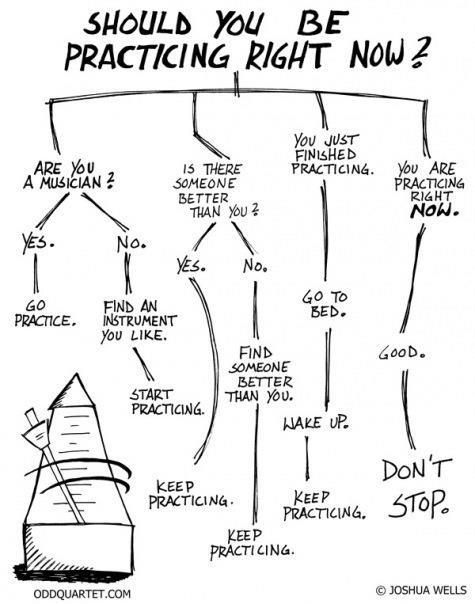
Most pianists – professional or amateur – know they should practise, and most know that regular, focused, and intelligent practise leads to noticeable progress and deep learning. An important part of the practise process is retaining a sense of creativity, curiosity, spontaneity and experimentation. These aspects prevent practising from turning into mindless note-bashing and encourage us to find joy and excitement in our music making. There’s not much joy or vibrancy in a mindset which is continually under the sway of the tyranny of the should, and a whole lot of dissatisfaction and resentment. Unfortunately for musicians, much of formal musical training is geared towards the pursuit of perfectionism, even though perfectionism is an artificial construct and an unattainable goal.
As a musician, such obsessive perfectionist behaviour can stifle musical growth and creativity. The musterbator sets unrealistic or unachievable goals and then feels angry or depressed when such goals are unfulfilled. Musterbators worry excessively about mistakes, they dislike uncertainty, fear negative evaluation by others (teachers, peers, colleagues), and feel frustrated by the gap between what you expect of yourself and your current level of achievement/ability. The musterbatory mindset can lead to over-practising which in turn can lead to injury or greater susceptibility to injury, as well as feelings of low self-esteem and self-loathing, and resentment towards the instrument.
In 2016, when I was working towards my Fellowship performance diploma (a high level professional assessment/qualification), I found myself indulging in musterbatory behaviours, though I wasn’t aware of the term at the time and did not really recognise my obsessive perfectionist attitude as being anything other than taking a “professional” approach to my practising and study. I have always enjoyed practising, I know how to practise productively, and I work best when I have a clear focus or end goal. These attributes are not negative in themselves. My self-imposed practise schedule was such that I would be at the piano by 8am and would schedule at least 3 hours practise into each day. I felt I needed to practise every day and if I missed a day, I berated myself for lack of focus. I think it is important to note at this point that I am not a professional concert pianist and I did not, and do not, need to work at such a concentrated level day in day out. There were periods of time when I felt very angry with myself for not making greater progress and several occasions when I felt I had a reached an immovable impasse with the music (Schubert’s penultimate piano sonata). On these occasions, the piano, which resides in my living room, became a negative presence looming over me, reminding me of my failings. In addition, I suffered several bouts of extremely painful tendonitis and developed a shoulder problem which has still not been fully resolved. There were many times during the process when I felt deeply dissatisfied and disappointed with myself, that I was “not good enough” and I was ready to give up. On reflection – and I took 4 months away from the music after failing to pass the diploma to do some serious re-evaluation – I can now see that my personal unhealthy perfectionism, my “musterbation” was actually harming my relationship with the piano and my enjoyment of music, in addition to causing harm to my body and my emotional well-being.
Fortunately, it is possible to reframe one’s way of thinking to escape the tyranny of the shoulds and the musterbatory mindset. Not all perfectionism is negative, and unlike the musterbator, the “adaptive” or “self-oriented” perfectionist derives “a sense of pleasure from their labors and efforts, which in turn enhances their self-esteem and motivation to succeed…….Self-oriented perfectionists may then use their pleasure in their accomplishments as encouragement to continue and even improve their work“*
Of course, you cannot achieve perfection and you kind of get paralyzed, so you have to find equilibrium between the possible—what’s realistic and what is ideal.
– Yo-Yo Ma, cellist
These “healthy” perfectionists set themselves realistic goals and high personal standards which are achievable. They enjoy the process of striving, have a strong sense of personal autonomy and self-determination (“I choose to….” instead of “I must”), and notice incremental/marginal gains as well as larger achievements, and feel good about them. This in turn encourages greater effort and further achievement. In piano practise, this attitude enables one to regard mistakes as learning tools, to be imaginative and resourceful about problem-solving (of technical issues, for example), to be positive in self-evaluation and reflection, and be open-minded about critique from others (mentors, peers). The healthy perfectionist finds joy, spontaneity and love in their music making, which leads to greater feelings of satisfaction, self-worth and motivation.
If you find yourself prone to musterbatory traits in your piano practise, it’s probably time to question where this negative way of thinking or behaving has come from and why it must be followed. Are you placing undue pressure on yourself to meet unachievable goals, or maybe the pressure – real or imagined – is coming from an external force, such as a teacher or peers? Query whether this mindset is really benefitting you and your music (does it make you happy? Probably not……) and consider how setting realistic goals may improve your musical progress, your relationship with your instrument and your overall emotional health. It may be necessary to do this in consultation with a sympathetic teacher or trusted colleague.
Only when you banish toxic musterbatory thinking and free yourself from the tyranny of shoulds can you truly rediscover the love and joy of making music.
I practice because I’ve experienced so much love that you practice out of loving a phrase, loving motivic change, loving a structure or harmony change or the way a sound can get to something – Yo-Yo Ma
Further reading
*(Kilbert, J.J., Langhinrichsen-Rohling, J., & Saito, M. (2005). Adaptive and maladaptive aspects of self-oriented versus socially prescribed perfectionism. Journal of College Student Development, 46
Exclusive Reader Offer from Practising the Piano Online Academy
Readers can enjoy a 20% discount on the special annotated study edition of Chopin’s Nocturne in c sharp minor, op Post. which includes detailed notes on approaching this music, together with background information and links to video demos, all prepared by acclaimed teacher, pianist and writer Graham Fitch.
Use voucher code GPPYDEH7Y7G7 when ordering
The following links go directly to checkout for specific products with voucher applied (which include the Chopin):
- The study edition (stand-alone) – https://dfp.informance.biz/ebooks/transactions/new?product_id=6&voucher_code=GPPYDEH7Y7G7
- Study Edition bundle (Chopin plus others) – https://dfp.informance.biz/ebooks/transactions/new?product_id=15&voucher_code=GPPYDEH7Y7G7
- Practising the Piano eBook series plus the above – https://dfp.informance.biz/ebooks/transactions/new?product_id=3&voucher_code=GPPYDEH7Y7G7
Readers can also enjoy 20% off any of the eBooks in the Informance online store https://dfp.informance.biz/ebooks/products



 The Cross-Eyed Pianist