A “bias” is a mental inclination which is irrational, preconceived and/or unreasoned. Biases are inherent in human nature and we all have them, to a greater or lesser extent. Whatever your upbringing, intelligence and education, it’s impossible to completely eliminate biases from your thinking. An ever-evolving list of cognitive biases has been compiled by psychologists and behavioural scientists, identifying the many biases which describe specific traits of thinking and behaviour, from confirmation bias to the Ikea Effect, to name but two.

Biases distort objective consideration of an issue or problem by introducing influences drawn from our own social reality into the decision-making process that are separate from the decision itself. Usually we are unaware of the biases that affect our judgment because cognitive bias is all about the thinking patterns in our brain – literally the neural connections and pathways which are created and activated unconsciously. If we tend to a certain way of thinking, the plasticity of the brain carves neural pathways which reflect this (see my article on neuroplasticity) which means we invariably think in the same way, regardless of how open-minded we may think we are, because we just don’t have the connections to see something else. We also tend towards certain cognitive biases to avoid irreversible decisions or making mistakes

A musicians, cognitive bias can affect the way we practise and approach our music, yet we are probably not even aware that it does because we naturally tend towards that which is immediate, relatable, simple, quick and the least risky, which preserves the status quo and reinforces our current mindset and scope of experience. Some of these cognitive biases may have been created, unconsciously, by the influence of certain teachers or our professional training. In terms of practising, this may lead us to practise in the same way every day, because this way is the most familiar and the least risky. Thus, you may always start your practising with scales and arpeggios, or exercises like Hanon, because that is how you’ve always done it and it is familiar, safe and simple. We’d rather do the quick, simple thing than the important complicated thing, even if the important complicated thing is ultimately a better/more productive use of our time and energy. The “Anchoring” bias, for example – an over-reliance on an initial single piece of information or experience to make subsequent judgments – can limit our ability to interpret new, or potentially relevant information.

Unfortunately, this kind of mindset, continually reinforced by our cognitive bias, can make us less open-minded or receptive to new ideas or different ways of approaching our practising. If we practise in the same way every day, we may tend to practise on “autopilot” which can kill our enjoyment and productivity at the piano. Practice can become strained or monotonous because it’s too often primarily directed by an unchanging or unchallenged preconceived idea or goal. You may feel you’re doing a lot of practising, a lot of hard work, without noticeable or quantifiable progression. Unfortunately, many people practise like this because it is familiar, comfortable and relatively easy, but it can lead to an impasse or cul-de-sac in one’s music making which in turn breeds feelings of dissatisfaction or lack of motivation.

It can be tough but it is possible to beat your cognitive bias and adjust your mindset to find new, more creative ways to practise. Here are a few suggestions:

  • If you always begin your practising with scales and arpeggios and/or technical exercises such as Hanon, maybe try some exercises away from the piano to warm up hands, arms and shoulders. Warming up away from the piano also allows you to mentally focus on what needs to be done at one remove from the instrument. Penelope Roskell’s warm up sequence
  • If you really can’t drag yourself away from your beloved technical exercises, add more creativity and artistry to them by removing mindless, mechanical playing and instead aiming for musical playing which focuses on quality of sound, control, tone production, dynamic contrast, articulation etc.
  • Try not to get bogged down in the minutiae of your pieces and instead look at the bigger picture/narrative of the music. What do you think the music is about and how do you want to convey this meaning to your audience?
  • Practise in a mindful, self-aware way: be alert to nuances of dynamics, articulation, tempo etc. and how the music feels under the hands and fingers and indeed the whole body. Listen for details, self-evaluate, reflect, adjust, play
  • Seek inspiration from listening around the music you are working on, reading about it, discussing it with others, going to concerts

There are many online resources which encourage creativity, imagination and new thinking in practising, such as

Practising the Piano

The Bulletproof Musician

The Musician’s Way

Piano Playing Questions and Answers

Piano Portals

What do you do when you read a concert review that you disagree with? Do you bristle with ripe indignation because the reviewer did not concur with your view of the concert and then fire off some harrumphy comments in response, informing the reviewer that they clearly need their hearing tested? (I’ve had a couple of comments like this in response to reviews on this blog – it does happen!) Or do you read the review in a considered way, accept that not everyone is going to agree with you, and be glad that it’s possible for people to express differing (sometimes wildly) opinions?

Nowadays, we live in a world where everyone is a critic: whether someone has seen one show or several thousand, they have an opinion about them and the means to broadcast them. But it is palpably false to say that all opinions are equal. Some people stand above the noise and clamour of the internet simply by virtue of the credibility their opinions have earned.

– Mark Shenton, The Stage

The internet has made us all “reviewers” to a greater or lesser extent: from “likes” on Facebook or Instagram to product reviews on Amazon to long articles on personal blogs and mainstream news sites, the medium allows us to express our thoughts and opinions like never before.
On one hand this can be wonderful: it adds variety to discussions and fuels debate; but the internet also seems to have created a place where every entrenched or polarised view is expressed without the nuance that comes from more considered or face-to-face interactions. People can be far more brutally frank or insensitive in the anonymity of the web than they would ever be to someone’s face. Sometimes when I read comments on concert reviews I see quite of lot of responses which suggest, none too subtly, that “if you don’t agree with me, you are wrong!”. Twitter is, sadly, one of the worst places for this – the brevity of the medium (140 characters) seems to encourage polarity and confrontation rather than nuanced discussion. The commentator might counter that “everyone is entitled to their opinion” but a sense of entitlement is not enough: as far as I’m concerned, you’re only entitled to an opinion if it’s an informed opinion….
 The problem with “I’m entitled to my opinion” is that, all too often, it’s used to shelter beliefs that should have been abandoned. It becomes shorthand for “I can say or think whatever I like” – and by extension, continuing to argue is somehow disrespectful. And this attitude feeds, I suggest, into the false equivalence between experts and non-experts that is an increasingly pernicious feature of our public discourse.
– Patrick Stokes
An example of this is the reaction online to a review in The Washington Post of a concert by pianist Sir Andras Schiff. A flurry of comments online in response to the review reveal an uncomfortable amount of entrenched or binary views rather than accepting the review as an informed, coherent write up offering one person’s opinion of the concert. Of course it doesn’t help that it’s a review of an artist whose statue borders on sacred and who is regarded by many as a high priest of the piano.
Many concert-goers, and even some critics and reviewers, feel a very special, personal connection to performers like Andras Schiff, or Martha Argerich, Maurizio Pollini, Yuja Wang, and many others. We seek out our favourite artists, enjoying the special magic they create for us personally in their performances and recordings (and never forget that music is a highly personal, subjective experience). Social media platforms like Twitter allow us to contact and interact with many of these artists directly, giving us an even greater personal connection with them. We place these people on pedestals for our personal worship and we’ll argue vociferously with those who do not share our reverence and admiration. And that’s fine – just so long as we’re able to accept that others have differing tastes and opinions.
But it troubles me when I come across comments which accuse the reviewer of being “wrong” or worse “stupid” simply for not appreciating a concert in the same way as the reader did. Reviews offer a record of an event and express one person’s opinion: it is neither right nor wrong, merely an opinion. In a well-written, coherent review, the reviewer should be able to write a record of the concert based on a degree of knowledge, to describe the music and performance, and explain why he/she liked or disliked aspects of the concert, in language which is intelligent, considered and fair, rather than just making bald unsubstantiated statements or, worse, hiding their lack of an opinion or knowledge in purple prose or jargon-ridden, high-falutin language.
The purpose of a review is to provide a record of what happened at a performance and to evaluate what happened, whether the reviewer heard greatness, horror, or mediocrity. Evaluation is what sets a reviewer or critic apart; a reviewer theoretically has enough knowledge and experience to support the opinions they form about a performance.
– Lisa Hirsch, Iron Tongue of Midnight
Some years ago, an acquaintance, who knows about my reviewing and blogging activities, wrote to inform me that he thought a certain international concert pianist, one whom I much admire and have reviewed several times in concert, was an example of “the emperor’s new clothes”. There was no further explanation as to why this person held this view of the pianist in question (and I suspect the comment was largely driven by professional jealousy). Now, if asked, I could give at least three coherent, considered reasons why I admire this particular pianist, or indeed any of the other musicians whom I admire, and I would expect – nay, welcome – someone who disagrees with me to be able to argue otherwise in a similarly coherent, substantiated way.
All of this reminds me of that quote attributed to Voltaire: “I disapprove of what you say, but I will defend to the death your right to say it.” In the curious and very noisy echo-chamber of the internet, it serves as an important reminder that we should take note of the opinions of others, to respect or accept them, to respond in a more nuanced way, and to agree to disagree.
707px-graham27s_hierarchy_of_disagreement-svg
 Hierarchy of disagreement (source: Wikipedia)

“The loneliness doesn’t worry me……I spend most of my life alone, even backstage…….I’m there completely alone. I like the time alone….”

Stephen Hough, speaking on BBC Radio 4’s Desert Island Discs

The pianist’s life is, by necessity, lonely. One of the main reasons pianists spend so much time alone is that we must practise more than other musicians because we have many more notes and symbols to decode, learn and upkeep. This prolonged solitary process may eventually result in a public performance, at which we exchange the loneliness of the practise room for the solitude of the concert platform.

Most of us do not choose the piano because we are loners – such decisions are usually based on our emotions, motor skills or the aural appeal of the instrument. For me, as a child – and an only child – the piano was a companion and a portal to a world of exploration, fantasy and storytelling. It remains a place to retreat to and time spent with the instrument and its literature can be therapeutic, rebalancing and uplifting. For many of us, being alone is the time when the sense of being at one with the instrument is strongest.

In addition, there is time alone spent listening to recordings – one’s own (for self-evaluation) and by others (for inspiration and ideas on interpretative possibilities, or purely for relaxation) – and time simply recovering from practising and refocusing in readiness for the next session. Many pianists tend to be loners – the career almost demands it and self-reliance is something one learns early on, as a musician – but that does not necessarily make pianists lonely or unsociable.

To me it’s always about connection – connecting with parts of myself, with the thoughts and feelings of the composer, and ultimately sharing with an audience. It’s travelling through time and space to experience other eras and cultures…..I can’t think of anything that makes me feel less lonely!

Stephen Marquiss, pianist & composer


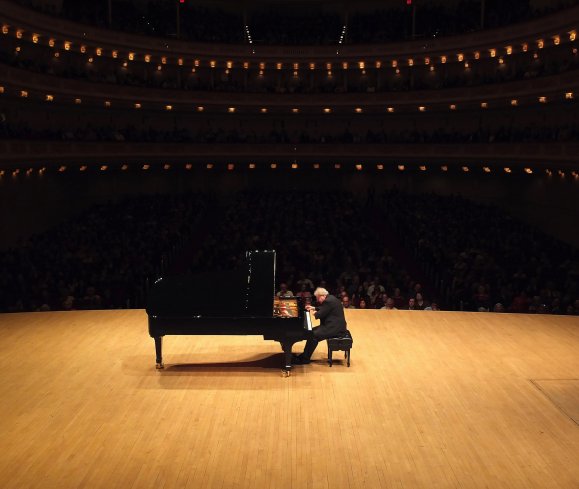
The life of the concert soloist is a strange calling, yet many concert pianists accept the loneliness as part of the package, together with the other accessories of the trade. The concert pianist experiences a particular kind of solitude (as noted by Stephen Hough in the quote at the beginning of this article). The solitude of travelling alone – the monotony of airport lounges, the Sisyphean accumulation of airmiles, nights spent alone in faceless hotels. Dining alone, sleeping alone, breakfast alone, rising early to practise alone. And there is the concert itself: waiting backstage, alone, in the green room, and then the moment when you cross the stage, entirely alone….. The pianist Martha Argerich has described the “immense” space around the piano that has always made her feel alone on stage. But it is this aloneness, this separation, which the solo pianist exploits for the purpose of captivating and seducing the audience, drawing them into his or her own private world for the duration of the performance.

I suppose being an introvert in a ‘public performance’ profession has been my greatest challenge. It isn’t straightforward, of course – I seem to have a deep need to communicate music to an audience and get their reaction, and I love to be appreciated, but there are many other aspects of being ‘on show’ that don’t come naturally. I’m very interested in people, but I’m quite a private person and need lots of time to myself.

Susan Tomes, pianist and writer

The traditional positioning of the piano on stage, so that the pianist sits side on to the audience, heightens this sense of separation and aloneness. In a concert, the pianist must navigate a path between private, subjective feelings and public expression in a curious display of both isolation and exhibitionism. The power of performer, and performance, is this separateness from the mass of audience. Some performers may exploit this to create a sense of “us and them”, while others are adept at creating an intensity or intimacy of sound and gesture during which the audience may feel as if they have a private window onto the pianist’s unique world, in that moment.

emanuel-superjumbo

Up there on the stage, one can feel more alone than anyone would ever care to be, yet it can make one better than one thinks possible because one’s ego is constantly being tested when one plays. To meet a Beethoven sonata head on, for example, it stops being about you – how fast you can play, how technically accomplished you are. Instead it is about getting beyond oneself, becoming ego-less, humble in the face of this great music, developing a sense of one-ness with the composer…..

After the performance, when the greeting of the audience and CD signing is over, the pianist may happily retreat to his or her solitary practise room or studio. Many of us long for this special solitude and actively relish the time spent practising alone.

The internet and social media has, for many of us, been a huge support in relieving feelings of loneliness and separation. Facebook, Twitter and other social media platforms enable us to connect with pianists and other musicians around the world, allowing us to preserve our solitude, while also engaging meaningfully with others when required.

An earlier version of this article appeared on the Pianodao blog


(Picture: Emmanuel Ax in recital at Carnegie Hall, photo by The New York Times)


Guest post by Doug Thomas

“Music washes away from the soul the dust of everyday life.” 

This is what the German poet Berthold Auerbach might have answered had he been asked what the role of music was for him. To me, it seems plausible that music carries a significant meaning in most people’s life. Whether it is for a simple amateur, a true mélomane or a professional musician, it seems to always have a particular role, guiding people in their own existence.

In my experience, music has taken several aspects but three important ones prevail. Music has been part of my daily life for many years and wherever I go, whatever I do, it embellishes my world. It is also a great catharsis, and it is what allows me to compose and create on a regular basis. Most importantly, music is a source of intense pleasure which very few other forms of art have been able to provide me with.

Whenever I get tired of listening to silence, music comes to the rescue. I often see music in a similar way to the French composer Erik Satie – as furniture music. Music that is meant to decorate the environment or have a functional purpose. It is not necessarily music I pay much attention to. There are many situations were music sits in the background; at home on a lazy afternoon, during a dinner with friends or on a simple train journey.

I compose music for a living. In addition to fulfilling my need to create things, composing music acts as a sort of catharsis. It is a way to externalise my deepest feelings and emotions. Although I consider my music as somehow intellectual, the creative process often starts with a feeling. Whether it is the expression of happiness or deep sadness, or the simple appreciation of beauty. There is a splendid satisfaction once a piece of music is composed, a feeling of lightening, a burden which seems to go away.

Above all, I believe that music represents a fantastic source of pleasure. There are not many feelings comparable to the one I get when I hear a new piece of music that suits my tastes. Or the sensation I have when I hear one of my favourite piece performed live. Besides, there has been many scientific studies that have shown how music triggers emotional sensations in the brain.

On a daily basis, music decorates the important moments of my life as well as the most meaningless ones. When I create, music acts as a deliverer of pulses and inspirations. More significantly, when music is at its best, it is a source of intense pleasure which makes the hair on the arms stand up, and gives the sensation that time has stopped for just a few moments.

The British composer Max Richter once said that making art was a way to deal with the problem of being alive. If we perceive the arts as being a toolbox to dealing with life, then in my opinion music is perhaps the ultimate Swiss Army Knife.

Doug Thomas is a French composer and artist based in London.
 
Since founding NOOX in 2014, Doug has released numerous solo projects, including Short Stories, Vol. 1&2, Angles and Cassiopeia. His interest in multi-media collaboration has also led to engagements with choreographers, photographers and visual artists from around the world, including London, New York and Reykjavík.

Doug has studied at the Institute of Contemporary Music Performance in London, as well as with Berklee Online College of Music. Some of his mentors include Jérôme Bechet, Dylan Kay, Audrey Riley, Maurizio Malagnini, Enrica Sciandrone and Stefania Passamonte.

“Music allows me to express ideas and feelings in a unique way. Each piece I compose is an attempt in finding balance between interest and beauty, within the limits of my own language and experience. I like the idea that music can provide us with an alternative to our daily life, whether it completes it, or helps us take some distance from it.”

Doug Thomas appears in a future Meet the Artist interview at www.meettheartist.site


