Guest article by William Howard

howardskempton_forwebsite
Howard Skempton

Howard Skempton is one of the UK’s most engaging and distinctive composers. Now in his seventies, he has produced a large and varied body of more than 300 works. Amongst these are over 100 pieces for solo piano, which he describes as the ‘central nervous system’ of his work. It is a treasure trove for both amateur and professional pianists, in which most of the pieces are very approachable from a technical point of view (in contrast to a great deal of contemporary piano music) whilst being at the same time hugely rewarding to explore and perform.

Almost all of Skempton’s piano pieces have been written for friends and colleagues or for special occasions. They are predominantly short, tonal and sparingly composed, with very few notes to the page. Many of them look very simple and are, in fact, quite easy to sight read, but, in my experience the only time these pieces are ever easy is when you are sight-reading them. As soon as you start practising them the challenge begins. Their apparent simplicity is deceptive, a conclusion reached in an excellent programme on BBC radio 3 recently called The Simple Truth, in which Tom Service explored the subject of ‘Simplicity in Music’. Commenting on one of Howard Skempton’s short piano pieces, he said “Simple, isn’t it…well, you try composing it!”. I would add “try playing it!”.

One of my favourites is Solitary Highland Song, which he wrote in 2017 for a collection of love songs for solo piano that I commissioned. When the piece first arrived, I immediately read it through and found it deeply moving. In fact, I couldn’t get it out of my head for days. It consists of a simple and haunting eight bar tune, repeated six times, each time slightly differently. The dynamics start at pp, progress to mp and return to pp. Nothing complicated here. And yet I remember practising the piece for hours and hours before I gave its first performance, and I still practise it a lot before a performance. Why? The simplest answer that I can give is that it takes time to really hear the music. Skempton’s musical language is so distilled and pared down that every note, chord and musical gesture must be perfectly calibrated. Quite apart from the question of mastering total control of touch and voicing, the performer must seek out the essential character of each piece by learning to be open to what is interesting within the music, rather than trying to make the music sound interesting. There are no short cuts in this process. Skempton deliberately gives only minimal performance instructions, so that performers are invited to participate in the music and develop their own awareness of subtle changes and shifting patterns. The more I play Solitary Highland Song, the more I become aware of the genius behind every choice the composer has made: the subtle changes of register, for example, or the distribution of notes in chords and unexpected changes of harmony and rhythm. For me the piece is an enduring delight, and, I think for others too, since it has recently achieved the wonderful landmark of being heard over a million times on streaming platforms.

An example of an even sparser piece would be the third of the Reflections, a collection of eleven pieces that Skempton wrote for me between 1999 and 2002. It consists of four two note chords, a ninth or tenth apart, which are repeated in a different order eight times. The only performance instructions given by the composer are that the chords should all be played approximately two seconds apart, ppp and pedalled throughout. Where is the challenge here? Well, for a start, it is not easy to sustain molto pianissimo playing with a consistent sound, even for just over a minute. The more you play the piece, the more your listening becomes tuned in to the slightest blemish, or bumped note. And the more you listen, the more you start to become aware of the harmonic resonance shifts in different ways as the order of the chords change. By the time I came to record this piece, my ears were highly sensitised to the point where the tiniest imbalance in a chord would sound like a catastrophe. But it became very clear in the recording sessions that what brings a performance to life for the composer are the tiny unexpected or unplanned things that happen and the way a performer responds to them. In his characteristically gentle and encouraging manner, Howard Skempton decided that what we might have called ‘blemishes’ should be referred to as ‘involuntary refinements’! For him, the most important thing is to keep the music alive at every moment rather than aim for clinical perfection.

I recommend this repertoire strongly to fellow pianists at every level of ability. You will find pieces that are hauntingly beautiful, others that are quirky and playful; they are always imaginative, beautifully crafted and unpredictable. As well as giving a huge amount of pleasure they can teach us a great deal about our relationship to the keyboard and about how we listen to ourselves. Having totally immersed myself in Skempton’s music recently, I find that all the other repertoire I am coming back to sounds new and refreshed to my ears.

Scores are easy to obtain. Oxford University Press have published three volumes of Skempton’s piano pieces, which are reasonably priced. Most recently Howard Skempton has taken on the challenge of writing 24 Preludes and Fugues, an intriguing cycle of miniatures covering all 24 major and minor keys, written last year and lasting barely 23 minutes. These will be published by OUP in the coming months.


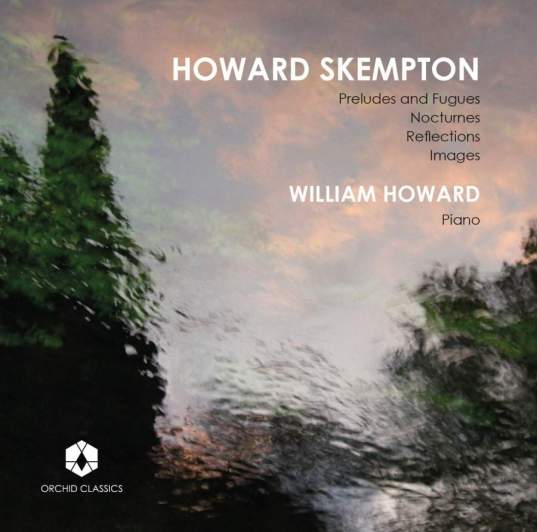
William Howard’s recording of Howard Skempton’s 24 Preludes and Fugues (2019), Nocturnes (1995), Reflections (1999-2002) and Images (1989) will be released on Orchid Classics (ORC100116) on 14th February. Pre-order here.:

Anyone who pre-orders the album can enter a prize draw to win one of five copies of Solitary Highland Song, signed by the composer. Please forward your order confirmation email to mail@williamhoward.co.uk before 14th February.

The album will be launched with a recital by William Howard at Kings Place on Wednesday 12th February at 7.30pm in which he will play works by Bach, Schubert and Howard Skempton. Tickets and further details here

Meet the Artist interview with William Howard
williamhoward.co.uk

orchidclassicsorc100116

“Heaven on earth for pianists”

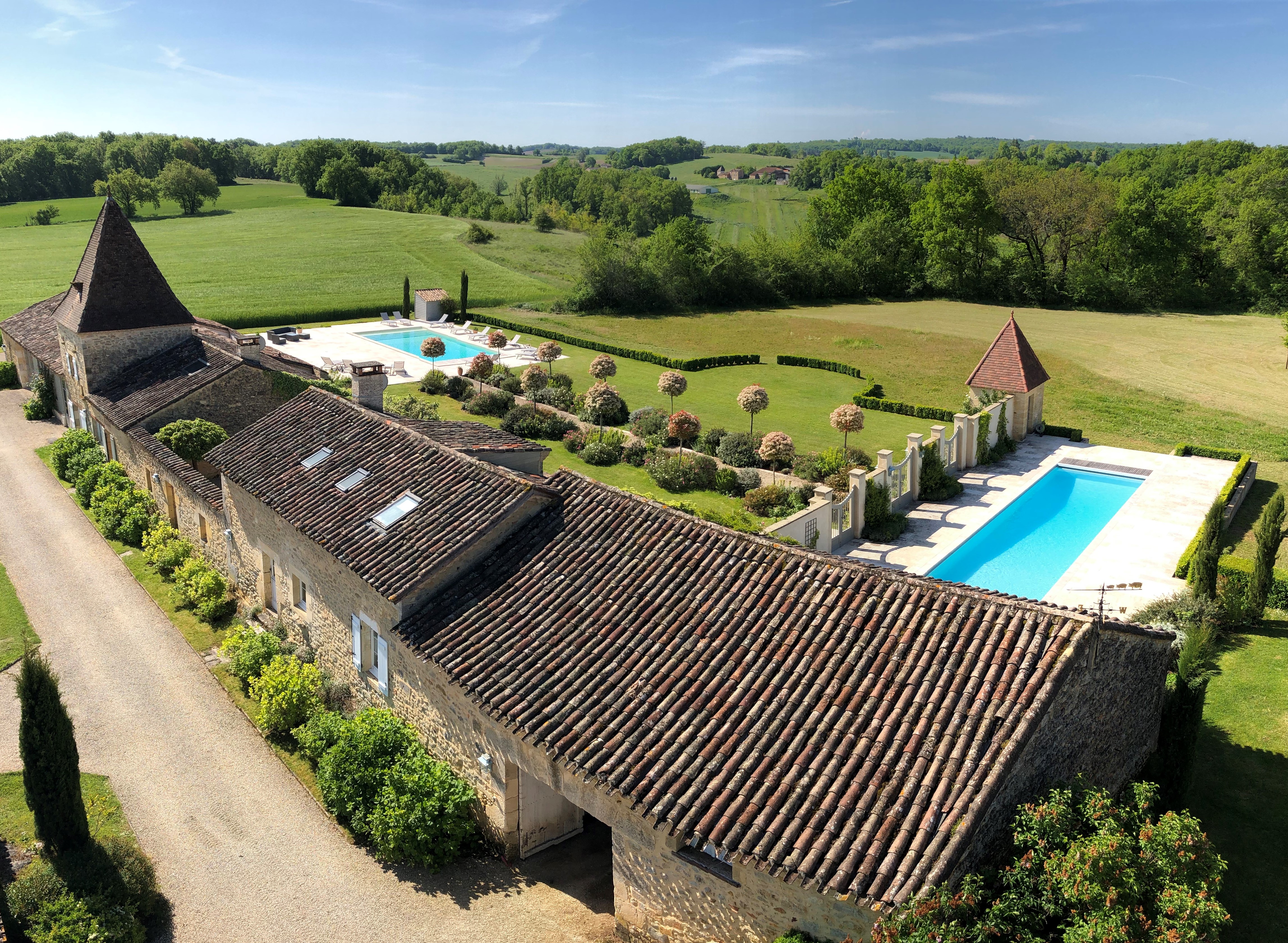
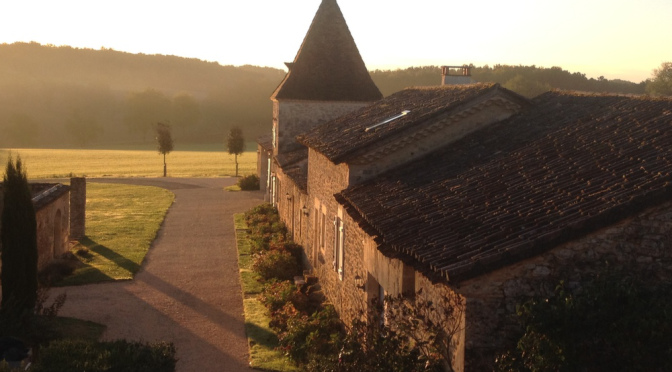
Now its sixth year, La Balie, nestled in beautiful rolling countryside in south-west France, offers a very special kind of experience to adult pianists. The brainchild of former investment banker Fiona Page, in just a handful of years La Balie has become a go-to musical destination for pianists from all around the world, and the summer courses are now an established part of the piano calendar, a fact recognised by Pianist magazine in 2019 when it named La Balie in its top 10 piano courses and festivals around the world.

Much more than a ‘piano holiday’, La Balie offers unrivalled luxury accommodation, gourmet food prepared by an in-house chef, a friendly convivial atmosphere, excellent practice facilities and, above all, expert and supportive tuition from internationally-renowned pianist-teachers.

Created with taste, expertise and passion, the secret of La Balie’s success is an emphasis on personal attention and exceptional teaching. With three masterclasses, two individual lessons and recital opportunities for each guest, everyone is scheduled to play on each day of the course – an important consideration for anyone attending a piano course. Guests usually choose three pieces to study in their masterclass sessions with additional pieces selected to perform in the evenings and at the end of course concert. The courses are devised to be intensive and to equip each guest with a meaningful set of skills to encourage confident independent learning and productive practising on returning home. They are also designed to be fun and to provide plenty of time for both practice and relaxation – and who can resist La Balie’s gorgeous saltwater pool on a hot summer’s afternoon, the air heavy with the scent of lavender?

The atmosphere is in no way competitive….but instead full of mutual support and pleasure in the progress of others

Graham

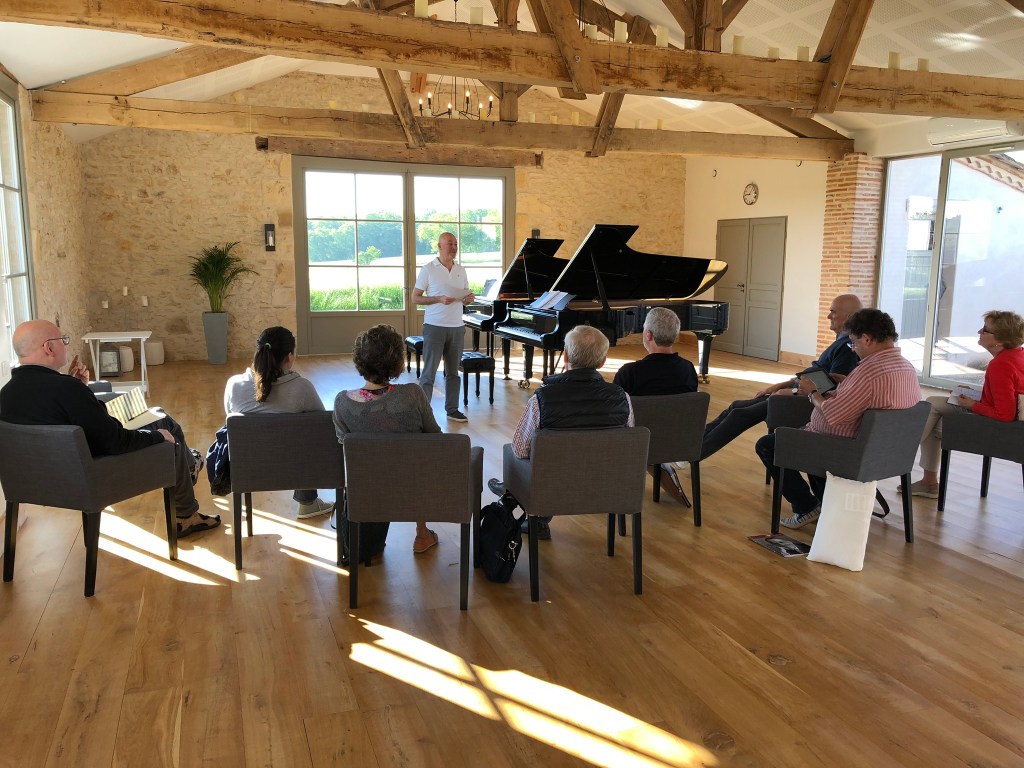
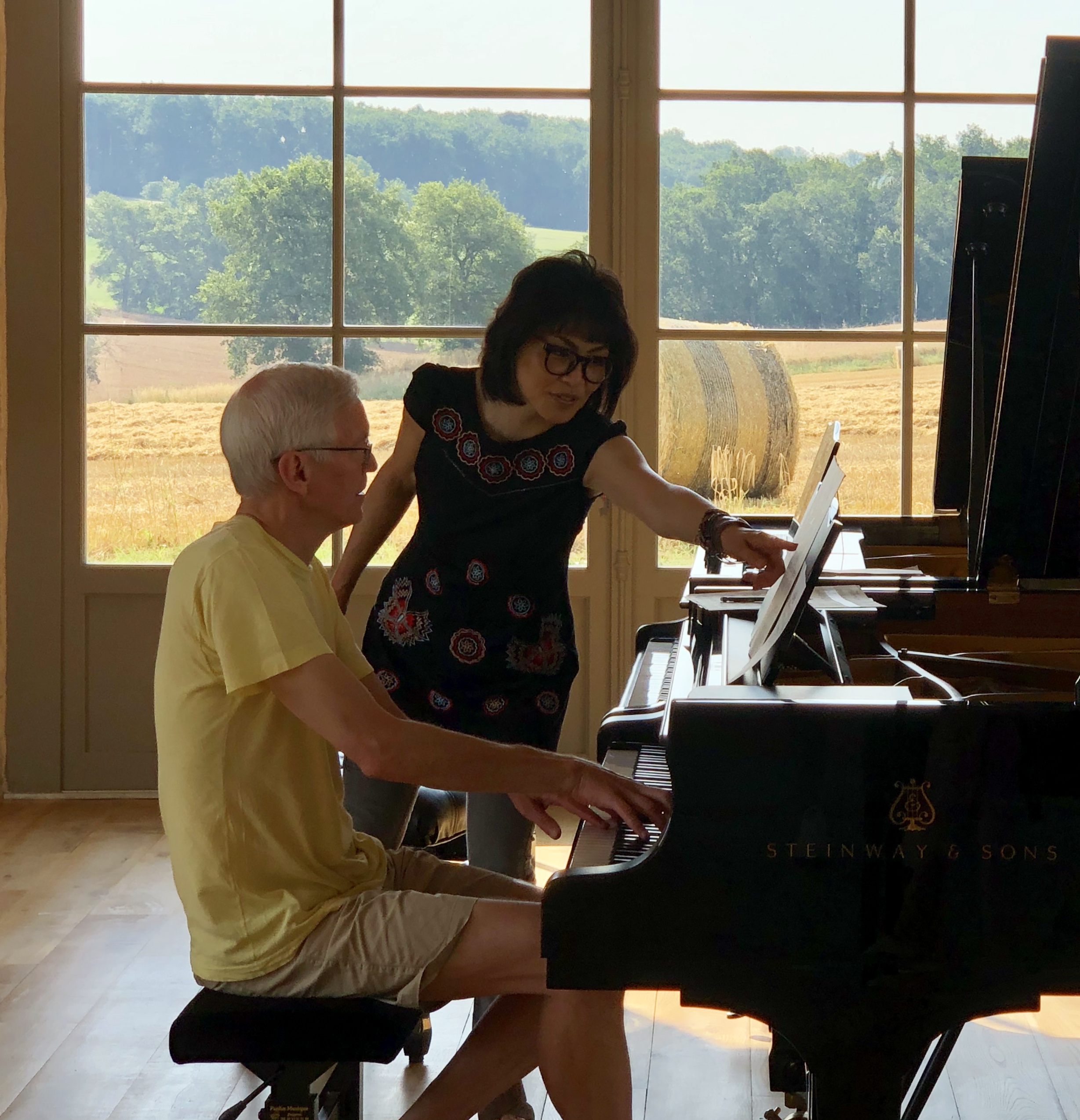
Teaching and concerts at La Balie take place in a light-filled, air-conditioned studio, complete with a magnificent Steinway D piano (a rarity amongst piano courses in France), and a second quality grand piano for demonstrating and piano duos. The room also has a superb recordable acoustic, which only enhances the quality of live performances, and offers students and tutors a really special space in which to play.

The Studio at La Balie

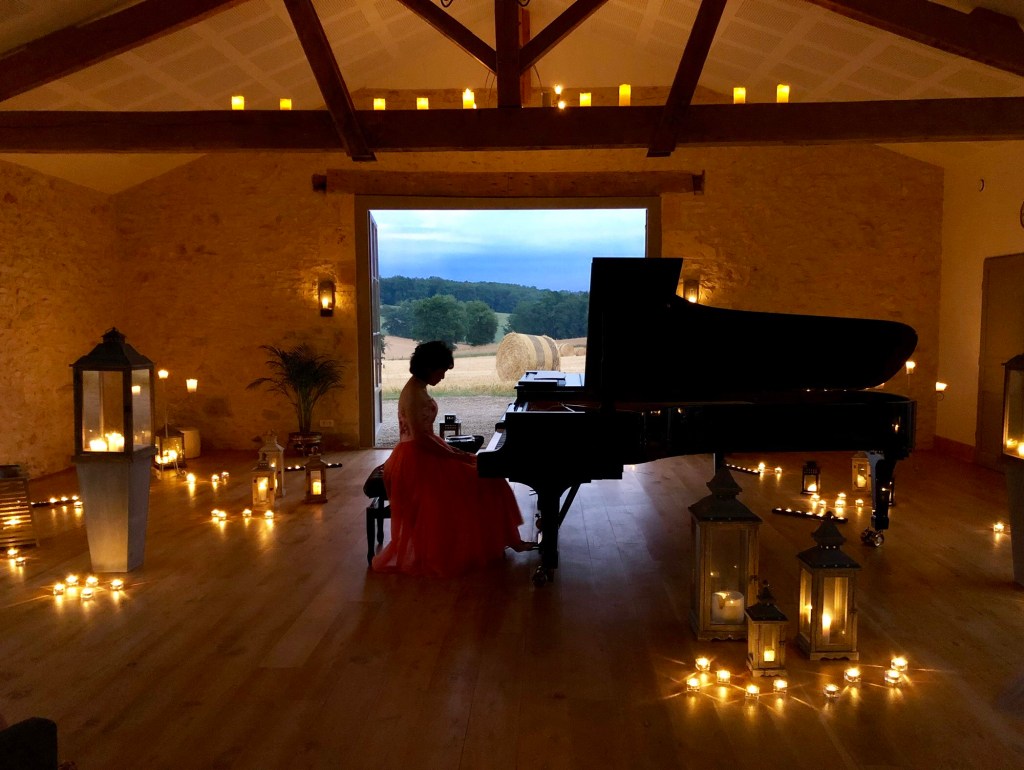
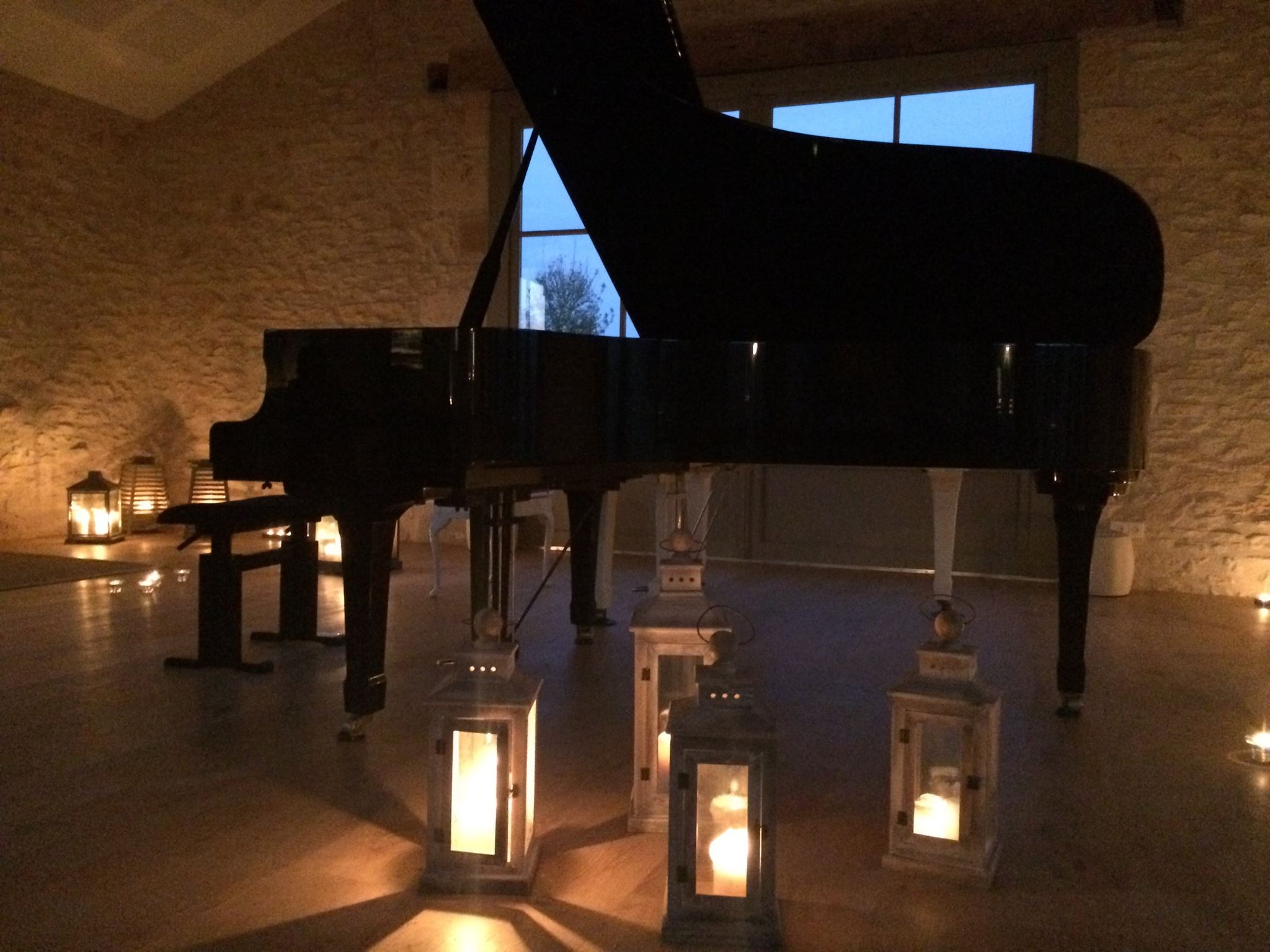
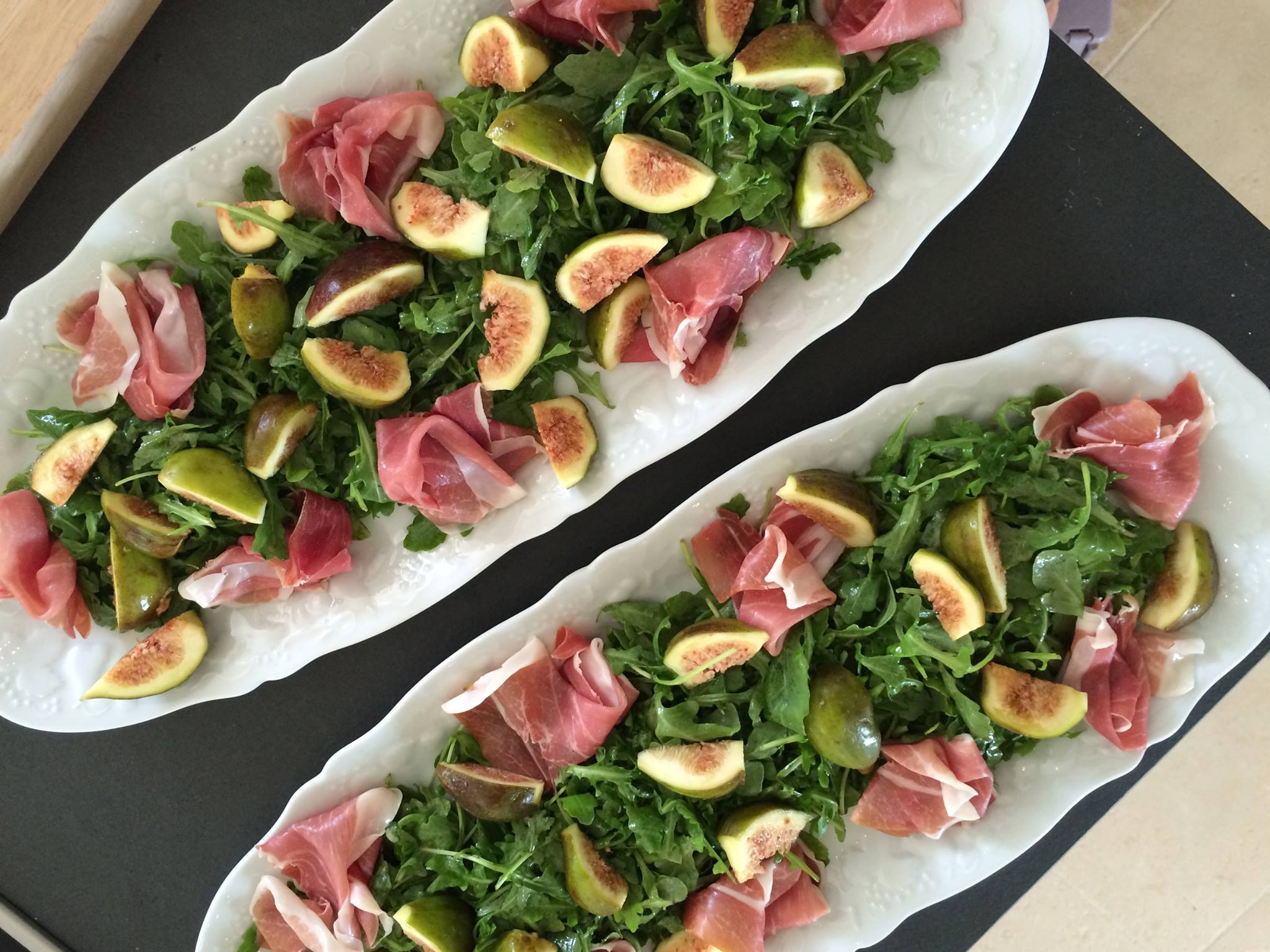
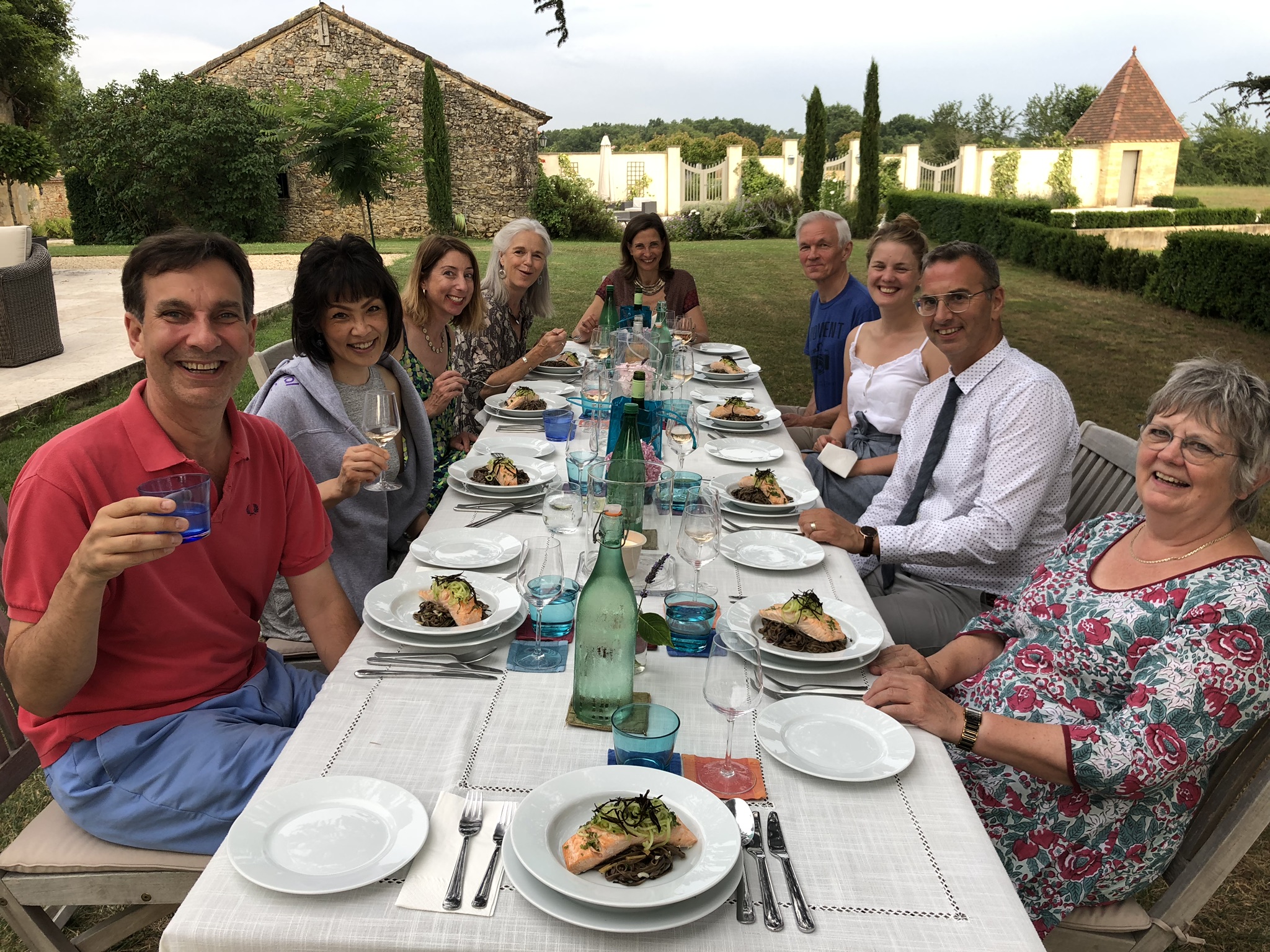
After daily tuition and practising or relaxation, evenings begin with an informal “aperitif concert” where guests can hone their performance skills and enjoy playing to a friendly, sympathetic audience. Dinner follows, taken al fresco in the attractive garden with delicious freshly-prepared food, fine local wines and a magnificent cheeseboard. There are also two tutor recitals during the week, one of which is held, atmospherically, by candlelight later in the evening, the piano’s sounds dissolving into the night sky….

Concert by candlelight with Noriko Ogawa

One of the chief attractions of a piano course is the opportunity to connect with other pianists. Playing the piano can be a solitary activity and a course is one of the best ways to meet other pianists, hear one another play, share repertoire, indulge in piano chat, and have fun while learning. Firm friendships are forged at La Balie, with many participants returning year after year, not only to enjoy the expert tuition but to catch up with piano friends. This conviviality is further enhanced by piano meetups, performance platforms and masterclasses hosted by La Balie in London throughout the year.

There was a tremendous sense of camaraderie and solidarity….. everything was beautifully done and impeccably organised: an artistic achievement in itself

Conrad

I felt the luxury of learning with an inspired teacher/performer who really drew his students into this magic of the piano

Lynnette

For 2020, La Balie boasts an impressive quartet of tutors – Charles Owen, Noriko Ogawa, Vedrana Subotic and Martin Cousin – who between them will run six courses from early May to the end of August. Guests are guaranteed a warm welcome, superb tuition, wonderful accommodation and food, and, above all, the chance to indulge a passion in a truly magical, inspirational setting that will send you home with renewed focus and enthusiasm.

2020 Courses

6-13 May – CHARLES OWEN

24 -31 May – 2020 VEDRANA SUBOTIC

4 – 11 June – 2020 NORIKO OGAWA

17 – 24 June – CHARLES OWEN

10 – 17 July – MARTIN COUSIN

23 – 20 August – MARTIN COUSIN

Booking is now open – please visit the La Balie website for full details


Who or what inspired you to take up composing, and pursue a career in music?

My music teacher at school, Margaret Semple, instilled the habit of musical curiosity, and didn’t think it strange that I would want to write and perform my own music.

Who or what were the most significant influences on your musical life and career as a composer?

As a teenager, playing the oboe in all kinds of rep, from Bach to improv. The lively new musical culture in my youth, the 1960s, both pop and “classical”. Early inspirations included Cage, Stockhausen, Messiaen, John Tavener.

What have been the greatest challenges/frustrations of your career so far?

The frustration has always been, and remains, the huge amount of time it takes to compose a new piece of music. A perpetual challenge is to sense the right structure and timescale for musical ideas while struggling to write these ideas down for the first time.

What are the special challenges/pleasures of working on a commissioned piece?

Composing for friends or close colleagues is like spending time with them – they are constantly in my mind as I write. Conversely, the challenge is writing for people you don’t know – will they understand and sympathise with your intentions?

Of which works are you most proud?

I am usually thinking about recent work – it’s as if the music I wrote long ago can look after itself. Coming to mind immediately are In the Land of Uz (mini-oratorio), The Big Picture (site-specific cantata) and my Oboe Concerto.

How would you characterise your compositional language?

Above all it is animated by line/melody and rhythm.

How do you work?

I brood for a long time. I’m trying to think of a concept which will be so irresistible and compelling that it writes itself. It doesn’t always work out that way…

Who are your favourite musicians/composers?

They change all the time, it’s impossible to say. To give some kind of answer, I’ve just looked at what is piled on my CD player today: We Go To Dream (a lovely album by Astrid Williamson); Not Now Bernard and Other Stories (composer Bernard Hughes, excellent); Brendel plays Bach, on the piano obviously; an organ album played by Konstantin Reymaier (more Bach, plus Handel, Marcello,etc).

As a musician, what is your definition of success?

When the work continues to flow in, of its own accord.

What do you consider to be the most important ideas and concepts to impart to aspiring musicians?

I wanted to study music because I was interested and curious about it – I still am, almost fifty years later. That has kept me going in difficult times. So my advice is: If you’re not really, really interested in music – the actual dots – don’t bother!


Judith Weir was born into a Scottish family in 1954, but grew up near London. She was an oboe player, performing with the National Youth Orchestra of Great Britain, and studied composition with John Tavener during her schooldays. She went on to Cambridge University, where her composition teacher was Robin Holloway; and in 1975 attended summer school at Tanglewood, where she worked with Gunther Schuller. After this she spent several years working in schools and adult education in rural southern England; followed by a period based in Scotland, teaching at Glasgow University and RSAMD.
During this time she began to write a series of operas (including King Harald’s Saga, The Black Spider, A Night at the Chinese Opera, The Vanishing Bridegroom and Blond Eckbert) which have subsequently received many performances in the UK, Germany, Austria, the Netherlands, Belgium and the USA. The most recent opera is Miss Fortune, premiered at Bregenz in 2011, and then staged at the Royal Opera House Covent Garden in 2012.
As resident composer with the City of Birmingham Symphony Orchestra in the 1990s, she wrote several works for orchestra and chorus (including Forest, Storm and We are Shadows) which were premiered by the orchestra’s then Music Director, Simon Rattle. She has been commissioned by the Boston Symphony Orchestra (Music Untangled and Natural History) the Minnesota Orchestra (The Welcome Arrival of Rain) and the London Sinfonietta (Tiger under the Table); and has written concert works for some notable singers, including Jane Manning, Dawn Upshaw, Jessye Norman and Alice Coote. Her latest vocal work is Good Morning, Midnight, premiered by Sarah Connolly and the Aurora Orchestra in May 2015.
She now lives in London, where she has had a long association with Spitalfields Music Festival; and in recent years has taught as a visiting professor at Princeton, Harvard and Cardiff universities. Honours for her work include the Critics’ Circle, South Bank Show, Elise L Stoeger and Ivor Novello awards, a CBE (1995) and the Queen’s Medal for Music (2007). In 2014 she was appointed Master of The Queen’s Music in succession to Sir Peter Maxwell Davies. In January 2015 she became Associate Composer to the BBC Singers.
Much of her music has been recorded, and is available on the NMC, Delphian and Signum labels. In 2014-15 there were releases of The Vanishing Bridegroom  (NMC) and Storm (BBC Singers/Signum).  Judith Weir’s music is published by Chester Music and Novello & Co.  She blogs about her experiences of cultural life in the UK at judithweir.com.


Not Now Bernard and other stories is an irresistible album of music for all the family revelling in the magical colours of childhood memories, featuring world premiere recordings of pieces for narrator and chamber orchestra by British composers Judith Weir, Malcolm Arnold, John Ireland and Bernard Hughes, performed by the Orchestra of the Swan, conducted by Tom Hammond, and narrated by leading actor, TV star, comedian and broadcaster Alexander Armstrong.

The album is the brainchild of composer Bernard Hughes and conductor Tom Hammond. Bernard and Tom have worked together on a number of projects since 2009, including Tom commissioning Bernard’s pieces on the album for two of his orchestras. The aim of this album was to bring together a diverse selection of pieces in high-quality performances, plugging holes in the recorded legacies of great British composers alongside Bernard’s pieces. It was also their ambition to bring a sense of fun to the music, celebrating works that are intentionally enjoyable and funny. Bernard Hughes’s settings of classic children’s stories are the most recent pieces, using vividly imaginative, witty and tuneful music to bring to life three wonderful stories by David McKee and James Mayhew. Alexander Armstrong gives a hilarious and touching performance as narrator, his distinctive voice characterising each piece brilliantly to explore humour and human nature. The result is an engaging, lively and thoroughly entertaining collection of music and words which all the family can enjoy together.

The album is produced by Bernard Hughes himself and is released on 7 February by Orchid Classics, one of Britain’s leading classical labels.


The pieces and the composers

Malcolm Arnold – Toy Symphony. Arnold was one of the towering figures of British music in the twentieth century, whose prodigious output included nine symphonies and over 70 film scores. Composed in 1957 for a musicians’ fundraiser, the Toy Symphony pits a quintet of professional players against a battery panoply of novelty instruments, including a train guard’s whistle, a quail whistle and three parping toy trumpets, to hilarious but brilliantly musical effect. This is one of the few major Malcolm Arnold pieces in his ‘occasional’ style never previously commercially recorded, showing a combination of winning melodies with absurdity.

Judith Weir – Thread! Written in 1981 near the beginning of her stellar career, Thread! is a setting of texts sewn into the Bayeux Tapestry, and is a vivid re-telling of the Battle of Hastings, from the Norman perspective. This piece has also never been commercially recorded, although it is a personal favourite of the composer. An exciting and vibrant piece that deserves a wider audience.

John Ireland – Annabel Lee. A melodrama for piano and narrator in a new chamber arrangement by Bernard Hughes, setting a chilling, atmospheric poem by Edgar Allan Poe.

Bernard Hughes – Not Now, Bernard, Isabel’s Noisy Tummy and The Knight Who Took All Day. These pieces are based on children’s books by David McKee (Mr Benn, Elmer the Patchwork Elephant) and James Mayhew. Originally scored for narrator and symphony orchestra, this recording features the versions for chamber orchestra. In Not Now, Bernard a young boy, neglected by his parents, meets a monster in his garden, with shocking results. Isabel’s Noisy Tummy tells of a girl who is troubled – but eventually redeemed – by a misbehaving stomach. The Knight Who Took All Day tells of a knight confronting a dragon – with the timely help of a princess. All three are enchanting stories told with humour and melodic, friendly music

Not Now Bernard and other stories is released on 7 February by Orchid Classics, one of the UK’s leading classical labels. The album is available to pre-order now.


Orchid Classics website