Guest post by Dakota Gale. The latest article in Dakota’s series Notes from the Keyboard, aimed at adult pianists
I recently attended a piano performance, during which I spoke with a 92 year old woman sitting next to me. She’d played and taught piano for decades. When I mentioned that I take lessons online, her eyes widened. “ONLINE lessons? But…that is the most amazing thing!”
She’s not the only one surprised. “Wow, you take lessons online?” is a common response from most people, even after the nuclear proliferation of pandemic Zoom meetings.
Yep, ever since I began taking lessons in spring of 2021, I’ve done them online. My teacher, Antonio, is located in southern Brazil; I’m in the Pacific NW in the U.S, thousands of miles away. And it’s not just me; plenty of people do it, including:
Those looking for specific expertise (e.g. Chopin etudes from a professional)
Those being careful while going through chemo or with a disease affecting their immune system.
Those who travel a lot (tougher if you’re flying, obviously)
If you have a favoured, dear teacher, but one of you moves, going online allow you to continue lessons.
Me and Online Lessons
For me, initially I took online lessons because of two things: to save money and to avoid COVID.
Since then, I’ve seen additional benefits. For one, they’re much more time efficient. No travel across town! For parents, I imagine this would be a huge benefit since you’d avoid shuttling kids around. (Actually, one of my friend’s kids is taking lessons with Antonio.)
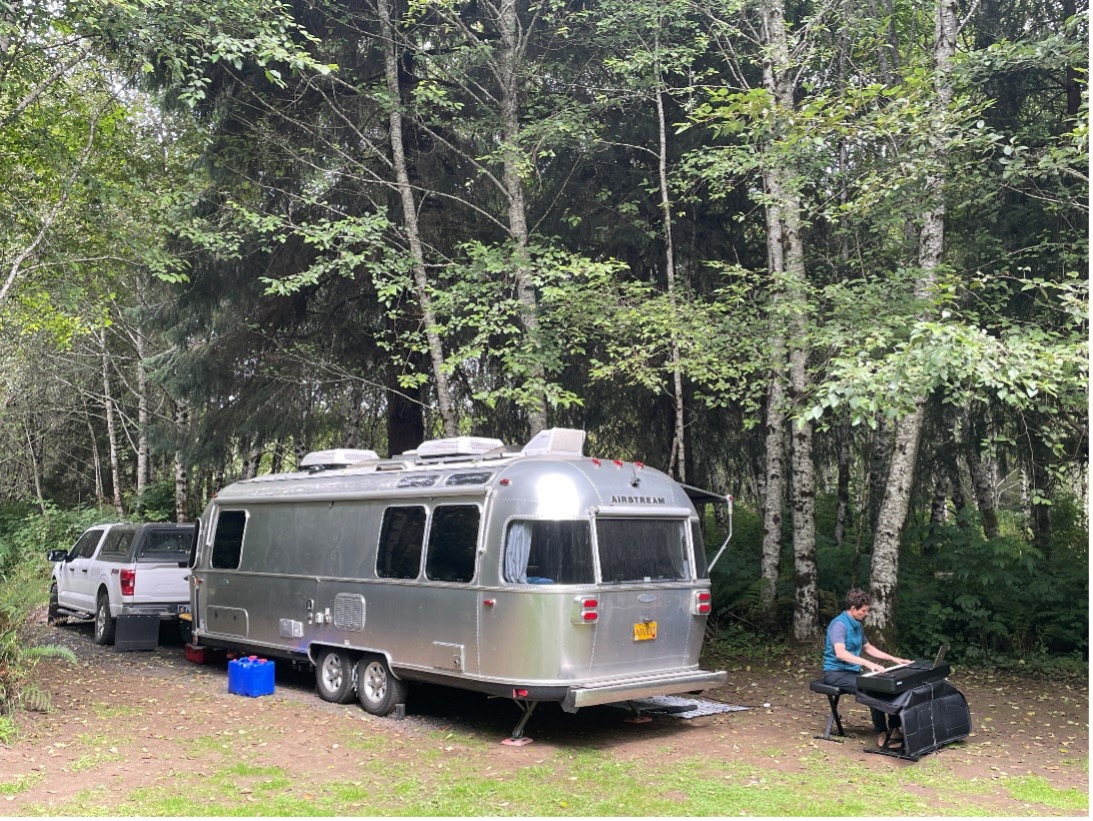
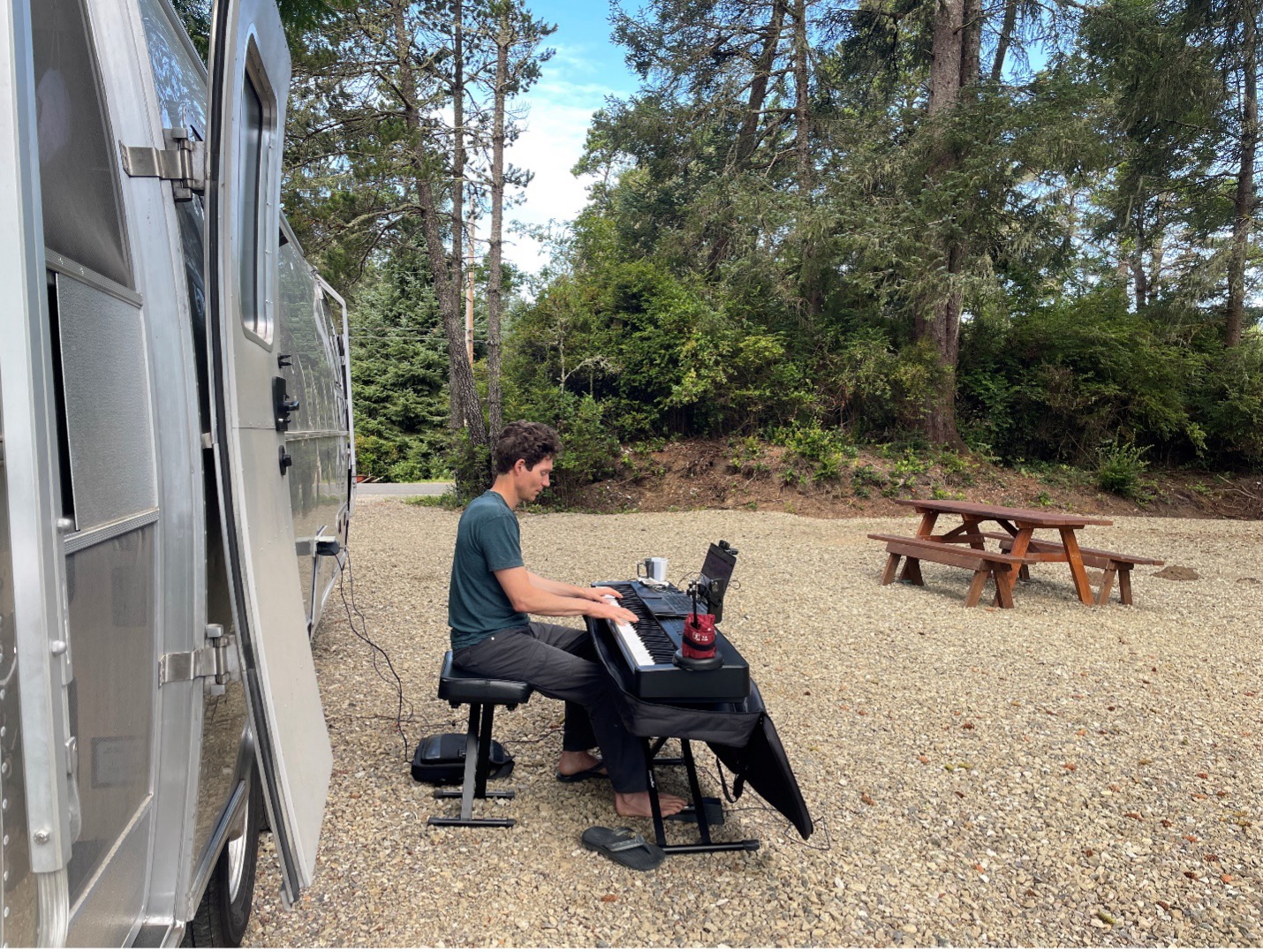
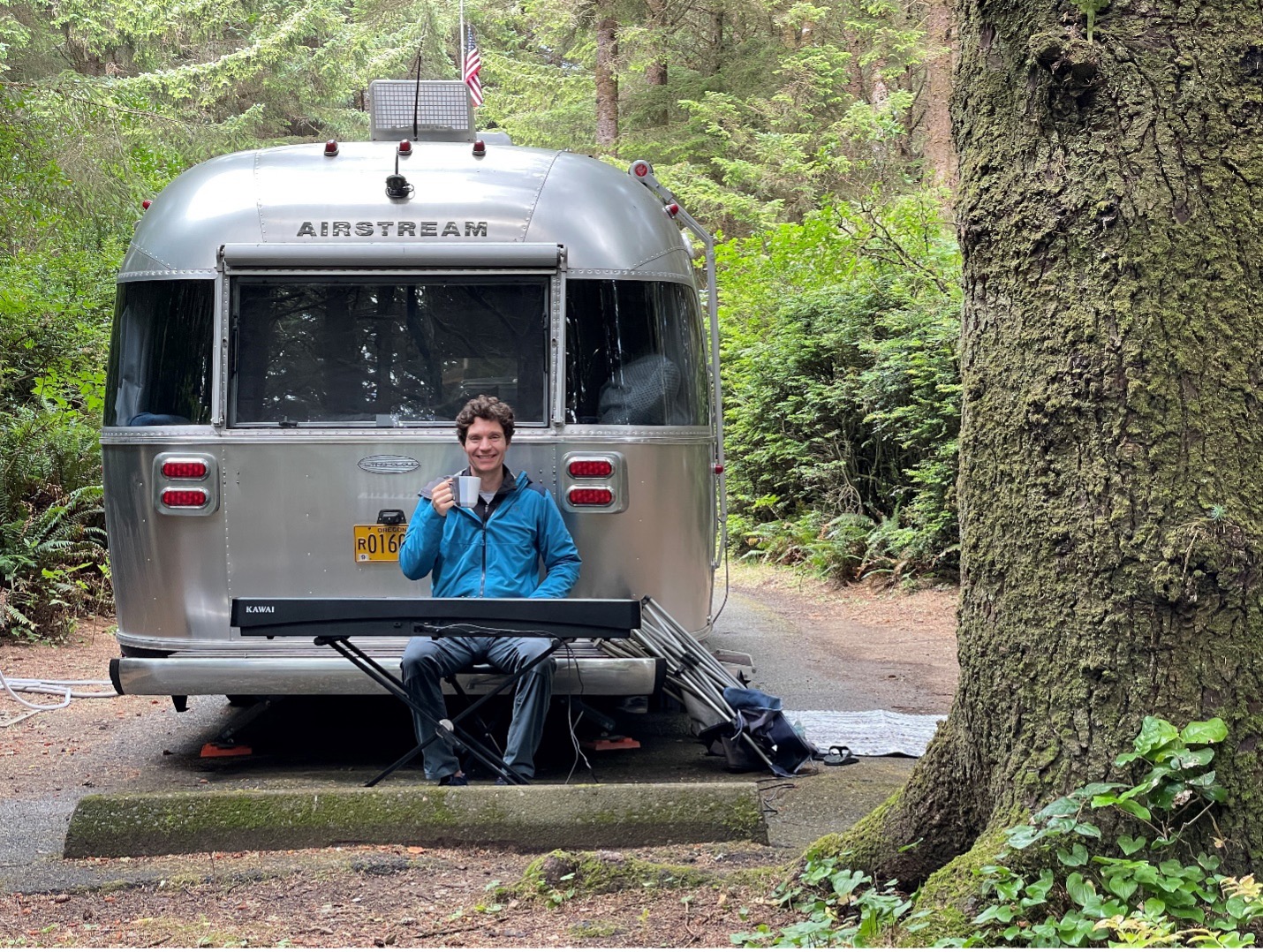
I travel fairly often and like to keep lessons going. In fact, I’m currently rolling around the Pacific NW with my wife for three months in a Airstream travel trailer. Between mountain bike rides, hikes, and hanging with friends, I’m both continuing to play consistently and still taking my weekly lesson. Courtesy of Starlink satellite internet and a digital Kawaii piano, I’m not skipping a beat.
When my teacher is on vacation, I’ve also taken lessons with professionals such as Grzegorz (Greg) Niemczuk, who I found on YouTube. You might be surprised how many YouTubers offer lessons (a friend takes lessons with the popular Heart of the Keys YouTuber.)
You know what makes piano better? Playing outside!
Beyond all those boring logistical things, Antonio being Brazilian brings a fun perspective to my experience. (I’ve learned a few choice phrases in Portuguese, for one!) I’ve also learned about (and love!) Brazilian music that I would otherwise not know, including tangos, the music of Tom Jobim and Ernesto Nazareth, and folk songs arranged for piano.
It inspired me to start a listening quest of different genres and international composers that has deepened my relationship to piano. Perhaps a local teacher would have provided that, but certainly it would have been different.
The nuts and bolts of online lessons
For those wondering how this is possible, allow me to describe the situation:
Antonio uses a Yamaha grand piano to teach. On it, he has four cameras for his face, top down on his hands, sideways on his hands, and another on his pedal. He even uses software that allows the camera to track his hands (AI magic!).
The sound quality is quite good–the nuances he can hear and comment on astonish me.
For my setup, I use a different system depending where I am. At home, it’s my computer with a webcam plus my phone on a stand looking straight down at my hands. While traveling, I just go with my phone on a small tripod set up to the side and occasionally my laptop in front of me. It works great.
The benefit of all this: the only time I’ve missed a piano lesson is when I’ve taken bikepacking trips. I challenge you to carry a full-size digital piano through the mountains…no thanks. A pianist needs to take a break from the keyboard SOMEtimes!
Resources:
To find an instructor, just type “piano lessons online” into any search engine. A few popular services: Superprof or Wyzant; a fellow traveler I met on this trip used Preply to find her ukelele instructor. (If you want to work with Antonio, just ping him on Whatsapp at +55 48 9181-9164.)
The second in Dakota Gales series of guest articles, Notes from the Keyboard, aimed at adult amateur pianists
When my wife gifted me a smooth and shiny Yamaha keyboard for my birthday in 2020, I couldn’t play Chopsticks or even find middle C on it. As an adult learner, I also had limited time, so focused practice was of the essence.
After flailing about, I developed the most effective practice mindset and routine that I could. I’ll share it below.
Over the next four years, I dug into playing piano, but also into how to learn to play piano. Four years later, I’m playing pieces I thought were a decade out. Chopin. Beethoven. Debussy. I sometimes can’t believe my fingers can fly the way they do.
A portrait of Debussy I did while learning to draw people.
None of this magically arrived in a brain chip from Amazon. I didn’t buy Pianist Hands on Ebay and splice them onto my arms.
Nope. This progress was achieved through good old-fashioned dedication. *yawn* I know, I know…show me the TikTok video that has you playing 650 pieces in a week using JUST FOUR CHORDS!
Riiight. The faster success is gained, the shakier it is. Get Rich Quick with this money-making scheme! Learn a language in a week! Get a six pack sitting on the couch! Earn a college degree between episodes of your favorite Netflix series!
Hogwash. Easy come, easy go. There’s so much satisfaction to be found in the effort, the daily scales, the consistency. I’d wager that every pianist who continues to play must embrace the daily grind.
After years of doing this, I’ve realized something important: the toughest part of learning piano is… BEING PATIENT.
It takes as long as it takes. Want to learn a Beethoven sonata or Chopin etude in your first year? That’s nice. It’ll be built on a shaky foundation. Even pros like Andras Schiff didn’t even feel capable of tackling Beethoven’s sonatas until he was in his 40s!
However, if you create a smart practice routine and stick to it, you will improve. Not a matter of maybe: you will.
Ten minutes of practice per day is 60 hours per year. Thirty minutes is 180 hours! I’d wager that you can find 10-30 minutes each day to learn a new skill. Trade some social media or Netflix time for piano. Your future self will thank you.
That said, I’ve wasted plenty of time in the four years since a piano dropped in my lap. Since we’re adults and lack the time to futz about, we’ve gotta maximize our time at the piano!
Here are four key things that benefited me the most:
When I started playing piano, I’d do some scales, arpeggios, whatever to warm up. Then straight into repertoire, which consisted of just trying to play something, over and over. I had no plan, just “start at the beginning and wear this down via submission.”
Picture me with a catapult outside a Piano Piece Castle. If I lobbed enough rocks at the walls, eventually I could break it down! The problem: I wasn’t being thoughtful about where or when to throw the rocks. Sometimes I attacked Castles that were WAY too big for my artillery.
Since then, I’ve learned to use deliberate practice to simplify things and hammer concepts into my brain in smaller chunks.
I break pieces down into their smaller parts (e.g. only working on 2 bars at a time, or breaking an arpeggio into block chords, or an octave into only the root note). I slow pieces to 50% and only increase the tempo once I can lights-out play it. I might play the same bar 25 times in a row, firehosing it into my brain, coating that brain circuit in myelin so that it’s a superhighway, not a goat trail.
It feels slow in the moment, but I learn pieces not just better, but faster, one bar at a time. Deliberate practice builds a stronger structure, brick by brick, versus throwing up a stick built house that blows over in the wind of live performance.
Book recommendations: The Musician’s Wayby Gerald Klickstein,Effortless Masteryby Kenny Werner, andThe Art of Practicing by Deline Bruser. These have helped me dial in my practice routine and develop a different mindset around performing (and mistakes—they’re just feedback!).
Scoring a couple hours of piano in a friend’s studio on a sweet grand piano.
Learning music theory
BLERGH. Music theory, the Brussels sprouts of learning piano. Give me the repertoire, the chocolate cake!
Well, I quickly realized that trying to learn pieces without knowing the basics of theory meant it took forever to figure out a piece. If we compare it to reading, I was basically sounding out letters vs. reading sentences. Th…e. THE. C…aaaa CAT.
Painful. By learning key signatures and basics like major and minor triads (and then their inversions), I made much faster progress. I also developed the ability to memorize pieces quite well because I was thinking in chords and chord progressions instead of individual notes. Now I play all my pieces from memory.
In my experience, spending some time on music theory will drastically speed up your learning progress. I’ve grown to enjoy the analysis that I do with pieces before even putting my hands on the keys. Brussels sprouts as the appetizer, thank you very much.
Resource: This Skillshare course by professor Jason Allen is fantastic.
Hiring a teacher
There are SO many resources for online self-paced piano lessons. They’re affordable and easy to use. They help. I still occasionally do.
Let me encourage you to also hire a teacher, local or online. I cast about for nine months before starting lessons and am so so so glad I didn’t wait longer.
Mine, a Brazilian named Antonio, offers me feedback and insight on my playing a video course could never provide. “Hey, what if you shifted your wrist 10 degrees? In most renditions, pros play that piece like ____. Perhaps this fingering for that passage works better for your hand?”
I’ll write more about my experience with online lessons, but real quick… Not only are online lessons more affordable, they offer the benefit of being portable. When I travel, I can bring my keyboard and still take lessons.
My progress accelerated dramatically when I hired Antonio for a weekly lesson. He corrected things I’d never even considered (like pivoting on my 3rd finger for big left hand arpeggios, not the 2nd finger). If almost every pro had a teacher when they were learning, it’s probably worth it for us amateurs!
Resource: Just search “online piano teacher.” Many popular YouTube pianists also teach lessons.
Piano with a view in my camper van.
Don’t get too big for your britches
Many intro piano pieces felt too simple or boring for me. Right out of the gate, I wanted to play the beautiful pieces.
When the Saint’s Come Marching In? HAH. March on OUTTA here: give me Chopin’s Nocturne in Eb, baby!
The problem: I had zero piano skills. I couldn’t even read music or play a scale!
I was learning how to bungee jump by wingsuit jumping. Less risky on a piano (no bridges to smash into), but certainly a waste of time.
I spent HOURS learning the melody line to the Chopin nocturne…with zeroooo chance I’d be able to actually play it with the left hand added in. I didn’t even know what the key of Eb meant.
My teacher helped me understand which pieces would push me vs. shut me down. Instead of expending hours on a piece I had no chance of playing, I started grabbing achievable pieces. They still took work (I’m looking at you, Consolation No. 3 and your mind-bending triplets), but I could do it!
But I still dream, keeping a list of “goal” pieces. These are pieces that I really want to be able to play that are too difficult for me to learn efficiently at this time. This gives me a long-term set of goal trajectories, which helps me focus on what to work on now. (I’ll also work hard sections of pieces slowly, over months, such as the fast cadenzas in Liszt’s Liebestraum #3 or Chopin’s Db nocturne.)
To keep track of pieces, I created a spreadsheet that I update regularly. I also have an ongoing Spotify playlist to which I add pieces that catch my fancy. (After four years, it’s a tour of my listening.) I listen broadly to different eras of piano music as well as different continents. Albeniz from Spain, Villa Lobos from Argentina, Copland from America, and of course the core canon from Western Europe.
Keep dreaming, but stay reasonable! No wingsuiting just yet…
Your future self will thank you
In college, on a whim I test drove a Lexus I had zero chance of affording. The sound system was top-notch, crystal silky magic.
Later, I chatted with a friend about how I couldn’t wait to own a car like that and listen to classical music while I drove.
“Don’t turn into an old man TOO fast,” she cautioned.
Now I’m an almost-old man at the ripe age of 42. I get to listen to classical music while I drive…but I can also PLAY a bunch of it!
Sure, it took focused work and required shifting time from other activities.
It was worth it. I’ve launched a ship I can sail on for the rest of my life, a journey into a whole new language—nah, world— I hadn’t visited before.
A gift my younger self forwarded to future me that I gratefully accept.
When he isn’t playing piano, Dakota Gale enjoys learning languages (especially Italian) and drawing. He also writes about reclaiming creativity as an adult and ditching tired personal paradigms in his newsletter, Traipsing About. He can often be spotted camping and exploring mountain bike trails around the Pacific Northwest.
This site is free to access and ad-free, and takes many hours to research and maintain. If you find joy and value in what I do, why not
The pursuit of musical excellence is a journey that many musicians embark upon with a fervent desire to achieve perfection. We strive for flawless performances, impeccable technique, and unwavering precision. As an advanced amateur pianist, these are goals to which I too aspire.
But the constant pursuit for perfection and an ongoing desire for perfectionism in one’s music making can be a double-edged sword for musicians. The relentless pursuit of flawlessness can lead to a never-ending, often negative cycle of self-criticism and anxiety. Musicians who set impossibly high standards for themselves may find it difficult to ever feel satisfied with their performances, leading to a constant state of stress and self-doubt. Some may ask themselves, “will I ever begood enough?”
The pursuit of musical mastery is admirable, and indeed the striving for mastery is a major driver of motivation and commitment. However, it is also essential to recognise the significance of know when and accepting that you are “good enough” as a musician. Perfection can be an unattainable goal; acknowledging you are “good enough” is not only perfectly acceptable but can also be liberating and personally fulfilling. It can help musicians to break free from the paralysing grip of perfectionism, allowing them to enjoy the process of making music and to develop as artists and individuals.
My own personal acceptance that I am “good enough” came after I had spent nearly ten years studying for professional performance diplomas, having returned to the piano seriously after a gap of nearly 25 years. Having secured two diplomas with distinction in relatively quick succession, my ego led me to believe that the final, Fellowship diploma was well within my grasp. Unfortuntely, I failed this diploma; the deep disappointment I felt on receiving the news gave me an opportunity to reflect on what I really wanted from my music. I knew I would never be a professional musician, despite playing at an advanced level and receiving external validation from teachers, mentors, peers and audiences, and I knew I was a good pianist. But taking lessons, and attending courses and piano meetup events, where there was a tendency to constantly compare oneself to others of a similar ability, made me question my own abilities in a way which made practicing and music making feel like a chore rather than a pleasure. (And ultimately, as a amateur musician, pleasure should be at the foundation of one’s musical pursuits.)
“You don’t need to go on courses to know you’re good” my ultra-sensible, pragmatic and honest husband told me one day. And he was right. So I learnt to trust my own musical instincts, to recognise the value of what I had to say and to measure it against the music rather than other people – to, as Schumann said, “…converse more with scores than with virtuosi” – to recognise my own autonomy as a musician, and accept that I am “good enough”.
The result has been liberating. I no longer care what other people are playing, at what level they play at, or what repertoire they are working on. I play the music I want to play, and I’ve stopped beating myself up if I don’t practice every day (another joy of being an amateur is not feeling beholden to one’s instrument and muse every single day).
So why should you, as a musician, accept that you are “good enough?”. Here are some thoughts on the subject:
Embracing Individuality
Every musician possesses a unique set of skills, experiences, and perspectives. Embracing the idea that you are “good enough” means recognising and celebrating your individuality as an artist. It allows you to focus on your strengths, develop your style, and create a distinctive musical identity. While aspiring to reach new heights and improve is essential, acknowledging your current level of skill and artistry is a valuable step toward authentic self-expression.
Redefining Success
Success in music should not solely be measured by technical perfection or the approval of critics, peers, teachers or audiences. By accepting that you are “good enough,” you redefine what success means to you personally. It can encompass the joy of playing, collaboration with colleagues, the connection with your audience, and the sense of accomplishment from personal growth. This shift in perspective encourages a more holistic and fulfilling musical journey.
Reducing Performance Anxiety
The fear of making mistakes and the pressure to be flawless on stage are very common triggers for performance anxiety in musicians. Accepting that you are “good enough” can significantly alleviate this anxiety. When you recognize that making mistakes is a natural part of the learning process and that it does not diminish your worth as a musician, you can perform with greater confidence, freedom and enjoyment.
Sustainable Motivation
Constantly striving for perfection can lead to burnout. On the other hand, acknowledging that you are “good enough” can provide you with a sustainable source of motivation. The satisfaction derived from setting achievable goals, making incremental but noticeable progress, and celebrating small victories can keep you inspired and committed to your musical journey over the long term.
In conclusion, accepting that you are “good enough” is not a sign of complacency nor mediocrity. It is a testament to self-compassion, personal growth, and a healthier perspective on the art of making music. Embracing your current level of skill and artistry while still aspiring to improve can lead to a more fulfilling, enjoyable, and sustainable musical journey.
This site is free to access and ad-free, and takes many hours to research, write, and maintain. If you find joy and value in what I do, why not
I have written before about how some repertoire is considered “off limits” to amateur pianists, and should remain the preserve of the professional. I think what such an attitude demonstrates is how the “core canon” of piano repertoire is held in high regard, almost to the point of zealotry, and that certain pieces should remain on their exalted pedestals, accessible only of a chosen few.
My view has always been that the music is there for the many not the few, that it was written to be played, whether you are a world-famous professional musician or a “Sunday pianist” who enjoys playing in the privacy of your own home. We forget that many of the pieces which now regularly grace concert programmes around the world were intended for a more intimate salon or domestic setting – music to be played for friends and amongst friends, or at home.
One piece which seems to reside on the Mount Olympus of piano repertoire is Bach’s Goldberg Variations. Revered by musicians, students, critics, teachers, academics and audiences, the Goldbergs represent music of highest order of complexity, invention, technical challenge, expression and – if one is playing the entire set – stamina
One of the foremost reasons for the Goldberg Variations’ esteemed reputation is the sheer technical and artistic mastery the work demands of the pianist. Comprising an intricate series of 30 variations upon a simple bass line, this music presents a seemingly formidable challenge to even the most accomplished pianist. Each variation presents its own unique set of technical hurdles, from rapid hand crossings to intricate ornamentation and virtuosic passages. In addition, the Goldberg Variations are celebrated for their intellectual depth, requiring an understanding of counterpoint, harmony, and structure. Then there is the emotional and expressive depth of this music: each variation is infused with a distinct character and mood. From playful, witty and cheerful to melancholic and introspective, the variations traverse a wide emotional spectrum.
Of course these aspects are true of many other pieces, not just those by Bach, but the piano sonatas of Haydn, Mozart, Beethoven and Schubert, for example; Chopin’s Nocturnes; Brahms’ Intermezzi, and much, much more. These are universal aspects which make music interesting and engaging, challenging and satisfying.
While the amateur pianist may not be able to tackle the entire Goldberg Variations, individual variations are within reach of the intermediate to early advanced player: the Aria, and Variations 1, 2, 4, 7, 13, 18, 19, 21 and 25 – and all can be played and enjoyed as stand-alone pieces. (The Aria appears in the 2024 Trinity College London Grade 8 piano syllabus, thus bringing this wonderful music to students of all ages, and, perhaps, encouraging further exploration of Bach’s mighty achievement.)
As a starting point for tackling some of the Goldberg Variations, it is worth exploring some of Bach’s other keyboard music, both as a player and a listener. For example, the two- and three-part inventions are a useful lesson in his use of counterpoint; while the 48 Preludes and Fugues demonstrate a wide range of moods and colours. Within the suites, there are movements which recall the Aria of the Goldbergs (for example, the Sarabande from the fifth French Suite). In addition, all of Bach’s keyboard music offers insight into his invention and imagination, his harmonic language and his use of ornamentation to enhance the melodic line.
Learning the Goldberg Variations, whether in its entirety or single variations, is an absorbing, long-term endeavour for any pianist. Be patient and embrace the journey, but never ever believe that as an amateur pianist, you shouldn’t be playing this glorious music! There will be moments of frustration, but perseverance will lead to growth as a pianist, a sense of personal achievement, and a deeper understanding of Bach’s wonderful music.
This site is free to access and ad-free, and takes many hours to research, write, and maintain. If you find joy and value in what I do, why not
The Cross-Eyed Pianist is free to access and ad-free, and takes many hours every month to research, write, and maintain.
If you find joy and value in what I do, please consider making a donation to support the continuance of the site







 The Cross-Eyed Pianist