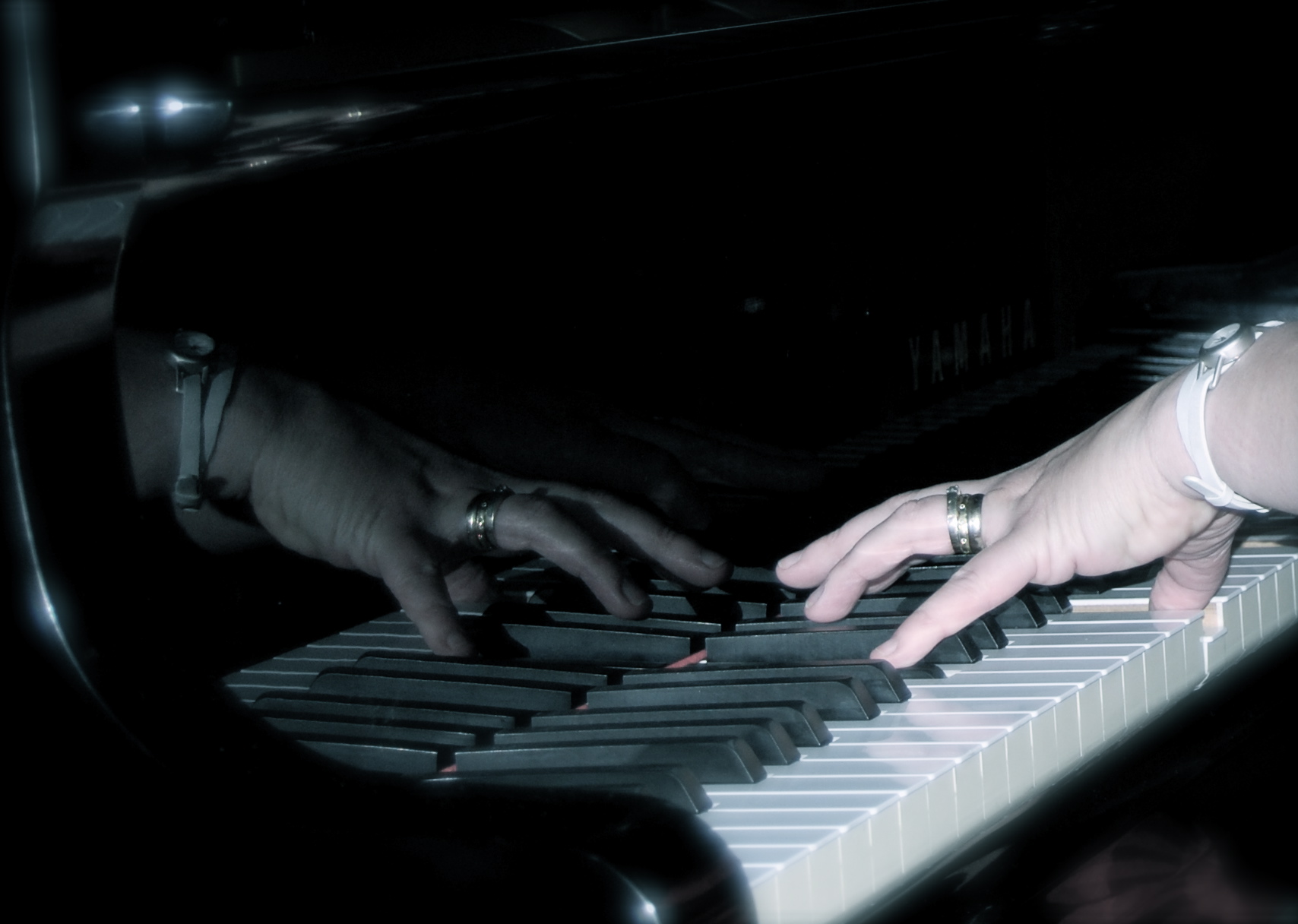
13 WAYS of Looking at the Goldberg: Bach Reimagined; Lara Downes, solo piano; Tritone Records

Pianist Lara Downes first heard the Goldberg Variations on an LP “as a little girl sitting in my father’s big chair”, played by – who else? – Glenn Gould in his iconic 1955 recording, the same recording my parents had, with the expressive photographs of Gould on the album sleeve. She was, like Gould, like many of us, “transported” by the music, the twists and turns of Bach’s creative process, and Gould’s interpretation and realisation of it.

Inspired by the poem ’13 Ways of Looking at a Blackbird’ by Wallace Stevens, ’13 Ways of Looking at the Goldberg’ is, like the poem, an exercise in “perspectivism”, a “re-imagining”, for each piece makes a nod, sometimes obvious, sometimes more tenuous, to Bach’s original, while demonstrating both the permanence of Bach’s great Baroque work, and its ongoing relevance and fascination today. In 2004, thirteen composers were invited to compose thirteen new variations based on Bach’s original. They are not all classical composers, and they represent a diverse and varied group – as do their interpretations. Many share rhythmic, melodic and harmonic motifs with the original, but each is individual, a short stand-alone work.

Catch a phrase or two of some of these ‘reworkings’ and you could easily believe this was Bach’s own creation in their closeness to the original (Fred Lerdahl: Chasing Gold, William Bolcom: Yet Another Goldberg Variation, Ralf Gothoni: Variation on a Variation with Variation), while others bear more than a passing reference to the atonality of Hindemith, Boulez or Messiaen (Mischa Zupko: Ghost Variation, Derek Bermel: Kontraphunctus, Stanley Walden: Fantasy Variation). And just like Bach’s original, there are stately chorales and sprightly dances. This album is almost a palimpsest of Bach: an imaginative and sensitive layering of new thoughts over the original.

The clarity of Lara’s playing ties these separate pieces together with crisp articulation, tender sonorities and arching melodic lines. To accompany the thirteen variations, Lara Downes includes on the album Bach-inspired works by two great American composers, Dave Brubeck and Lukas Foss, a fitting tribute to Bach and the lasting inspiration of his music. The final track on the album is the sublime ‘Sarabande’ from the French Suite V, BWV 816, whose exquisite simplicity echoes the opening ‘Aria’ of the Goldberg Variations.

For more information, please visit Lara’s website. The album ’13 Ways of Looking at the Goldberg’ is available to download via iTunes.

I am very grateful to Lara for giving me the opportunity to review this interesting and arresting album.

More on the Goldberg Variations here.

In our celebrity-obsessed, ‘image is everything’ times, it seems that the fledgling concert pianist’s path to the modern concert arena – the ‘Three C’s’ of Conservatoire, Competition and Concerto – has turned professional piano playing into a kind of Olympian activity whose creed is “faster, higher, louder”, and has reduced the vast and wonderful repertoire to a relatively small stable of over-played warhorses, most notably, perhaps, the ubiquitous Rachmaninov Third Concerto. Today’s young piano superstars are using technique as the be all and end all, rather than as a means to serve the music. Thus, while we might be impressed by flashy technical prowess and grand gestures, we are often being offered only superficial display.

Just as the four-minute mile has been shaved down by 17 seconds over the 50 years since Bannister’s record-breaking run, certain pieces in the standard piano repertoire seem to be getting faster – and/or louder. I ran an informal poll amongst my Twitter followers and Facebook friends to see what other people thought about this. As one person said, “….people are generally and more easily drawn to the more obvious things in life (just take a look at anything in the media today). Faster and louder is definitely more obvious than subtle and artistic. It also requires less work….”

Thus, certain pieces are wheeled out over and over again by young, ‘generic’ pianists, not because they are necessarily the hardest in the repertoire, but because they are the most impressive, both visually and aurally. And here I must admit that I was absolutely gob-smacked by the speed at which Marc-Andre Hamelin’s hands moved around the keyboard at his late-night Liszt Prom, even though I didn’t like the actual piece (Fantasia and Fugue on B-A-C-H) that much. But in his Benediction de Dieu dans la solitude, Hamelin proved that he is not just a brilliant technician: his account was ethereal, luminescent, profound and emotional, and it spoke of a long association with the music, something which younger players may not appreciate with their desire to rush from showpiece to showpiece.

My informal poll revealed a general consensus about certain works, acknowledged amongst pianists to be some of the most challenging in the repertoire, in terms of technical difficulty and/or length. These include, in no particular order (links open in Spotify):

Beethoven – Op. 106, ‘Hammerklavier’. The daring opening leap should, of course, be played with one hand!

Ravel – Gaspard de la Nuit

Stravinsky – Trois Mouvements de Petrushka

Chopin – Etudes (especially Op 10 Nos 1 & 2, Op 25 Nos 6 & 11)

Liszt – Transcendental Etudes (especially Feux Follets, Wilde Jagd)

Liszt – B minor Sonata

Brahms – Paganini Variations

Rachmaninov – 3rd Concerto

Prokofiev – 2nd Concerto

Bartok – 2nd Concerto

Alkan – Concert for Solo Piano

Messiaen – Vingt Regards sur l’enfant Jesus

Godowsky – transcriptions of Chopin Etudes

Sorabji – Opus clavicembalisticum (a piece which lasts around 4 hours)

Of course, while being hugely technically and physically demanding, many of these works, when played well, sound effortless (which, of course, is what we as pianists are all striving for!). And yet even the simplest piece, such as Mozart’s Adagio for Glass Harmonica, which I heard played as an encore at an eccentric little arts venue in Highgate some years ago, can sound sophisticated and refined – ‘Olympian’ even – in the right hands!

As a postscript, my own personal ‘Olympian’ works include:

Chopin – Etude Opus 10, No. 3. As my teacher said, the difficulty lies less in the technical demands, and more in the fact that this Etude is so well known, so one wants to do it justice.

Messiaen – Regard de la Vierge, no. IV of the ‘Vingt Regards’. For someone who had not really attempted any true atonal music before, the difficulty in this piece lay, initially, in “tuning” my ear into the discordant harmonies. Also, at first sight it looks utterly horrendous on the page!

Debussy – Prelude & Sarabande from ‘Pour le Piano’. The Prelude requires playful, fleet and pristine fingers, while the big, hand-filling chords of the Sarabande presented their own problem for the tenosynovitis in my right hand. Exercises and solid technique have enabled me to play this piece comfortably and without pain.

More on ‘Pianistic Everests’ from Tom Service

Robert Levin in action (Photo credit Kris Snibbe/Harvard News Office)

Anyone expecting a ‘traditional’ concert experience at the Queen Elizabeth Hall on Tuesday night would have been disappointed – or maybe pleasantly surprised. Consistently innovative, the Orchestra of the Age of Enlightenment (OAE) are offering a new music concept in the form of The Works, in which you can learn more about a Great Classical Masterpiece in a fun and informal way in the company of the orchestra and an ‘expert’. Future events include harpsichordist Laurence Cummings on Bach, but for the first event of this new series, the OAE were joined by charismatic pianist and renowned Mozart specialist Robert Levin.

Levin, who has a passionate and forensic interest in the minutiae of Mozart’s music and his creative life and compositional processes, is a lively and engaging speaker. While not everyone may like his particular brand of New York Jewish ebullience nor necessarily agree with his “scholarship”, there is no doubting his infectious enthusiasm for his subject. He has studied Mozart’s manuscripts in microscopic detail to winkle out all the details of his creative process and to attempt to understand his precise vocabulary of rhythm, melody, counterpoint, harmony, architecture. As Levin says, “Mozart hides sophistication behind apparent simplicity” (thus, calling to mind Schnabel’s famous quote about Mozart’s music). His detailed study of Mozart informs both his teaching and his playing.

A few years ago, I attended a study day with him entitled ‘Mozart and the Piano’ in which he examined the evidence to suggest that Mozart was not only intimate with all the quirks and foibles, strengths and weaknesses of the musicians with whom he worked (a bassoon part written for a player with loose teeth, for example) but also with the capabilities – and limitations – of the instruments at his disposal. It was a fascinating and entertaining angle on Mozart’s music.

“If Mozart had had access to a modern Steinway, just think what he would have written!” Levin declared provocatively at the start of The Works. Of course, as Levin immediately countered, we cannot make such assumptions: Mozart worked with what was available at the time – the harpsichord, fortepiano and fledgling piano. What we can do, however, is look at the documentary evidence – the drafts, the autographed scores, his letters – to gain a glimpse into the compositional world of Mozart.

Levin has argued, convincingly, that the paper, ink and quill that Mozart used all point to a prolific genius who could turn his hand to almost anything, a consummate multi-tasker who would sketch out a draft of a piano concerto and then set it aside to work on more lucrative projects.

He also feels Mozart was the “Duke Ellington” of the 18th century, endlessly improvising off the cuff, and knocking off dazzling cadenzas at the drop of a hat. He didn’t need to write them down because each time he performed he would do something new.

Levin is also an improviser, and his intimate study of Mozart allows him to offer suggestions as to how Mozart may have performed (directing from the piano, of course) which sound fresh and natural, but never ersatz. Sometimes there is an astonishing latitude in Levin’s interpretations, but at no point have I ever felt, when hearing Levin perform, that he is taking unfounded liberties with the material. Rather, there is a sense of someone who is thoroughly immersed in the ‘language’ of Mozart, but who does not hold up what is written in the score as “sacred”. A degree of danger and unexpectedness is what makes Levin’s playing so intriguing, and he believes he has a responsibility to create something “new” in each performance he gives.

I am no purist about historically accurate performance on historically accurate instruments: I feel it is impossible for us to truly recreate the sound, feel, nuance, atmosphere of Mozart’s music in his time – and certain attempts to do this can come across as either overly esoteric, or an undignified ‘Disneyfication’ of the music. Robert Levin’s approach offers some interesting and thought-provoking angles on the subject: in his hands, Mozart’s idiosyncrasies become a wonderful asset and serve as a pretext for a better understanding of the man and his music, as well as reviving the art of improvisation in classical music and promoting novelty in musical performance.

Robert Levin talking about how differently things would have been done in Mozart’s day.

Robert Levin on improvisation in the Piano Concerto No. 23 from the OAE blog, and on Radio 4’s Today programme.

Radio 4 is kindly allowing us, Joe Public, to offer up our own choices as the venerated programme approaches its 70th birthday (you can submit your choices here, and explore the archive). I put together a playlist on Spotify last week, but didn’t give it that much thought. Meanwhile, a very thoughtful and varied post by fellow-blogger The Argumentative Old Git inspired me to review my choices and make a more considered selection. I have always enjoyed the programme, and although I am not 70 (nor will be for another 25 years!), I do remember Roy Plomley presenting the programme. Desert Island Discs is, like The Archers, and Woman’s Hour, one of our radio national treasures, to be cherished and revered.

The music listed is available via Spotify, free to download and free to use, and the list is in no particular order, rather the pieces are listed as they come to mind. Nor are they necessarily “favourites” (though many are); these are simply pieces which have special resonances for me.

Mozart – Clarinet Quintet, K581, II Larghetto: My father was a fine amateur clarinettist and this was one of his favourite pieces (sadly, he had to give up the clarinet some years ago because it was affecting his teeth). We used to play a reduced version for piano and clarinet together, and he often played this with Music Minus One, which I would hear from my bedroom as I was going off to sleep as a child.

Mozart – Clarinet Quintet In A Major, K. 581: II. Larghetto

Beethoven – Symphony No. 7: My paternal grandfather was a Marxist, a (old) Labour man all his life, and a trade union leader (NUPE) in the 1960s. He was a fascinating man and I had a great fondness for him. He encouraged me to play the piano from a very young age, and he had a great affinity with fellow Old Radical and his music. This, along with the Pastoral Symphony (No. 6), was one of his favourites. He requested this movement at his funeral, but only I remembered his request – and too late.

Beethoven – Symphony No. 7 In A Major, Op. 92: III. Presto

Kate Bush – ‘Wuthering Heights’: I have always been a great fan of Kate Bush, a musician who never stands still and who has never rested on her musical laurels. She is constantly reinventing herself, while retaining the key elements of her music which make it so distinctive. ‘Wuthering Heights’ was the first single I bought, after seeing Kate on Top of the Pops in 1978 when she was still a teenager. Her latest collection ‘Director’s Cut’ is about to be released, a compilation and reworking of tracks from her 1990s albums The Sensual World and The Red Shoes.

Kate Bush – Wuthering Heights

Talking Heads – ‘Road to Nowhere’: This is the track of my university days in the mid-80s, oft requested at discos and parties, along with ‘Once in A Lifetime’ from an earlier album of the same name. Whenever I hear this song, I am transported back to Exeter, to a cold attic room in a drafty student house, to learning how to cook for myself in a kitchen with a permanently sticky floor, and arguments over whose turn it was to do the washing up. Happy days! I had waist-length dyed auburn hair, and a penchant for maxi skirts and chunky jumpers. I don’t remember doing that much work, though I did stay up all night to finish typing my dissertation to make sure it was handed in on time! Listening to the track now, the opening lyrics seem rather appropriate for a group of young people poised on the threshold of adulthood.

Talking Heads – Road To Nowhere – Early Version

Joy Division – ‘Love Will Tear Us Apart’: By being born in the middle of the 1960s, I was slightly too young to appreciate Joy Division first time round, when their lead singer Ian Curtis was still alive. Nevermind the tragic circumstances of Ian Curtis’s suicide, this song is the sound of a heart shattering, of the end of a love affair, the hauntingly tragic lyrics almost crooned over a mournful bass line and robotic drums. Monstrously beautiful and utterly beguiling, brutally claustrophobic, potent and ethereal, as sublime and chilling as Schubert sharing his painful outbursts and lyrical consolations, it sums up emptiness and sadness, yet is both enchanting and intoxicating. This is preposterously good music, with a spine-tingling uniqueness: it gets to me every time I hear it.

Joy Division – Love Will Tear Us Apart

Schubert – Impromptu in A flat, D899, No. 4: I first encountered Schubert’s Impromptus (the D899 and D935 sets) when I was in my teens and about to take my Grade 8 piano exam. I probably heard the pieces in concert and was struck by the ethereal nature of the fourth of the first set. I bought a Peters edition of the score and set about learning it. When I played it to my piano teacher for the first time, she shook her heard in disbelief at my total misunderstanding of how to play the fluttering semiquavers which make up the main motif of the piece. Once set on the right track, I was able to learn the piece correctly. This, for me, is part of my “tingle factor” collection, a piece I will also stop for, if it comes on the radio. It is both romantic and plaintive, beautiful and haunting. I still play it, though I have, with my current teacher’s guidance, “unlearnt” the fingering scheme of my teens and replaced it with a more logical and comfortable scheme to cope with the semiquavers. It is one of the few pieces I can play from memory (just!).

Murray Perahia – Schubert: Impromptu No. 4 in A-flat Major. Allegretto

Joni Mitchell – ‘Both Sides Now‘: As well as missing out on Punk, I missed out on the flower-power generation, and so became a “neo-hippie” in my teens in the early 1980s, discovering the protest music of Bob Dylan and Joan Baez, as well as Janis Joplin, The Doors, Patti Smith, Carole King, The Velvet Underground, Jefferson Airplane, and, my most favourite female singer of all, Joni Mitchell. Like Kate Bush, Joni has managed to reinvent herself, and is still going strong, songwriting and painting. Her voice has deepened, grown more gravelly (like Dylan’s), with time. This song is my absolute favourite, and one which can trigger tears, even when I play it to myself on the piano.

Joni Mitchell – Both Sides Now

Beethoven – Piano Sonata in A, No. 31, Opus 110: “Who’s your favourite composer, Fran?” asked Ben, one of my keenest students, after a lesson spent working on a reduced version of the Moonlight Sonata with him. “Beethoven” I replied emphatically. “And who’s your second favourite?” he asked. “Ah, now that’s a difficult one, Ben, because there are so many composers whose music I love…..”. Lucky Ben, poised on the cusp of a lifetime of discovery of the greatness of the piano’s repertoire….. I’m not working on any Beethoven myself at the moment (though I probably should be), but he is a composer who I always return to, for his wisdom, his wit, his humour, his ever-changing moods, his sheer weirdness and unpredictability. I have favourites among the piano sonatas, but the Opus 110 is my absolute favourite, and the piece I would take to the desert island with me (also the choice of tenor Ian Bostridge, clearly a man of taste). This isn’t music, it is philosophy, written near the end of the composer’s life, though there is nothing valedictory nor depressing about it. Truly life-affirming, with that amazing fugue, the most stable and steadying of music devices, in the final movement. Favourite recordings? Glenn Gould, who gives it a quasi fantasia reading by segueing effortlessly between movements, Claudio Arrau, Mitsuko Uchida…..

Piano Sonata No. 31 in A flat major Op. 110: Moderato cantabile molto espressivo

Kirsty Young: “And so, Cross-Eyed Pianist, we come to your book choice. You have the Bible and the Complete Works of Shakespeare…..”

How difficult to be asked to select one book out of many! Here, I think I would have to bend the rules of the programme and ask to take all the books I’ve been meaning to read, and all the books about which friends and colleagues have said “you must read this!”. These include Charles Rosen’s ‘The Classical Style’, Chopin’s Letters, Alan Walker’s three-volume ‘Life of Liszt’, Adam Zamoyski’s ‘Chopin: Prince of the Romantics”, and many, many more, too numerous to list here. You see, I’m far too idle and lacking in practical life-skills (beyond being able to cook and change a plug) to try and build a raft to escape from the Desert Island. And so I will sit on the beach in the sun, or in the shade of a palm tree, reading,reading, reading…..

Kirsty Young: “And your luxury?”

If I was replying as my other blogging persona, Demon Cook, I would request a good cooking knife and a wok. As The Cross-Eyed Pianist I must, of course, request a fine grand piano, and the score of the Complete Piano Sonatas of Beethoven. That, and the extensive reading list should keep me pretty occupied until I am rescued….