The ‘Sonetto 123 del Petrarca’, from the second, Italian, Années de Pèlerinage, was my first serious foray into Liszt’s music, and formed part of my ATCL Diploma programme. While waiting for the Diploma results at the beginning of this year, too superstitious to start looking at LTCL repertoire, I dabbled with the ‘Sonetto 47’ (I will return to it and learn it properly at later date). Now I’m working on the middle, and most popular work of the triptych, the ‘Sonetto 104’.
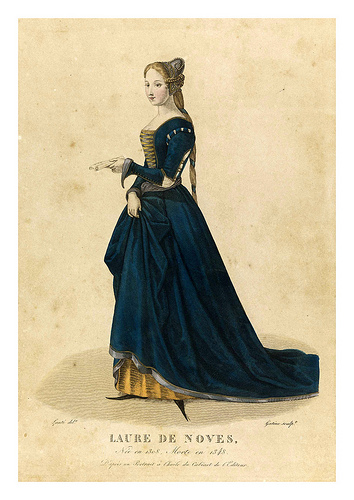
Laura de Noves

The three ‘Petrarch Sonnets’ are often performed together, separately from the rest of the Italian Années. They are inspired by the poetry of Italian Renaissance poet Francesco Petrarca, and are all concerned with love, in one form or another, which links them, yet each is a meditation on love in itself, specifically the poet’s love for Laura de Noves. Originally conceived as songs for piano and high tenor voice, Liszt later recast them as solo piano works. His extreme sensitivity to Petrarch’s original text allows him to beautifully capture the atmosphere and sentiment of Petrarch’s words, though they do not take their cues directly from the text (a comparison with the scores of the original song versions is useful when studying these works). Rather, they reflect Liszt’s own response to the poetry in the same way as earlier pieces in the Italian Années, ‘Spozalizio’ and ‘Il penseroso’, convey the composer’s response to a painting and a sculpture by Raphael and Michelangelo respectively.

The ‘Sonetto 104’ is perhaps the most passionate, agitated and dramatic of the three, based on the Sonnet Pace non trovo (‘I find no peace…..’ Canzone CXXXIV; sometimes erroneously noted as Sonnet 47). In it, the poet ponders the confused state love has put him in. Enthralled to his lady, he feels imprisoned yet free, he burns with love, yet feels he is made of ice: in modern psychological parlance, a true state of ‘limerence’ (a life-altering and passionate love or infatuation for someone, often unrequited). Reading the original text, one has a sense of the protagonist caught in an emotional ‘trap’ of his own making: while wallowing in the contrasting and sometimes painful emotions, he is also enjoying them. Liszt achieves these rapid changes of mood – the ‘highs and lows’ of romantic (and possibly physical) love – with the use of contrasting sections, dramatic, often unexpected, harmonic shifts, declamations, ‘meaningful’ fermatas, and cadenza-like passages. There are moments of calm contemplation, shot through with soaring climaxes and intense agitation, the surprising harmonies emphasising the protagonist’s confused state of mind. The piece ends calmly, with a restatement of the recitative-like opening motif with a languorous coda and some uncertain harmonies before a prayer-like final cadence.

When studying this piece, it is worth having both the original text by Petrarch and a copy of the libretto to hand for reference (available to download from IMSLP). The beautifully expressive melodic line, from the song versions, is retained in all three ‘Sonetti’.

Recordings: I like Thomas Quasthoff in the song versions, and Wilhelm Kempff and Christine Stevenson in the Années de Pèlerinage. Lazar Berman’s recording of the complete Annees is very fine too. You can hear my version of the ‘Sonetto 123’ via my SoundCloud.

Francesco Petrarca CANZONE CXXXIV

Pace non trovo

Pace non trovo, e non ho da far guerra,

E temo, e spero, ed ardo, e son un ghiaccio:

E volo sopra ‘l cielo, e giaccio in terra;

E nulla stringo, e tutto ‘l mondo abbraccio.

Tal m’ha in priggion, che non m’apre, né serra,

Né per suo mi ritien, né scioglie il laccio,

E non m’uccide Amor, e non mi sferra;

Né mi vuol vivo, né mi trahe d’impaccio.

Veggio senz’occhi; e non ho lingua e grido;

E bramo di perir, e cheggio aita;

Ed ho in odio me stesso, ed amo altrui:

Pascomi di dolor; piangendo rido;

Egualmente mi spiace morte e vita.

In questo stato son, Donna, per Voi.

I find no peace, but for war am not inclined;  
I fear, yet hope; I burn, yet am turned to ice; 
I soar in the heavens, but lie upon the ground; 
I hold nothing, though I embrace the whole world. 

Love has me in a prison which he neither opens nor shuts fast; 
he neither claims me for his own nor loosens my halter; 
he neither slays nor unshackles me; 
he would not have me live, yet leaves me with my torment. 

Eyeless I gaze, and tongueless I cry out; 
I long to perish, yet plead for succour; 
I hate myself, but love another. 
I feed on grief, yet weeping, laugh; 
death and life alike repel me; 
and to this state I am come, my lady, because of you. 
Liszt’s Années de Pèlerinage Suisse (published 1855) are not fictional imaginings conjured up at home but his responses, in music, to the alpine landscape and landmarks of Switzerland, which he visited with Marie d’Agoult during the period 1835-1839. While owing a great deal to the romantic poetry of Goethe and Byron (in particular Childe Harold), these are also musical ‘postcards’, and the landscape and places they describe can still be viewed and visited today.

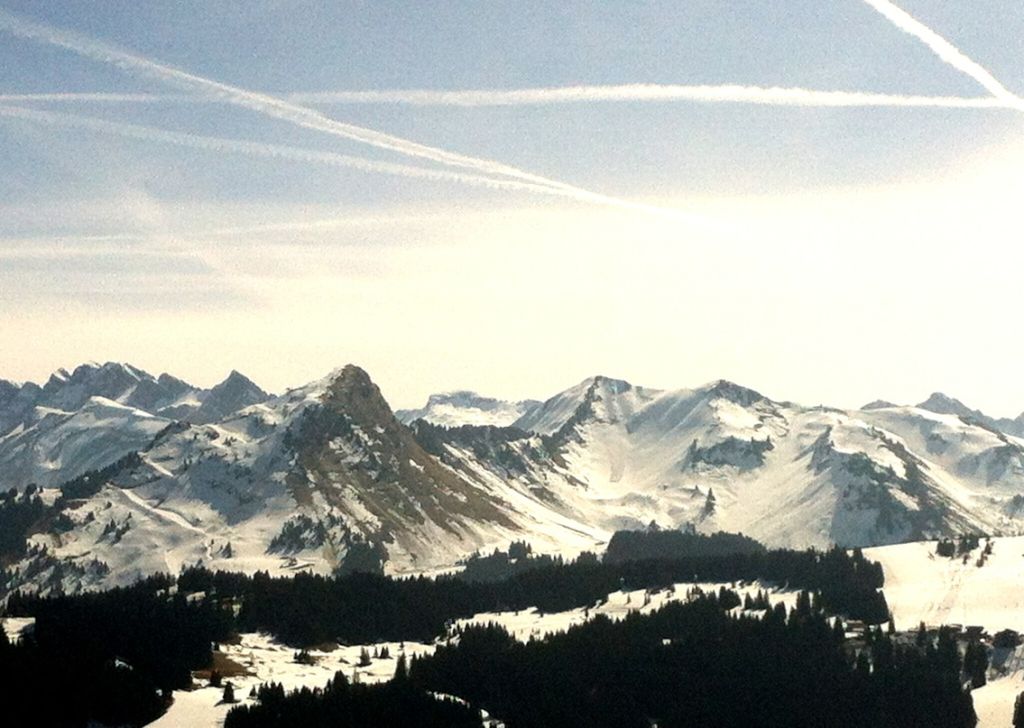
Having just enjoyed another holiday in the French Alps, quite close to the places of Liszt’s peregrinations, it is easy to see how the landscape inspired him. Driving down the autoroute south of Dijon, the first intimation one has of a change in the landscape, from the dull, flat agricultural land of the French interior only occasionally relieved by sugar-beet processing plants and statuesque wind turbines, are the Jura mountains, but these are mere trifles compared to the soaring grandeur of the Alps, whose snowy peaks rise up around Geneva and its lake. One really begins to appreciate their awesomeness when one leaves the motorway to begin a 30 minute ascent up twisting mountain roads to one of the many villages and ski stations that nestle in the high valleys. With spring now underway, there are cowslips and other wild flowers in bloom, and streams, augmented by the melting snow, gush noisily down the slopes, rushing headlong to sea level.

The peaks and high slopes are still snow-covered and on a sunny day the snow glints and glistens like crystal. The sky is intensely blue, the sun, in the thinner mountain air, hot on one’s skin. After a few days in this glorious landscape, one feels refreshed and healthy, released from the smog and noise of the city. Franz and Marie probably felt the same.

Looking towards Mont Blanc, from Mont Chèry, France

The alpine landscape of today isn’t so different from the landscape Liszt encountered in the mid-nineteenth century. Approaching Switzerland from the east, he probably enjoyed the great peaks of the Matterhorn and Mont Blanc. Travel would have been far more difficult then, with few proper roads through the mountains, but local guides could be hired to take one on walking tours, and there were plenty of refuges and hostels for weary travellers to rest in at the end of a day spent hiking.

In ‘Pastoral’ Liszt evokes lush mountain pastures, wild flowers, birdsong and fauna, and the pleasure of being in such a landscape; while ‘Au Bord du Source’ describes a mountain stream, playfully carving its course towards the sea. ‘Au Lac de Wallenstadt’ vividly captures the image of a beautiful mountain lake, a light breeze ruffling its clear surface.

‘Orage’ describes the rapidly changing weather of the Alps: I’ve sat and watched a storm brewing in the opposite valley, dark clouds rolling in, the heavy sky scored with shards of lightning, and Liszt brilliantly captures the storm with unsettling chromatic scales in octaves, massive left-hand chords and cadenza-like passages.

‘Vallee d’Obermann’ is a more pensive and philosophical piece, and the place itself does not exist. Rather, the music is based on a romantic literary construct. Built on a simple descending figure, which is recapitulated many times throughout the piece, the music is both imposing and wistful, with its impressive double octaves, evoking the grandeur of the landscape, and graceful melodic lines.

‘Eclogue’ returns to the pastoral mood of the earlier pieces. Short and gentle, it evokes the joy of the dawning of a new day. In ‘Le mal du pays’ the homesickness of the traveller is evoked, tinged with depression and yearning, and a poignant farewell to country. Its ending, in the lower register, brings no relief from the melancholy mood. In the final piece of the suite, ‘Les cloches de Genève’, (‘The Bells of Geneva’) the music is less evocative of the sound of bells, but its mood, underlined by one of Liszt’s more romantic melodies, suggests joy and love, providing an antidote to the dark mood of the previous piece.

British pianist Peter Donohoe describes these pieces as ‘very personal and visual… highly emotional for composer, performer and audience’, and a good performance (such as Donohoe’s at the Southbank in February – review here) can be intense, romantic and highly concentrated. The works from the second year (Italy) are, by contrast, more concerned with literary and artistic impulses (a painting by Raphael, a sculpture by Michelangelo, the poetry of Petrarch) but are no less interesting and absorbing, to listen to and to play.

For a good recording of the complete Années de Pèerinage, look no further than Lazar Berman, though I also like Wilhelm Kempf, particularly in the three Petrarch Sonnets.

by Gavin Dixon

Is classical music in need of a revolution? The industry probably is, but classical events themselves seem to tick over quite nicely in my view. But then, I’m the kind of person who is happy to sit in silence for hours on end and take my medicine. That usually involves besuited, unspeaking and unsmiling performers presenting the music in socially stifling environments, on the shared assumption that the elevating sounds that result make it all worthwhile.

It is easy to see why many people disagree that this is a healthy way for an artform to function, and Classical Revolution is out to do things differently. The core goal here is to get more people listening to classical music by taking it out of the concert hall and presenting somewhere more friendly, on this occasion a gay(ish) bar in Soho. There are other innovations too, sofas for example – a couple of those in the Purcell Room would certainly be welcome. And spoken introductions, which I’m certainly in favour of. Despite the rhetoric of revolution (that’s a metaphor right, these guys aren’t actually planning to shoot anybody?), the classical soirée format is hardly new. But Classical Revolution has a specific format that’s fresh and interesting. It is an American thing that has only just reached the UK, but on the strength of this first outing, I think it might have legs.

The Busch Trio (photo by Tristan Jakob-Hoff)

There is still a bit of an identity crisis going on though. ‘Informality’ is applied to what is essentially a mixed classical recital. Talking, drinking and background noise all play a part in the ambience. But nobody here this evening was prepared to treat the performances as background music, and nor should they, as the quality of the playing was very high and deserved close attention. So there was a definite change in atmosphere when the first act began. The programme opened with Bach’s First Cello Suite, played by Richard Harwood. His account was compelling, but with a lightness that was ideal for the occasion. But as soon as he started, everyone stopped talking and started listening. That came as a surprise to me, given the spirit of informality that the event promotes. I had an idea to spark up a conversation or something, but it didn’t seem like the right thing to do. It reminded me of the story about Eric Satie conducting one of his ‘furniture music’ pieces to a Paris audience stunned into silence by the bizarre sounds. Satie’s solution was to turn round and demand that everyone keep talking.

Cellist Richard Harwood (photo by Tristan Jakob-Hoff)

None of that here though. It turned out we didn’t actually have to talk during the music, listening is fine too. And there was plenty here worth listening to. I understand that the programme had been drawn up late in the day, so the diversity of the performers and repertoire was down to chance as much as anything. Nevertheless, I was impressed at the diversity of the music, and also at the fact that there was no pandering to populist tastes. One approach to this sort of thing could be to ensure that all the music on the programme is familiar and friendly, but extended works by Judith Weir and Schnittke demonstrated that the organisers had more faith in their audience. That said, the concept of ‘classical’ music was ring-fenced to a certain extent. I spoke to a singer in the audience (you know who you are) are asked if she would be performing. It turned out that she wasn’t allowed because she does rock and roll. Apparently she’s looking into an Elvis Costello/Brodsky Quartet type collaboration for a future event, but for the time being classical is classical as far as the revolution is concerned. The only exception was The Frolick, a singer and ensemble act (ensemble of one on this occasion) specialising in bawdy 18th century songs. Apparently this counts as ‘classical’ on account of the music’s vintage, and sure enough, you’re unlikely to meet it in most non-classical club nights.

I attended the event as a guest of the organiser, Simon Hewitt-Jones. It’s not usually my policy to own up to the freebies that get me into classical events, but when I told Simon I’d be writing about the evening, he insisted I make a full disclosure. I suggested that I could just write a bad review to compensate for any possible bias, but apparently that is missing the point. There is too much nepotism and insider trading in the classical music world, at least in Simon’s view, and that is part of the problem that Classical Revolution seeks to address. After all, how are you going to get new people involved in an event like this when everybody knows everybody else? And even worse, pretends not to?

The Frolick (photo by Tristan Jakob-Hoff)

Professional musicians are an important ingredient for this concept, just simply to perform the music to the standard required to show off classical music at its best. But non-specialists (‘newbies’ was the evening’s buzzword) are the target audience, and I wasn’t convinced that many people here were not musos of one sort or another. That said, the relaxed format did allow the listeners and performers to interact socially, and I appreciated the opportunity to have a chat with some of the players later on. That’s something that this format could promote much more, and for me it was considerably more valuable than the introductions from the stage.

The evening concluded with a chamber music jam, which was wonderful, but the fact that the punters were now on the stage playing Schubert at a professional level only further underlined the fact that a large proportion of the audience were professional musicians. Still, the drinks were flowing by then and the relaxed atmosphere was certainly convivial. I had to leave them to it to catch the last train – the gig running into the night is another notable distinction between a chamber concert and a classical club night. But I left with the pleasurable sensation of Schubert’s C Major Quintet still ringing in my ears and the feeling that the evening had been a success. A few minutes earlier, the bar takings had reached the level required to guarantee a repeat of the event next month. I’d certainly recommend it – especially if you’re a newbie.

Gavin Dixon is a writer, journalist and editor specialising in classical music. He tweets as @saquabote and blogs at Orpheus Complex

More photos from the event here

Classical Revolution London

Today BBC Radio Three began a week-long Schubert-fest, called ‘The Spirit of Schubert’, to mark the 215th anniversary of Franz Peter Schubert’s birth. The season will attempt to get inside the music and mind of the man in c200 hours of continuous broadcasting. Live concerts, discussions, requests, a ‘Schubert Salon’ and ‘Schubert Lab’, this will surely be a “must” for Schubert fans and anyone who wants to explore his music further.

His music remains perennially popular, from the sunny, holiday moods evoked in the ‘Trout’ Quintet, to the serene beauty of ‘Ave Maria’, through the symphonies and string quartets, to the late works for piano and the great song cycle ‘Winterreise’. His music spins the agony of his desire, yet at every turn he draws back from the void, and surprises us with warm melodic lines, striking harmonic shifts, rich textures, dances and songs. There is sunshine, as well as darkness, in Schubert’s music.

For me there does not have to be a specific anniversary or reason to play or listen to Schubert’s music. I have loved and lived with his music all my life: as a young child hearing my father play Der Hirt Auf Dem Felsem (‘The Shepherd on the Rock’) on the clarinet, my own LP of the ‘Unfinished’ Symphony, my first encounters with the ‘Impromptus’ for piano in my mid-teens, as a precocious, know-it-all student who could play the notes, but who understood little of where this music came from.

On my iPod I have a playlist called ‘Schubert Favourites’ – not some naff compilation torn from the front of ClassicFM magazine, but my own selection of my most favourite pieces of his music. One of my piano students, Ben, regularly asks me “Who’s your favourite composer, Fran?”, to which I always reply “Beethoven”(Beethoven is Ben’s favourite composer too!). I love Beethoven – for his wit and humour, his mercurial mood swings, and his sheer weirdness and unpredictably in his later works.  But I love Schubert too, though I find it hard to put my finger on exactly why I love his music so much. Maybe because it encompasses so much: the grandeur of Beethoven, a swooning romance which looks forward to Liszt, and beyond, the tenderness of Chopin at his most introspective and intimate?

From my Schubert Favourites list (in no particular order):

Impromptu No. 4 in A-flat Major. Allegretto

Der Hirt Auf Dem Felsen D. 965 (Op. 129)

Notturno

Fantasie in F minor D940 : I Allegro molto moderato

Quartettsatz in C Minor, D.703

Trout Quintet: Scherzo

Fantasy In C Major, D. 605a, “Grazer Fantasie”: I. Moderato Con Espressione

Piano Sonata No.21 in B flat, D.960 – 1. Molto moderato

Schubert: 3 Klavierstücke, D.946 – No.3 in C (Allegro)

Schubert links:

Spirit of Schubert on BBC Radio Three

Schubert’s Glasses

Schubert is needed now more than ever – article by Roger Scruton

Why Schubert? – article by Jessica Duchen

Schubert memorials in Vienna

Why Schubert’s music holds us in thrall – article by Ivan Hewett

Tenor Ian Bostridge in an excerpt from the film of ‘Winterreise’ by David Alden


