I finally got round the watching John Bridcut’s film of Winterreise, with baritone Benjamin Appl and pianist James Baillieu. I’m a great admirer of Bridcut’s films, in particular those about Benjamin Britten, and this new film of Winterreise is immensely appealing in both setting and, of course, the music. It’s filmed in Switzerland, in and around the extraordinarily striking Julier Tower, a remarkable modern theatre constructed of wood and glass whose stark, blood-red walls contrast sharply with the snow-covered landscape in which it stands. The scene is set immediately, with Benjamin Appl trudging through deep snow, in a snow storm (apparently, the snow began to fall just before filming began). Here is Schubert’s lonely wanderer, having left the house of his beloved, cast out on a journey of reflection on love, love lost, regret, sorrow, the torment of reawakening hope and the journey to resignation. Set to poems by Wilhelm Müller, this is a literal and metaphorical journey for the protagonist.

I love this music (and as regular readers/followers know, I love the music of Schubert in general, and his later piano music in particular), and I’ve heard Winterreise in concert on a number of occasions, each one of them moving and memorable – Ian Bostridge with Mitsuko Uchida, in English translation with Roderick Williams and Chris Glyn, in a modern reworking in Zender’s Winterreise (also with Bostridge) and most recently sung by mezzo-soprano Angelika Kirchschlager with Julius Drake, on one of the hottest days of the year back in the summer of 2018. Each time I have found much to ponder in this, perhaps the finest song cycle by Schubert, or indeed anyone else….

Ian Bostridge in Zender’s Winterreise

There is no denying the arresting grandeur of the setting of Bridcut’s Winterreise. Bright white, deep snow, stunning Alpine peaks – and that curious modern structure set amidst it all. Appl is as striking as the landscape, as perfectly chiselled as those mountains, with deep blue eyes which burn with passion or glaze with tears in the more poignant songs or passages, or occasionally fix the viewer with an unsettling directness which only adds to the power of Müller’s text and Schubert’s music. He has a wonderfully clear, clean voice, with a range from a whispered pianissimo (the level of control here is impressive) to raging fortissimo. James Baillieu, playing a gorgeous Bösendorfer piano, whose case (was it rosewood?) seems to hark back to a Schubert- era instrument, brings depth and clarity to the music. He avoids ponderousness in the darker songs and there are moments of delicious sweetness or tender poignancy – in Der Lindenbaum or Frühlingstraum, for example – but it is in the darker or more desolate songs that Baillieu really portrays the wanderer’s predicament, often simply through judiciously placed single notes or a fractional pause (agogic accent) before placing a note (Gefrorne Tränen, for example). The closing song, Der Leiermann, is absolutely devastating in its spare simplicity.
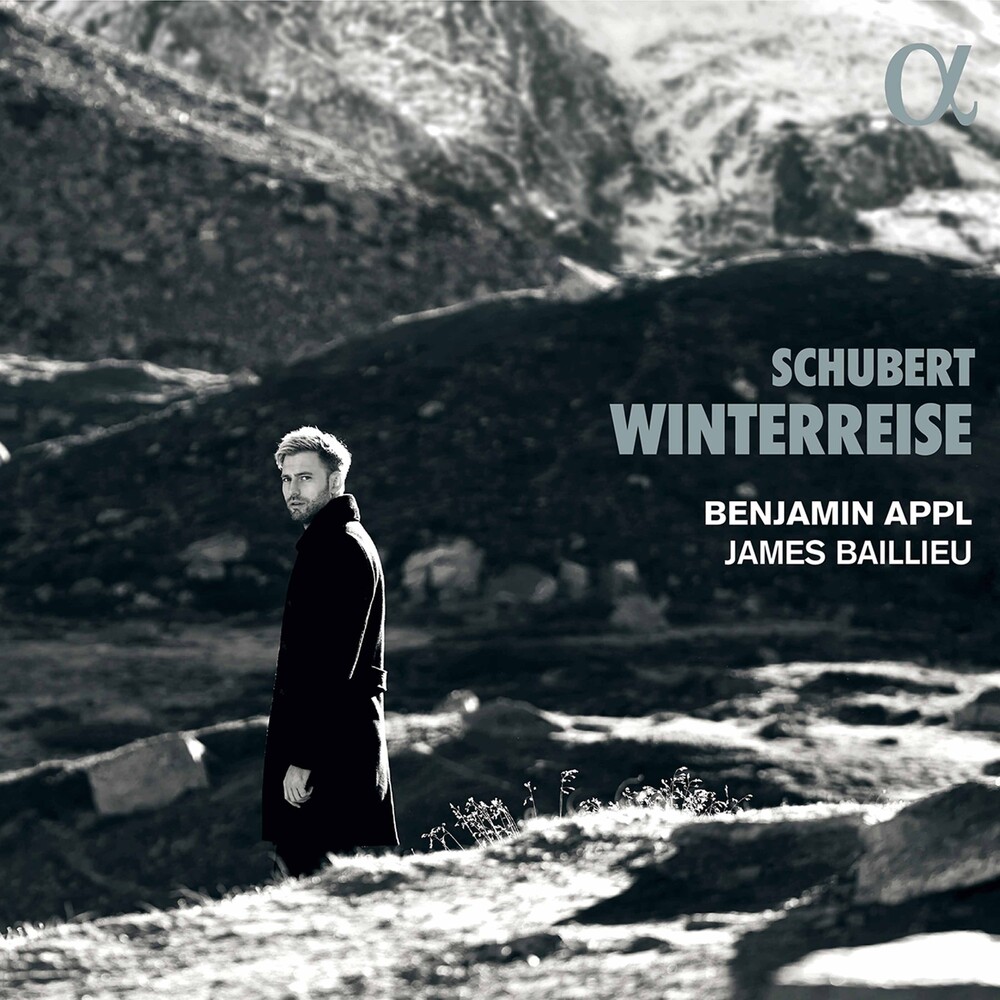
The performance of the music is first class, really engaging, and both singer and pianist deftly capture Schubert’s shifting emotions, curious harmonic shifts (as Baillieu says in one of the commentaries, the shift from major to minor in Schubert is like moving from one universe to another). The songs are occasionally interspersed with commentary by Appl and Baillieu (less frequently) on the music, and there’s a wonderful segment of Appl in conversation with Brigitte Fassbaender, discussing the appropriateness of this music for the female voice as well as the male.

But I have to admit, I found quite a lot of the film distracting. Pondering this after the event, I suspect it is because I have my own internal image of the lonely wanderer and for me, he (or she) is not in an awe-inspiring Alpine landscape, but rather trudging along a snowy road, in a flat, featureless landscape only occasionally relieved by a signpost, a village, a stream….. I also found some of Appl’s acting a little contrived – he didn’t always seem entirely comfortable (and presumably quite cold!) out in the snow drifts, and for me, he was always far more convincing when inside with Baillieu (and there are some wonderful moments when he sings seated at the pianist’s side, a nod, perhaps, to the way the songs would have been performed in Schubert’s day). Also, I don’t need visual cues to understand the narrative – but for this reason, I think the film is an excellent introduction for the Winterreise ingénue, the narrative compellingly matched in striking images and impressive sound quality which allows us to fully appreciate and enjoy composer, music and of course the musicians.

Winterreise is available via the BBC iPlayer and Marquee TV

Listen to a podcast with Benjamin Appl

Benjamin Appl’s new recording of Winterreise, with James Baillieu, is available on the Alpha Classics label

Schubert…..makes tears catch at the edge of my eyes; such fragile hope, such powerful emotions.

Ian McMillan, poet (via Twitter)

I was reminded of Ian McMillan’s quote while listening to the final lunchtime lockdown concert from London’s Wigmore Hall, a devastatingly beautiful, austerely unsentimental yet profoundly poignant rendering of Schubert’s late great song cycle Winterreise, performed by tenor Mark Padmore with pianist Mitsuko Uchida. Music so fitting for these strange days, with its narrative of loss, longing and separation.

Schubert is the composer for our corona times. Listening in isolation to performers playing to an empty hall, this acccount of isolation, its chill frequently tinged with the tenderest poignancy, seemed particularly appropriate. We are at home, but we are separate, living in our “bubbles”, unable to hug our family and friends, yet finding a sense of closeness, warmth and solace through music.

That same sense of isolation is evident in the Andantino from Schubert’s penultimate piano sonata, or the bare “horn call” first subject of the F minor Fantasie, D940, the fearful tread of the second movement of the Trio, D929, or the haunting opening measures of the unfinished sonata D 571. There are numerous other examples, of course….

In both the Andantino of D959 and the D929, it is those unexpected modulations into the major key, when the sun comes out to warm one’s skin and the chill of winter momentarily recedes, that make this music so magical, so breathtakingly extraordinary in its harmonic and emotional volte-faces. And then, only a few bars later, the melancholy and the sorrow flood back…. Often even more tragic in the major key, it is as if Schubert recognises the darkness visible, acknowledges and accepts it.

No one does chiaroscuro quite like Schubert: he mixes light and dark more subtly than any other composer and colours his musical palette with an elusive hue of mystery. Light and dark, levity and depth all reside in close proximity in Schubert’s music, perhaps even more so than in Mozart’s (and Mozart too is a master of light and shade).

I’ve loved Schubert’s music, and, more specifically, his later piano music since I was a child. I grew up listening to my parents’ recordings on LP of the ‘Trout’ Quintet, the Unfinished and ‘Great’ Symphonies, the string quartets, and The Shepherd on the Rock, which my father would play on the clarinet – and, when I became a more competent pianist, I would accompany him. When I was about 12, still a fairly novice pianist, my mother gave me an Edition Peters score of the Moments Musicaux and both sets of Impromptus – works which portray in perfect microcosm the breadth and variety of Schubert’s artistic vision and emotional landscape. I stumbled my way through these works, mostly too advanced for me at the time, though there were fragments of each which I could actually play. I took the A-flat Impromptu to my then teacher and instead of ticking me off for trying to learn music which was far in advance of my capabilities, she helped me find my way through the score. At this time, in the late 1970s, Schubert was regarded as the poor relation to Beethoven, his melodies sweet as sachertorte, his structures incoherent, and his emotions too introverted. Then I had little knowledge about Franz Schubert beyond the notes on the page, but there was definitely something that drew me to his unique soundworld….

Much as I love Beethoven, his gruffness and uncompromising spirit, as I’ve grown older I turn more and more to Schubert’s introspection, his tenderness and his intimacy. He speaks more softly, more personally than Beethoven for me. His unmatched gift for melody enables him to spin the agony of desire, melancholy and sorrow, and the joy of living  – and a whole gamut of emotions in between. He has a remarkable ability to switch rapidly between terror and lyricism, from the darkly tragic and melancholic to golden transcendence or joyous other-worldliness, all rendered in music of incredible, almost revolutionary inventiveness. Often this is achieved through the most miraculous modulations, an unexpected sonic shift and, for me, as a synaesthete who sees the musical keys in colour, a completely new luminosity.

His other great skill is in managing rests and pauses. Silences abound, freighted with poetic imagination and who knows what, suspending time and offering pause for reflection, while also clarifying the structural expansiveness of the music, his “heavenly length”. In addition, Schubert’s use of dynamics is often ‘psychological’ rather than purely physical, suggesting an intensity of feeling rather than volume of sound. As pianists, we shouldn’t play Schubert as if you would Beethoven (though some do!). Even in his grandest gestures, for example the fff passages in the first movement of the Sonata in G, D894, there’s a restraint. His generous use of pianissimo in particular creates an ethereality in his music as if hovering between different states of mind.

In those moments, his music makes you feel as if you are the last person in the universe…..

How does one explain Schubert? The simple answer is – one can’t.

Steven Isserlis, cellist


Concert going is a social as well as a cultural activity and one of the great pleasures is the after-concert discussion with friends – and occasionally strangers who linger in the auditorium or foyer – keen to share their thoughts on what they’ve just heard. Sometimes a performance can be so profound, moving or thought-provoking that an immediate verbal response may be impossible, as we each privately digest and consider what we have just heard. At other times, the words tumble out eagerly as we rush to share our impressions of the event.

Last week I was back in London for a very special concert at Temple Church, part of a series hosted by Temple Music Foundation featuring pianist Julius Drake and friends. Here was Schubert’s heartrending song cycle Winterreise, a work written the year before he died which has been invested with all kinds of meaning and psychobabble by those who believe this painful narrative is an autobiography of sorts. Austrian mezzo-soprano Angelika Kirschlager was singing this great work for the first time – and for me this was the first time I’d heard a female voice in the role of Schubert’s lonely winter traveller (I’ve now heard the work performed by tenor and baritone voices and also in an excellent English translation). Seated at the back of the church, it took awhile to tune one’s ear into the church’s acoustic, but once settled, it was clear to me that this was a performance of exceptional intensity, drama and emotion. I couldn’t see Kirschlager very easily from my seat, but her projection and commitment to the role was clear, her voice at times rough-edged and richly-hued to bring greater meaning and expression to the text and music.

Repairing afterwards with friends to a cosy pub on the Strand, we discussed what we had just heard over wine and beer (we also discussed the vessel from which my friend Adrian drank – was it a “tankard” or a “glass with a handle”? Such is the way when lively, inquisitive minds meet….!). While I enthused about the intensity and drama of the performance, my companions were rather more guarded, and this provoked a vigorous, but always friendly and considerate discussion. This was not some dry bar-by-bar analysis of the work and its performance, but thoughtful, heartfelt and immediate reactions by people who really care about music and concerts. It proved how meaningful, subjective and, above all, personal our experiences of music are.

It was a real treat to hear such an absorbing gig, then ‘share’ it there and then, as if the evening re-booted into 2 great nights in 1 – Adrian (@adrian_specs)

Never before has a performance led to a spirited, respectful and absorbing conversation. Something that deepened my understanding about a work and a performer – Jon (@thoroughlygood)

As a writer and reviewer, I find such conversations can crystallise or adjust one’s thoughts about a concert, the works performed and the performers, offering valuable reflection or reappraisal ahead of a review or article being written. It’s also a healthy reminder that we do not all like or appreciate the same things – and thank goodness for that, for these differences make the concert-going experience far more rewarding and interesting.


Adrian’s review of the concert at Temple Church will be published on this site shortly.


Schubert’s Winterreise, published in 1828, the year of the composer’s death at the age of 31, is often described as the greatest song-cycle ever written, and its central themes and preoccupations – love and loss, life and death – resonate through the centuries and continue to have a deeply emotional and philosophical impact today.
German composer Hans Zender’s ‘Winterreise’ is not a transcription of Schubert’s original for small orchestra. It is a “composed interpretation”, a work in its own right, which reflects and refracts the original song-cycle. Its orchestration takes the listener from Schubert’s Vienna, through Mahler and Schoenberg to the cabaret of Weimar Berlin and Kurt Weil. In this way, it challenges received notions of authenticity, historical accuracy and interpretation, and the relationship between performer, composer and audience. If anything, Zender’s Winterreise is even bleaker than Schubert’s with its strong Expressionist flavour and rich sonic associations with contemporary repertoire and instrumentation.

(photo: Hugo Glendinning)

In this production at London’s Barbican Theatre, the music and its narrative are staged by director, designer and video artist Netia Jones using striking black-and-white film, projections, haunting shadows, and chiaroscuro. The video screen is slashed into jagged shards, like a broken mirror, onto which are projected images of frost, a river, bare branches, a lonely snowy landscape through which a solitary figure, Schubert’s tragic “fremdling”, trudges.

Read my full review here


