Woolf String Quartet & Duncan Honeybourne, Chamber Music Weymouth lunchtime concert, Wednesday 25 February 2026
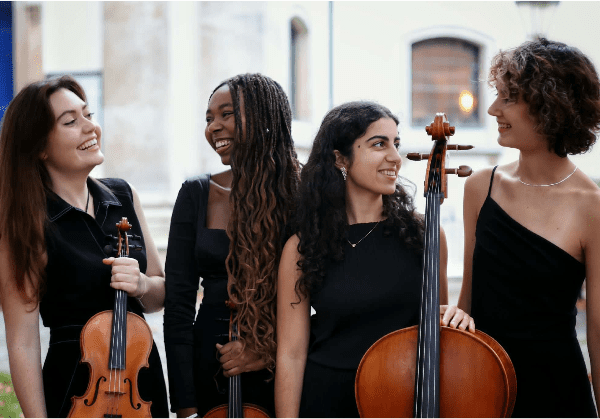
Woolf Quartet are: Zosia Herlihy-O’Brien (violin), Emily Harrison (violin), Beatrice Slocumbe (viola) and Hoda Jahanpour (cello)
When the audience comes out of a concert with words like “incredible!”, “brilliant” and “that was absolutely superb”, you know the musicians, and the music, has touched them. And that is what happened on Wednesday, 25 February, when the Woolf Quartet returned to Weymouth to impress the lunchtime concert audience once again. This London-based string quartet was formed at the Royal Academy of Music, and they take their name from author Virginia Woolf, as they often rehearse in Bloomsbury, close to where she lived.
They made their Chamber Music Weymouth debut in 2025 and wowed the audience with an engaging programme that featured Debussy and a piece by the quartet’s cellist, Hoda Jahanpour. This time they were joined by pianist and CMW Artistic Director Duncan Honeybourne to perform just one piece – Brahms’ Piano Quintet in f minor. A big-boned work of symphonic textures and narrative breadth, it has the expansiveness of Schubert in its four movements, and is one of the most challenging and important works in the chamber music repertoire. It asks of all the musicians virtuosity, stamina and cohesion, and an ability to navigate many modulations, complex rhythmic shifts, and fugal passages. It’s a monumental work, emotionally intense and physically demanding, and a challenge for any ensemble – and one which the Woolf Quartet rose to with commitment, maturity and musical insight.
It’s rare to feel a thread of concentrated energy through an entire concert – not an easy feat for musicians to achieve – but the Woolf Quartet, with Duncan Honeybourne, succeeded in doing just this. It’s a credit to them – and a mark of the infectiousness of their concentration – that the audience was almost completely silent for the entirety of the concert, listening intently to Brahms’ shifting soundworld and the emotions it suggests.
The Woolf Quartet, both individually and together, brought much colour and nuance to the music. Brahms’ writing gives each player a chance to shine. The ensemble playing was precise and committed, amply matched by Duncan Honeybourne, who made light of Brahms’ rather unforgiving piano textures. Most engaging, though, was that the musicians clearly enjoyed themselves. It’s always a pleasure to see performers truly immerse themselves in music that they love.
Catch the Woolf Quartet if you can – you won’t regret it! They will be at London’s Wigmore Hall on Saturday, 2 May, where, I’m told, they will be performing a piece they have written together, as well as music by Shostakovich.
Chamber Music Weymouth’s lunchtime series continues on Wednesday 11 March with a recital by distinguished pianist Margarat Fingerhut. Find out more
Ahead of the world premiere of his new piano work Sudden Memorials, written in response to the aftermath of 9/11, composer Kevin Malone shares insights into his creative life, his influences and inspirations and why he thinks we need to take more “time to think”….
Who or what were the most significant influences on your musical life and career as a composer?
Roger Mroz, my first serious saxophone teacher in Buffalo, New York, has left a positive, indelible influence on my teenage psyche regarding high levels of performance and serious repertoire. Ken Radnofsky at New England Conservatory offered wisdom by telling me to attend cello and voice masterclasses so that I wouldn’t be just a saxophonist, but instead like a musician who considers the context of interpretation.
When I stumbled upon the music of Rouse, Stravinsky, Weir, Reich, Beethoven, Crumb and Laurie Anderson, I realised that there are approaches to composition outside “the system,” yet their works contained logic, rigour and a strong sense of internally-established identity which made sense to me. Discovering the music of Ives at age 14 changed my life completely. His meticulous irrationality (an oxymoron, but an accurate description!) gets to the heart of what it’s like to be human: the visceral and philosophical self being one.
All of the above meld into how I think of what a composition is for me: a script for musicians to act upon, to interpret.
What have been the greatest challenges/frustrations of your career so far?
Without any doubt, it is time to think. Teaching at a university is about productivity, making it challenging to create anything truly unique to add important works to the repertoire or broaden musical expressivity. If we had time to think, then we could properly assess where we’ve come from and where we are in musical composition. For the past 60 years, the focus in the arts has been on manner, not substance, and manner (style) is highly marketable so it’s taken precedence. These mannerisms pretend to address the above questions, but instead they create a veneer to evade truly addressing and reevaluating compositional substance.
There’s also time wasted because, as a citizen, we have responsibilities to challenge oppression, injustice and maltreatment. When a government sets out to privilege its financial support base and offer promises specific to its voting base, then every musician and composer must join others to take action. That takes up much mental space and time. I’ve been shocked when some composer associates have told me that such activism is up to others, even though my associates will benefit, because they claim they are here to be composers.
What are the special challenges/pleasures of working on a commissioned piece?
I usually come up with ideas which I’m burning to compose into audience experiences; some of these become proper commissions, such as Sudden Memorials for Adam Swayne. When approached with a commission idea, then I like lots of discussion to ensure I honour the commissioner. For example, A Day in the Life is a violin concerto commissioned in 2018 by Andy Long, Associate Leader of the Orchestra of Opera North. He had a very specific brief that it should relate to Robert Blincoe, an indentured child forced to work in Northern textile mills in the late 18thC. I undertook massive amounts of research into Blincoe, indentured children and historic and current Northern mills. We discussed the proposed scenario at length, considered the audience, and after many coffees together, the music just flowed, since we had devised the vessel inside which the music would sail with many adventures along the way.
What are the special challenges/pleasures of working with particular musicians, singers, ensembles or orchestras?
Oh my, that’s everything! With some close artistic associates, I actually want to completely let go of the piece when I give it to them, so that it’s entirely theirs. I want to wait until they perform it before I hear it! That level of trust and synchronised thinking is rare, but so very precious.
With others, I like to get into lots of conversations about what the piece should be doing for the listener, and how they may wish to change things here and there to achieve that. I want to hear and learn about their sound, timing, phrasing and articulation so that they and the music are speaking the same language, dialect and accent as to what I intended.
Of which works are you most proud?
Eighteen Minutes (concerto for double basses) and Requiem77 (cello and voices) for their simplicity and directness (both are on iTunes and Spotify)
Sudden Memorials (piano) and Opus opera (string quartet) for their scale which goes beyond structures, and variety of emotional unfolding.
A Day in the Life (violin concerto) and The Water Protectors for their thorough grounding in people’s experiences, tribulations and activism
And HerStories Unsung Vol.1 and The People Protesting Drum Out Bigly Covfefe for the reaction they evoke from audiences: real audience participation! Check out the premiere by Diana Lopszyc of HerStories: Lilith:
and The People Protesting premiere by Adam Swayne:
How would you characterise your compositional language?
It is polystylistic in that each work is a heady brew of multiple styles and dialects, aimed at thwarting predictability as to what comes next, yet often imbued with familiar sounds in unusual gestures. For example, a series of triadic chords may appear – what I call “tonal artefacts” – and sometimes they might suggest a sort of archaeological dig revealing a tonal centre, but one which is seriously disjointed (not apologetically muddied or blurred). So it sounds familiar, but the syntax is wildly new.
I like what Beethoven said: good music should always have beauty and surprise. That’s a powerful combination when it’s understood and balanced. I would say my music is 20% music for music’s sake, and 80% music for listener’s emotional and psychological enlivenment. I like to experiment with new approaches in compositions for ensembles, and not to experiment with the musicians themselves. As a performer for many years, it was disheartening to have a composer ignore the many thousands of hours I put into a wide palette of solid technique, only to find that I had to develop an equally convincing technical range for just this one composer for just one piece (which most likely would be performed once). We are social beings, and it is important to respect what your musicians bring to the table. A medium-size orchestra offers 600,000 hours of high-level musicality to a composer, so to ignore that is quite arrogant!
How do you work?
I think of what the audience experience would be, then I make a structural diagram of that experience, as specific as 2” phrases in some places. The structure is drawn linearly, often stretching four meters left to right. While I create the structure, I hear musical ideas in my head to make that experience, writing them in notation and English and taping the bits of paper to where they will be most effective. Eventually, the structure suggests where new ideas and developed ideas should go to best create that experience. This is wildly different from what I was taught, which was to take an idea(s) and develop it to see where it goes. I don’t think an audience cares to hear what decisions a composer took (that’s composerly-orientated music). To my ears, that approach sounds like the minutes of a staff meeting or a logical proof being justified. I’d rather focus on giving the audience an experience instead of asking them to experience my music as a composition.
This may sound quite opinionated, but I think of it as my music having an opinion – and strong ones at that – so that its narrative is spicy, flavourful, sometimes contradictory, always provocative.
As a musician, what is your definition of success?
To attain a sustained high level of craft which produced provocative, original works that communicate to audiences. I am suspicious of celebrity artists; surely hearing their artistry without knowing who they are should have the same value as knowing their identity. But sadly, there’s so much emphasis on marketing the person and putting artists into gladiator-type situations like X Factor and Britain’s Got Talent, where artists are spontaneously judged with the goal of choosing one winner and many dozens of losers. I’d love to see a TV show called Comp Idol: composers writhing in ecstatic spasms of inspiration, trying to impress instead of express. (Channel 4: I have the treatment already drawn up.)
What do you consider to be the most important ideas and concepts to impart to aspiring musicians?
To work your ass off. To not underestimate the incalculable hours and years of work it takes to really say something artistically. To seek criticism from every quarter. To take risks. To not be defensive. To not try to be original, but instead to be genuinely the best of what’s inside you, which takes a lifetime. When these are achieved, you’ll be making a unique contribution to that life-force we call music.
What do you feel needs to be done to grow classical music audiences/listeners?
To teach the art-music of our diverse cultures from pre-school onward as compulsory in every school. To insist on accurate representations of art-music (it is for all people, not just certain social classes) and a vocabulary to talk about it (a perfect fifth is a perfect fifth in classical, hip-hop, reggae, ska, house, techno, jazz, folk, pop, etc.). To have a funded community orchestra/ensemble in every borough, and to make it accessible to everyone. Look at all the sports facilities in boroughs (wonderful!) but where is the funding for expressive arts? This mirrors the contempt that governments have for the power of the expressive arts: the mechanism which activates people to raise their voices and have their say.
Where would you like to be in 10 years’ time?
I have no idea. I live mostly in the present, evaluating where I’ve come from.
What is your idea of perfect happiness?
I don’t believe people should try to achieve happiness (a goal, a thing); rather, people should be happy (action, doing). This means making happy feelings for ourselves: they are our responsibility and under our control, and can change as circumstances change. For me, that is to write music which is rich with emotions and psychological states (wit, humour, sadness, surprise) and rigorously structured.
Is music the most important thing to me? No, but it is the only portal through which I achieve clarity to find out.
What is your most treasured possession?
It’s my Soviet-issued ceramic bust of Lenin which was given to me by the Composers Union of Ukraine. In 1994, they were no longer required to keep it on display in their office. I keep Lenin’s head warm with a pink pussy hat I knitted 5 years ago.
What do you enjoy doing most?
For leisure, watching films, which is such a widely diverse art form. What I enjoy doing most is composing when I’m not relaxing.
What is your present state of mind?
Great anxiety for society and humanity due to the immense greed of politicians and wealth-extraction industries (i.e. most capitalist businesses). But day to day, I am enriched by my partner and our long-haired German Shepherd dog; they buoy my hope for the future.
Sudden Memorials by Kevin Malone receives its world premiere in a concert by pianist Adam Swayne at London’s Wigmore Hall on Saturday 11th September at 1pm, the exact hour in Britain twenty years on the from the beginning of 9/11. More information
The work of Kevin Malone spans genres and media beyond conventional labelling. He is equally at home with electronics, multimedia and harpsichords to choirs and orchestras, embracing postmodernist and hybrid approaches across his work.
Abandoning high Modernism, Malone speaks with an open, personal expression, freeing his music from the baggage of serious high art music without actually throwing away the bags.
I’ve been guilty of it myself, proudly trumpeting “this concert is now sold out!” for the events I have been promoting over the past two months (I work for a London-based arts organisation and a local concert series), and I know I’m not alone. For those of us who have been so bereft of live music this year – musicians, venue owners, promoters and of course audiences – the fact that live music, with audiences, has been able to resume is something to celebrate.
Government restrictions in response to coronavirus mean that venues cannot operate at full capacity, whether this is a church (capacity c80) or a major London venue (capacity c3000). Social distancing regulations require a certain amount of space to be allowed between audience members and in order to adhere to these regulations many venues are operating at less than half their normal capacity. Obviously, venues must be safe for audiences – if audiences feel safe they will come to events – but the maths is simple and very stark: fewer “bums on seats” means lower ticket revenues. And venues and concert promoters rely on this revenue in order to pay artists and cover the other costs of putting on concerts and running a venue. Additionally, venues are restricted regarding F&B service (Food and Beverages), in normal times a significant income stream.
So what to do? Obviously, venues and promoters, and of course musicians, are keen to welcome back live audiences – a concert is not really a concert without a live audience – but balancing the costs of presenting a concert against reduced ticket and other income is a significant headache.
If your venue is less than half full do you charge more than double the usual price for the tickets? Of course not. This would be unfair on audiences, and while a few would be prepared to pay more, to support venue and artists, many would be deterred by a hike in ticket prices and would choose to stay away. With current restrictions in place, many venues and promoters are struggling to break-even.
But for those of us who give or promote concerts, to be able to welcome audiences back through the doors once again is very important and I firmly believe that venues must, if they can, offer audiences something, within the limitations of coronavirus restrictions. Some venues are lucky to have generous patrons and benefactors or have benefitted from government handouts; others do not but are still willing to, in the medium term, take a financial hit and bring audiences back. But this scenario cannot last indefinitely and without proper ticket revenues, many venues and promoters will struggle, along with performing musicians.
The last properly sold out concert I attended before the first UK lockdown was at the Wigmore Hall at the end of February, when American pianist Jonathan Biss gave a thrilling performance of Beethoven Piano Sonatas (read more here). At the time, the coronavirus was not yet headline news; of course people were aware of it, and I recall a friend hugging me in the vestibule of the Wigmore before the concert and saying “oh, maybe we shouldn’t do that!” – and then we both laughed. The hall was full to capacity and the bars downstairs were busy and noisy as people enjoyed pre-concert and interval drinks and conversation. At the time, I didn’t know it would be the last live concert I would attend for seven months. When the Weymouth concert series, which I help to organise, resumed in October, we presented two shorter concerts to allow for a socially-distanced audience of reduced numbers (less than half our usual audience) and while the church looked sparse, it was wonderful to hear live music and also applause. We took the decision not to increase ticket prices and hoped to be able to at least cover our costs and pay our guest artist, without eating into our bank balance. We are fortunately in having low overheads, but we face similar difficulties to other concert organisers and promoters.
Times are tough once again for musicians as the UK is poised to enter another period of lockdown and live events must be suspended. Let us hope that the new year will bring more positive developments regarding the management of the virus, which will allow venues to operate more profitably.
Meanwhile, those of us who love live music can support artists and venues by buying concert tickets, to live and online events, and making a donation where possible.
This site is free to access and ad-free, and takes many hours to research, write, and maintain. If you find joy and value in what I do, please consider making a donation to support the continuance of this site
JS Bach, arr. Busoni Chaconne from Partita No 2 in D minor for solo violin, BWV 1004 Schumann Fantasie in C, Op 17
Charles‐François Gounod – Meditation sur le 1er prelude de Bach (encore)
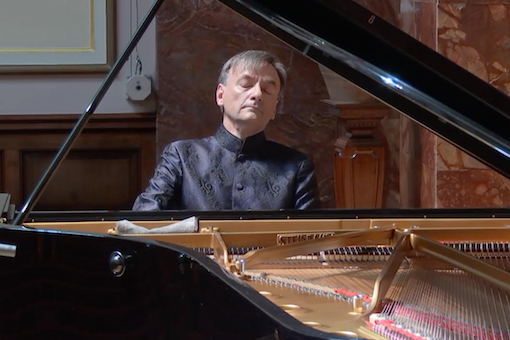
Stephen Hough, piano
Monday 1 June 2020
I admit I welled up as Stephen Hough played the opening measures of the Bach D minor Chaconne, transcribed for piano by Ferruccio Busoni. Yes, that opening has a spine-tingling authority, but the spontaneous tears were less for the music and more the effect of having beloved Wigmore Hall filled with music again – if not filled with an audience. Along with many other people, musicians and music lovers, I miss live music so much: I feel painfully bereft and in order to deal with this emptiness, I have avoided, until now, the many livestream performances and other music making which is going on online all the time now.
This was the first of a much-heralded and eagerly anticipated series of live concerts from Wigmore Hall, made possible by a collaboration with Radio 3, the hall and a generous benefactor. Why is this so significant, so tear-jerkingly meaningful? Because in the third week of March 2020, Wigmore Hall, along with the rest of London’s cultural life, closed its doors in the wake of the coronavirus pandemic. My last visit to WH was at the very end of February to hear, with a good friend, Jonathan Biss scorching his way through Beethoven, a concert which had an edge-of-the seat electricity and immediacy, and left us speechless. I didn’t know then that this would be my last visit to beloved Wigmore Hall for many months; I don’t know when I will be back there.
But, as Stephen Hough said in a conversation with Petroc Trelawny on Radio 3’s Breakfast show, the fact that live music has returned to WH, albeit bereft of an audience but for the Radio 3 presenter and hall director John Gilhooly, is a glimmer of hope, a sign that things may be making tiny, tentative steps to return to normal (I refuse to use phrases like “the new normal”!). Later, in an interview on Channel 4 News, Stephen said that not since the 16th century had we been “starved of” live music in this way; the concert halls remained open and the music played on even during wartime.
The programme was, of course, exemplary in both its selection and execution. One can guarantee that Stephen Hough will always perform music which is so much more than notes on the page. Ferruccio Busoni was a regular performer at the Wigmore, then Bechstein Hall, in its early years, and indeed played at the hall’s inaugural concert. His transcription of the extraordinary Chaconne is a romantic tour de force, for both instrument and player, a fantasy of sorts, while remaining faithful to Bach’s original conception. Robert Schumann’s Fantasie in C, Op 17, is also a tour de force, of the myriad facets of love, originally conceived as a deep lament for his beloved Clara during a period of enforcement separation.
This music is profoundly moving at the best of times, and now, in what for the music industry is the worst of times, it had a special resonance, emotionally charged, brave yet never showy, authoritative and thoughtful and, in the Schumann, both extrovert and virtuosic and passionately tender. Inspiring, uplifting and painfully wonderful, there was Stephen Hough on stage, immaculate in his usual concert attire, playing beautifully to an empty hall.
As he said in his Channel 4 interview, the audience are a crucial part of the concert experience for the performer. Not only does a hall full of people have a different acoustic, but a living, breathing – and, yes, coughing – audience creates “a very active involvement in the music, and I think a performer senses this, the energy…and that quietness, when people are listening and attentive, and you feel an electricity there that you cannot replicate” (Stephen Hough).
An empty hall has a different kind of quietness, and in that strange solitude Busoni’s architecture seemed all the more monumental, while Schumann’s inner struggles had a greater poignancy.
Apparently, some 2000 people tuned in for the livestream performance, which was notable for the high quality of both sound and filming (for piano nerds like me, close ups of the pianist’s hands were a real treat – you just don’t get that close as an audience member). As a friend of mine, like me a regular at Wigmore Hall, remarked on Twitter:
Of course this makes us ache for performance with an audience again; but it’s also brought home to me that this is the only way some people can *ever* see/hear a Wigmore Hall concert. That so many of us are ‘together’ remotely for this adds something inexpressible to the stream. @Adrian_Specs
There was, via the social networks, indeed a shared experience. Not the same shared experience as one enjoys at a concert with friends, but nonetheless a very palpable togetherness. I knew I was listening with several of my regular concert companions, albeit remotely, and this brought a feeling of solidarity too. Because we will be back at Wigmore Hall. We will once again sink into its plush red velvet seats, open the programme to peruse the evening’s offering, enjoy conversation and wine during the interval, and experience the incomparable thrill of live music.
In the meantime, BBC Radio 3’s Special Broadcast series continues at Wigmore Hall every day until 19 June. Full details here
The Cross-Eyed Pianist is free to access and ad-free, and takes many hours every month to research, write, and maintain.
If you find joy and value in what I do, please consider making a donation to support the continuance of the site

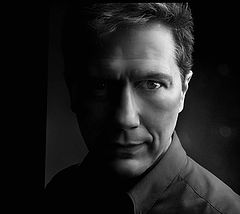 The work of Kevin Malone spans genres and media beyond conventional labelling. He is equally at home with electronics, multimedia and harpsichords to choirs and orchestras, embracing postmodernist and hybrid approaches across his work.





 The Cross-Eyed Pianist