I was distressed to read this article by Richard Morrison in The Times yesterday about the possibility that St John’s Smith Square (SJSS), a beautiful baroque Grade 1 listed church in the heart of Westminster, may close permanently within 18 months due to financial difficulties.
For a long time the poor relation, despite its best efforts, to the cultural edifice of the Southbank Centre just across the river, SJSS has in recent years put itself on the map as a go-to musical destination, thanks in no small part to the imaginative, open-minded and innovative efforts of its Director, Richard Heason. In post since 2012, Heason has transformed SJSS from a “hall for hire” into a distinctive, forward-thinking vibrant cultural hub in the heart of London with new commissions, specially curated festivals and events, concerts featuring the venue’s fine organ, and a programme which supports young artists early in their careers. And while the Queen Elizabeth Hall was undergoing major refurbishment, SJSS hosted the International Piano Series and International Chamber Music Series, bringing it further endorsement of its status amongst London’s classical music venues
Back in the 1980s, when my father worked for a leading international insurance company, I attended concerts at SJSS which were sponsored by his company. I remember being struck by the beauty of the venue and its fine acoustic. In recent years I have rediscovered SJSS, not least because of its ease of access from Vauxhall station (a mere 10-minute walk across the bridge and along Millbank). It is my favourite concert venue along with Wigmore Hall and I have enjoyed some very fine concerts there – piano recitals by Paul Badora-Skoda, Steven Osborne, Pierre-Laurent Aimard and Tamara Stefanovich, to name but a few, choral concerts by Polyphony, chamber music (most recently I Musicanti’s stimulating residency), Rolf Hind’s eclectic Occupy the Pianos Festival of contemporary music (returning 20th April), and Stephen Montague’s 75th birthday concerts (March 2018). I’ve heard premieres and new commissions, I’ve heard friends perform there, and I have made new friends there (a chance encounter in the café ahead of a performance of Messiaen last year). I have even had the privilege of performing at SJSS myself, playing the hall’s beautiful Steinway as part of its Music Marathon events, which bring amateur and professional musicians together to celebrate shared music making.
For purely selfish reasons, I would be very sad to see this fine venue close for good. It would also be a loss for London’s cultural/musical heritage. It is a wonderful place, with a vibrant, varied programme of music. If you have not already done so, I urge you to discover it and support it. It is easy to find, being located within walking distance of Vauxhall, Pimlico, Victoria and Westminster stations. There is a pleasant café in the crypt and the venue is staffed by friendly, helpful people. Richard Heason can often be seen at concerts and is very amenable and approachable.
To survive, SJSS needs “a minimum of £200,000 a year for at least ten years” (Martin Smith, Chairman of the Board of Trustees). It receives no regular public subsidy, unlike its neighbour across the river, nor money from the Heritage Lottery Fund or Westminster City Council.
To quote that well-known advertising jingle, “every little helps” – so buy a ticket or three, or become a Friend, and go and experience the magic of music at SJSS (and the lemon drizzle cake is pretty good too, enjoyed with an inexpensive glass of rosé!).
A pianist drums a rhythm with his fingers on the side of the piano stool. At first he appears to be simply warming up his hands, but the rhythm is insistent and repetitive. His fingers move up to the fall board of the piano, still drumming. His hand reaches around to the flank of the instrument, edging towards the gold Steinway logo. He stands and moves around the curved body of the instrument, still drumming drumming drumming…. Suddenly a red balloon flies out of the belly of the piano, twirling into the air with a comical farting noise…..
Another pianist curls over a tiny toy piano, picking out a quirky tune which, on that instrument, sounds like many carriage clocks chiming…..
A flautist yells at the end of a piece which requires overblowing, triple tonguing and other complex techniques
Welcome to the world of composer and pianist Stephen Montague.
In celebration of Stephen’s 75th birthday St John’s Smith Square played host to 24 hours of music making, beginning at lunchtime on Friday 9 March: 5 concerts during the day and evening followed by a performance of Satie’s bizarre Vexations – 840 repetitions (c15 hours of music) of a curious little two-line piece, played by a tag-team of pianists in hourly slots. In the crypt below a video wall (set up by film maker Rob Munday and Royal College of Arts students) showed a new film by Kumi Oda (a biography of Stephen Montague) along with short films by Alex Julyan, Rob Munday and others which ran throughout the day and into the long night.
The daytime and evening concerts featured works written over the course of 40 years, including some new commissions/premieres, and demonstrated the quantity, breadth, variety and richness of Stephen’s work. This is the man who had breakfast with Aaron Copland as a student and who spent 15 years working with maverick composer John Cage; who has lived in the UK since 1974 but who still retains very strong ties to his American homeland, not least through his music. He’s a composer with a keen imagination, sharp wit and a healthy sense of humour, who, in his own words, has lived his life “looking forward”, and who shows no sign of stopping now that he has reached his three score years and 15.
Stephen’s connections to the country of his birth were revealed most strongly in the first concert of the day, ‘After Ives….and Beyond’. One of the most significant influences on Stephen is the American composer Charles Ives, and in the 1pm concert pianists Mikaela Livadiotis, Yaoying Wang, Jiarui Li, Christina McMaster and Lewis Kingsley Peart performed a programme of works which paid a direct homage to Ives in the use of folksongs, hymns and spirituals, marches, jazz, boogie-woogie and the mechanised sounds of the 20th century, together with Ivesian tone clusters and musical collisions, strummed and plucked effects inside the piano, and the drumming on the piano case. These effects – and the later performance by flautist Rebecca Griffiths of Vlug (Speed) which uses extended techniques and overblowing – demonstrate, in my view, Stephen’s fascination with sound. Now that may seem a daft thing to say of a composer, whose business is to create sounds, but Stephen is a composer who likes to push the capabilities of the instrument to it limits to create deep dark rumblings in the bass of the piano, or ethereal strummed murmurs from its innards, proving that striking the keys needn’t be the only way to “play” a piano. Chords and collections of notes are used for their colour and timbre rather than strict harmonic progression, and theatrics, surprise, chance and silence are also important elements. These things connect him closely to John Cage, who beleived that “all sound is music”.
The piano works in this segment combined Lisztian virtuosity in tumultuous passages with moments of repose, delicate far-away melodies and fragments of hymn tunes. The concert closed with After Ives (1993) which ends with an outrageously rambunctious and “perverse homage” to J P Sousa, whom Ives apparently detested, quoting his famous The Stars and Stripes Forever on the piano with Chopinesque melodic interjections and Lisztian extravagance, all masterfully and very wittily handled by Lewis Kingsley Peart.
In the second concert, Beguiled, Stephen paid homage to another of his musical heroes, Henry Cowell (1897-1965), a composer who liked to “live in the whole world of music” – an ethos to which I suspect Stephen also subscribes! This concert had an altogether more reflective, meditative atmosphere, showcasing works which draw on Japanese and Indian musical aesthetics, Blues, loops and phasing, and graphic scores. Highlights of the programme were Haiku, (which, according to the composer’s introduction, started out as a very short work (like Haiku) and became a long one): beautifully and sensitively performed from memory by Chi-Ling Lok, it was haunting, dreamy and ethereal, while the accompanying electronics lent a rather more unsettled backdrop to the work; Nun Mull, ‘Tears’ (2014) written in memoriam the Korean ferry disaster, commissioned and performed by Jenna Sung, who brought a plaintive tragic intensity to the work; Raga Capriccio (2017), a kooky work for toy piano and tape, inspired by Indian music, commissioned and performed by Helen Anahita Wilson, which sounded like many clocks chiming and the delicate the “ting” of prayer bells; and Eine Kleine Klangfarben Gigue, in which the opening measures of the Gigue from Bach’s First Keyboard Partita provide a ground bass over which other instrumentalists (in this instance The Ling Ensemble – two recorders, violin and bass clarinet) gradually winkle out hidden melodies. It was played with a wonderful sense of humour and spontaneity, the musicians leaving the stage one by one as the piece drew to a close.
A quick glass of wine in the interval and back to the hall for the 4pm concert which was concerned with matters of life and death. Dark Train Coming (2001) was written for harpsichordist Jane Chapman and is the composer’s response to serious cardiac surgery following a doctor’s warning that he could be headed for the “Dark Train into the ether”. The work has a frenetic, filmic quality, with passages in the first movement reminiscent of the soundtrack to a silent film where the heroine is tied to a train track. In the second movement, we hear Baroque arabesques gone mad, while in the third the player taps out a rhythm on the case of the instrument before striking notes which have the exact electronic timbre and insistency of a hospital heart monitor. The finale was a simple melody in the upper treble accompanied by a music box playing Brahms’ famous lullaby, which suggested the hallucinatory landscape of anaesthesia and coming to from a deep sleep.
The middle works in the programme – Folk Dances (2002) performed by Ian Pace (piano) and Madeleine Mitchell (violin) and Mira, performed by pianist Roxanna Shini – were rather more upbeat. The first work was infused with idioms drawn from folk music, jazz and Blues, the second an exercise in using only the white notes of the piano with forearm clusters to create a work of expressive warmth. The programme closed with a magnificently portentous and apocalyptic organ work, Behold a Pale Horse (1990), inspired by the Book of Revelation (“Not exactly a happy birthday message but ya gotta have a sense of humour!”).
The final concert of the afternoon showcased talented young people performing works from Stephen’s collections Five Easy Pieces and Autumn Leaves, together with the world premiere of Hound Dog Blues for piano duo. In his introduction, Stephen explained that he has always found inspiration and nourishment from working with children and young people, and this charming short concert celebrated the new generation. Stephen even performed some of the music himself which lent a lovely sense of shared experience to the concert.
Fortified by more wine and supper, we returned to St John’s Smith Square for the evening concert which brought together other instrumentalists, pianists and the Fulham Symphony Orchestra, who between them performed three concertos, a short ensemble work called Dead Cat Bounce (2014) with lively animations on the columns of SJSS by Royal College of Art students, and a humorous piece Texas Pulp Fiction which was an ode to the composer’s travels through Texas on a Greyhound bus.
Ritual Ode to Changwan (2017) received its premiere at the concert. Performed by pianist Jenna Sung and the Project Instrumental ensemble, it is a theatrical work based on a popular South Korean folk song realised by prepared piano and string orchestra. Once again, we experienced the extraordinary sonic worlds a grand piano can produce when the pianist barely strikes a single note. It was a concentrated and highly arresting work in which the piano took centre stage, though not in the conventional sense of a classical piano concerto, but rather as a piece of performance art, and which finished with Jenna leaving a trail of tiny roses as she glided gracefully off the stage.
Disparate Dances showcased Nancy Ruffer (flute) and Oliver Wass (harp) in a three-movement work inspired by Eastern European, Japanese and Irish dance forms, with a wonderful foot-tapping, exuberant finale.
The final work of the evening was Stephen’s Concerto for Piano and Orchestra (1997). Scored in the traditional arrangement of soloist and orchestra and in three movements, it employs experimental elements favoured by Ives and Cowell, including fist and forearm clusters, and great walls of sound from the piano. The work draws on American vernacular music, folksongs and Civil War battle songs, and is an epic confluence of the composer’s American roots, viewed from the perspective of having lived away from the US for over 40 years. An intense, energetic and highly-charged work, it was performed with great gusto, vigour and elan by Rolf Hind.
Although the formal concerts finished at 9.45pm, the music was not over, and the performance of Satie’s Vexations, which had commenced at 9pm on an upright piano the crypt bar, continued upstairs as Norman Jacobs (New Music Brighton) appeared in the lift, playing the work on Helen Wilson’s toy piano. The music was then “transferred” to the upright piano and thence to the Steinway D for the overnight performance. Space was cleared in the hall for people to chill out or bed down for the night……. The all night count of repetitions was cleverly made visible by the RCA students’ real-time animation of expanding tree rings elegantly projected on the high walls and ceiling.
The whole event was a wonderfully vibrant and exhilarating showcase of Stephen Montague’s impressive compositional output, and the cheerful presence of the composer throughout the day – introducing the works, chatting to the audience – created a relaxed, informal atmosphere: this was very much music for friends, with friends and amongst friends.
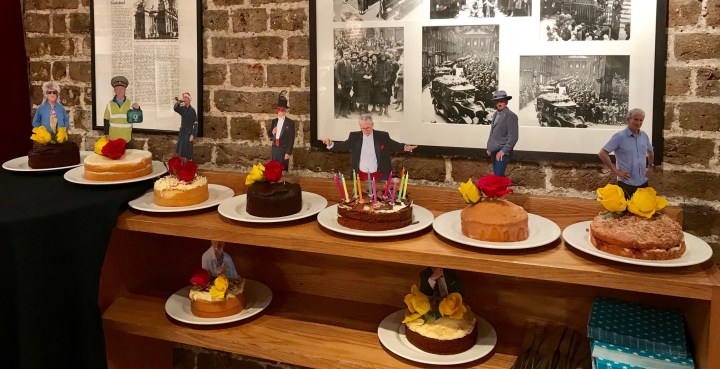
Birthday cakes for Stephen Montague in the crypt bar at St John’s Smith Square
Who or what inspired you to take up conducting and pursue a career in music?
I was born into a musical environment: my father, Bernard Rose, was a huge inspiration. He was a conductor, composer, scholar, organist, horn player, singer, inspirational teacher. I studied with him at Oxford and sang in his daily choir at Magdalen College, but before that I was a chorister at Salisbury Cathedral, as was my father, his brother and both my brothers. At Salisbury we had about 8 services a week, with about 12 rehearsals, from the age of 8-13. I remember thinking at the age of 12 or so that I wanted to be in music, and thought conducting would be good. My father sent me to have lunch with his old teacher at the Royal College of Music, Sir Adrian Boult, and Boult gently grilled me for over an hour over lunch, insisting that I should only pursue conducting if I really wanted it. This helped focus my mind. Leopold Stokowski used to stay frequently at our house from when I was very young, and I think this must have had an influence on me also. As soon as I went to Oxford I began serious conducting, having already taken on a small Oxfordshire choral society.
Who or what are the most significant influences on your musical life?
In the early days Christopher Dearnley, Organist at Salisbury Cathedral, and my first piano teacher, was a strong influence. Then at my senior school my teacher for A-level played me Stockhausen’s “Gesang der Juenglinge”. I was 15 years-old, and it blew my head off. I knew from that moment that I would dedicate much of my life to ‘living’ music.
When I left school I studied ’12-note music’ in Vienna with a former pupil of Arnold Schoenberg, and this has been a strong influence all my life. Whilst at Oxford I became fascinated by the conducting of Pierre Boulez, and used to go to watch him conduct. This was my main conducting influence.
What, for you, is the most challenging part of being a conductor? And the most fulfilling?
The most challenging aspect is inspiring musicians, professional, students or amateur, to create exciting musical sounds, and, hopefully, display their enjoyment of this to the audience. Certainly, it is very fulfilling teasing the written notes into audible sounds, whether it be medieval music, Classical or music of today.
As a conductor, how do you communicate your ideas about a work to the orchestra?
Through gesture as much as possible. When teaching conducting I stress the importance of “less talking is more music”. The fact that in the concert or recording venue at the moment of impact there is no speaking is a vital aspect of communication from conductor to musicians.
How exactly do you see your role? Inspiring the players/singers? Conveying the vision of the composer?
My first role as conductor is my being the representative of the composer in the room, from whatever period. I always do masses of research into the composer’s background at the time of composition, etc, before studying a work. I have had the pleasure of working directly with many hundreds of living composers, and I am a composer myself, so feel I am “on their side”! If the piece is not written out logically I do all I can to persuade the composer to make the scores as logical as possible.
Is there one work which you would love to conduct?
Stravinsky “Sacre de Printemps”
Do you have a favourite concert venue to perform in?
The Philharmonic Hall in St Petersburg, Russia, is unbelievable!
Who are your favourite musicians/composers?
There are too many to list. It goes from Perotin in the 1150s through to Machaut, Byrd, Tallis, Sheppard, Monteverdi, Bach, Mozart, Hummel, Beethoven, Mahler, Schoenberg, Berg, Webern, Stockhausen, Ligeti, Xenakis, Arvo Paert, Steve Reich…
As a musician, what is your definition of success?
Achieving a fine/masterful performance.
What do you consider to be the most important ideas and concepts to impart to aspiring musicians?
The joy of performing at the highest possible standard; rehearsal, rehearsal, rehearsal!
Where would you like to be in 10 years’ time?
Still conducting and composing internationally
What is your idea of perfect happiness?
The morning after a great concert!
What is your most treasured possession?
The autograph score of Bach’s B Minor Mass
What is your present state of mind?
Good! I’ve just finished editing a new CD in Latvia and am preparing for my 70th birthday concert in April. I am a lucky person!
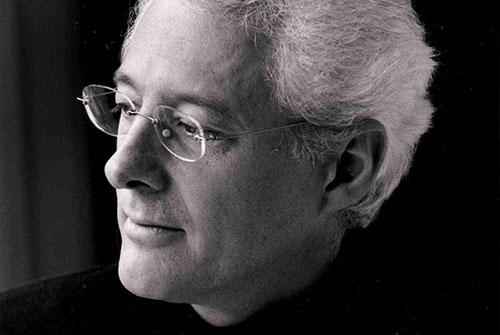
Gregory Rose’s 70th birthday concert is on 18 April 2018 at St John’s Smith Square. The programme includes several premieres, including a piece for solo voice with Loré Lixenberg and a new Violin Concerto, specially composed for the acclaimed violinist, Peter Sheppard Skærved.
Gregory Rose is particularly noted for his performances of the romantic and contemporary repertoires, having conducted over 300 premieres of orchestral, choral and ensemble music throughout Europe and the Far East. He studied violin, piano and singing as a young child and was a pupil of Hans Jelinek (Vienna Academy) and Egon Wellesz (Oxford University), both former students of Arnold Schoenberg, and of his father, the late Bernard Rose.
Gregory is Music Director of the Jupiter Orchestra, Jupiter Singers, Singcircle and CoMA London Ensemble. He has conducted many concerts and operas for Trinity College of Music, including concerts with the Contemporary Music Group, and operas by Poulenc, Stravinsky, Virgil Thomson, Scott Joplin, Berthold Goldschmidt, Samuel Barber, Nino Rota and Malcolm Williamson. He is a professor of conducting at Trinity Laban Conservatoire.
St John’s Smith Square announces OCCUPY THE PIANOS Festival 2018
Friday 20 -Sunday 22 April 2018
Celebrating two themes: Protest and The Journey Within
Including more than a dozen world premieres, a led meditation, a queer concert and Radulescu’s Icons in SJSS’s crypt (pianos laid on their sides with their action removed)
St John’s Smith Square is delighted to announce its third full Occupy the Pianos festival curated by pianist and composer Rolf Hind. The numerous concerts from 20-22 April are studded with many freshly-written works and radical takes on music and concert-giving, with new and radical piano music at its core.
The two themes this year are Protest (from the feminist angle in Maxwell Davies to the words of prisoners in Rzewski, from a plea for compassion to animals to radical rethinking of music making from a queer angle) and The Journey Within. These themes don’t merely relate to the music chosen but the manner of presentation: so the second main day – The Journey Within – will gradually dissolve into audience participation with everyone ending up downstairs in the cafe together, by way of a concert conducted as a led meditation with Eliza McCarthy.
Rolf Hind says of this year’s festival:
St Johns’s Smith Square is only a stone’s throw from Parliament Square, site of protest and agitation for hundreds of years. In keeping with our name, this year’s programming considers politics and protest. At the same time – reflecting the beautiful, serene space in which we find ourselves in this church, the festival’s 2nd day will move towards spirituality and the journey within, offering new ways for the audience to encounter music and their experience of it.
There will be more than a dozen new works over the weekend, placing the focus on future directions for the piano, a focus also highlighted by the appearance of the extraordinary Magnetic Resonator piano in Rolf Hind’s Friday night recital. There has been a Call for Scores (Occupy the Pianos received over 100 new pieces in the past) and the weekend begins with a workshop on writing for the piano, with further pieces dropped into the weekend as surprises.
Increasing the sense of fluidity between events there will be two of Radulescu’s Icons housed in the crypt. These Icons are grand pianos laid on their sides which have had the action removed and are then played in unique ways. At the end of the festival there will be a chance for members of the public to improvise on these instruments themselves.
Don’t miss the concert “On a Queer Day” on 21st April at 4pm, where several pieces will be introduced by an investigation of what it means to play Bach queerly and later that evening at 7.30pm there is Kagel’s Staatstheater, a surreal theatre piece, funny, disturbing, and politically engaged, which takes apart the whole concert hall experience, and doesn’t really put it back together again!
Also on the 20th there is a must-see performance of Peter Maxwell Davies’ extraordinary glimpse into the mind of a mad, wronged woman – uniquely in this case the role of Miss Donnithorne is shared by two of our most exciting vocalists, Elaine Mitchener and Loré Lixenberg.
Rolf Hind
Elaine Mitchener
Lore Lixenberg
George Barton
Eliza McCarthy
The musicians involved in Occupy the Pianos are hand-picked by Rolf Hind: creative, multi-faceted and collaborative.
As well as being wonderful players they are thoughtful and curious about repertoire, and willing to take part in different elements of the weekend which gives it a joyful, collegiate feel. In each festival new players are added to the mix, fascinating young players often at the beginning of their careers. Not necessarily the “prize-winners” but brilliant musicians with a distinctive edge and profile.
At the festival’s heart is an ever-growing team of brilliant musicians whose approach is outwardlooking, unconventional and curious. The collegiate communal spirit of that group has made Occupy the Pianos such an adventure. An adventure that continues…
The Cross-Eyed Pianist is free to access and ad-free, and takes many hours every month to research, write, and maintain.
If you find joy and value in what I do, please consider making a donation to support the continuance of the site








 The Cross-Eyed Pianist