Fans of acclaimed teacher and performer Graham Fitch’s insightful, instructive and highly readable blog Practising the Piano and eBook series, his regular contributions to ‘Pianist’ magazine, his YouTube videos on piano technique, and his inspiring and supportive workshops and courses will be excited to learn of his latest initiative for pianists, the Practising the Piano Online Academy.

ckrzfuvgi6b1nyn4vxa6

The Ultimate Online Resource for Pianists and Teachers 

The aim of the project is create the ultimate online resource for mastering the piano. Building on Graham’s hugely successful eBook series and blog, this will take his tried and tested methodologies to the next level with a comprehensive library of lessons, masterclasses and resources combined with insights from other leading experts. Aimed at piano teachers and pianists, these materials will be presented in an intuitive, interactive manner and will transform the way you approach teaching and playing the piano. The crowdfunding goal is £10,000 and funds raised will be used directly for creating additional content and resources.

Graham tells us more about the project:

I’m passionate about teaching and playing the piano. The art of practising is a special area of interest to me and is rarely taught specifically enough. Our practice time at the piano is just as significant to the end product as the hours of training undertaken by professional athletes, but this time can so easily be wasted unless we have the know-how.  Effective practice is essential to mastering the piano and it’s for this reason that I have spent decades researching and experimenting in the art of practising to find the optimal approaches.

I’ve developed a methodology comprising practice tools, strategies and techniques which I’ve tested and refined in my work with students of varying ages and levels of ability. I would love to see as many people as possible benefit from my work but obviously not everyone can get to me for one-to-one lessons. Therefore I’ve embarked upon a number of initiatives to make my work more widely accessible including my blog and eBook series. These provide a conceptual introduction to my approach and I am now planning to build on this foundation with the Practising the Piano Online Academy.

  • My blog (www.practisingthepiano.com) which is regularly updated and contains hundreds of articles on subjects relating to piano playing

  • Multimedia eBook series which combines text, video, audio and numerous musical examples to introduce my methodology and approach

  • A print version of my eBook series which is currently being developed due to popular demand

 The Practising the Piano Online Academy will build on these solid, tried and tested foundations and will take Graham’s work to the next level.

The Practising the Piano Online Academy is an extensive, searchable, and regularly updated library of lessons, articles and resources which will:

  • Illustrate my methodologies and approach in more depth with multimedia content, interactive features and resources including musical examples, worksheets and annotated scores which can be downloaded and printed.

  • Expand on practice tools and strategies with masterclasses and tutorials applying them to popular pieces in the repertoire, exam syllabuses and specific technical challenges.

  • Share the expertise of guest experts on subjects including applied theory, improvisation and healthy piano playing.

  • Be regularly updated, easily searchable and allow for personalisation with bookmarking and notes.

  • Be shaped by your input, responding to your questions and suggestions for new content to meet your needs.

 lfcyulnz44w2jcvvna08
What will it do for you?

Whether you are a budding student, keen amateur, passionate piano teacher or a professional musician, the Practising the Piano Online Academy will provide you with the knowledge and resources at your finger-tips to:

  • Get the best possible results from your time spent practising the piano.
  • Avoid injury and overcome technical difficulties with panache.
  • Learn new pieces quickly and master trouble spots or challenging areas within the repertoire.
  • Deliver performances or achieve examination results which reflect your full potential.
  • Inspire your students and enhance their enjoyment of the piano.

How can you be involved?

We’ve already started creating content for this project and are now seeking the further support of pianists and teachers via our crowdfunding campaign to help us make this resource as good as it can possibly be. A number of great rewards ranging from discounted subscriptions through to opportunities to sponsor lessons and obtain a one-to-one consultations with me are on offer. Supporters will also have an opportunity to shape the Online Academy by suggesting and voting for topics and content they would like to see featured.

To show your support for the project and to read about it in more detail, please visit https://www.indiegogo.com/projects/the-practising-the-piano-online-academy#/

https://www.indiegogo.com/project/the-practising-the-piano-online-academy/embedded

Development of the Practising the Piano Online Academy is already underway with Informance (see below), with an expected launch in July 2016.

ABOUT THE AUTHOR 

8481e4cf3afe7f10c19eGraham Fitch has earned a global reputation as an outstanding teacher of piano for all ages and levels.  He is a popular adjudicator, a tutor for the EPTA Piano Teachers’ Course, and a regular writer for Pianist Magazine with several video demonstrations on YouTube.  His blog www.practisingthepiano.com features hundreds of articles on piano playing and together with his multimedia eBook series is read by thousands of musicians all over the world.


ABOUT INFORMANCE

Informance ™ is a publishing imprint which creates rich, interactive digital publications aimed at musicians.  By combining state of the art technology with expert insight, Informance enables musicians to reach their full potential in the most effective and enjoyable manner.  It offers a modern way to engage with the timeless art of music making.

Informance is published by Erudition (www.eruditiondigital.co.uk), a next generation digital publishing company which partners with publishers and content owners to create purposebuilt digital publications from new or existing content.

This excellent initiative was started by Australian piano teacher and composer Elissa Milne. The purpose was to promote and implement the concept of students learning a huge quantity of piano pieces in one year to allow students to learn, experience and perform far more pieces than our exam-focussed culture tends to allow. Known learning outcomes from the exercise include improved sight-reading skills, greater independence in learning, and enhanced musicianship and music appreciation.

Another similar initiative is the Go-Play Project, in which US pianist and teacher Catherine Shefski set herself the task of learning (or relearning) a piece of piano music each week over the course of a year (she recorded the pieces and uploaded them to SoundCloud). Like many piano teachers, Catherine felt she was not spending enough time at the piano for herself amidst all the teaching and admin that goes with running a piano teaching studio. I followed Cathy’s project with interest and told myself that one day I would do something similar.

A new year, and a number of pianist friends and colleagues have embarked on their own 40-Piece Challenge. Despite, or because of, the fact that I have set myself a vast learning challenge in Schubert’s penultimate piano sonata (D959 in A), I decided it was time to try my own 40-Piece Challenge. My motives for doing so are slightly different from the original purpose of the project:

What kind of repertoire?

The Schubert sonata is a big work in four movements, which takes c.40 minutes to play, and the learning process is by necessity long and detailed. It would be foolish to add other very advanced works to my musical diet, so the premise is to learn shorter and “easier” works for the challenge. And the pieces selected do not necessarily have to be “new”: as part of the exercise, I am revisiting some pieces I learnt a few years ago. There is much to be gained from reviving previous repertoire, as new insights and ideas about the music are revealed.

To guard against boredom and retain variety in my practising

I would be crazy to devote all my practise time to the Schubert alone. Adding a variety of shorter works is a supplement to my main learning and a way of ensuring I retain interest and excitement in the piano.

To extend my repertoire

When one is working for exams or diplomas, there is a terrible tendency to focus only on the set pieces. This is not healthy, as too much focus on a narrow repertoire can lead to familiar pieces growing stale. One often finds that even the most disparate repertoire will inform other works. I also wanted to have a “bank” of pieces I could call on for the occasional concerts I give.

Each piece will be recorded and uploaded to my Soundcloud

Recording is an excellent way of evaluating one’s playing and an opportunity to listen in a different way, allowing us to make judgements about which areas need revision or improvement. By insisting on recording each piece, I am forcing myself to prepare each work carefully. This in itself is a useful exercise: just because the repertoire is “easier”, it should still be prepared to a high (concert-ready) level.

Update 1 – September 2015

With 27 pieces recorded and uploaded to Soundcloud, I am nearly three-quarters of the way through the project. There was a slight hiatus during the summer break when I was devoting much of my practise time to the Schubert Sonata in order to meet a personal deadline to have the entire sonata in the fingers by the end of June. Also, the piano was in need of a tune and I didn’t want to make any further recordings until it had been tuned.

Learning outcomes so far:

  • The project has encouraged me to learn “fast and smart”
  • I have become slightly less hyper-critical than usual about my playing, resulting in, I think, fresher and more imaginative recordings.
  • It has given me a focus in that each week I consider which works should be prepared for the challenge and add them to my practising diet.
  • It has made my work on the Schubert more enjoyable because there is variety in my practising regime

Update 2 – December 2015

I completed the project in early December – ahead of my deadline – and 40 pieces are now uploaded to my SoundCloud. I enjoyed the project very much, in particular the discipline of learning shorter pieces quickly and carefully. I am now considering a new 40 Piece Challenge for 2016 during which I will learn and record 40 new pieces of music (rather than a mixture of new and revived works).

The pieces:

For those considering a similar challenge, I offer some repertoire suggestions (intermediate to advanced level):

J S Bach – Kleine Preludes, Two- and Three-Part Inventions

Chopin – Preludes, Waltzes, Mazurkas, Nocturnes

Beethoven – Bagatelles

Schubert – Moments Musicaux, Ländler, Waltzes

Heller – Etudes

Rachmaninoff – Preludes, Moments Musicaux, 6 Morceaux Op 11, Etudes-Tableaux

Scriabin – Preludes, Etudes and other shorter piano works

Prokofiev – Visions Fugitives

Bartok – Mikrokosmos (later volumes)

Ligeti – Musica Ricercata

Debussy – Preludes, Children’s Corner

Scarlatti – Sonatas

Single movements from sonatas by Haydn, Mozart, Beethoven, etc.

Returning to old repertoire can be extremely satisfying, and one often discovers new things about the music when returning to it after a break. I also recall all the reasons what I like about the repertoire and why I selected it in the first place.
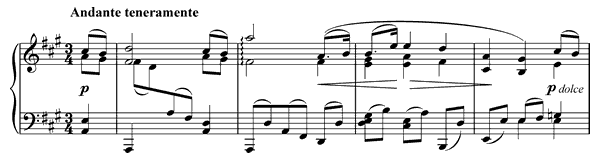
My teacher has cautioned me about reviving repertoire I learnt as a teenager. This is good advice, for despite a gap of over 30 years, all the impetuous errors of youth seem ingrained in the piece and the fingers, and undoing these problems can be nigh-on impossible. Against my teacher’s advice, however, I revived Schubert’s E-flat Impromptu for my ATCL Diploma in 2011, because I needed a “fast piece” in the programme. I had not touched the piece seriously for over 30 years, yet I was pleasantly surprised at how much of it I could remember (it must be said that this is not a particularly difficult piece to memorise, being constructed from repeating patterns and motifs). But working from the old Editions Peters score I had as a teenager meant that all the errors were still there, as well as my then teacher’s annotations. In order to learn the piece carefully, I ditched the dog-eared score and purchased a new Henle urtext edition. In effect, I started again from scratch with the piece: I learnt new fingering schemes, thought carefully about the structure and atmosphere of the piece, and was delighted to have it described as “an assured and stylistically accurate performance” by the diploma examiner. Having taken the trouble to re-learn the work carefully, it is now very securely lodged in fingers and memory.

People often ask me whether it is “hard” to revive old repertoire. In general, I have to say I have found it relatively easy to return to previously-learnt repertoire, though this isn’t always the case (the ‘Toccata’ from Bach’s 6th Partita will take some careful work if I want to revive it). However, one can take steps to ensure that once learnt a piece can be revived and made ready for performance relatively quickly.

Lately, I have been enjoying revisiting some of Szymanowski’s Opus 50 Mazurkas, the first two of which I played for my ATCL recital. The pieces felt different without the pressure of an exam hanging over me, and I felt I was playing them in a freer way as a result. I am also working on Rachmaninov’s G minor Etude-Tableau (Opus 33, No. 8), for my debut in the South London Concert Series in May (the piece will be paired with Szymanowski’s Mazurka no. 1). It is a mark of how carefully I practised the piece in the first place that within an hour of practising earlier today, I felt it coming back together nicely. Of course there are elements that will need some careful, detailed work (the cadenza, for example), but overall, it is still in pretty good shape. Getting it “concert ready” should not take too long.

Professional pianists will have many pieces “in the fingers” which can be downloaded and made ready for performance in a matter of days. This may include 20 concertos or more, most of Beethoven’s 32 Sonatas, many of Bach’s 48 Preludes and Fugues, plus other pieces which are ‘standard’ repertoire: Mozart and Schubert sonatas, works by Chopin, Schumann, Brahms and Liszt, much of Debussy and Ravel etc., and popular ‘standards’ from the 20th Century repertoire by composers such as Messiaen, Bartok, Stravinsky, Ligeti, Berio, Berg, and Schoenberg. Careful learning and preparation mean that repertoire can be learnt, revived and kept going simultaneously. It is this kind of deep, thoughtful practise that is essential for ensuring repertoire remains in the fingers (and brain) even if one is not practising it every day.

Some thoughts on reviving repertoire successfully:

  • Recall what you liked about the pieces in the first place. What initially attracted you to the pieces? Rekindle your affection for the pieces when you revisit them
  • Don’t play through pieces at full tilt. Take time to play slowly and carefully.
  • Trust your practise skills. Be alert to issues as they arise and don’t allow frustration to creep in.
  • Look for new interpretative and expressive possibilities within the music. Try new interpretative angles and meaningful gestures.
  • Don’t hurry to bring the piece up to full tempo too quickly. Take time to practise slowly and carefully.
  • Schedule performance opportunities: there’s nothing better to motivate practise than a concert date or two in the diary.

This week I had the pleasure and privilege of attending a piano seminar with acclaimed Italian pianist and pedagogue Carlo Grante. Held over two days (I attended the first day only), the seminar focussed on a number of topics, drawn from Carlo’s book Fundamentals of Piano Methodology and his new book, currently in preparation, including:

  • “Chunking up and down”: the Lisztian legacy of problem-solving in piano writing
  • Identifying structures in seemingly complex music
  • Voicing and tone production
  • Mind-mapping and memorisation

Presented in the form of a lecture with musical examples, student participation and demonstrations at the piano by Carlo himself, the seminar offered stimulating and interesting food for thought for piano students, teachers and professional musicians.

In the first lecture of the day on “chunking up and down”, Carlo demonstrated how apparently very complex music can be reduced into small units or motifs, enabling one to simplify the music for learning. This practice also has benefits for memory work, as well as musical analysis.

Using Liszt’s ‘Mazeppa’ (the fourth Transcendental Etude) as an example, a work that on first sight appears highly complex and virtuosic, Carlo highlighted recurrent patterns, both thematic and harmonic, and showed how Liszt manipulates and expands this material, while never really deviating from the opening statements.

This approach encourages one to:

      • Simplify the structure of a seemingly highly complex piece of music
      • Looking at harmonic progression to help fingering
      • Learning the shape of the harmonic “chunks” to learn appropriate/most comfortable/efficient hand shapes
      • Looking for predictable/familiar devices, such as chromatic scales, arpeggios or triads
      • Putting all these “chunks” together to create a whole

The second morning session used Brahm’s Intermezzo in A, Op 118 as the example for a discussion of how music can be divided into smaller elements, “zooming in” on these constituent parts to achieve more focussed practising.

For example, the right hand part divides into two distinct “voices”, upper and lower: practising each part or “voice” separately enables deeper learning. Much of this seems quite obvious, but it is surprising how many piano who play and study piano music do not use these kinds of learning tools.

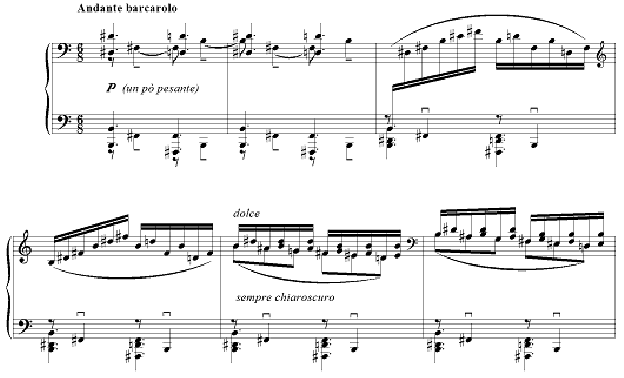
After lunch, during which I enjoyed talking about concerts and piano repertoire with some of the other participants, Carlo presented a session on memory work, demonstrating once again how reducing the music into small sections and patterns can facilitate memorisation. The musical example was Busoni’s elegaic barcarolle All’Italia.

Busoni

The session finished with some discussion on expressive grammar, the study of which is necessary for a truly coherent reading of a piece: by this, Carlo means not only the obvious dynamic, tempo and articulation markings, but other aspects such as the “stretching” intervals (in the manner of a singer), masculine and feminine endings and cadences, different types of accents and so forth.

Throughout the seminar, Carlo stressed that these aspects of piano study and method should not be seen in isolation and that the ultimate goal is to encourage deep, thoughtful practise resulting in an profound understanding of the music and the ability to play with expression. He also stressed the need to be a “curious learner”. All in all, it was an extremely valuable and thought-provoking seminar and I left full of new ideas for my own piano study and my teaching.

Carlo’s book Fundamentals of Piano Methodology is available in English (publisher Rugginenti)
