Guest post by Dakota Gale. The latest article in Dakota’s series Notes from the Keyboard, aimed at adult pianists


I recently attended a piano performance, during which I spoke with a 92 year old woman sitting next to me. She’d played and taught piano for decades. When I mentioned that I take lessons online, her eyes widened. “ONLINE lessons? But…that is the most amazing thing!”

She’s not the only one surprised. “Wow, you take lessons online?” is a common response from most people, even after the nuclear proliferation of pandemic Zoom meetings.

Yep, ever since I began taking lessons in spring of 2021, I’ve done them online. My teacher, Antonio, is located in southern Brazil; I’m in the Pacific NW in the U.S, thousands of miles away. And it’s not just me; plenty of people do it, including:

  • Those looking for specific expertise (e.g. Chopin etudes from a professional)
  • Those being careful while going through chemo or with a disease affecting their immune system.
  • Those who travel a lot (tougher if you’re flying, obviously)
  • If you have a favoured, dear teacher, but one of you moves, going online allow you to continue lessons.

Me and Online Lessons

For me, initially I took online lessons because of two things: to save money and to avoid COVID.

Since then, I’ve seen additional benefits. For one, they’re much more time efficient. No travel across town! For parents, I imagine this would be a huge benefit since you’d avoid shuttling kids around. (Actually, one of my friend’s kids is taking lessons with Antonio.)

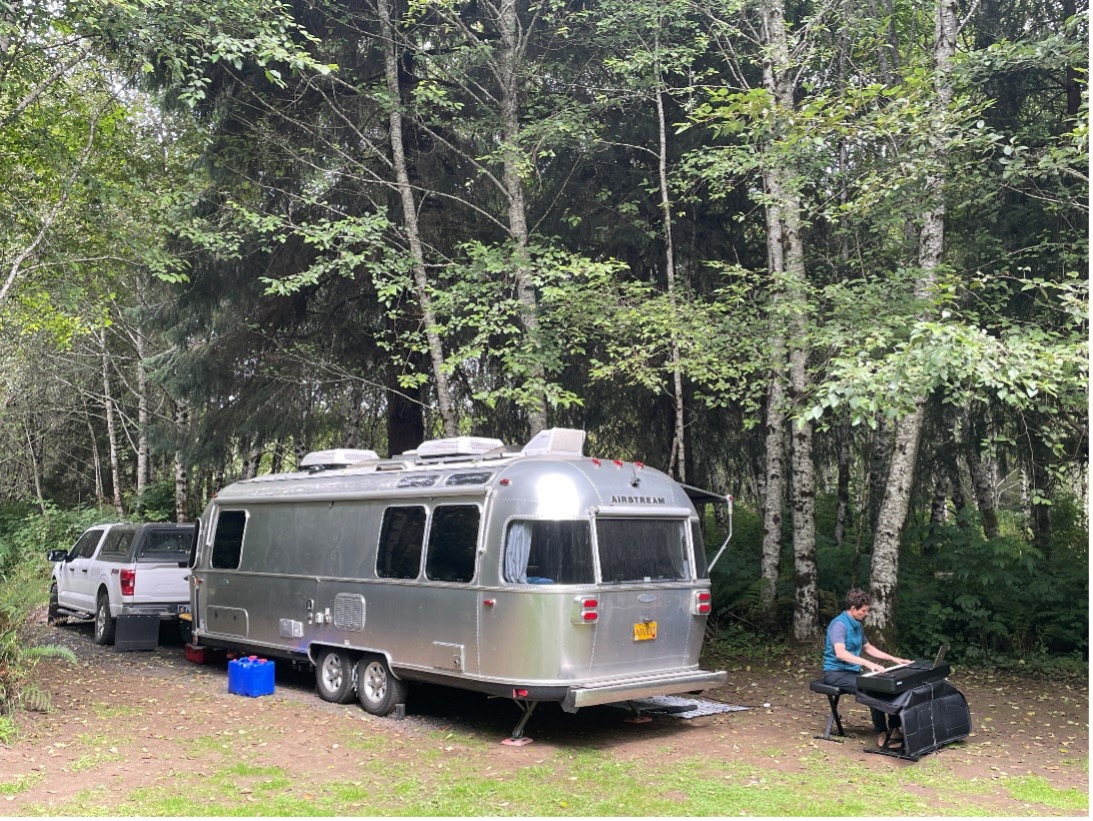
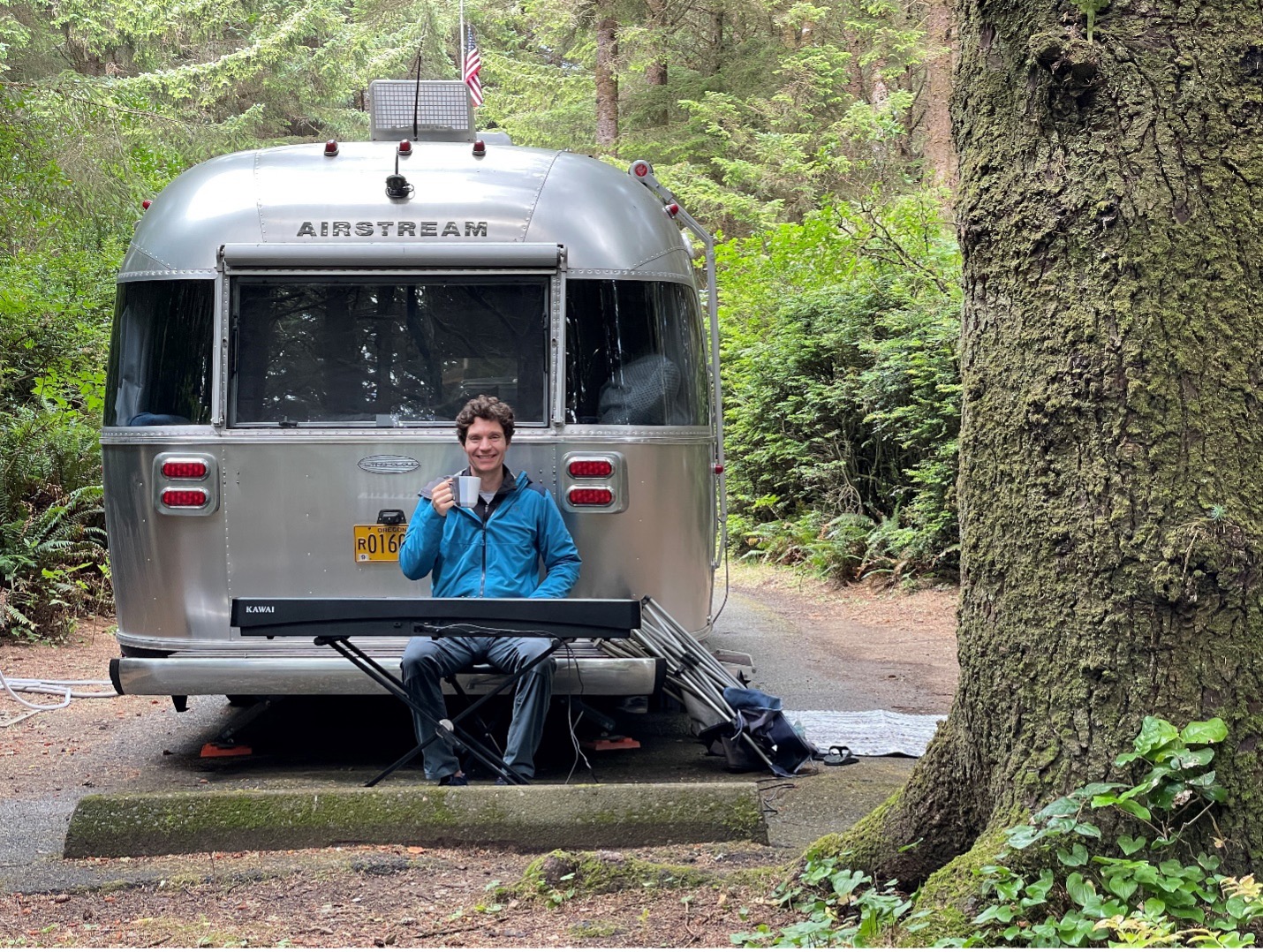
I travel fairly often and like to keep lessons going. In fact, I’m currently rolling around the Pacific NW with my wife for three months in a Airstream travel trailer. Between mountain bike rides, hikes, and hanging with friends, I’m both continuing to play consistently and still taking my weekly lesson. Courtesy of Starlink satellite internet and a digital Kawaii piano, I’m not skipping a beat.

When my teacher is on vacation, I’ve also taken lessons with professionals such as Grzegorz (Greg) Niemczuk, who I found on YouTube. You might be surprised how many YouTubers offer lessons (a friend takes lessons with the popular Heart of the Keys YouTuber.)

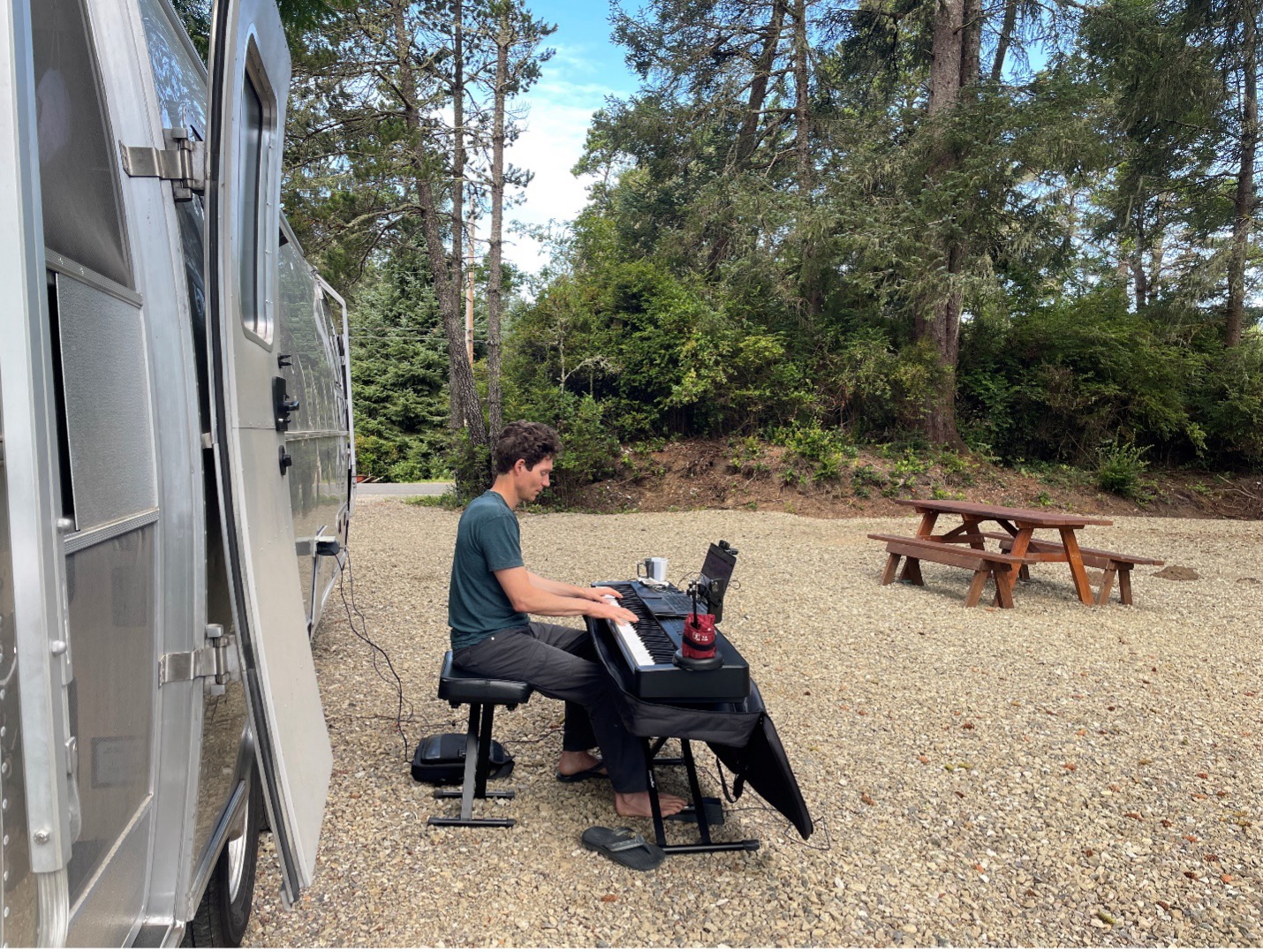
You know what makes piano better? Playing outside!

Beyond all those boring logistical things, Antonio being Brazilian brings a fun perspective to my experience. (I’ve learned a few choice phrases in Portuguese, for one!) I’ve also learned about (and love!) Brazilian music that I would otherwise not know, including tangos, the music of Tom Jobim and Ernesto Nazareth, and folk songs arranged for piano.

It inspired me to start a listening quest of different genres and international composers that has deepened my relationship to piano. Perhaps a local teacher would have provided that, but certainly it would have been different.

The nuts and bolts of online lessons

For those wondering how this is possible, allow me to describe the situation:

  • Antonio uses a Yamaha grand piano to teach. On it, he has four cameras for his face, top down on his hands, sideways on his hands, and another on his pedal. He even uses software that allows the camera to track his hands (AI magic!).
  • The sound quality is quite good–the nuances he can hear and comment on astonish me.
  • For my setup, I use a different system depending where I am. At home, it’s my computer with a webcam plus my phone on a stand looking straight down at my hands. While traveling, I just go with my phone on a small tripod set up to the side and occasionally my laptop in front of me. It works great.

The benefit of all this: the only time I’ve missed a piano lesson is when I’ve taken bikepacking trips. I challenge you to carry a full-size digital piano through the mountains…no thanks. A pianist needs to take a break from the keyboard SOMEtimes!

Resources:

To find an instructor, just type “piano lessons online” into any search engine. A few popular services: Superprof or Wyzant; a fellow traveler I met on this trip used Preply to find her ukelele instructor. (If you want to work with Antonio, just ping him on Whatsapp at +55 48 9181-9164.)

Cheers to piano on the road!


This site takes many hours each month to maintian and update. If you find value and pleasure in what I do, why not

I haven’t touched the piano for months. I have a beautiful early 20th-century Bechstein model A grand piano which has been sitting, untouched, in my piano room/office. There is music open on the stand – Schubert’s Piano Sonata in A, D664 – suggesting intent, but I have not played it seriously in over six months.

Why? Lack of motivation, lack of time, yes. But also something which I think is particular to the amateur musician – the knowledge that, unlike the professional musician who must practice regularly to maintain their skill and artistry, one can come back to the instrument at any time and pick up where one left off.

But it can be hard and the first line of that wise saying of violinist Jascha Heifertz – “If I don’t practice one day, I know it…” holds true as much for the amateur as for the  professional musician. The more time passes, the harder it becomes to start over again.

But it’s not impossible.

Rekindling the habit of practicing and playing the piano after a pause, however long, can be both challenging and rewarding. The key to a successful return lies in setting realistic goals, cultivating patience, and reviving your passion for music. Here’s a guide to help you navigate this journey back to the piano:

Set Realistic Goals

One of the first steps in returning to piano practice is setting achievable goals. Begin by assessing your current skill level and recognising that you may not be able to play at the same proficiency as before. Setting short-term goals that focus on gradual improvement, such as playing music that is already well-learnt or attempting a short piece or study, help you reacquaint yourself with the instrument, build confidence and provide a clear sense of progress.

Establish a Routine

Consistency is crucial in developing any skill, and piano playing is no exception. Create a practice schedule that fits comfortably into your daily routine. Practice “little and often”: even 15 to 30 minutes a day can make a significant difference over time. Ensure your practice sessions are regular, but also be flexible and kind to yourself if the demands of daily life/work interrupt your schedule.

Revisit Familiar Pieces

Playing pieces you were once comfortable with can be immensely satisfying and a great confidence booster. It allows you to gauge how much you remember and where you need to focus your practice. These familiar pieces can act as a bridge, easing you back into more challenging repertoire while providing a sense of accomplishment.

Explore New Repertoire

While revisiting old favourites is comforting, exploring new music can really reignite your interest. Choose pieces that inspire you and reflect your musical tastes. Don’t feel you have to learn certain pieces because they are good for you; play the music that interests you. Learning new repertoire not only keeps practice sessions interesting but also broadens your musical horizons and challenges your skills in different ways.

Seek Guidance and Support

If you have taken a long break from the instrument, consider taking lessons, even if only temporarily. A teacher can provide personalised guidance, help you set realistic goals, and correct any bad habits that may have formed during your hiatus. Additionally, joining a music meetup group can offer support, motivation, and opportunities to share your progress with others.

Be Patient and Positive

Returning to your instrument after a break requires patience and a positive mindset. Progress may be slow at first, and you might feel frustrated by the gap between your past abilities and your current performance. Set realistic goals and celebrate small victories – and, above all, remind yourself of the joy that playing the piano brings. With time and persistence, your skills will improve, and the music will flow more naturally.

Enjoy the Process

Ultimately, the journey back to the piano should be enjoyable. Embrace the process of relearning and rediscovering your love for the instrument. Allow yourself to experiment, make mistakes, and have fun. Remember, the ultimate goal is the joy and fulfilment that comes from making music.

Happy practicing!


This site takes many hours each month to maintian and update. If you find value and pleasure in what I do, why not

Following one of those wonderfully serendipitous encounters on the internet, I am delighted to present “Notes from the Keyboard”, a series of articles for adult amateur pianists, by Dakota Gale, chronicling his own experiences of learning the piano as an adult.


Four years ago, my wife surprised me with a digital piano for my birthday. I’d mentioned my desire to learn a few times and, ever the muse, she called my bluff.

I couldn’t read music. Finding middle C was a quest. I was a B-E-G-I-N-N-E-R.

And yet…she was right. At 38 years old, I tumbled rapturously into the world of piano. 

Four years later, the honeymoon phase is over, and yet I remain motivated to play every day and am still loving the journey. (<–understatement: I’m head-over-heels for it.)

I even do stuff like learning to do portraits by drawing musicians! (My wife tells me that’s eccentric…) 

I’m playing pieces by Chopin, Debussy, Beethoven, Liszt, and other famous composers that I thought were a decade off. Even facing the inevitable frustrations of piano study, I’m finding joy in piano every.single.day.

Learning piano transcends fun – I feel like I’ve unearthed a gift, a path to access some of the most beautiful music ever written. Accessing the pieces revealed a fountain of satisfaction that isn’t tied to money or achievement, a much-needed oasis of play as an adult.

In fact, I’ll often drop into a flow state for 30 minutes and be surprised when my timer goes off. Where else do we get that feeling once we’re done playing with Legos or mud pies?

You, mega-savvy adult reader, can do it too!

Adults CAN learn to play piano

I share my achievements not to brag (many pianists young and old far outshine my abilities), but to offer hope to adult learners. If you’re telling yourself, “Oh, I could never learn to play” or “I’m not musical” or “only kids can learn piano,” let me persuade you otherwise.

I’m shocked how many people tell me only children can learn. Well, kids are “naturals” at learning because:

  1. They don’t over-complicate things, focusing on foundational blocks that are small and approachable. (Be it music, language, or other skills.)
  2. Kids are able to practice more undistracted hours because an adult provides housing, food, and does their laundry. Their job is to be curious sponges; our Adult Role is often yawn-tastic Tuesdays, repeated.

Adults lack those luxuries. We put pressure on ourselves, try to play songs that are too hard for us, question if the time investment is worth it, and simply don’t have as much time to practice.

I’m an adult. (It snuck up on me.) On top of all the typical adult stuff, I have far too many hobbies. Sometimes friends do annoying things like interrupt my piano reverie to invite me to dinner or on bike rides. *sigh* The inconsiderate louts, I must practice!

And yet by carving out time each day to study piano, in a few months I reached a deeply satisfying level of proficiency that kept me coming back. After four years, I’m frankly astonished sometimes at what my fingers can do.

As a bonus, it’s beautiful for people to listen to (or so they pretend). A skill I’ll enjoy and develop for a lifetime, long after I’m done taking irresponsible risks on my mountain bike.

Beyond that, I’m fired up! I look forward to enjoying creating music the rest of my life and only wish I’d started earlier.


Dear reader, welcome to “Notes from the Keyboard: Adult Piano Chronicles” on The Cross-Eyed Pianist. This will be an ongoing series about my journey learning piano as an adult. I’ll share my journey (ups and downs!) and headaches with pieces and how I resolve them. I promise to absolutely not take myself too seriously—after all this is a hobby, not a vocation.

If you have ideas for topics you’d like to hear about from a dedicated amateur student of classical piano such as myself, please don’t hesitate to reach out. I’m looking forward to sharing this journey with you!


Dakota Gale

When he isn’t playing piano, Dakota Gale enjoys learning languages (especially Italian) and drawing. He also writes about reclaiming creativity as an adult and ditching tired personal paradigms in his newsletter, Traipsing About. He can often be spotted camping and exploring mountain bike trails around the Pacific Northwest.


This site is free to access and ad-free, and takes many hours to research, write, and maintain. If you find joy and value in what I do, why not

Guest post by Jessica Yeartie

To our benefit, there are usually several paths one can choose to arrive at the same end result. Doing so in the traditional way or manner, and the unconventional way. Whichever decision you make is incumbent on the most comfortable way for you in accomplishing something.

To me, I am always seeking the easiest and most convenient way to do something, however I would not perceive myself as lazy. I am just conservative and selective with how I spend my energy. The only thing I exercise to the brink of exhaustion on a daily basis is my brain and thought processes. I can usually just take a nap to recuperate when necessary.

When I had decided I wanted to learn the piano, I knew seeking out a professional teacher to personally instruct me was out of the question, financially and time-wise. My mentors and research consisted of pianists who posted helpful videos on YouTube for beginners and affordable piano books and exercises I could purchase from Amazon.

Due to my circumstances, these choices suited my situation best and I made the best with what I had at my disposal. If aspiring pianists have the funds to hire a personal instructor, I would highly encourage you to do so.

Many tactics I did not learn until much later would have been made aware to me had I had someone to overlook my practice sessions and provide instant feedback I could apply on my own time. Though I think I have gotten on fine enough considering the circumstances.

Like everything in this universe, there are pros and cons when we make these choices. When we choose one thing over the other, we are knowingly sacrificing what could have been had we chosen differently. Sometimes the fear of ¨what could have been¨ can cripple us so much that we just do not make a choice at all.

Some have the opportunity to experience both but I cannot say if that is the default when it comes to decision-making. Although, I can say that hard work can certainly aid with filling in the gaps where personal instruction could have been well-utilized.

Pros

Learning anything outside our immediate area of expertise is a struggle, to say the least. Fortunately the individuals who would consider themselves to be of a more independent nature could definitely benefit from the self-taught avenue.

Adhering to Your Own Schedule

Going solo means you do not have to refer to someone else for when a task should be completed. Finding ways to manoeuvre around each other´s, sometimes very busy, schedules can be time-consuming and hard to negotiate.

Also, life is still going on around us. Many of us have outside responsibilities that come first before giving precious time to what most would consider a hobby. Things like family, relationships, work, household duties, etc. are more than enough to keep the average citizen occupied for the majority of their week.

Of course we definitely need sleep as well, especially me. We are not machines that only need to be recharged when we are feeling fatigued at the end of a long, busy day. Being self-taught can eliminate some of these issues.

Photo by Juan Pablo Serrano Arenas on Pexels.com

No Time Constraints

Typically, teachers expect you to have practiced a certain amount during the week and present that to them when you see them next. Sometimes, the pressure of performing and getting in the required time for a full practice session can be tiresome and anxiety-inducing.

While I immensely enjoyed taking a piano close as a Junior in high school, I hated the weekly tests the teacher would grade us on for the song he selected. I always performed so much worse during the exam than when I was practicing and it frustrated me to no end.

Also, my school did not have enough pianos for each student to have their own so our allotted time slot was much shorter time to accommodate our larger than average classrooms. Now that I practice in the comfort of my own home, I can take as much time as I need to make sure I fully understand a concept.

Working at Your Own Pace

Slow-learners and fast-learners are the bane of the other´s existence. We all have that one subject or skill we excel in and get mildly irritated when others are not. At least that was the case for me in the past. I was even more irritated when I did not understand something and everyone else did, leaving me behind while I struggled.

Some concepts take longer to comprehend than others so rushing them can exacerbate their feelings of inadequacy, leading them to eventually quitting.

On the contrary, moving too slowly can lead to boredom. It is hard for a professional and newbie to come to terms with their individual skill levels and find a way to move forward that satisfies both of their needs.

Working alone means you can work as fast or slow as you need. You can speed up when something comes easier to you or take additional time for more difficult roadblocks without feeling like you are infringing on someone else´s time while still moving forward.

Cons

On the other side, there are some hiccups one should take into consideration before taking the plunge. While there is a considerable amount of freedom that comes with being self-taught, there are also some factors one should think about. Determine whether or not these possible setbacks are something you are willing to take on during your progression.

Lack of Support

One thing that makes starting a new hobby so exciting is meeting new people who have the same passion as you. This can be said about starting a new sport, joining a club at school, or attending weekly community gatherings for a specific project.

What all of these activities have in common is a group of individuals that are physically present. You have others you can converse with as the two of you are working while establishing a relationship.

In the beginning stages, learning an instrument can be kind of isolating if you are teaching yourself. Having a teacher present can remind you that they are there to help and support you when you eventually hit a wall. We can sometimes lose motivation when we have no one holding us accountable.

Lack of Foundation

If you are anything like me, you tend to want to skip the ¨boring¨ stuff and tackle the more exciting lessons. The problem with this is you hit a plateau much quicker due to a lack of knowledge in basic strategies you should have focused on to begin with.

We all have songs in our heads we really want to learn so we convince ourselves, prematurely, that we can learn it at our current level only to receive a slap in the face when you realize you cannot even play both hands at the same time without being out of time.

It takes a responsible person to stave off instant gratification and spend time on the more mundane, but important, aspects that are the very foundation of what they can accomplish in the future.

Little to No Feedback

Unless you asked someone to watch over you who is well-versed in piano and the proper form, you do not have much immediate feedback so you would have to refer to second-hand resources for clarity.

Playing in front of someone can be extremely nerve-wrecking but it is worth it to learn in the early stages which behaviours need to be corrected so they do not turn into bad habits that are nearly impossible to break further down the line.

Don´t shoot yourself in the foot by relying on your intuition in unfamiliar territory. There are lots of resources and videos out there that will inform you on better ways to play arpeggios or the perfect posture to maintain when practicing.

In Conclusion

We are all different. Some thrive in solitude while others, in the company of others. I do not regret that I chose to be self-taught however I definitely believe I could have benefited greatly from having a stable authority present to help me when I struggled.

Ideally, I think the best situation would be to experience both. Have a teacher as a novice player then gradually become more independent as you improve. That is just my opinion, though.

Whatever decision you choose is ultimately up to you unless you have parents who insist on paying for your lessons. I hope whatever path you choose leads you to victory.

Keep playing!


Jessica Yeartie is a US-based writer and blogger.

Find out more