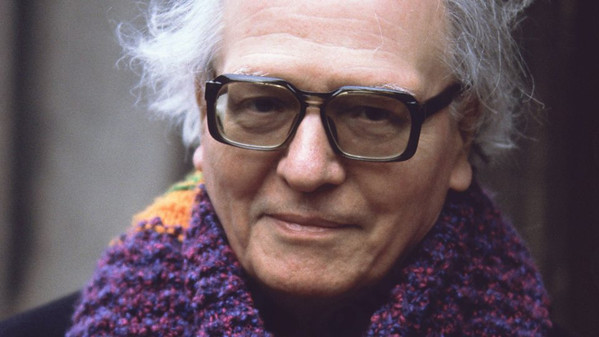
Olivier Messiaen is widely regarded as one of the most important composers of the 20th century, known for his unique approach to harmony, rhythm, and melody. His music is challenging for any performer, requiring not only technical skill, but also a deep understanding of his unique musical language.
The pianists presented here demonstrate a remarkable ability to capture the essence of Messiaen’s music, bringing out its intricate harmonies, colours, textures and rhythms, as well as its emotional depth.
Yvonne Loriod
Messiaen’s student, muse and second wife, Yvonne Loriod was a highly accomplished pianist in her own right. Many of his piano works were written with her in mind. The Vingt regards sur l’Enfant-Jésus (“Twenty Contemplations on the Infant Jesus”) were dedicated to Loriod, and she premiered the work at the Salle Gaveau in Paris in March 1945. Loriod’s playing is known for its clarity and precision, as well as her ability to capture the essence of Messiaen’s unique style. She recorded several albums of Messiaen’s piano music, including the complete set of Preludes and the Catalogue d’Oiseaux.Pierre-Laurent Aimard
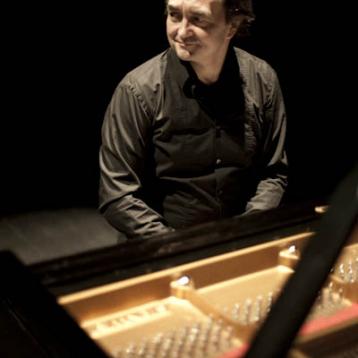
French pianist Pierre-Laurent Aimard is widely recognized as one of the foremost interpreters of Messiaen’s music. Aimard’s connection to Messiaen’s work runs deep, as he was a student of the composer and worked closely with him and his wife Yvonne Loriod. Aimard’s recordings of Messiaen’s piano music are considered some of the most authoritative, and he has performed Messiaen’s works all over the world to critical acclaim.
Angela Hewitt
Canadian pianist Angela Hewitt is perhaps best known for her interpretations of Baroque and Classical music, but she has also made a name for herself in more contemporary repertoire, including Messiaen’s piano music. Her recordings of Messiaen’s music are admired for their technical precision and attention to detail, as well as her ability to bring out the emotional depth of the music.
Steven Osborne
Scottish pianist Steven Osborne has performed Messiaen’s music all over the world, including the Vingt regards and Turangâlila Symphonie. Osborne expertly navigates the intricate harmonies and rhythms in Messiaen’s music with ease, bringing out the complex textures and polyrhythms that are hallmarks of the composer’s style. At the same time, he captures the emotional breadth and spiritual intensity that are crucial features of Messiaen’s music. His performances of the Vingt regards in particular are extraordinarily absorbing, meditative and moving, combining musicality, virtuosity and commitment. (I’ve heard Osborne perform this monumental work twice in London and on both occasions it has been utterly mesmerising and profoundly emotional.)
Tal Walker
For his debut disc, the young Israeli-Belgian pianist Tal Walker included Messiaen’s Eight Preludes. Composed in the 1920s, they are clearly influenced by Debussy with their unresolved or ambiguous, veiled harmonies and parallel chords which are used for pianistic colour and timbre rather than definite harmonic progression. But the Preludes are also mystical rather than purely impressionistic, and look forward to Messiaen’s profoundly spiritual later piano works, Visions de l’Amen (for 2 pianos) and the Vingt regards. Tal Walker displays a rare sensitivity towards this music and his performance is tasteful, restrained yet full of colour, lyricism and musical intelligence.
Other Messiaen pianists to explore: Tamara Stefanovic, Peter Hill, Jean-Yves Thibaudet, Ralph van Raat, Benjamin Frith, Peter Donohoe
This article first appeared on InterludeHKThis site is free to access and ad-free, and takes many hours to research, write, and maintain. If you find joy and value in what I do, why not
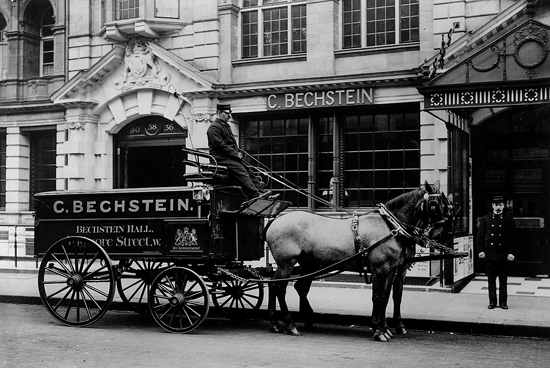
For one night only, audiences at the Wigmore Hall were treated to a glimpse of the hall’s origins, in those pre-First World War days when it was Bechstein Hall and home to the German piano maker C. Bechstein’s London showroom.
When Bechstein Hall opened in 1901, Bechstein was Europe’s leading piano maker (it produced 5000 pianos in 1901), its instruments preferred by most pianists outside America, where Steinway predominated. The Bechstein piano company built similar concert halls in Paris and St Petersburg to showcase its instruments and the leading performers and singers of the day. With its special barrel roof “shoebox” design, beloved of many musicians, the hall still boasts a fine acoustic, while its small size (its capacity is c600 seats) makes it the perfect place to enjoy intimate chamber and piano recitals.
At the beginning of the twentieth century Bechstein Hall on London’s Wigmore Street was promoted as the best of places for intimate music making, and boasted unrivaled comfort and facilities for patrons and artists with its elegant green room up a short flight of stairs behind the stage (so that singers did not arrive on stage breathless). At the time of its opening, concert life and leisure in general in London were enjoying something of a revolution. Theatres and music halls were opening across the west end, a wide public was being introduced to the experience of shopping for pleasure in the new “department stores” (Selfridges is a mere 10 minute walk, at the most, from Wigmore Street), and with cheap and efficient public transport, it was easy for people to enjoy these delights in the centre of the metropolis. A new breed of international concert promoters, agents and impresarios, such as Robert Newman, who with conductor Henry Wood founded the world-famous Proms, were dedicated to organising high-quality recitals, and Bechstein Hall alone scheduled two hundred concerts a year.
During the First World War, it became increasingly difficult for Bechstein Hall to trade viably. Strong anti-German sentiments and the passing of the Trading with the Enemy Amendment Act 1916 led to the hall’s closure in June 1916, and all property including the concert hall and the showrooms was seized and summarily closed. The hall was sold at auction to Debenhams, was rechristened Wigmore Hall and opened under its new name in 1917. Today Wigmore Hall enjoys an international reputation for high-quality music in an elegant and intimate setting.
To give the modern audience a flavour of those halcyon pre-war days of concertising in London, the French pianist Pierre-Laurent Aimard gave a concert on an 1899 Bechstein grand piano, a piano which may well have been sold out of the Bechstein piano showroom next door to the hall on Wigmore Street. The concert, which included music by composers active at the time when the Bechstein piano company was at the height of its powers, was preceded by a talk with Pierre-Laurent Aimard, Peter Salisbury, a leading piano technician who restored the piano, and composer Julian Anderson, whose work ‘Sensation’, written for Pierre-Laurent, had its London premiere at the concert.
As Pierre-Laurent Aimard explained, the event was the culmination of a long-held dream: to present a concert of the kind of repertoire and composers – and instrument – contemporary with the hall when it first opened. Peter Salisbury talked about the difficulties of preparing a piano for a specific hall, for each space has its own distinct acoustic and the piano must be adjusted and voiced to suit venue, performer and repertoire. When the 1899 Bechstein was brought into Wigmore Hall, Peter noted how closely instrument and venue suited each other, evidence that Bechstein built concert halls to showcase their instruments at their best – and vice versa!
Prior to the First War, piano design and manufacture was still evolving, and each make had its own distinct sound and character. Bechsteins of this period are notable for their special resonance and projection, which result from their manufacturing process. Pierre-Laurent commented on the piano’s uniquely rich palette of colour and tones, combined with great clarity. Every note seems to have “many overtones”, resulting in an orchestral sound which is rich but not cloying.
For composer Julian Anderson, the Bechstein piano has a special place in his life: his own piano is a 1913 Bechstein, passed on to him from his father, and is the instrument on which he composes. He admitted a “great affection for the Bechstein tone”, and that it has a range of colour which “encourages metaphor” and makes it easier to imagine other sounds or instruments when composing.
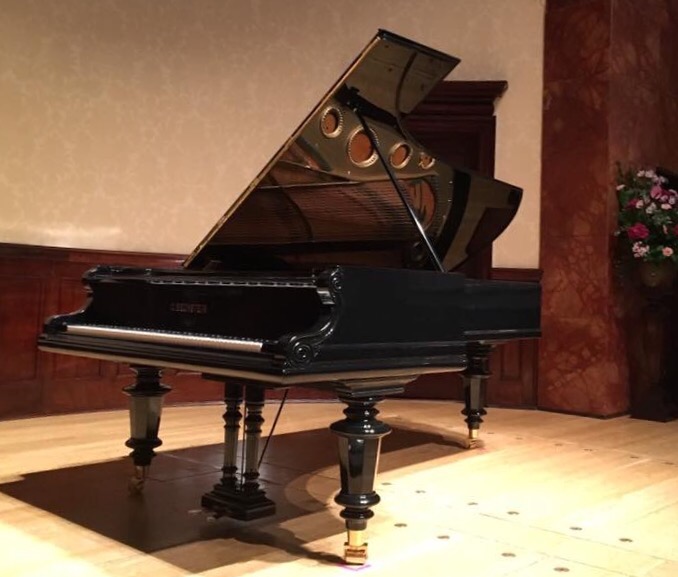
The 1899 Bechstein has been restored by Peter Salisbury and retains the original soundboard and bridge. A new mechanical action was fitted to provide technical accuracy, with new hammers voiced according to Bechstein’s original sound concert. An attractive instrument with a polished black case with scrolled details, the piano has turned legs and a fan-shaped music desk. The instrument is 275 cms (9 foot)long, with 88 notes (not all pianos were at that time – my Bechstein has 85 keys), and it took 3 months to rebuild it fully. For Peter the piano represents “a portal to the past, a lost era of tonal distinction”.
Peter Salisbury’s 1899 Bechstein concert grand on the stage at a Wigmore Hall
After 1910, piano design and manufacture became standardised across makes, and today most concert pianos (most commonly Steinway) have a consistency of sound and touch which enables performers to move fairly effortlessly between a piano in a Tokyo concert hall and one in London or New York. Concert pianos have also grown bigger to project into larger halls, and in the 10 years that I’ve been going t concerts regularly, I’ve noticed the sound of these pianos is, generally, much brighter and often quite strident.
As the owner of a 1913 Bechstein model A, I was very curious to hear this slightly older piano in a concert setting in an acoustic for which it was built. The programme included music by Liszt (the first version of Harmonies poétiques et religieuses), Scriabin and Debussy (both of whom owned Bechstein pianos), Julian Anderson (b.1967)!and Nikoly Obukhov, a colouristic Russian composer whose music bridges the Russian and French compositional traditions of the first decade of the twentieth century. The first half of the concert proceeded without interruption for applause (something with several audience members near me seemed to find quite “difficult”, though I enjoyed the flow of music from one composer to another). From the first notes of the Liszt, I felt I was hearing my own piano in concert – those distinct resonances and layers of colour which drew me to my instrument when I first played it in my tuner’s workshop were made more explicit in Pierre-Laurent’s hands. A surprisingly deep bass resonance, but clear and bell-like, without the chocolatey Sachertorte richness of a Bosendorfer, and a remarkable sustain with unexpected harmonics evident in the sound decay. In the Scriabin pieces, the piano’s multi-faceted sound came to the fore, responding perfectly to Scriabin’s sensual textures with harmonies superimposed on different registers and layered overtones.
The selection of Debussy’s Études was particularly fascinating. Here Pierre-Laurent balanced clarity with tonal sensitivity and the studies burst into to life with delightful shifting colours. The sweet lucid treble was wonderful, so different to the rather strident treble sound one finds in modern instruments, and there were further opportunities to enjoy this sound in the works by Julian Anderson and Nikolay Obukhov. Despite the piano’s resonance and sustain, there was no sense of the sound being too big or overly domineering (again an issue, for me at least, with modern concert grands in medium-sized or small venues). For me, the highlights of the evening, aside from the opportunity to hear this period piano in concert, were the works Debussy and Obukhov – had I not seen the programme, I would have thought the latter was post-Vingt Regards Messiaen, yet this was music written prior to the Russian Revolution, avant-garde and way ahead of its time.
In a recent interview for Reuters, French pianist Pierre-Laurent Aimard described Debussy as a “hedonist” of sound, and this definition was clear in Aimard’s performance – one of incredible precision, intensity, sensitivity, and sensuality, which showed Debussy to be a composer of great complexity, a profound and dark artist, and a revolutionary of sonority and musical colour. Read my full review here
French pianist Pierre-Laurent Aimard demonstrated Liszt’s far-reaching musical legacy in a spell-binding concert of intense concentration and illuminating pianism celebrating Liszt’s bicentenary and the release of Aimard’s new recording, The Liszt Project. Read my review for Bachtrack.com here.
The Cross-Eyed Pianist is free to access and ad-free, and takes many hours every month to research, write, and maintain.
If you find joy and value in what I do, please consider making a donation to support the continuance of the site

 Olivier Messiaen is widely regarded as one of the most important composers of the 20th century, known for his unique approach to harmony, rhythm, and melody. His music is challenging for any performer, requiring not only technical skill, but also a deep understanding of his unique musical language.
The pianists presented here demonstrate a remarkable ability to capture the essence of Messiaen’s music, bringing out its intricate harmonies, colours, textures and rhythms, as well as its emotional depth.
Yvonne Loriod
Messiaen’s student, muse and second wife, Yvonne Loriod was a highly accomplished pianist in her own right. Many of his piano works were written with her in mind. The Vingt regards sur l’Enfant-Jésus (“Twenty Contemplations on the Infant Jesus”) were dedicated to Loriod, and she premiered the work at the Salle Gaveau in Paris in March 1945. Loriod’s playing is known for its clarity and precision, as well as her ability to capture the essence of Messiaen’s unique style. She recorded several albums of Messiaen’s piano music, including the complete set of Preludes and the Catalogue d’Oiseaux.
Pierre-Laurent Aimard
French pianist Pierre-Laurent Aimard is widely recognized as one of the foremost interpreters of Messiaen’s music. Aimard’s connection to Messiaen’s work runs deep, as he was a student of the composer and worked closely with him and his wife Yvonne Loriod. Aimard’s recordings of Messiaen’s piano music are considered some of the most authoritative, and he has performed Messiaen’s works all over the world to critical acclaim.
Angela Hewitt
Canadian pianist Angela Hewitt is perhaps best known for her interpretations of Baroque and Classical music, but she has also made a name for herself in more contemporary repertoire, including Messiaen’s piano music. Her recordings of Messiaen’s music are admired for their technical precision and attention to detail, as well as her ability to bring out the emotional depth of the music.
Steven Osborne
Scottish pianist Steven Osborne has performed Messiaen’s music all over the world, including the Vingt regards and Turangâlila Symphonie. Osborne expertly navigates the intricate harmonies and rhythms in Messiaen’s music with ease, bringing out the complex textures and polyrhythms that are hallmarks of the composer’s style. At the same time, he captures the emotional breadth and spiritual intensity that are crucial features of Messiaen’s music. His performances of the Vingt regards in particular are extraordinarily absorbing, meditative and moving, combining musicality, virtuosity and commitment. (I’ve heard Osborne perform this monumental work twice in London and on both occasions it has been utterly mesmerising and profoundly emotional.)
Tal Walker
For his debut disc, the young Israeli-Belgian pianist Tal Walker included Messiaen’s Eight Preludes. Composed in the 1920s, they are clearly influenced by Debussy with their unresolved or ambiguous, veiled harmonies and parallel chords which are used for pianistic colour and timbre rather than definite harmonic progression. But the Preludes are also mystical rather than purely impressionistic, and look forward to Messiaen’s profoundly spiritual later piano works, Visions de l’Amen (for 2 pianos) and the Vingt regards. Tal Walker displays a rare sensitivity towards this music and his performance is tasteful, restrained yet full of colour, lyricism and musical intelligence.
Other Messiaen pianists to explore: Tamara Stefanovic, Peter Hill, Jean-Yves Thibaudet, Ralph van Raat, Benjamin Frith, Peter Donohoe
This article first appeared on InterludeHK
Olivier Messiaen is widely regarded as one of the most important composers of the 20th century, known for his unique approach to harmony, rhythm, and melody. His music is challenging for any performer, requiring not only technical skill, but also a deep understanding of his unique musical language.
The pianists presented here demonstrate a remarkable ability to capture the essence of Messiaen’s music, bringing out its intricate harmonies, colours, textures and rhythms, as well as its emotional depth.
Yvonne Loriod
Messiaen’s student, muse and second wife, Yvonne Loriod was a highly accomplished pianist in her own right. Many of his piano works were written with her in mind. The Vingt regards sur l’Enfant-Jésus (“Twenty Contemplations on the Infant Jesus”) were dedicated to Loriod, and she premiered the work at the Salle Gaveau in Paris in March 1945. Loriod’s playing is known for its clarity and precision, as well as her ability to capture the essence of Messiaen’s unique style. She recorded several albums of Messiaen’s piano music, including the complete set of Preludes and the Catalogue d’Oiseaux.
Pierre-Laurent Aimard
French pianist Pierre-Laurent Aimard is widely recognized as one of the foremost interpreters of Messiaen’s music. Aimard’s connection to Messiaen’s work runs deep, as he was a student of the composer and worked closely with him and his wife Yvonne Loriod. Aimard’s recordings of Messiaen’s piano music are considered some of the most authoritative, and he has performed Messiaen’s works all over the world to critical acclaim.
Angela Hewitt
Canadian pianist Angela Hewitt is perhaps best known for her interpretations of Baroque and Classical music, but she has also made a name for herself in more contemporary repertoire, including Messiaen’s piano music. Her recordings of Messiaen’s music are admired for their technical precision and attention to detail, as well as her ability to bring out the emotional depth of the music.
Steven Osborne
Scottish pianist Steven Osborne has performed Messiaen’s music all over the world, including the Vingt regards and Turangâlila Symphonie. Osborne expertly navigates the intricate harmonies and rhythms in Messiaen’s music with ease, bringing out the complex textures and polyrhythms that are hallmarks of the composer’s style. At the same time, he captures the emotional breadth and spiritual intensity that are crucial features of Messiaen’s music. His performances of the Vingt regards in particular are extraordinarily absorbing, meditative and moving, combining musicality, virtuosity and commitment. (I’ve heard Osborne perform this monumental work twice in London and on both occasions it has been utterly mesmerising and profoundly emotional.)
Tal Walker
For his debut disc, the young Israeli-Belgian pianist Tal Walker included Messiaen’s Eight Preludes. Composed in the 1920s, they are clearly influenced by Debussy with their unresolved or ambiguous, veiled harmonies and parallel chords which are used for pianistic colour and timbre rather than definite harmonic progression. But the Preludes are also mystical rather than purely impressionistic, and look forward to Messiaen’s profoundly spiritual later piano works, Visions de l’Amen (for 2 pianos) and the Vingt regards. Tal Walker displays a rare sensitivity towards this music and his performance is tasteful, restrained yet full of colour, lyricism and musical intelligence.
Other Messiaen pianists to explore: Tamara Stefanovic, Peter Hill, Jean-Yves Thibaudet, Ralph van Raat, Benjamin Frith, Peter Donohoe
This article first appeared on InterludeHK






 The Cross-Eyed Pianist