Guest post by Frances Jones

As a big fan of Poulenc’s music, I’m delighted to see his Concerto for Two Pianos on the Proms programme this year. It’s an exciting piece, both for performers and audience alike, and great to see in concert. But it’s the solo repertoire that occupies my thoughts at the moment, as I try to get to grips with another of his Nocturnes. I mentioned in a previous article back in May that I was working on the first Nocturne and although I haven’t made as much progress as I might in learning the rest, snatches of these sublime musical portraits have been flitting around my head like moths around a camp-fire (more on moths later).

There are eight Nocturnes, composed between 1929 and 1938 when Francis Poulenc was in his 30s. Some of them have descriptive titles, suggesting glimpses of civilised nocturnal scenes, and they alternate between the serenely beautiful and the fast and furious.

Number 1 falls into the first category; Poulenc’s ability to write a beautiful melody is proven in the opening bars, and he uses the range of the piano and takes unexpected harmonic turns as the music progresses. It is at once original, with an edge of melancholy, and also deeply comforting to listen to. Despite the discords, the music always resolves but almost never to a straightforward major chord; there’s always a note that ‘jars’ slightly with the rest. I like to think this is Poulenc’s way of telling us that, whilst there might be great beauty in the world, there is no such thing as perfection in life and his music does not intend to escape this.

Number 3, ‘Les Cloches de Malines’, gives us the bell-like sound promised in the title. He sets up an almost-repeated bassline to represent the bells, switching from 3 time to 4 time and back so it feels out of kilter; with Poulenc, there is always a twist. After being lulled into a false sense of security with the bells’ gentle music, there is a bar of complete silence, followed by a passage of brash accented chords, marked agité. It is as if the bells have gone rogue, and reminds me of one of Charles Dickens’ Christmas stories, in which the traveller is tormented by incessant ringing and imagines climbing up the church tower to the bells which have taken on frightening forms. He awakes in the morning and, of course, it’s all been a dream. So it is in this nocturne; after the clanging and clashing there’s another bar of silence and the familiar bassline of the opening returns; all is well, and normality has been restored.

The fifth nocturne is a portrait of moths (‘Phalènes’) and, as the music is both presto and staccato in the opening section, these insects seem to be clamouring around a light; a street-lamp perhaps, or a glint from a window. The music is animated and there’s no real let-up until the end. It switches between pp and f, even ff, from legato to staccato, until finally coming to rest with a big sforzando chord.

Number 7 is another of the faster pieces but this one is joyful from the outset. It was written in August, 1935; perhaps the composer was enjoying a summer holiday in the country or at the coast – but this is speculation. The music runs up and down the keyboard in a friendly chase. Even the middle section, steady and perhaps somewhat cautious if a depiction of a character was intended, lasts only a short time before the carefree melody of the opening returns. This nocturne has no title; it’s up to the listener to make their own conjectures.

The final nocturne, Number 8, was written as a coda to the collection. It’s another lyrical melody, but concise; a final moment of gentle beauty after the antics of the previous piece. Number 8 brings the cycle full circle, using the ending of the first nocturne to draw the piece, and the collection, to a close. Having listened to these pieces countless times, I feel I’ve gained a glimpse into the composer’s life. But only a glimpse and, after all, that’s what these nocturnes are; sounds of the evening, auditory shapes in the twilight. I like that about them; the titles of some give us ideas but, for the rest, we can make our own suppositions. I haven’t yet come close to learning all eight, but I feel much better acquainted with them, and that’s a good start.


Frances Jones read music at York University followed by a PGCE at Cambridge. She teaches piano in SW London.

I can’t remember when I first heard this piece, but it was almost certainly on BBC Radio Three’s Breakfast programme and, as is often the way, the piece caught my attention and I decided to find out more about it.

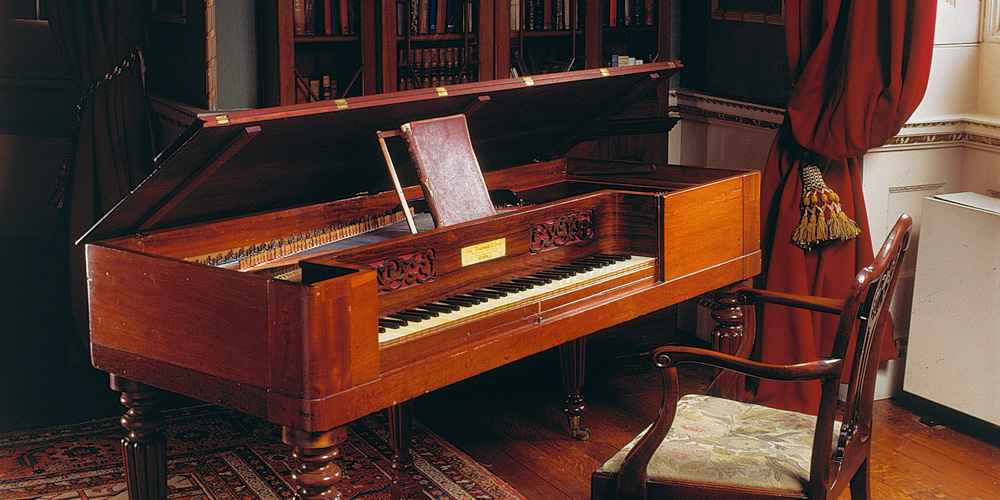
My score has the date “September 2013” inscribed on the inside cover, which means I purchased the sheet music just a month after I took delivery of my 1913 Bechstein model A grand piano. A few months prior to this, I visited the Cobbe Collection, a fascinating collection of historic keyboard instruments, and had the opportunity to play a square piano which had belonged to Edward Elgar. 

(Image: The Cobbe Collection)

Elgar composed Dream Children in 1902, so my piano is almost contemporary with the piece. Originally written for small orchestra, the work offers a glimpse into the composer’s more introspective and poetic side. The transcription for solo piano highlights the music’s delicate lyricism and nostalgic in a more intimate setting. The work’s reflective mood and gentle expressiveness make it one of Elgar’s most personal and touching miniatures.

The title Dream Children comes from an essay by Charles Lamb, “Dream Children: A Reverie,” published in 1822. In that essay, Lamb imagines telling stories to his children – who, by the end, are revealed to be only figments of his imagination, the children he might have had with his lost love, Alice. Elgar was deeply moved by Lamb’s bittersweet meditation on memory, loss, and the power of dreams, and he translated those emotions into music with remarkable sensitivity.

The piece consists of two short movements. The first, marked Andante, unfolds like a tender lullaby. Scored in 12/8, it has the feeling of a gentle barcarolle with a simple and songlike melody evoking the innocence of childhood and the wistful beauty of remembered joy. The music rarely leaves the pp and ppp dynamic range, except for bar 8 where there is a moment of drama marked molto lento, leading to a sustained g minor chord. Elgar emphasises the tender wistfulness of the piece through the use of rubato, ritardandos and pauses. At the very end, a single modulation through the introduction of a B natural in the bass brings the piece to an close on a hopeful, literally uplifting note.

The second movement, Allegretto piacevole, provides an animated contrast while maintaining the same emotional core. Its mood and rhythm is more animated, with a gently lilting character. A pianist friend of mine remarked that the semiquaver figures in this movement suggest the composer cycling around the countryside of Malvern where he lived. Yet even in its lighter moments, there is an underlying poignancy. The coda returns to the theme of the first movement, back in g minor now, but once again the music ends in G major, fading into a ppp whisper.

While not especially technically challenging for the pianist (I would say this piece is around Grade 6 to 7 standard), the piece requires sensitivity of touch and competent legato pedalling in the first movement to sustain the cantabile melody. And while the first movement remains in a mostly hushed dynamic range, there is plenty of scope for expressivity.

I recently played this piece for a friend who owns a beautiful Steinway B. Having not touched the music for nearly 10 years, I was reminded of just how charming this pair of miniatures is. The score is published by Faber Music.

Here’s another atmospheric solo piano piece by Elgar:

This site is free to access and advert-free, and takes many hours each month to compile and edit. If you find value and joy in this site, please consider making a donation to support its continuance:

24 Preludes for Piano by Nicholas Scott-Burt

Da-Hee Kim piano

Premiere recording

Listen to the opening measures of the sixth Prelude from Nicholas Scott-Burt’s 24 Preludes for Piano, and you might be forgiven for thinking this is actually by J S Bach, with its combination of rigour and elegance, counterpoint and Baroque flourishes.

The ghost of Bach is also present in the very first Prelude of the set, redolent of the C major Prelude from Book 1 of the WTC in its processional momentum, its rhythm, and expression. Played by pianist Da-Hee Kim with a luminous glow and clear articulation, it’s a wonderful opening to this intriguing new release of contemporary piano music, drawing you into a composer’s soundworld that is richly coloured, texturally diverse, witty, and at times quite beautiful. 

British composer Nicholas Scott-Burt composed his 24 Preludes during 2019 and 2020. Following a tradition established by J S Bach and continued by, among others, Chopin, Debussy, and Shostakovich, Scott-Burt’s cycle reimagines the prelude as both a brief musical statement and a means for expressive variety. Each piece acts as a standalone miniature whilst also contributing to the overall narrative of the complete set: the Preludes are organised into four ‘Books’, which can be performed as an integrated sequence, ‘pausing for longer at the end of each book, as one might pause between the movements of a sonata or symphony’ (Nicholas Scott-Burt).

Each book has its own distinct character: Book 1 is neat and neo-classical; Book 2 is more extravagant and romantic; Book 3 is somewhat more introspective; and Book 4 is bright and sunny, though not without some darker moments.

The composer was kind enough to allow me to see the score, and it’s clear that he draws on a wide range of pianistic textures, rhythmic gestures, and harmonic languages in his writing. Some preludes evoke lyrical introspection, others have driving rhythmic energy or contrapuntal interplay. There’s a powerful array of dynamics from hushed delicacy to declamatory chords, and many of the preludes experiment with colouristic sonorities that brilliantly celebrate the piano’s resonance, sonic variety and expressive range. 

With their imaginative harmonic progressions, rhythmic variety and shifting tonal perspectives, each prelude embodies its own character and atmosphere. The result is a sequence that invites both performer and listener to explore a wide range of moods – from reflective calm to virtuosic brilliance – within the intimate scope of the piano miniature.

While rooted in the tradition of the prelude cycle, Scott-Burt’s collection has a distinctly modern voice, with his musical influences clearly evident. It echoes composers such as Bach, Chopin, Shostakovich, as well as Handel, Purcell, Schumann, Liszt, Prokofiev, Bartók, Messiaen, and jazz. Scott-Burt skillfully integrates all the colours of his own compositional language to craft music that is individual and contemporary, while acknowledging the rich traditions from which it emerges.

Award-winning Korean pianist Da-Hee Kim performs the preludes on this premiere recording, bringing both sensitivity and virtuosity to the music, always alert to its shifting colours and textures. She delivers pristine articulation, supple phrasing, some impressive pedal technique, a luminosity of tone, and wonderfully weightless playing, when required, highlighting the individual character of each prelude, and ‘musical personality’ of each Book.

In addition to the 24 Preludes for Piano, this album includes two further works by Scott-Burt, his Minimalis I, ‘a self-imposed experimental exercise in structuring’, and Love Song, a contemporary on the tradition of the piano ‘Love Song’ by composers such as Mendelssohn, Schubert, Schumann, and Liszt.

This is a wonderful addition to the contemporary piano literature, and I truly hope the composer can find a publisher for his 24 Preludes, so that more pianists, both professional and amateur, can explore and enjoy it. 

24 Preludes for Piano is released on the Divine Art label on CD and streaming.

Read Meet the Artist interviews with Da-Hee Kim and Nicholas Scott-Burt

This atmospheric piece for solo piano, whose Afrikaans subtitle ‘Wind oor die Branders’ translates as Wind over the Waves, is by Richard Pantcheff  (b.1959). It comes from ‘Nocturnus’, a suite of six pieces written for different instruments; the final work in the suite is 4th December 1976, written in memory of Benjamin Britten on the fortieth anniversary of the composer’s death. Pantcheff was mentored in composition by Benjamin Britten in the last years of Britten’s life, and his music displays a distinct affinity with Britten’s soundworld, as well as that of earlier English composers including Vaughan Williams, Herbert Howells, Gerald Finzi and Elizabeth Lutyens.

A prolific composer of choral, organ, chamber and instrumental works, Richard Pantcheff was trained in choral music and composition from an early age, initially as a chorister at Ripon Cathedral, and studied music at Christ Church, Oxford, under Simon Preston and Francis Grier. His music has been widely performed and praised for its originality and technical brilliance, combined with intellectual and emotional depth.

I discovered this piece through ‘De Profundis Clamavi’, a recent recording by British pianist, and friend of mine, Duncan Honeybourne. Duncan is a keen advocate of English music and a champion of lesser-known repertoire, and his recording on which ‘Nocturnus V’ appears (together with Pantcheff’s substantial Piano Sonata, of which he is dedicatee) contains no less than eight world premiere recordings.

The piece is minimalist in style. Its title ‘Nocturnus’ obviously suggests a Nocturne or night piece, and although this work makes stylistic reference to Chopin’s Nocturnes in its flowing accompaniment (almost continuous semiquavers to suggest both waves and wind), it is perhaps closer to Britten’s ‘Night Piece’ (which also appears on ‘De Profundis Clamavi’) and ‘Night’ from Holiday Diary in atmosphere, harmonic language and some of its textures. But while the middle section of Britten’s ‘Night Piece’ is unsettled, full of curious nocturnal twitterings and scurrying, Pantcheff exchanges the fluid semiquavers for a rising chordal figure in triplets which climaxes in fortississimo (fff) chords high up in the piano’s register. The effect is hymn-like and joyful. The music then subsides and pauses, before the semiquaver ‘waves’ return, now in the bass, with soft, piquant chords in the treble.

Although not particularly difficult (I would suggest this piece is around Grade 5-6 standard), the challenge for the player comes in retaining evenness in the semiquaver figures and sustaining long notes in the other register. Sparing use of the pedal will avoid muddying the sound in these sections, while the middle section requires greater projection and brightness of sound. It’s a satisfying piece to play as it offers the player plenty of scope for expression and “sound painting” to portray the music’s inspiration. 


‘Nocturnus V’ by Richard Pantcheff, played by Duncan Honeybourne

Buy the score

Guest posts are invited for this series. If you would like to submit an article about repertoire you are working on or enjoy playing, please get in touch


This site is free to access and ad-free, and takes many hours to research, write, and maintain. If you find joy and value in what I do, please consider making a donation to support the continuance of this site

Make A Donation