Guest post by Ann Martin-Davis, pianist and teacher


‘Dum diddle diddle dum dum dum.’

How can it be that this simple tune that we all know isn’t counted in three? Yes, you heard me, not in three, but in fact in four plus two.

Try it out right now in your head – go on – and then go through all those other Baroque minuets that you have been humming for years and you’ll see that the shape of the melodies and the articulation that follows fall into the same pattern.

Now fast forward 200 years to Ravel; Menuet sur le nom d’Haydn, the Sonatine, Menuet Antique, and you’ll find the same patterns, and why? Because this is how it’s danced.

Learning the dances of the Baroque period doesn’t just sort out your understanding and playing of these composers, but it can inform pretty much everything else dance related that you might be involved with.

I’m with the dancer and historical coach Chris Tudor, and I’m joined by harpsichordist Sophie Yates, and Bach specialist, Helen Leek. We’re here to learn some of the basics and after intros in our ‘comfortable clothing’, we’re warming up with a simple hand held chain called a linear carole.

Caroles, or carols as we now call them, always used to be danced and sung, but at some point we lost the dance element. The origins go way back to the ancient Greeks and to the choros, or circular sung dance. Remember the dancers on Achilles’ shield in Homer’s Iliad? The magic of the shield creates a moment of escape from the pressures of reality and of the battle; I too quickly forget my parking battle off the Euston Road and settle into the conviviality of it all.

Next up is a renaissance dance, the Branle, which Chris tells us is a surreptitious way of introducing some of the steps to a minuet. We take one step to the right, close, then one step to the left and over with the right. Always rotating clockwise as we don’t want any negative energy.

We make swift progress and then I drop the bomb.

‘How about a Courante?’

Chris grimaces a bit and at this point I suddenly have a flashback to a grade exam, where I galloped through a Bach Courante and landed with a grateful ‘ta dah-like’ placement of the final ‘G.’

Sophie steps in and tells me that the Courante was fast in the Renaissance, but by the time J S Bach got busy with it, the metre had moved to 3/2 making it one of the slowest of all of the Baroque dances. She continues, ‘it could be apocryphal, but gossip colomnist in Chief in Versailles, Titon du Tillet said it slowed down because of Louis XIV’s long-toed shoes, meaning an extreme turn-out was necessary.’

So the Courante gets us talking about the ‘cadence’ of a dance which can relate to two ideas. We have cadence, as in the cadence of your voice, the qualities of the dance (a Courante has a noble and stately quality), but there is also the exploration of the cadences in the music and how these are going to relate to the cadences in the dance.

This is blowing my fuses now, so we all agree it’s time for coffee…

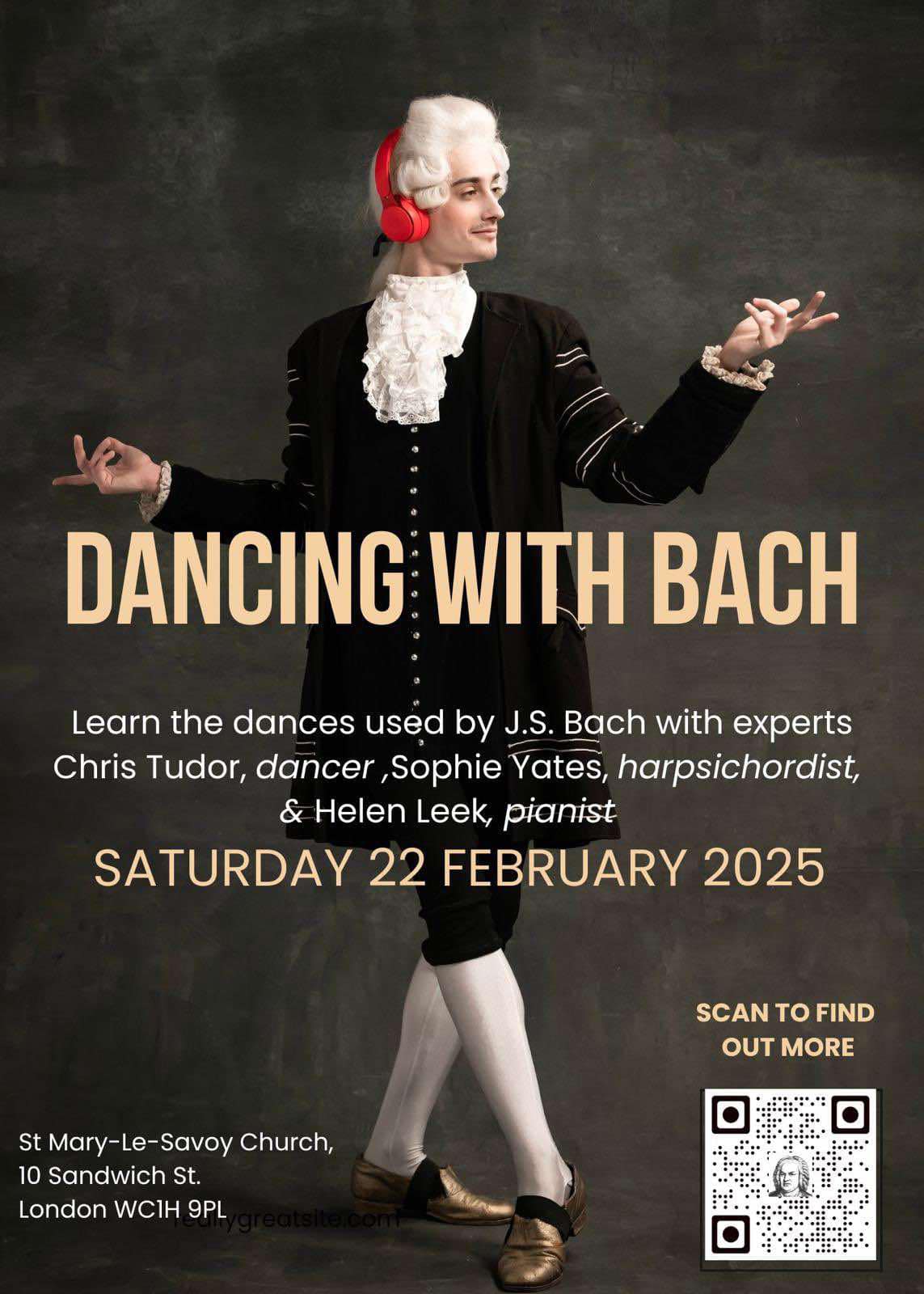
‘Dancing with Bach’, hosted by Ann Martin-Davis, with Chris Tudor, Sophie Yates and Helen Leek is a one-day workshop for pianists exploring the dance forms familiar to Bach that he used in his Partitas, Suites, and throughout his other collections of keyboard music.

Saturday 22nd February at St Mary-Le-Savoy Lutheran Church, London WC1H 9LP

Find out more here

Bring your dancing shoes!

Saturday 1 June 2024, 10am-4.45pm, Coach House Pianos SW6 4SQ

SPECIAL OFFER FOR READERS OF THIS SITE – DISCOUNTED OBSERVER PLACES

A one-day masterclass for advanced adult amateur pianists (Grade 8+) with pianist and pedagogue Dr Michael Low, hosted by Frances Wilson (The Cross-Eyed Pianist) at the sumptuous London showroom of Coach House Pianos. There is much to be gained from observing at a masterclass, including insights into technical and interpretative issues, practicing and performance, in addition to the opportunity to hear a variety of repertoire, including music by Schubert and Debussy.

Observer tickets £10 for the full day (save £5) – click on the image to book or scan the QR code to book


Book now

The event will be friendly, supportive and inspiring, and a great opportunity to observe top class teaching in friendly setting, plus the chance to meet other pianists. There will be plenty of time for discussion, Q&As, and relaxed ‘piano chat’ too.

Coach House Pianos is located at 79-91 New Kings Rd, London SW6 4SQ (nearest stations: Fulham Broadway, Parsons Green & Imperial Wharf). Please arrive promptly. Michael and Frances will be at the front entrance of the showroom to greet you.


Praised for his innovative approach and passionate insight into piano playing, Dr Michael Low’s teaching career in Asia and Africa has spanned almost a quarter of a century. As a student, Michael studied piano with Richard Frostick (the current director of the BBC World Voice Programme) before enrolling as a member of London’s prestigious Centre For Young Musician where he studied piano with the international pedagogue Graham Fitch. He obtained his Honours at Surrey University under the tutelage of Clive Williamson before completing his Masters of Music whilst studying with Nils Franke and Niel Immelman. An International Scholarship brought Michael to Cape Town where he completed his Doctorate under the supervision of South African greatest living composer, Hendrik Hofmeyr. Michael has also worked with numerous eminent teachers and pianists including, Nina Svetlanova, Frank Heneghan, James Gibb, Phillip Fowke, Renna Kellaway, Carolina Oltsmann, Florian Uhlig, Gordon Fergus Thompson, Francois du Toit and Helena van Heerden.
Frances Wilson is an advanced amateur pianist and writer under the pen-name The Cross-Eyed Pianist. Established in 2010, The Cross-Eyed Pianist blog has become “an important voice in the piano world” (Peter Donohoe, international concert pianist) and enjoys a wide global readership with c25,000 visitors to the site per month. The Cross-Eyed Pianist is now one of the UK’s leading blogs on classical music, with a special focus on pianists and the piano.

Frances is an advanced amateur pianist who returned to the piano after a gap of some 25 years, achieving Licentiate and Associate Diplomas (both with Distinction) in Piano Performance in her late 40s. She has studied with a number of acclaimed teachers, including Penelope Roskell and Graham Fitch, and participated in masterclasses, workshops and courses with, amongst others, Stephen Savage, Murray McLachlan and Charlotte Tomlinson.

A passionate advocate of amateur pianism, Fran co-founded the London Piano Meetup Group in 2013, which, 10 years, remains hugely popular with adult pianists of all abilities.

MOZART & MORE….

Saturday 1 June 2024, 10am-4.45pm

PERFORMER PLACES NOW SOLD OUT – PLENTY OF OBSERVER PLACES!

A one-day masterclass for advanced adult amateur pianists (Grade 8+) with pianist and pedagogue Dr Michael Low, hosted by Frances Wilson (The Cross-Eyed Pianist) at the sumptuous London showroom of Coach House Pianos

Observer tickets £15 for a full day

Book now

The event will be friendly, supportive and inspiring, and a great opportunity to enjoy top class teaching in friendly setting, plus the chance to meet other pianists. There will be plenty of time for discussion, Q&As, and relaxed ‘piano chat’.


Praised for his innovative approach and passionate insight into piano playing, Dr Michael Low’s teaching career in Asia and Africa has spanned almost a quarter of a century. As a student, Michael studied piano with Richard Frostick (the current director of the BBC World Voice Programme) before enrolling as a member of London’s prestigious Centre For Young Musician where he studied piano with the international pedagogue Graham Fitch. He obtained his Honours at Surrey University under the tutelage of Clive Williamson before completing his Masters of Music whilst studying with Nils Franke and Niel Immelman. An International Scholarship brought Michael to Cape Town where he completed his Doctorate under the supervision of South African greatest living composer, Hendrik Hofmeyr. Michael has also worked with numerous eminent teachers and pianists including, Nina Svetlanova, Frank Heneghan, James Gibb, Phillip Fowke, Renna Kellaway, Carolina Oltsmann, Florian Uhlig, Gordon Fergus Thompson, Francois du Toit and Helena van Heerden.

Frances Wilson is an advanced amateur pianist and writer under the pen-name The Cross-Eyed Pianist. Established in 2010, The Cross-Eyed Pianist blog has become “an important voice in the piano world” (Peter Donohoe, international concert pianist) and enjoys a wide global readership with c25,000 visitors to the site per month. The Cross-Eyed Pianist is now one of the UK’s leading blogs on classical music, with a special focus on pianists and the piano.

Frances is an advanced amateur pianist who returned to the piano after a gap of some 25 years, achieving Licentiate and Associate Diplomas (both with Distinction) in Piano Performance in her late 40s. She has studied with a number of acclaimed teachers, including Penelope Roskell and Graham Fitch, and participated in masterclasses, workshops and courses with, amongst others, Stephen Savage, Murray McLachlan and Charlotte Tomlinson.

A passionate advocate of amateur pianism, Fran co-founded the London Piano Meetup Group in 2013, which, 10 years, remains hugely popular with adult pianists of all abilities.

I was recently asked for some tips on returning to the piano after a long absence.

I stopped playing the piano at the age of 18 when I left home to go to university and I didn’t touch the instrument again seriously until I was in my late 30s.

It may be two years or twenty since you last touched a piano, but however long the absence, taking the decision to return to playing is exciting, challenging and just a little trepidatious.

Here are some thoughts on how to return to playing:

Stick with the familiar and play the music you learnt before

To get back in to the habit of playing, start by returning to music you have previously learnt. You may be surprised at how much has remained in the fingers and brain, and while facility, nimbleness and technique may be rusty, it shouldn’t take too long to find the music flowing again, especially if you learnt and practised it carefully in the past.

Take time to warm up

You may like to play scales or exercises to warm up, but simple yoga or Pilates-style exercises, done away from the piano, can also be very helpful in warming up fingers and arms and getting the blood flowing. This kind of warm up can also be a useful head-clearing exercise to help you focus when you go to the piano.

You don’t have to play scales or exercises!

Some people swear by scales, arpeggios and technical exercises while others run a mile from them (me!). As a returner, you are under no obligation to play scales or exercises. While they may be helpful in improving finger dexterity and velocity, many exercises can be tedious and repetitive. Instead try and create exercises from the music you are playing – it will be far more useful and, importantly, relevant.

Invest in a decent instrument

If you are serious about returning to the piano, a good instrument is essential. It needn’t be an acoustic piano; there are many very high-quality digital instruments to choose from. Select one with a full-size keyboard and properly weighted keys which imitate the action of a real piano. The benefits of a digital instrument are that you can adjust the volume and play with headphones so as not to disturb other members of your household or neighbours, and most digital instruments allow you to record yourself and connect to apps which provide accompaniments or a rhythm section which makes playing even more fun!

Posture is important

You’ve got a good instrument, now invest in a proper adjustable piano stool or bench. Good posture enables you to play better, avoid tiredness and injury

Little and often

Your new-found enthusiasm for the piano may lead you to play for hours on end over the weekend but hardly at all during the week. Instead of a long practice session, aim for shorter periods at the piano, every day if possible, or at least 5 days out of 7. Routine and regularity of practice are important for progress.

Consider taking lessons

A teacher can be a valuable support, offering advice on technique, productive practising, repertoire, performance practice, and more. Choose carefully: the pupil-teacher relationship is a very special one and a good relationship will foster progress and musical development. Ask for recommendations from other people and take some trial lessons to find the right teacher for you.

Pianists at play at a summer piano course in France

Go on a piano course

Piano courses are a great way to meet other like-minded people – and you’ll be surprised how many returners there are out there! Courses also offer the opportunity to study with different teachers, hear other people playing, get tips on practising, chat to other pianists, and discover repertoire. I’ve made some very good friends through piano courses, and the social aspect is often as important as the learning for many adult amateur pianists.  More on piano courses here

Join a piano club or meetup group

If you fancy improving your performance skills in a supportive friendly environment, consider joining a piano club. You’ll meet other adult pianists, hear lots of different repertoire, have an opportunity to exchange ideas, and enjoy a social life connected to the piano. Piano clubs offer regular performance opportunities which can help build confidence and fluency in your playing.

Listen widely

Listening, both to CDs or via streaming, or going to live concerts, is a great way to discover new repertoire or be inspired by hearing the music you’re learning played by master musicians.

Buy good-quality scores

Cheap, flimsy scores don’t last long and are often littered with editorial inconsistencies. If you’re serious about your music, invest in decent sheet music and where possible buy Urtext scores (e.g. Henle, Barenreiter or Weiner editions) which have useful commentaries, annotations, fingering suggestions, and clear typesetting on good-quality paper.

Play the music you want to play

One of the most satisfying aspects of being an adult pianist is that you can choose what repertoire to play. Don’t let people tell you to play certain repertoire because “it’s good for you”! If you don’t enjoy the music, you won’t want to practice. As pianists we are spoilt for choice and there really is music out there to suit every taste.

Above all, enjoy the piano!


This site is free to access and ad-free, and takes many hours to research, write, and maintain. If you find joy and value in what I do, please consider making a donation to support the continuance of this site

Make A Donation