What inspired you to take up the piano, and make it your career?

I loved the sound of the cembalo (harpsichord) very much when I was a child. Having no musical background whatsoever, my parents sent me to a local music school, where I was told that I would need to learn some piano before I could learn the cembalo. I fell in love with the piano immediately and quickly forgot about Bach’s harpsichord concertos!

In my teenage years, playing the piano was the activity I loved most. Nobody had to tell me that I should practice. As soon as I came home from school, I ran to my piano and played for hours. My time at the piano was quite evenly split between playing classical music and improvising or composing my own music. When I was discovered by a manager at age fifteen, I knew already that music would always be my main career, although my role as an interpreter of classical music – mainly of the romantic repertoire – was outweighing my activities as a composer at that time.

After two intensive years of touring and recording, I felt burned out. The growing success as a concert pianist had no positive impact on my happiness at all, quite to the contrary: I felt more and more isolated, and it became clear to me that I could not ignore my need to compose any longer. My manager considered my compositions as some kind of private hobby, but to me it was much more. As much as I love the music by the great masters, and as much as I enjoy playing it, composing (and performing) my own music had to come first. It was a difficult decision, since my possibilities as a soloist seemed to be endless and so many promising opportunities were at my fingertips. But I did what I had to do as an artist: I withdrew from the traditional career as concert pianist and immersed myself into the development of my musical language.

Who or what were the most important influences on your composing?

Being so well acquainted with the romantic repertoire, the music of Chopin, Liszt, Rachmaninov and Scriabin definitely had a strong influence on my early style. But since I am a child of the 20th century, I have also drawn inspiration from pop and rock music, maybe also a little bit from jazz music. When I discovered Keith Jarrett’s solo concerts and Arvo Pärt’s music in the late nineties, I was deeply moved by the sheer beauty that was still “allowed” in our time. My educational background had suggested to me that contemporary music had to be disharmonic, to put it politely, and I never cared for serialism and all the cacophony that followed. So, essentially, I am in constant search for truth and beauty in my music. My love for Gregorian chant, religious choral music and my Catholic faith have a great influence not only on my compositional style, but also on my understanding of music as a whole.

What have been the greatest challenges of your career so far?

When the Cistercian Monks of Stift Heiligenkreuz asked me to compose piano accompaniments for the follow-up of their hugely successful album ‘Chant – Music for Paradise’, I did not want to mess up. They were putting “their” sacred chants into my hands and let me interpret them! In plainchant you have so much freedom and detachment from clearly definable emotions in the sense that have become so accustomed to over the last centuries. It is indeed the most universal and pure musical language on our planet. Putting a piano part underneath it would naturally interpret the chants in some direction. Through hard work and constant rewriting of many passages I found a very personal, yet worthy and unsentimental style for these pieces. The monks liked them so much that they commissioned another four chants for their latest album ‘Chant – Stabat Mater’, which was released  recently.

Which compositions are you most proud of?

Many of my choir pieces are very special to me. Unfortunately, not many of them have been performed so far, which makes me all the more excited that the wonderful Platinum Consort under the direction of Scott Inglis-Kidger will sing the world premiere of my ‘Consecration Prayer’ on 16th November, which is a very personal composition of mine. I am also very happy with my piano piece ‘Obsculta’ and the really beautiful video that my friend Vitùc created for it.

Who are your favorite musicians?

At the moment I am very fond of so many magnificent British choirs: Tenebrae, The Sixteen, Polyphony, Platinum Consort, to name a few. You really are blessed with a unique choral tradition in England!

There are countless pianists that I admire and love, but if I had to pick one, it would be Dinu Lipatti. I love his unpretentious and pure musicianship. I try to follow this role model, and I have never liked musicians who take themselves too seriously and want to be more important than the music. It is the musician’s duty to serve the music, not the opposite.

What is your most memorable concert experience?

I was crying from beginning to the end when I attended my first live performance of Bach’s B minor Mass in Luxembourg ten years ago. I have never been so moved by a piece of music. It was then that I realised that there is no such thing as old or new music. If music is true, it is timeless and will always reveal a glimpse of eternity to us mortal beings.

What do you consider to be the most important ideas and concepts to impart to aspiring musicians?

For the interpreter:

  • Never take yourself too seriously.
  • Always play with open ears and an open heart.
  • Look for the essence behind the notes and remain faithful to the text.
  • Find your personal sound by pursuing meaning rather than virtuosity.
  • Practice hard and value technical exercises and scales. They help you to become better servants of the music you love.

If you’re a composer:

  • Compose with open ears and an open heart.
  • Look for the essence inside your musical ideas and omit what can be left.
  • Let the music write itself by listening as deep as you can.
  • Always question your work. If it can still be improved, don’t shy away from the work.
  • Study the masters, again and again, but be yourself when you compose.

What are you working on at the moment?

I practice Brahms’ Cello Sonata in E minor for a performance with a very special young talent next week. After that I will orchestrate my children’s opera ‘The Little Gnome’ which will be premiered on 19th January in Luxembourg. And I expect the master CD of my new solo album ‘Prayers of Silence’ (which I recorded in August) to be ready any day soon, so I will definitely spend some time with listening and preparing the publication of my most important album so far. In December I will play Beethoven’s Choral Fantasy, a piece that is not in my repertoire yet, so I’ll have to practice a lot in November.

What is your idea of perfect happiness?

Perfect happiness is a gift of the moment and it wouldn’t be special if it were a constant state of being. That being said, I can say that I suffer from failures and bad moments like everyone else, but I am also regularly blessed with happiness when I compose or when I play the piano. But the most blissful moments are those that I spend with my family and especially with my three little children. I should also mention that I find peace in prayer, and it is the hidden driving force of my life.

David Ianni’s ‘Consecration Prayer’ receives its world premiere in a concert by Platinum Consort, under the direction of Scott Inglis-Kidger, on Friday 16th November. Further information and booking here

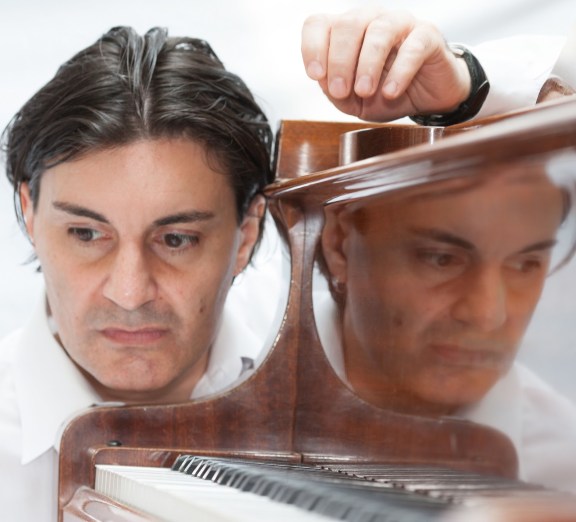
David Ianni was born in Luxembourg in 1979. He was accepted in the piano class of Daniel Feis in the Conservatoire d’Esch-sur-Alzette at the age of nine. At fifteen, he completed his piano diploma in Luxembourg with a “Premier Prix avec grande distinction”. He continued his studies in London at the Purcell School and later with Tatiana Sarkissova, teacher at the Royal Academy of Music. He also studied with Dimitri Bashkirov, Anatol Ugorski, Radu Lupu and Dirk Joeres. In 2005, he completed his studies with Tonie Ehlen at the Maastricht Conservatory.

After winning a number of prizes in national and international competitions, the sixteen-year-old musician began a career as a concert pianist, performing solo recitals as well as with orchestras in many European countries, India and Japan. His debut CD, with works by Beethoven, Rachmaninoff and Scriabin, was released in 1997. In 1999, the recording ‘Theodor Kirchner: Piano Music’ followed.

Since 1998, David Ianni has increasingly dedicated himself to composing his own works. He has written about 100 works, including the oratorio ‘Abraham’s Children’, ‘Pater Noster’ for piano and orchestra, a children’s opera, a string quartet, chamber music as well as numerous choral and piano compositions, which have been performed in Luxembourg, Germany, Austria, France, Italy, India and Japan.

David Ianni’s album Night Prayers with his own piano compositions was published in 2011.

That same year he composed and recorded the piano accompaniments for the album Chant – Amor et Passio by the Cistercian Monks of Stift Heiligenkreuz, which was awarded a Platinum award in Austria. In 2012 the monks commissioned David to compose and play four chant accompaniments for their album Chant – Stabat Mater.

His new solo album ‘Prayers of Silence’ will be released by Obsculta Music.
http://davidianni.com/

Angelo Villani


Pianist Angelo Villani is not exactly a household name. Over 20 years ago, he was due to participate in the prestigious International Tchaikovsky Competition when a trapped nerve in his right arm, the result of a sports injury, forced him to withdraw. The loss of sensation in his hand caused by the injury prevented him from performing, except only sporadically, while he sought a cure for his condition. In 2010, he started performing again in private recitals in London, and on 6th October 2010 he made his much-anticipated London debut at St James’s Piccadilly, in a programme of works by Brahms, Greig and Liszt, including the vertiginous ‘Après une Lecture de Dante: Fantasia quasi Sonata’ from the Années de Pèlerinage II (Italie).

I was fortunate enough to hear Angelo perform ahead of his London debut at St James’s Piccadilly, at an ‘at home’ concert hosted by Jessica Duchen. As regular readers of this blog will know, I am a big fan of music in small places, and concerts in people’s homes are the perfect way to enjoy music which was, by and large, intended for the intimacy of the salon. And for a performer, playing before a small, sympathetic and highly engaged audience is very useful preparation for a more formal concert.

Angelo played a selection of pieces from his St James’s programme. He opened with Brahms’s ‘Edward’ Ballade (Opus 10, no. 1, in g minor, so called because it is based on a ‘murder ballad’ of the same name), a piece whose open fifths and simple harmonies suggest myth and legend. It was played with an imposing and sombre elegance, its melancholy perfectly complemented by the wistful, tranquil Intermezzo in E from the Opus 116 which followed it. The alternate theme, following the rich, hymn-like opening statements, was imbued with poignancy, which led the programme nicely into a handful of Grieg’s lyric pieces. These were played with great character and sensitivity to the ‘narrative’ of each piece: a shimmering butterfly, a moody waltz, the joyful ‘Wedding Day at Troldhaugen’, a yearning ‘Arietta’ and a dancing ‘Remembrances’, the two pieces reflections of one another in their melodic and stylistic elements. The Brahms g minor Rhapsody, which followed these pieces, had an intense, Beethovenian drama, rich and passionate. In complete contrast, the two ‘Petrarch Sonnets’ by Liszt (nos. 47 and 123), from the Italian Années de pèlerinage, were songful, deeply expressive, with some beautifully judged “misty” pedal effects and graceful dynamic shading.

We demanded an encore, and we were rewarded, appropriately, with Schumann’s ‘Des Abends’ from the Fantasiestücke, Op 12. This was piano playing to savour: mature, thoughtful, committed and convincing. Angelo has a real understanding of romantic repertoire, but without selling out to crowd-pleasing piano pyrotechnics or over-sentimentality. Based on his Brahms, in particular, last night, I am sure his performance of Liszt’s ‘Dante’ Sonata will be assured, charismatic and profound.

Angelo played wearing white gloves. This is not a virtuoso affectation, nor some reference to the eccentricities of Glenn Gould; as Angelo explained to me afterwards, the gloves prevent his fingers “dragging” at the keys too much, thus protecting his hands.

For more information about Angelo Villani, please visit www.angelovillani.com. If you enjoy piano music delivered with seriousness, bravery, lyricism and drama, informed by some of the great pianists of earlier eras, go and hear Angelo live.

Jessica Duchen’s blog article about Angelo Villani

11073191_10153739875302846_5509429708149038994_n
(photo: Emma Phillipson)
Who or what inspired you to take up the piano and make it your career?

It’s not a glamorous answer at all, I’m afraid. When I was about 5, I had this very basic toy glockenspiel that had different coloured keys. The toy came with a card which had different colours printed for different tunes. Together, these colours matched up with the coloured keys on the toy and you could play basic tunes; melodies such as ‘Ode to Joy’ and ‘London Bridge is Falling Down’ etc. My parents could see how much I was enjoying it, and it was me who eventually said that I wanted to play the piano. I don’t come from a musical family at all, as such I don’t remember specifically watching or hearing somebody play the piano and wanting to emulate them. Who knows where I’d be if my parents hadn’t bought me that toy!

Who or what were the most important influences on your playing?

I think it would have to be a combination of my parents, as well as a legendary woman by the name of Penny Stirling. My parents both work full time and sacrificed an awful lot in order to provide my sister and I with what we needed. Whether it was taking me to evening concerts after they’d been working all day, taking a day off work to drive me to a music competition, or listening to me play a new piece in the living room of our house, they have been there every step of the way. Athletes and musicians have some integral things in common; one of the most important being totally supportive and dedicated parents. Penny Stirling is the founding manager of a government-funded scheme called Yorkshire Young Musicians. I started here at the age of 16, which saw me travel to Leeds every Sunday to receive advanced musical training, much like a junior conservatoire or specialist music school. Had I not studied at Yorkshire Young Musicians alongside my normal life as a comprehensive school/state school student, I very much doubt I ever would have gained a place at audition to study at the Royal Northern College of Music. Even now, at the beginning of my professional career in which I am quickly gaining some very prestigious opportunities and rapidly climbing up the ladder, I am still in contact with Penny for the odd bit of help, guidance and banter.

What have been the greatest challenges of your career so far?

Getting over myself! I like to think that I work very hard and dedicate myself to improving my musical communication everyday. I absolutely love playing the piano, nothing compares to live performance and being on stage makes me feel the most alive. That said, from a young age I have “suffered” from sometimes crippling performance anxiety and an inability to replicate what I do so effortlessly in a practice room in front of an audience. Hours before a performance, I used to feel sick to the point of sometimes throwing up; I would shake, sweat, become tense and randomly develop a very runny nose. At the age of 23, I can now safely and proudly say I have managed to overcome these problems. I still feel the adrenaline rush, and I hope I always do. The big difference now is that I feel relaxed, poised, and in control. Physically I might sweat but it is no way near as debilitating as it once was. Being on stage is no longer an ordeal; it’s a great pleasure!

Which performances/recordings are you most proud of?

Difficult one, as I don’t wish to sound like I’m simply reeling off some of my best experiences. I am really proud of the recital I gave for Lord Levy and the Russian ambassador within his residency at Kensington Palace Gardens. It was such a beautiful environment, and I was so excited to be playing within Kensington Palace Gardens at the age of 19. Equally, I am still dead chuffed that I performed alongside The Manfreds, Blake and Lulu for the Prince and Princess of Monaco, and I got to meet them both after I performed. Who ever thought a Yorkshire lad from rural and quiet East Yorkshire would be performing in front of high European royalty! That concert gave me a tantalising taste of what might lie ahead for me, and really gave me a confidence boost straight out of graduating out of music college at 22. I always seem to remember the recitals I give for a reduced fee for charitable causes – I know artists are divided as to whether you should ever reduce your fee or “play for free”, but sometimes I think it’s important just to remember how lucky you are and help those who are in a less fortunate position.

Do you have a favourite concert venue to perform in?

No, not really. Anywhere with a half-decent piano and people willing to listen and appreciate will do just fine thank you!

Favourite pieces to perform? Listen to?

I adore performing anything by Bach. I think his music is so pure and expressive, and says so much in such a seemingly simple and elegant way. As a pianist, there are challenges with performing his music live, memory being one of them, but it is nevertheless very rewarding and fulfilling. Favourite pieces to listen to will take far too much time to detail. Let’s jut say during a long journey, I can get through everything and everybody starting from Monteverdi right through to the Spice Girls! (Am I allowed to openly admit that…?)

Who are your favourite musicians?

The majority of them are non-classical musicians, does that make me a bad person?! I really admire The Beatles and wish I could have been alive when they first exploded onto the scene during the 60s. A lot of people seem to forget that they were basically copying what a lot of African-American musicians were doing over in the States, but I still admire the way in which they brought it to a mass audience and developed their own unique sound. Listening to ‘Tomorrow Never Knows’ from their album Revolver blows my mind pretty much every time I hear it. The same goes for David Bowie, T-Rex and Queen during the 70s; for me, everything they touched was pure gold. In terms of classical music, I am a massive fan of the British pianist Stephen Hough. I remember first listening to him play during one of the BBC Proms as a teenager. I just had no idea what had hit me, it was amazing! I also like how in interviews/writing, during masterclasses and even on Twitter, he comes across as a nice human being, as opposed to some sort of histrionic, pianistic machine that I have witnessed at times in other famous pianists.

What is your most memorable concert experience?

The first time I ever performed in public at the age of 7 at my village Methodist Church. I remember thinking, “Ey up, this is great!” I performed “Minuet in G major” by Bach from his Anna Magdelena notebook, “Walking in the air” from the Snowman, and “Yesterday” by The Beatles. Strangely enough, this mixture of playing different repertoire and styles has stayed with me right through to my career as a young adult, I never realised that until now. How strange!

What do you consider to be the most important ideas and concepts to impart to aspiring musicians?

Work hard, always stay human and keep an open mind about your future. I think keeping an open mind about your future is the most important.

What do you enjoy doing most?

For me, my ideal day involves going for a long run in the morning, usually up and down some big inclines to really get the heart racing. I’d then do some piano practice after lunch, followed by cooking a roast dinner for my close friends in the early evening. It would most likely be rosemary roast lamb or lemon and garlic chicken with all the trimmings, followed by ice cream or vanilla cheesecake for dessert. Probably both to be honest. Oh, wine would obviously be compulsory.

Emmanuel Vass was born in Manila, Philippines and grew up in East Yorkshire. Having passed Grade 8 piano with distinction at the age of 15, he subsequently studied with Robert Markham at Yorkshire Young Musicians, the centre for the advanced training for gifted young musicians based at Leeds College of Music. This was followed by four years at the Royal Northern College of Music, where Manny studied with John Gough and was supported by scholarships from the Leverhulme Scholarship Trust and the Sir John Manduell Scholarship Trust. He graduated in 2011.

philip_fowke_1What is your first memory of the piano?

My first memory of the piano was when my parents bought an upright for my sister Alison who was beginning to learn the piano. I can recall it coming into the house quite clearly and I must have been about 4 years old. I was fascinated by it from the start and its grinning mouth of keys. At my first school, Milford, in Gerrards Cross, the headmistress, Miss France, used to play the piano for hymns and music classes. I can remember watching her hands and the way the keys went down. It is a vivid memory and it was Miss France who first encouraged me to play and gave me my first lessons. Initially, I did everything by ear and taught myself simple harmonisations of well known tunes like ‘The British Grenadiers’. I remember playing this during break to all the other children as we had our regulation bottle of milk.

Who were your most memorable/significant teachers? 

Miss France, whom I mentioned above, was my first encounter with a piano teacher and she set me on the road. However, she felt I needed a more qualified teacher and she arranged for me to have an audition with Marjorie Withers who also lived in Gerrards Cross. She was an outstanding musician and teacher and I went to her when I was seven. It was she who really inspired me and had a gift for giving me pieces which really excited me. She also encouraged my playing popular tunes and improvising. I was heavily into Russ Conway, Winifred Atwell and Joe Henderson in those days and could do a passing imitation of them. At Downside School, where I boarded from 1964 to 1967, I also had remarkable teachers in Roger Bevan, the Director of Music, Lionel Calvert and Peter Matthews.

Who or what are the most important influences on your teaching? 

I have mentioned the teachers I had as a boy and they all had influences on me, most notably Marjorie Withers. It was really she who laid the foundations of such technique as I may have, and who instilled in me the discipline of practice and ways in which to make it creative and effective. She was also a fine pianist herself and was well able to demonstrate, quite dazzlingly as it seemed to me, Chopin Studies, bits of Rachmaninoff, Debussy, Grieg, and numerous other composers. Her attitude, her sense of fun and celebration of the music deeply influenced me

Most memorable/significant teaching experiences?  

Initially the pressures of having to earn a few pennies was quite an incentive to start giving lessons to local children and one or two adults. However, I do recall helping a friend at school, of no particular pianistic talent, to play a piece he was struggling with. I remember feeling a strong desire to help him conquer what seemed to be insurmountable difficulties! However, it was Gordon Green at the Royal Academy of Music who was the chief musical and pianistic inspiration and who continues to exert an extraordinary influence on me and many others who had the good fortune to study with him.  His philosophy was to allow young people to develop at their own pace in their own time. Not for him the pressures of competitions, rushed learning and the resulting stress and misery which can follow. He used to say that his concern was not how you played today, but how you would play in ten years’ time. His wisdom, gentleness and encouragement enabled many of his students to go on to achieve considerable success. He was neither possessive nor ambitious except in the sense of wishing students to be balanced, fulfilled human beings who happened to play an instrument.

What are the most exciting/challenging aspects of teaching adults? 

There are many issues but one is the tendency to choose too challenging a repertoire. Also nerves and confidence. Then there is physical condition, i.e. muscular flexibility. This can be very variable. In general my approach is always to build positively on whatever the situation presents. It is all too easy to be inadvertently discouraging and negative. Always be upbeat and positive. Quite often there have been bad, even traumatic experiences with past teachers and this can result in a general crisis of confidence which has never been fully addressed. Inevitably there is a tremendous legacy of vulnerability which must be handled with sensitivity and gentleness. The early lessons need to be a form of therapy with a bit of piano occasionally thrown in with no strings attached preferably! I often start with a course of simple exercises which involve the entire keyboard….a kind of embrace and bonding with the keys. It is also important do some simple pre-keyboard exercises, standing, bending stretching and relaxed breathing. It is also good to be aware of the prevalent danger of “wishful listening”. This is very common and accounts for attempting to play pieces before they have been sufficiently prepared and studied. The trouble is, a habit forms whereby the student doesn’t hear what’s actually being played, but hears an imaginary and vastly edited version which sounds, to their ears, acceptable…only it isn’t!

What do you expect from your students? 

Expectations vary especially between college students and amateur adults. Inevitably more is expected from a young person embarking on a professional life of a musician. In the case of adult amateurs, those doing it for pleasure in such time as they have available, different expectations arise. I take each person as they are, as circumstances allow, and work within those parameters. However, I do always work at simple strategies which, if followed closely, can save endless hours of needless repetition…..which unfortunately so much so called “practice” can often be. An issue which often arises is the one of that dreaded word “tension”. I make a point of never using the word preferring to ask whether the students feels “comfortable” in a particular passage. Invariably the answer is uncomfortable, so I suggest that together we find a more comfortable way of doing it. This, in itself, reduces tightness and anxiety. To simply say ”that looks tense” exacerbates the problem and is, in my view,  poor teaching psychology. I have found that many tension issues have not been addressed simply because the symptoms have been treated and not the cause. A tight wrist can be the result of weak fingers or an impractical fingering. It’s amazing what an unconventional fingering or a cunning redistribution can achieve…let alone the discreet omission of troublesome notes which can barely be heard. I rather hear fewer notes comfortably and confidently played than more, scrambled!

Another issue is the release of notes, usually caused by the notion that everything must be legato fingering. The horror of letting go and allowing the pedal to help in appropriate situations, is a real psychological and physical difficulty. The traditional tyranny has taught that not doing legato fingering is a mortal sin. There are ways of achieving legato other than holding on to notes in distorted and twisted ways which make a horrid sound and cause great discomfort. In saying this, I do not wish to mean that legato fingering is of no importance…. it is essential, but a realistic balance needs to be found and allowed for. Too often I encounter “off the peg” fingering – one size fits all. Only it doesn’t!

In general I find with adults, as with the younger generation, stretch and extension exercises have not been addressed. Fingers operate in isolation with one another. I encourage a dialogue between all the fingers so that they can get to know one another. Coordination exercises also can be of great benefit. So often fingers are complete strangers to one another, and rather hostile ones at that! Explore movement; find the slip roads on to the motorway. Ski, fly, grope the keys. When fingering, explore options, be daring. Give the fingers a choice. Within a very short time they will make their own decision….. and a good one provided they have the initial choice. Let the miserable, bald battery fingers out of their cages to roam free, grow feathers and lay big fat brown eggs. They’ll make a better sound. I call it Fowke’s Free Range Fingering. Your fingers will smile in gratitude and relief scuttling off into pastures new and sunlit glades.

Don’t get stuck on slow practice. Practice above tempo in short bursts, strong beat to strong beat to learn movements and gestures which can help the keyboard choreography. Practising slowly, though essential at all stages, does need an antidote. There can be a danger of practising to play slowly. Similarly with hands separate practice.

Practice pianissimo, or on the surface of the keys. Too much practice is too loud and too fast. Listen in your head. A good maxim, though not invariable,  is to practice loud passages pianissimo, and piano passages forte. Similarly, practice slow movements quickly and quick movements slowly. Play in different registers, crossed hands, even in different keys. Muck about. Practising can be like a kitten teasing a ball of wool. I always remember Shura Cherkassky saying to me that if I heard him practice, I wouldn’t think he could play the piano. This made an indelible impression on me at the time and beautifully describes real practice…. a craft that has to be carefully honed. Learn to dismantle a piece down to the tiniest component.

We press keys down, but do we consider the release? Same with the pedal. Practice the sustaining pedal with the left foot. Concentrates the mind and ear wonderfully!

What are your views on exams, festivals and competitions? 

Very mixed. They all have their place but in my view far too much emphasis is put on the competitive element and too little on the musical and artistic elements. Performing in public has become an international sport and the list of sporting casualties and injuries grows proportionately. We need to review the number and regularity of some of these major competitions…..and the way the media promotes them. As to exams, again they have their place, but it is noteworthy that countries where the graded system does not exist produces playing of a singularly and consistently high order from an early age.

What do you consider to be the most important concepts to impart to beginning students, and to advanced students? 

This is difficult to condense into a few simple sentences. If I have one thing to say it is that so many pianists of whatever age, ability and experience have little concept of the keyboard. They have never been encouraged to explore it, to improvise, to be allowed to make nasty noises eventually leading to rather more beautiful sounds. An intrinsic fear lies at the core of so much playing; fear of wrong notes, fear of going wrong. All this is caused by a basic lack of harmonic awareness, a hazy knowledge of scales and arpeggios, and an inability to busk and improvise. Teachers pass on their own fear as they themselves were never encouraged to improvise to play with the keyboard rather than on it. The tyrannical pull of middle C reigns supreme I fear!

What do you consider to be the best and worst aspects the job? 

I’m not sure I can answer this. Teaching is not exactly a job for me, more a mission. I simply want to explode myths, to enable and to explore, to reveal the keyboard as more than an extension of middle C

What is your favourite music to teach? To play? 

Well, of course it is always a pleasure to work on familiar core repertoire. However, I do enjoy the challenge of unfamiliar scores which nobody has issues with, received opinions and which no one has ever heard before!

Who are your favourite pianists/pianist-teachers and why? 

This is dangerous territory and one I have consistently tried to avoid!

Is there a link between teaching and performing? 

It has been said that performers don’t make good teachers. Well, this is true in some cases but certainly not all. Equally I know of some good teachers who don’t, and never have to any significant degree, performed in public. However, having said that, the experience of performing, the physical and psychological act, does possibly lend one’s teaching an element of realism and practicality. Knowledge and respect for the score is well and good, but how to deliver it? What I describe as health and safety editions with their plethora of notes and commentaries, foot and note disease, can be daunting. Nothing is left to chance and this can inhibit performance rather than inform it. Performing in public can give a teacher the insight into that which is to be aspired to, that which is feasible, and the experience to make the choice.


Philip Fowke, known for his many BBC Promenade Concert appearances, numerous recordings and broad range of repertoire performed worldwide, is currently Senior Fellow of Keyboard at Trinity College of Music. He is also known for his teaching, coaching and tutoring in which he enjoys exploring students’ potential, encouraging them to develop their own individuality. He is a regular tutor at the International Shrewsbury Summer School as well as at Chethams Summer School.Conductors with whom he has worked include Vladimir Ashkenazy, Rudolf Barshai, Tadaaki Otaka, Sir Simon Rattle, Gennadi Rozhdestvensky, Yuri Temirkanov and the late Klaus Tennstedt. He will shortly be recording piano works by Antony Hopkins CBE in celebration of the composer’s 90th birthday. In addition to Philip Fowke’s many invitations to tutor at festivals, summer schools, and numerous lecture recitals, he will be appearing with The Prince Consort, a group founded by his former student Alisdair Hogarth. Their recent recording for Linn Records featuring works by Brahms and Stephen Hough, has received outstanding acclaim, and was nominated CD of the month by Gramophone Magazine. Future appearances include the Wigmore Hall, Purcell Room, Cheltenham Festival and the Concertgebouw Amsterdam.

www.philipfowke.com

