Guest post by Howard Smith

Like many adult learners, Howard Smith found it surprising that he would suffer that most debilitating of all pianistic ailments: extreme performance anxiety. He explained to me that this came as a big surprise, having been a confident keynote speaker at many large events during his long career in the IT industry. Now semi-retired, Howard is working hard to lead a new creative life, focussed on the piano.

Members of the London Piano Meet Group (LPMG) guided the initial development of Howard’s collation of collective wisdom.


Confronting my fears and learning ways to reduce and manage them is empowering. I can become a more confident performer.

There are two kinds of performance anxiety:

  • Irrational anxiety: fear for no good reason!  If I am well-prepared, it should be possible to overcome irrational anxieties.
  • Rational anxiety: insufficient practice and preparation. Maybe I was just lucky playing at home in the practice room? Under the spotlight, things fell apart.

The combination of sufficient practice and building resilience under emotional stress can help to reduce performance anxieties.

Technical preparation is the bottom line. Stiffness, awkward movements and poor technique become completely dysfunctional during a live performance; my mind and muscles won’t be able to cope.

I must develop a narrative of success and avoid a narrative of failure. A series of poor performances can result in a vicious cycle of negativity. Avoid at all costs.

Consider using techniques from NLP and CBT to turn negative messages and the ‘toxic inner critic’ into positive affirmation and confidence-boosting messages.

1) Adopt the Right Mindset

Accept yourself for what you are. How well you perform is not a determiner of your self-worth.

Nobody is perfect. A few mistakes are OK. Most audiences won’t notice, and many are non-judgemental.

Accept that a degree of nervousness (butterflies) is healthy. It is natural and affects most everyone. If you are not nervous or are overconfident, something is wrong. Adrenaline can be useful but needs a channel.

To build a narrative of success, seek out a graduated series of low-threat performance opportunities. Start with a video camera or tape recorder. Treat this session as if it were a real performance. Stand up and address your imaginary audience. Keep going, even if you make mistakes. Try to maintain the tempo. Then move to the next level: a trusted friend or musical associate. Then a few more friends. Etc.

Each time you perform, think about what you found hard. Consider what new coping strategies may be required.

2) Choice of Music

A successful performance of any piece of music boosts your confidence and increases emotional resilience in readiness for your next performance.

Choose music safely within or below your grade: ‘easy for you’ pieces with which you are entirely comfortable. Hard to say, difficult to do.

Play at a tempo at which you can be confident.

Performing less well-known repertoire can be helpful. Familiar or iconic music can attract higher expectations from audiences, heightening your natural fear of being ‘under the spotlight’.

3) Prepare for the Performance

Be well prepared. Practice. Practice. Practice. Eliminate anything and everything that can go wrong. Practice until you cannot go wrong.

Tip: A few days before your performance, identify the one bar (one) that you find the most challenging. Experience shows that this simple, practical solution seems to ‘clinch’ the sense of confidence after all else is said and done.

Perform whenever and wherever you can. For example, find a piano in a public space. Play when your friends come round, whether they want to hear or not. Tell your ad-hoc audiences to accept your performance for it is: the practise of practice! Doing so will help you feel what it is like to be nervous. These ‘safe’ performances reveal whether you have sufficiently practised.

Also, practise in front of your teacher. Take their advice but ask them not to obsess about tiny details. It’s too late for that. Ask them for their input on the entire sweep of the performance.

Work on controlled breathing, and meditation. Relax. Find the mind tools to redirect thoughts when they turn negative.

Be healthy. Exercise. Eat properly.

4) The Day Before

Limit stimulants. Get adequate sleep.

Practise yes, but avoid over-practise. Focus on the big picture.

Take a walk, jump up and down, shake out muscles, or do whatever feels right to ease any anxious feelings. Repeat nearer the time.

5) At the Performance

If possible, warm up beforehand by playing a few scales.  At least try to feel the piano keyboard in advance. Play a few notes and chords. Don’t forget the pedals.

Remind yourself that you are well-prepared. Don’t over-think what could go wrong.

Foster a ‘safe space’ for yourself in which to perform. Get into ‘the zone’. Centre yourself.

Adopt an aura of confidence. Visualise your success. Face down your anxiety.

Think of the audience as your friends. Connect with them – smile, make eye contact.

Shift the focus from your vulnerabilities, towards the music itself. Close your eyes. Imagine your audience enjoying the music.

Aim not only to perform correctly but also to communicate the emotion of the music (sadness, joy, profound feelings).

As you start to play; play with confidence. The success of the first few bars is essential to your continued confidence throughout the performance.

Breathe. Don’t hold your breath. Relax your facial muscles.

Play with passion! Play joyfully. Play as if you are giving a GIFT to your audience, instead of focussing on what may go wrong or being over-critical of yourself. Perfection if not the same as beauty. Moreover, leave your ego at home!

As you play, listen but do not analyse. Focussing too closely on finger and hand movement is not going to help at this stage. Communicate the expression or ‘story’ of the music rather than its technical aspects.

Allow the music to flow through you, imagine yourself as a conduit for it, rather than deliverer or controller.

Be in the present. Play in the moment. Don’t anticipate difficult future bars or upcoming tricky passages.  Avoid thoughts such as ‘I must not get that tricky chord wrong’ or ‘I must not trip up at bar 25’. Avoid all such negative thoughts.

Tip: Imagine the music is a music roll ticker-tape, inexorably moving forward. Let the music carry you along. Declutter your thoughts from the mechanical details of performance.

Bring your mind and hands together as one, not as separate machinery. Concentrate as you play. Do not allow stray thoughts to enter your head. Chase them out.

If you make a mistake, pick up, recover and carry on – with the least amount of fuss. Keep going. Maintain tempo. Whatever happens, try not to re-start.

Have fun!

5) After the Performance

Don’t dwell on what happened during your performance, other than to learn from obvious mistakes.

Plan for your next performance, right away.

Postscript: Additional Thoughts

Minimise distractions. Find a fixed point in the distance. Focus on whatever makes you feel comfortable. This point could be your music stand, the keyboard, or somewhere beyond the piano itself. Wherever or whatever it is, ensure that your focal point is below eye level.

Be deliberate. When you step up to the piano, how exactly do you intend to sound? What, precisely, do you intend to communicate to your audience?

Build the appropriate mental image of the way you would ideally like to perform. Tell yourself that you are going to perform brilliantly, with passion and clear dynamics. Think about positive words such as light fingers, smooth playing, even shifts, fluid movements, strong chords, quiet, calm, ease. Breathe from the diaphragm.

Avoid shallow, rapid, chest breathing. Performance anxiety creates muscle tension. As you breathe, focus on each group of muscles, releasing tension as you exhale.


Howard Smith
instagram.com/howardneilsmith

If you enjoy the content of this site, please consider making a donation towards its upkeep:
Buy me a coffee

Most of us tend to focus on the things that didn’t go so well in a performance – the misplaced notes, the smudged runs, the memory slips. Analysing why these things happened and exploring solutions to problems or finding ways to “future proof” our music for the next performance are important aspects of the “practice of practising”.

When a performance goes well, we might simply shrug and say “that went well” and briefly bask in the inner glow of success, the satisfaction of a job well done before moving on to the next task and preparing for another performance.

Reflection and critical self-feedback are important aspects of the process of learning and practising, and being able to pinpoint why a performance went well is as useful in the process as identifying and rectifying problem areas.

In early December 2017, I took part in a really delightful concert at the home of Neil Franks, chairman of the Petworth Festival. I had been invited to join him and two other pianists to play music for 2 pianos/8 hands, 6 hands and some solo works. Potentially, this was a nerve-wracking situation for me: I had given only a couple of public performances during the year and felt slightly out of practise as a performer. Added to that, I had to learn the ensemble pieces in a matter of a week, I would be working with people whom I had not met before, on pianos I had never played before. Ok, this was not the Wigmore Hall, but my naturally perfectionist nature wanted to ensure I was well-prepared for the concert so that I did not let down the others and played to the very best of my ability.

As it turned out, the concert proved to be the best thing I have done, musically, since I returned to playing the piano seriously about 10 years ago, and the entire evening was hugely enjoyable and rewarding for all sorts of reasons (read more about the event here). I was on such a high after the concert, I couldn’t sleep that night and spent the entire train journey back to London from Sussex the next day alternately grinning and admiring the lovely flowers I was given at the end of the evening. The following Monday, I had coffee with a pianist friend, and she asked me about the concert – had I been nervous and if so, how did I handle my nerves? What did I play? And – and this is important – exactly why I felt my performance had gone so well. “I really couldn’t say,” I replied. “It was just that it was all perfect!”.

I’ve subsequently allowed myself some time for proper reflection on the performance and drew some useful conclusions:

Choice of repertoire – I selected solo miniatures (works by Peteris Vasks, Chick Corea, Benjamin Britten and William Grant Still) which I knew well (apart from the Corea, of which more in a subsequent post), and had performed several times before. I spent quite a lot of time at home deciding in which order to play the pieces to create the right sense of flow, connection and atmosphere in my solo performance, for the audience and myself. Above all, these are all pieces which I absolutely adore and always enjoy playing.

The other pianists – highly capable, enthusiastic, intelligent, kind and supportive during our rehearsals, and positive in their feedback. The sense of a shared experience and mutual cooperation was so important in creating a really fine concert.

Ambiance – playing a beautifully set up Steinway B in Neil’s lovely country home, with views across the downs and friendly labradors wandering in to see what we were doing, undoubtedly helped take the edge off any performance anxiety

The audience – warm, friendly, enthusiastic, and very generous in their comments, both during the interval and after the concert.

Of course it is not always possible to have such a perfect combination of circumstances to enable a performance to go well, but we can try to go some way to recreating them each time we perform. This is something the Polish pianist Piotr Anderszewski says he does to allay his own performance anxiety: try to recall the positive feelings of a previous performance that went well and use this to build confidence and positivity about the next performance. To this I would also add playing repertoire in one which feels totally comfortable (not only have you prepared it carefully but you also like it). Above all, try to enjoy the experience – because sharing music with others is a truly wonderful thing to do.

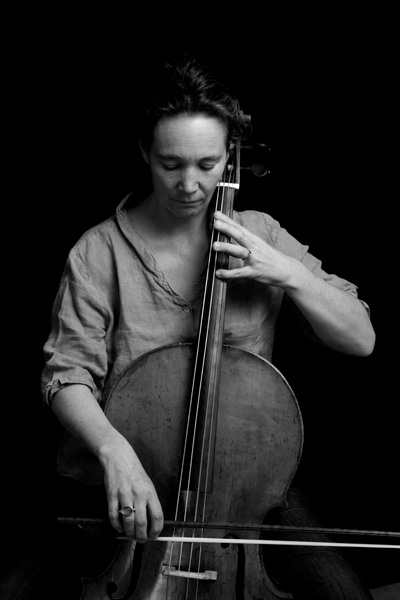
An interview with Ruth Phillips, cellist, teacher and creator of Breathing Body, Breathing Bow workshops for cellists and other musicians

phllips-ruth-1

Who or what inspired you to take up the cello and pursue a career in music?

My mother is a music teacher and my father a painter. I started the cello at the age of 4 and had to get up every morning to practice before school. To be honest I remember it being excruciating. I was so uncomfortable in my body for so much of my childhood and early teens that I was unable to feel much connection to the instrument. To this day, I do not know how much the hours of practice on the instrument during those and even some of the subsequent years served me. However, singing and being immersed in music as a language from so early, having it be a source of community and communication, at first in the family and, later, on music courses, in chamber music and orchestras, was something from which I could not, initially, turn away and which, ultimately, I chose as a way of life. Career is a funny word…At the time I would have been ‘choosing a career’ I simply followed my heart and did that which I loved. Both my parents did that. My husband and I do it. I suppose, fortunately, I have never known anything else.

Who or what have been the most significant influences on your musical life and career?

I was a friend (and fan) of Steven Isserlis from a very early age – way before he was famous – and I attended the Cello Centre run by his teacher Jane Cowan both in London and at Edrom. If anyone breathes through their instrument in my opinion, it is Steven. That pretty much set the bar for me, though playing so effortlessly and with such apparent joy was an alien concept for a long time to come. Other inspiration was largely drawn from the extraordinary experiences I had year after year at the International Musicians’ Seminar at Prussia Cove, with Sandor Vegh, Andras Schiff, Daniel Phillips and Johannes Goritzki, and later my wonderful teacher in the US, Timothy Eddy. What touches me is that every one of these people goes back in some way to one person whom I sadly never met or heard play, but the great grand teacher of so many of us – Pablo Casals. I was incredibly lucky to play in the Chamber Orchestra of Europe for eight years under conductors such as Claudio Abbado and Nikolaus Harnoncourt and there are other things too, … standing on a street corner in Bamako (where my son was born) singing and dancing, African drumming, looking at the waves, writing a poem, watching my husband paint….it’s all connected.

What have been the greatest challenges of your career so far?

For musicians, a sense of belonging is important and yet as a freelance musician, that sense can be elusive. One is so easily replaceable, indeed so often replaced, and usually without explanation or a chance to evolve. It is hard not to take this personally (and of course sometimes it is personal) and thus become less and less confident even as one gains experience and ease on the instrument. The challenge seems to be to develop an inner confidence and be true to one’s voice. Now, approaching my mid-fifties, I, along with many of my colleagues I believe, am facing the challenge of moving gracefully into the latter part of my life as a musician. For me, this is about continuing to play whilst allowing the world of concert touring to flourish largely without me, turning my energy instead towards holding and passing on something of that which I have been so lucky to have been given. Happily this period coincides with having a young child late in life so it’s quite a relief on all fronts!

How did you develop your Breathing Bow technique?

I mentioned Steven Isserlis and most of my life has been spent trying to understand how his exquisitely breathing bow worked (because I don’t think he really understands it himself, it’s so natural!). His teacher Jane always spoke about winged bowing which was an important key, but learning how turn the lock and open the door took the next two decades and I am of course still learning.

When my beautiful Banks cello on which I had played all my life was smashed into a hundred pieces on tour with COE in 1989, I was forced to face the fact that it is not the cello but my body (and heart and spirit if you like) that is the instrument through which to express the music. The trouble was, I wasn’t in any way connected to my body. That was a point of breakdown, my starting point, and the point at which I went to study in America.

Since that fateful day, there have been several moments and elements that have come together to influence my approach. The first was my teacher Tim Eddy saying to me in my first lesson ‘Ruthie, something has to move inside you for you to be moved to play‘. It took me the next four years to understand and experience the truth of this, but that phrase changed my direction completely. Initially I became interested in Alexander technique and had a teacher come out to Stony Brook to work with all the string players. Then, on my return to the UK, having developed a frozen shoulder and been told I would never play again (doctors should get some counselling on how to deal with such situations!), I started practicing yoga and was lucky to find a teacher, Peter Blackaby, who revealed to me how movement happens in release, and how that release is connected to the breath. This, itself a mindful practice, led to practicing meditation.

Though I work happily alone, I am lucky to have two dear friends, also cellists, with whom I collaborate, one an Alexander teacher (Dale Culliford) and another a yoga teacher (Jane Fenton). I love working alongside them and increasing my own awareness at the same time, keeping my approach alive and changing rather than fossilizing into a technique. I hope to enjoy other collaborations in the future. For example, I’d love to work with a Feldenkrais teacher.

How has this technique helped you as a musician, performer and a teacher?

At university in America where I performed solo for the first time (having sneakily avoided it until then!) I suffered terribly from stage fright. Before my degree recital I actually thought I was going to die. I have since found out of course that I am not alone with having had these feelings. It’s helpful as a teacher to know that place first hand and, also, to know that it is not something one needs to suffer at all, let alone in silence. Having come through that myself I know that stage presence is something one can practice, just as one practices vibrato. I am now happier on stage than anywhere else. (Well, apart from watching my six year old son make fresh tagliatelle for 25 people!.)

How does your Breathing Bow technique support and help string players?

I suppose wind players have the greatest advantage in uniting their musical phrasing and their technique through the breath, because they can’t play otherwise. As string players, however, the breath is rarely mentioned other than something we have to catch occasionally between phrases. But, there is hope! We have this incredible curved extra limb called a bow which, when connected through the arm to the expanding and contracting rib-cage, can express all the qualities that the breath has – tension, release, expansion, contraction, expression, inspiration, control, letting go, strong, weak – and of course on which the music is based. Rather than the effort involved in sustaining an even bow pressure or speed or contact point resulting from a thought about the music and having to control every millisecond, the breath becomes a sort of limousine in which we can ride, uniting the body, the instrument and the music. Playing becomes such a pleasure!

bbc20vc2

Do you think Breathing Bow has relevance to other instrumentalists and how might it help them?

I call it the Breathing Bow, but of course it’s not just about the bow. There are so many aspects to this approach that can help performers on all instruments, though I have of course developed it on the cello so I can apply things more easily to that instrument. For example, on the cello, when one releases from an impulse and the elbow drops (as in the release after bouncing a ball) the bow naturally rides up towards the fingerboard which creates exactly the release in the sound that the music demands. However, for a violinist, this is the opposite. Releasing the elbow brings the bow nearer the bridge. I have worked with quite a few violinists and violists and they are helping me with this. But yes, I believe anyone can benefit. I get everyone I work with to watch Andras Schiff play the piano, for example (as well as watching Roger Federer play tennis), and I do think he could do a mean line in the Breathing Keyboard…

How does Breathing Bow help in performance and can it counter the effects of performance anxiety?

I love to think about developing stage presence as opposed to countering the effects of performance anxiety or dealing with stage fright. The language we use is already so negative and I think one of our largest obstacles is that negative thinking and the fact that the subject has been taboo (it’s changing now, happily). Another is that I believe we are taught and therefore we practice being constantly in control – of every split second of every note, or every bit of every phrase. What we do not practice and therefore that with which we are uncomfortable is the aspect of the movement and the music that we do not control. We call this being ‘out of control’ and it terrifies us. No wonder we fall apart on stage when we lose some of our ability to be in constant control. However, we do not need to be in control all the time! In fact, I would say we need to be in control more like 30% of the time. I try and show people how to practice that aspect of letting go, allowing what we have set in motion to live its own life without our constant interference, knowing when to rest and simply listen. This takes a different kind of practice which is very enjoyable, like practicing being on holiday! Developing a quiet non-judgemental mind and knowing how to come into the present moment is naturally a huge part of this, and I would say one of the best things to do before going on stage, rather than running up and down the instrument, is to meditate.

What do you consider to be the most important ideas and concepts to impart to aspiring musicians?

When I was playing under Harnoncourt in the Chamber Orchestra of Europe, I will never forget the experience of the 4th cello, the second oboe, the soloist, the person in the back row of the audience, the conductor, even the space itself, being an equal part of this magical moment-to-moment unfolding. I am still not sure how Harnoncourt created this other than by being a true ‘conductor’, but I know that a search for this humility, this sense of simplicity and common humanity is the most important thing for me. We get so knotted up in ‘my performance’ ‘my technique’ ‘my interpretation’, and that ‘my’ implies a ‘your’ which creates duality. Sometimes the ‘you’ is a voice with whom we are at war within ourselves. If we can find a way to open ourselves and allow the music to flow through us as it is in the present moment then we can be at peace in a non-dualistic world which, especially in this current climate, feels like an urgent need. We are so privileged as musicians to be able to share this. I would encourage all musicians do find whatever way they can to make music not with fear but with joy.

For more information about The Breathing Bow, please visit Ruth’s website:

http://thebreathingbow.com


Last weekend I performed at St John’s Smith Square, one of London’s premier music venues. This was part of their Music Marathon, 12 hours of continuous music making to coincide with the Open House London weekend. There was a great range of music and performers, a good-sized audience and a friendly atmosphere. I chose to perform, perhaps rather over-ambitiously, Schubert’s Sonata in A, D959, preceded by Britten’s Night Piece – a demanding programme of music lasting 45 minutes. I performed the Schubert Sonata 7 times last year (including the FTCL Diploma recital) but as any performer will tell you, each live performance reveals new or unexpected things about the music and you as a performer. I believe it is important to perform the music we study and play – not least because this wonderful music was written to be shared. Performing can take many forms – from informal playing at home with friends to a concert at a world-renowned concert hall – and each performance presents its own dificulties, stresses, pleasures and revelations.

I came late to performing, having had a long break from the piano after university, and completed two performance diplomas in my late 40s. In order to do this, and because I had not had a formal musical training in conservatoire, I had to “learn” how to be a performer (mostly by teaching myself and talking to and observing professional musicians at work). The most significant thing I have learned is that one must be extremely well-prepared – and prepared for anything and everything that can happen, both within the music itself and all the things one cannot control. Even the best laid plans in practise can come awry in performance, for a variety of reasons. For this reason most professional performers (and serious amateurs too) will do a number of practise performances in less important venues before the most important concert in their diary (at the Wigmore Hall for example, reputedly one of the hardest places to perform in because of its famously knowledgeable and discerning audience). Each performance is part of the learning process and whatever happens in a performance should be seen as a point of reference for future practising and preparation (and a timely reminder that we can never truly say that a piece of music is “finished”).  For example, during my SJSS performance certain passages which had seemed pretty secure in practise came unstuck (noticeably to me, but probably not to the audience as I managed to improvise). It can be quite a jolt to discover that one’s careful practising may not have been quite as scrupulous as one thought. For this reason, I try not to spend too much time negatively reflecting on a performance which may not have gone as well as I’d hoped, preferring to note the areas which require improvement and incorporate these into my practising regime. Thus, through these marginal gains one can take the music to another or different level each time it is performed.

Performing is physically and mentally demanding. and an unusual level of mental concentration is required combined with physical stamina for the duration of the performance (and playing for 45 minutes continuously is hard work!). Interruptions to one’s focus, such as noises in the hall, an error or memory lapse, or negative self-talk, can throw a performance off track and one sometimes has to muster huge forces to bring one back to the task in hand. This is why we must practise so meticulously, to make the music as secure as possible, so that we don’t break down or stop in performance (something I have only witnessed once in a professional performance, though I have encountered numerous but tiny errors or memory slips).

In addition, the stress and anxiety of performing does not pass the moment one leaves the stage. It can take some hours for the body’s stress hormones to return to their normal levels, which can leave one feeling jittery, restless, irritable and sleepless – despite one feeling physically and mentally drained. I have found isotonic drinks such as Gatorade help alleviate the physical and emotional effects of performing (these products have been proven to offer enhanced recovery to patients undergoing complex surgery).

Finally, one should try not to negatively post-mortem a performance too much. It has happened, in the moment, and now it is over and one should look forward to the next opportunity to present one’s music in concert. Compliments and generous feedback from audience members, colleagues and friends can make a huge difference to one’s attitude to a performance and help maintain a positive mindset.

So what did I learn from performing at St John’s Smith Square? First, that meticulous preparation is crucial and constantly reminding oneself of this truth is so important. Secondly, that one should never become complacent in the face of this great music; remain humble and do not allow one’s ego to get in the way of the music. Thirdly, accept compliments and comments with courtesy and humility – these are almost always genuine and given generously. Lastly, I have huge respect for professional musicians who perform regularly – because it ain’t easy!